In 1656 Archduke Leopold Wilhelm, brother of Emperor Ferdinand III, gave up the governorship of the Spanish Netherlands and moved about 1,400 paintings from Brussels to Vienna. He had bought many of them during his years as governor, while civil war was being fought in England and the collections of ruined royalists were coming onto the market, among them the collection of the Duke of Hamilton, who was executed in 1649. After the archduke's death his paintings passed to Emperor Leopold I, and that is how Giorgione, Titian and van Eyck came to be in Vienna.
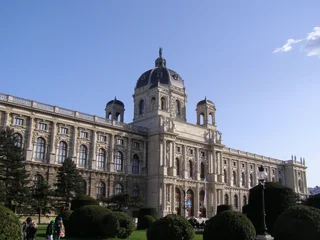
The museum building on the Ringstrasse, designed by the architects Semper and Hasenauer, opened in 1891 to bring under one roof the imperial collections that lay scattered across palaces, castles and treasuries. The dynasty had spent four centuries gathering them.
We will tell you about 25 works. For most of them the path into the imperial collection can be traced: a gift from one ruler to another, a bride's portrait, a purchase at the sale of an English collection, the altarpiece of a suppressed order. For Rembrandt's self-portrait and Rubens's Het Pelsken the trail breaks off, and all that is known is the date by which each was already recorded in Vienna. The last work, a Vermeer, entered the state collection after the end of the empire, through a deal with Hitler.
Gifts and purchases between princes (1570–1595)
1. Saliera (Salt Cellar) — Benvenuto Cellini, 1540–1543
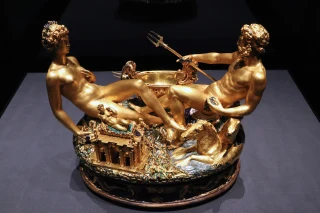
At about four in the morning on 11 May 2003, Robert Mang, a Viennese alarm installer, climbed the scaffolding on the museum's façade, which was under repair at the time, forced in a first-floor window, smashed a display case and walked off with Benvenuto Cellini's gold salt cellar. He was inside for less than a minute. The alarm went off, but it was taken for one more false alarm, and the theft was not discovered until after eight. Mang later said he had acted on the spur of the moment and learned from the newspapers what the salt cellar was worth. For about a year and a half it lay in a suitcase under his bed, then he buried it in a box in a forest in Lower Austria and demanded ten million euros from the insurance company, threatening to melt the gold down. In October 2005 he sent Neptune's trident, which can be taken off the figure, as proof. Mang was caught through a surveillance camera in a mobile phone shop where he had bought SIM cards for his messages, and on 21 January 2006 he led the police himself to the hiding place near the village of Brand. The box had to be dug out of frozen ground.
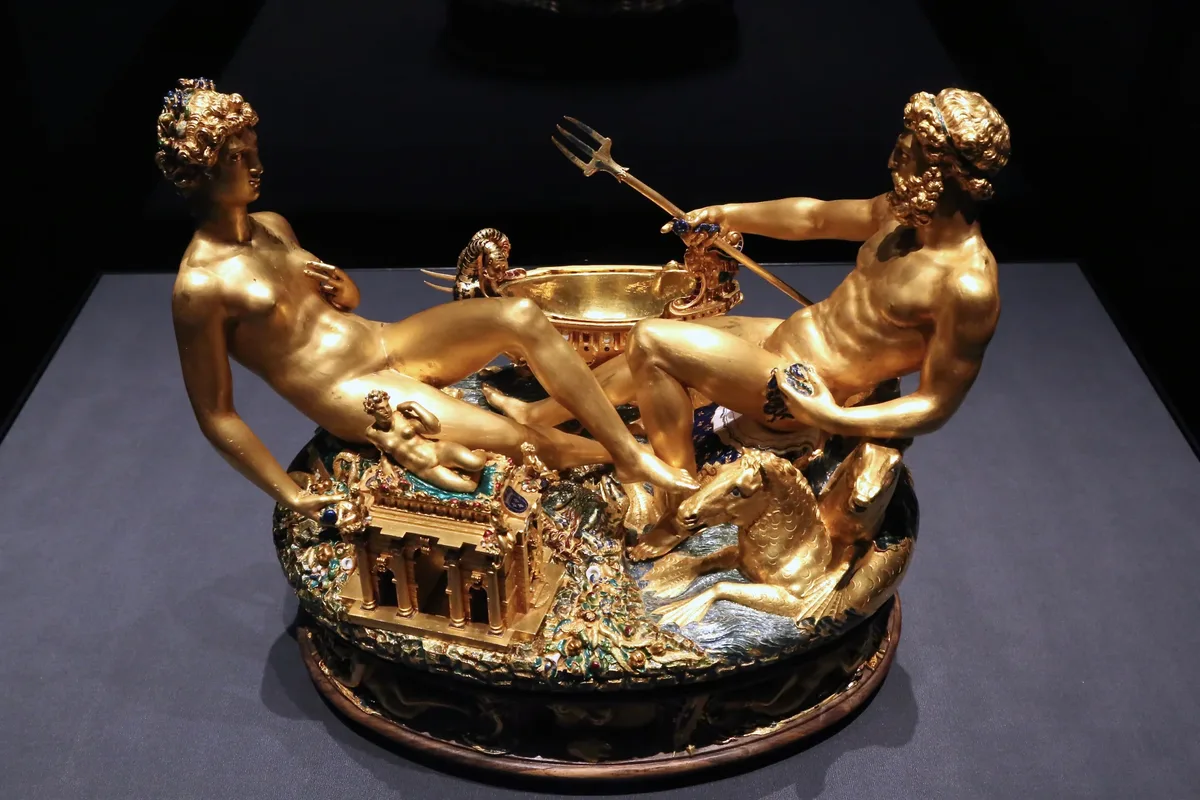
Cellini made the salt cellar in Paris for the French king Francis I, and of all his work as a goldsmith it is the only one to survive. On an oval ebony base two gold figures recline facing each other, their legs intertwined. Cellini himself called them Sea and Earth, and later they came to be known as Neptune and Tellus. Neptune raises his trident, and in front of him a sea horse rears out of blue enamel waves. Earth presses her palm to her breast, and beside her stands a small gold temple that held the pepper. On the side of the temple facing her is a little blue enamel shield with gold lilies, the arms of the kings of France. The salt went into a gold boat with curled ends, which sits on the other side, between the figures' legs, so that from the temple side it is almost hidden.
The salt cellar came to Vienna as a gift. On 22 October 1570, in Speyer Cathedral, Francis's grandson King Charles IX married Archduchess Elisabeth, daughter of Emperor Maximilian II. The marriage was by proxy, and the groom was represented at the altar by the bride's uncle, Archduke Ferdinand II of Tyrol. In gratitude Charles IX gave him the salt cellar and three other precious vessels, which are also in this museum. Ferdinand put it in his Kunstkammer, his cabinet of art and curiosities, at Ambras Castle near Innsbruck, in 1596 it was entered in the inventory of his estate, and later it was taken to Vienna with the rest of the Ambras treasures.
When the salt cellar was restored in 2006, the scratches left on the gold by the shards of the display case could not be removed entirely, and fine marks remain on Earth's breast and belly.
2. Summer — Giuseppe Arcimboldo, 1563
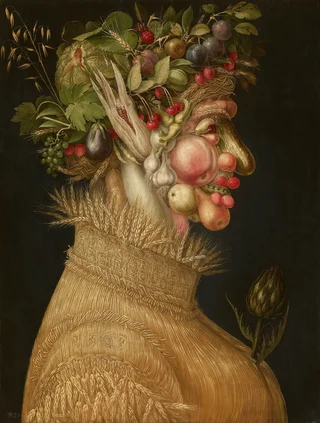
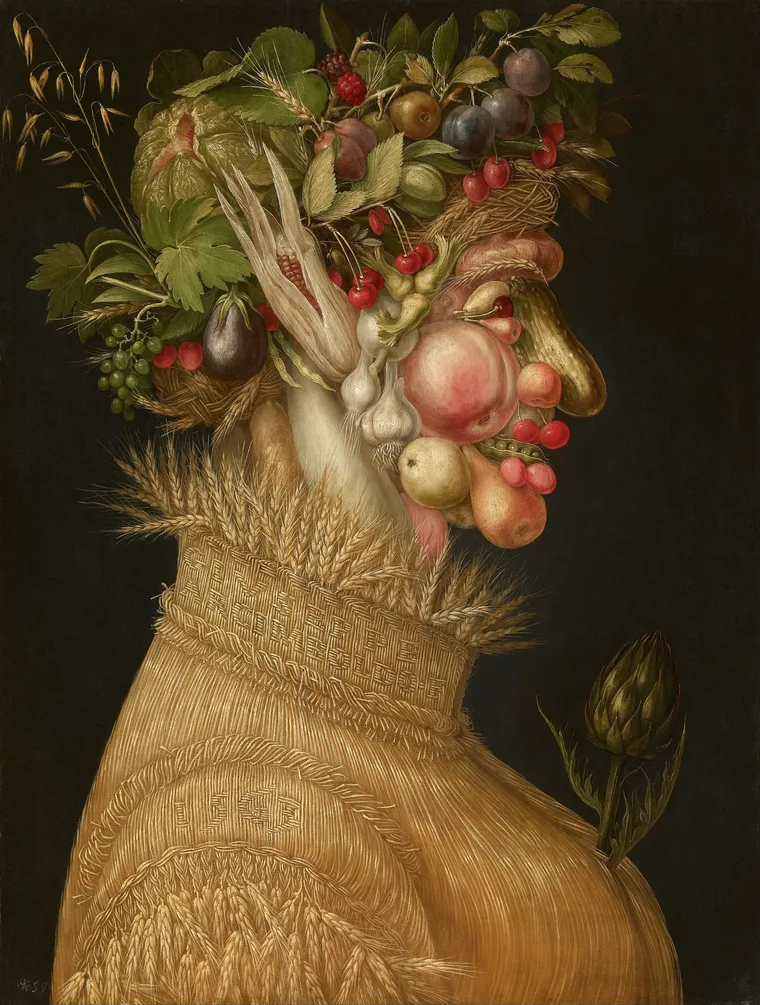
The cheek of this profile is a peach, the brightest spot on the panel, the nose a young cucumber, the lips two cherries, and between them, in place of teeth, lies an open pea pod. The chin is a pear, and the eye a small dark cherry under a pale little pear. The ear is a cob of maize peeping out of its split straw husk, with heads of garlic and their roots hanging below it. Maize had then been grown in Europe for only a few decades, and to the Vienna court it was an exotic rarity from overseas. The hair and hat are made of a melon, vine leaves, an aubergine, plums and blackberries, and at the top left a tuft of oats sticks up like a feather.
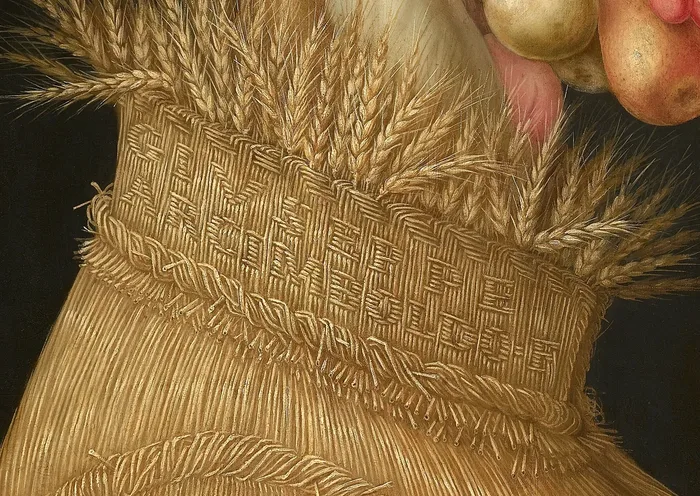
A ruff of wheat ears stands up round the neck, below it is a stiff plaited collar, and woven into its straw in capital letters is the painter's name, GIVSEPPE ARCIMBOLDO. The letters are easy to mistake for a pattern. The date, 1563, Arcimboldo wove into the straw at the shoulder, lower left. Scholars at the National Gallery of Art in Washington see in the woven signature an allusion to Pliny's story of the ancient Greek painter Zeuxis, who had his name woven in gold letters into his cloak. In the very bottom left corner of the panel there is also a small pale number ending in 59, apparently an old inventory mark.
Arcimboldo came to Vienna from Milan in 1562, and he painted Summer in his first full year in the service of Archduke Maximilian, who became emperor a year later. Of that first series of The Seasons, two panels are undisputedly his, and both are here, Summer and Winter. On New Year's Day 1569 the painter presented Maximilian II with The Seasons and The Elements together with a Latin poem by Giovanni Battista Fonteo, in which the composite heads were read as an image of an eternal empire where the most varied creatures live together in peace.
For almost 270 years Summer was kept among curiosities, first in Rudolf II's Kunstkammer, then in the Vienna treasury, where it was recorded in 1748. It was moved into the picture gallery only in 1830.
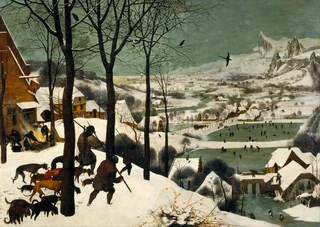
3. The Hunters in the Snow — Pieter Brueghel the Elder, 1565
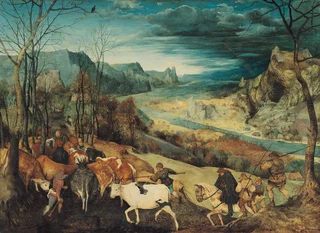
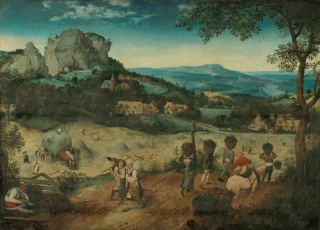
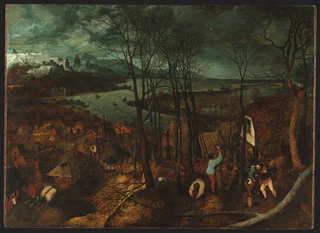
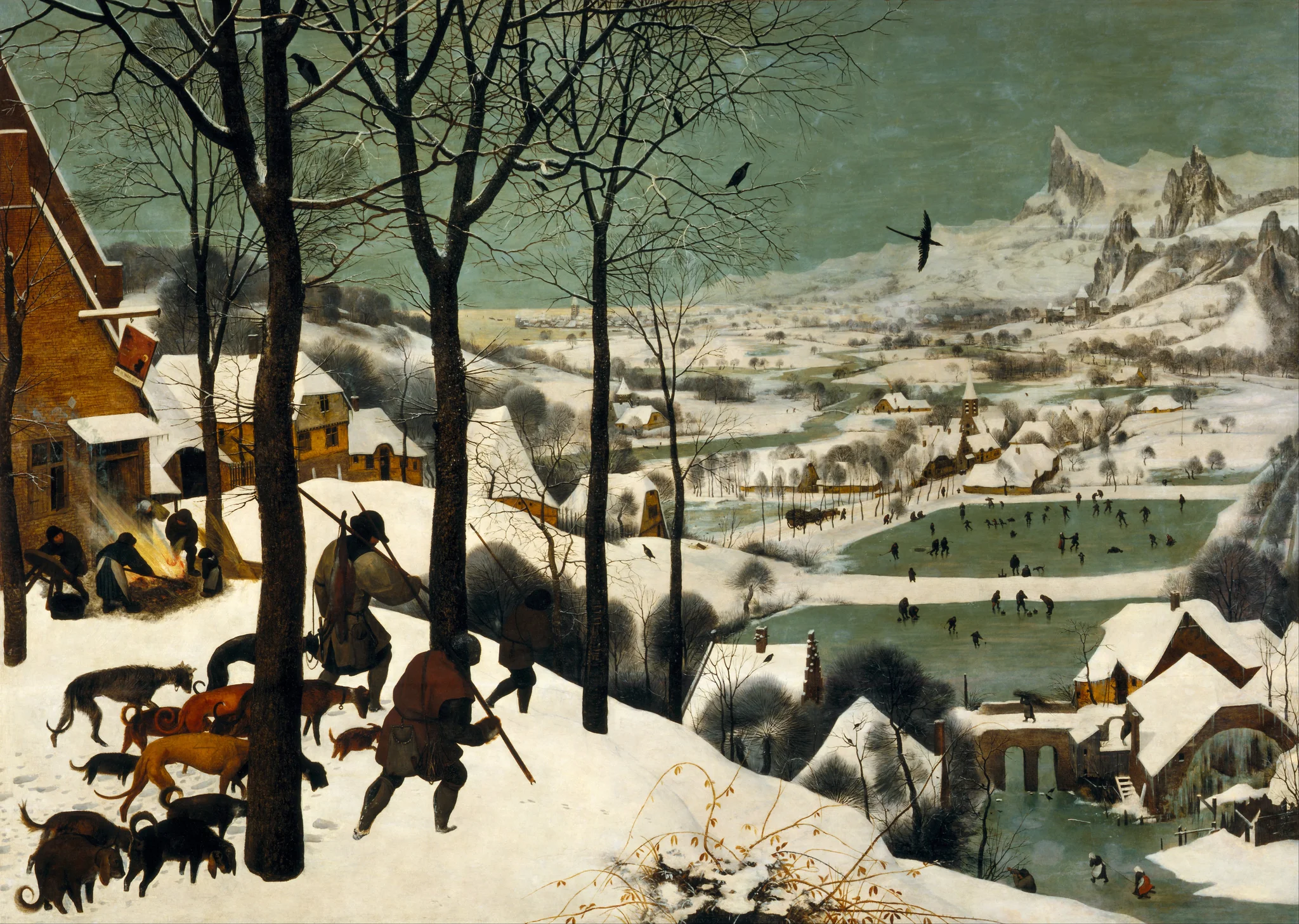
The Antwerp merchant and financier Nicolaes Jongelinck was the biggest collector of Brueghel's work, and in 1565 the painter made him a cycle of the seasons, six panels with two months on each. According to the museum, they hung in Jongelinck's dining room, between the windows. The Hunters is usually taken to show December and January.
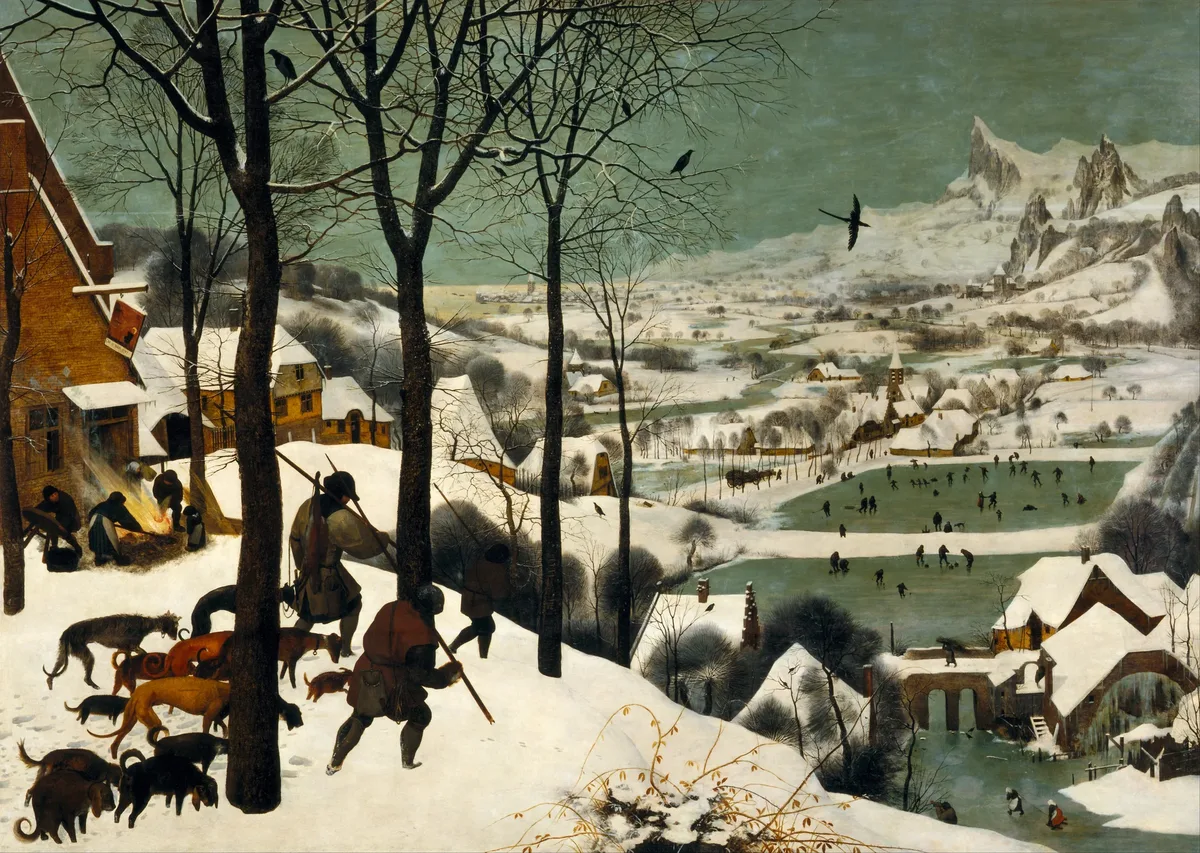
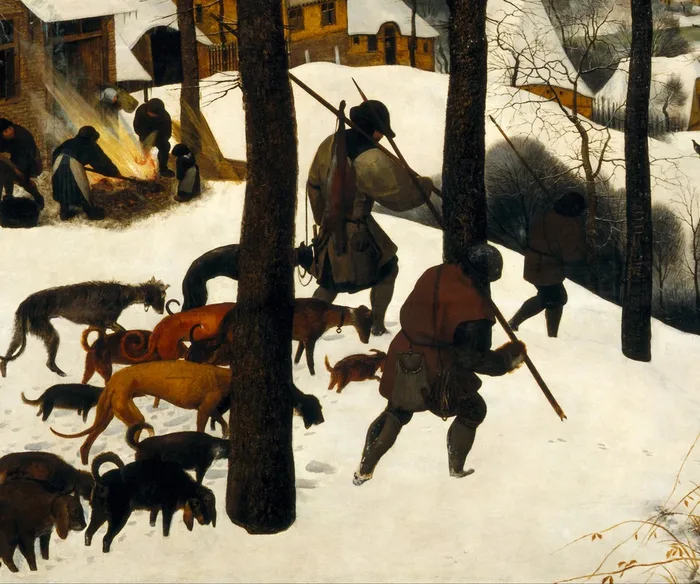
We look down from a snowy hill. On the left three hunters go down the slope with their backs to us, long spears on their shoulders, and the first has a single thin fox slung on his back. The pack trails around them, most of the dogs with heads and tails down. A row of bare trees with crows runs downhill from the hunters, and a lone magpie glides across the sky. Lower down, on two frozen ponds, tiny dark figures skate, fall over, chase something with curved sticks and send stones sliding across the ice. At the far left stands an inn, and its sign with a stag is held to the pole by only one hook, so it hangs askew. A straw fire burns in front of the inn, and a woman in an apron stirs it with a stick. In the distance rise sharp grey peaks of a kind Flanders does not have. The day is overcast, and the light lies evenly on the snow, without shadows. When the painting was examined for the 2018 exhibition, it turned out that the leading hunter was not part of the first design, and Brueghel painted him over snow and a tree trunk that were already finished.
In 1566 Jongelinck stood surety for 16,000 guilders for his friend Daniël de Bruyne, a tax farmer who owed money to Antwerp, and pledged 16 paintings by Brueghel, among them The Twelve Months, meaning this cycle, and The Tower of Babel. After that the cycle ended up with the city. In 1594 Antwerp presented it to the new governor of the Netherlands, Archduke Ernst of Austria, brother of Emperor Rudolf II, on his ceremonial entry into the city. Ernst died in February 1595, Rudolf took the panels for himself when the estate was divided, and Archduke Leopold Wilhelm's inventory of 1659 lists five of them.
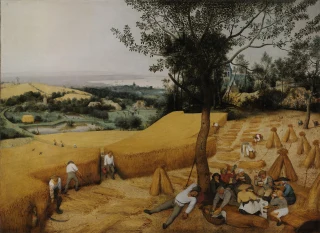
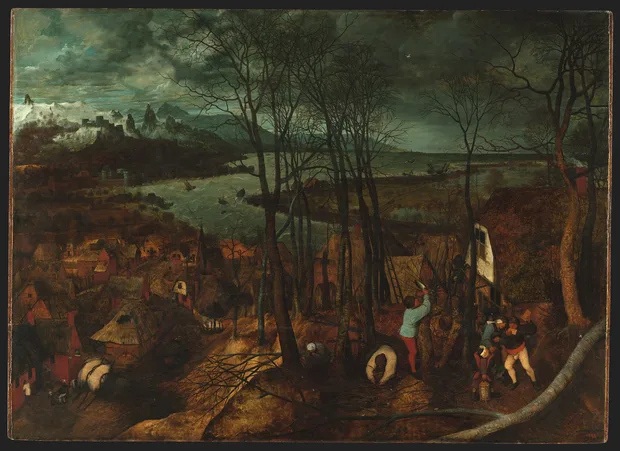
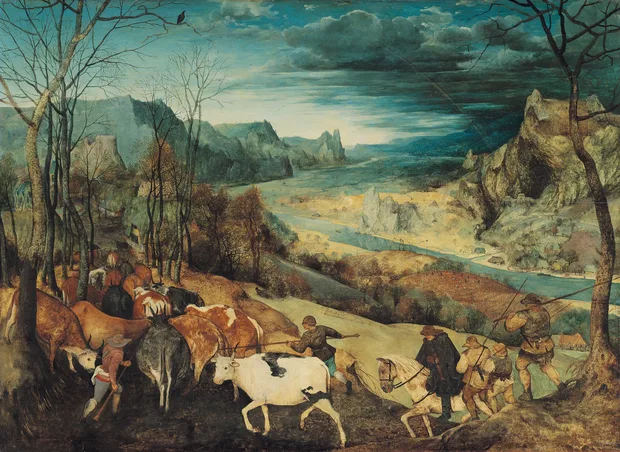
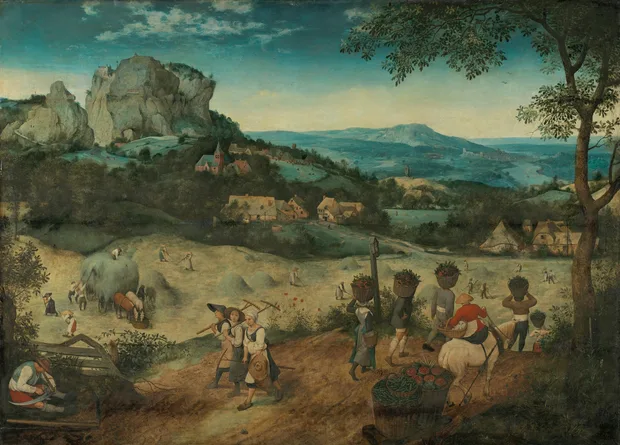
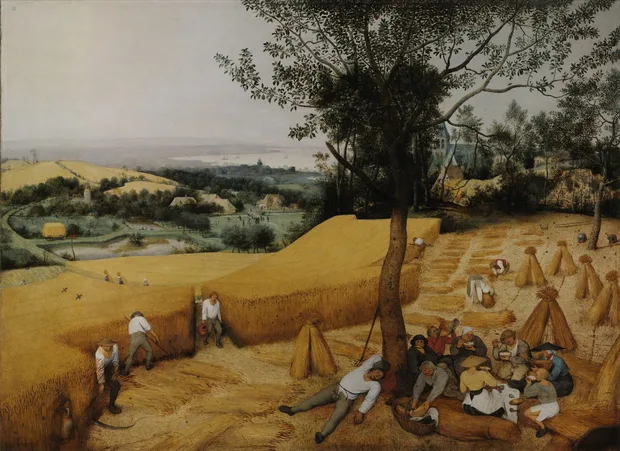
Of the six panels, three are in Vienna: The Hunters in the Snow, The Gloomy Day and The Return of the Herd. The Hay Harvest is in Prague, in the collection of the Princes Lobkowicz, The Harvesters is in the Metropolitan Museum in New York, and the panel with late spring was lost as early as the 17th century.
4. The Peasant Wedding — Pieter Brueghel the Elder, 1568
Karel van Mander, the Netherlandish biographer of artists, wrote about Brueghel in 1604, 35 years after his death, and there is nothing to check him against. According to van Mander, Brueghel and the merchant Hans Franckert used to dress up as peasants and go to village weddings and fairs. They brought presents like every other guest, passed themselves off as relatives and watched the peasants eat, drink and dance.
Brueghel painted his large peasant scenes in the last years of his life, after he had moved from Antwerp to Brussels. Both of the best known are in Vienna, The Peasant Wedding and The Peasant Dance.
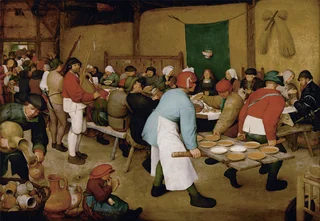
The wedding is held in a barn, with grain stacked against the back wall right up to the beams. The bride sits at the back, a little right of centre, in front of a dark green cloth, and above her head a two-tiered paper crown hangs on strings. Her eyes are almost closed, her hands are folded on the table, and she is not eating. In the right foreground two men carry a door taken off its hinges in place of a tray, crowded with bowls of yellow porridge, and the iron strap of a hinge is still on the front edge of the door. The one walking away from us has a wooden spoon stuck in his green hat. At lower left a child in an enormous red cap with a peacock feather sits on the floor licking its fingers and holding an empty plate, and one of the two bagpipers follows the passing food with his eyes. The bottom edge of the panel was once cut down and later extended with a narrow strip, so the very bottom of the picture, where the floor is, was painted later, on the added wood.
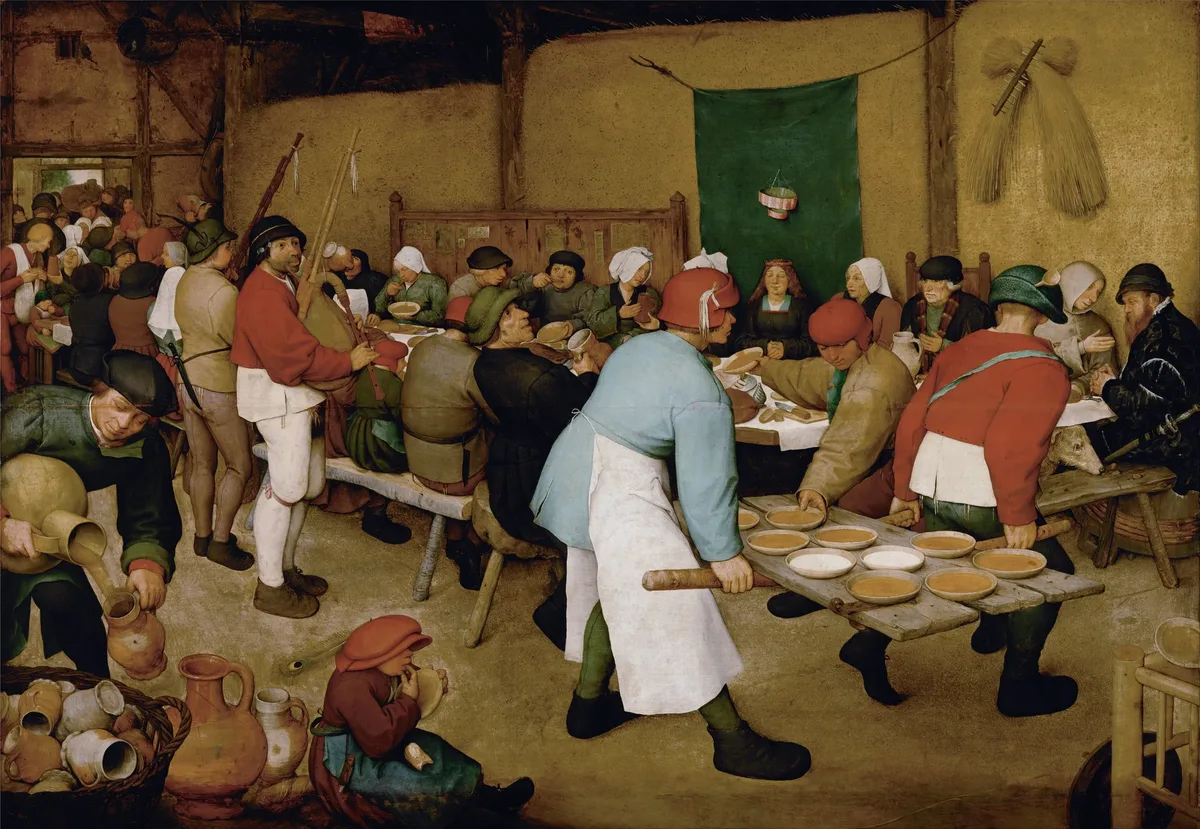
The museum finds no groom at the table, since by custom he did not sit at the feast. Other scholars still try to find him, either in the young man with a spoon beside the bride or in the man pouring beer.
Archduke Ernst bought the painting in Brussels in 1594, the same year Antwerp gave him The Seasons, and later it is recorded in Leopold Wilhelm's collection. The museum dates it to 1568, our catalogue gives 1567, and both dates occur in the literature.
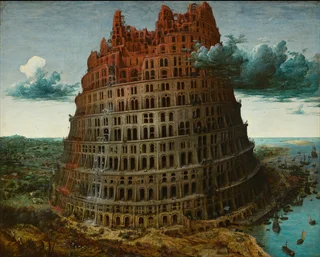
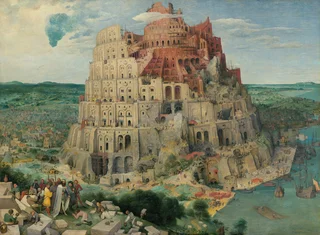
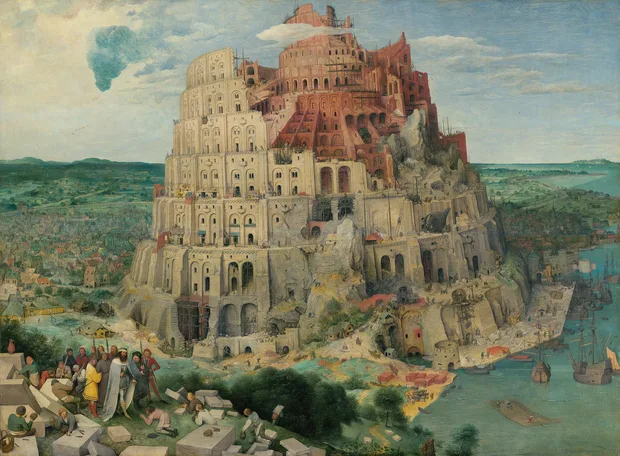
5. The Tower of Babel — Pieter Brueghel the Elder, 1563
Brueghel set his tower on a real rock, and the grey stone still breaks through, on the right several tiers up and in the middle of the lower storeys. The tiers of arches narrow towards the top, and just below the summit a small white cloud wraps round the tower. The left side is already faced with pale limestone, while at the top right the facing has not yet gone on, and red brick walls and vaults show as if in cross-section. The whole tower leans noticeably to the left, towards the city. Building is in full swing, with treadwheel cranes standing on it, wooden centring set under the arches and tiny workers swarming on every tier, and at the foot on the right lies a harbour with ships and stacks of bricks.
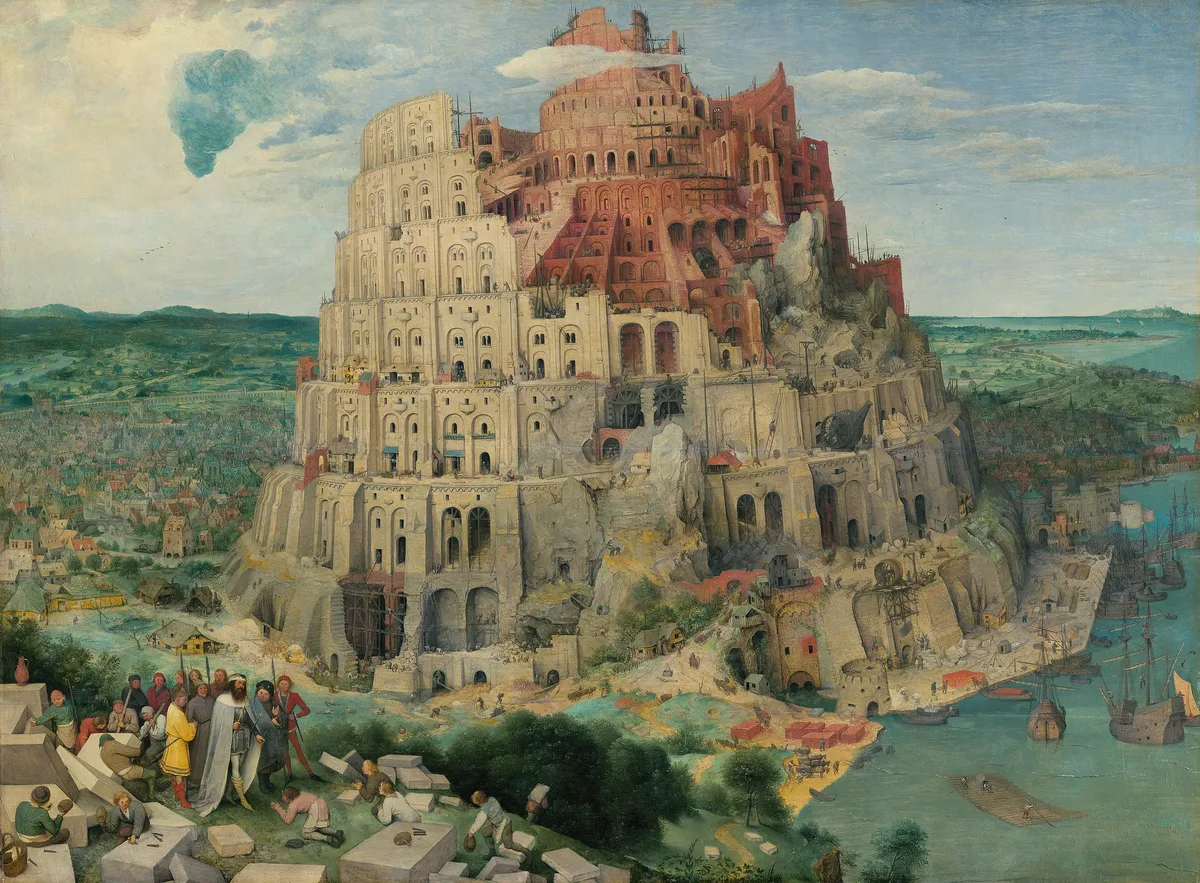
At lower left, on a rise, stands King Nimrod, to whom tradition ascribed this building work, wearing a crown and a long bluish-grey cloak with a white fur collar and holding a sceptre, and he is larger than anyone else in the picture. Stonemasons kneel before him, and one of them has thrown up his hands and dropped his cap on the ground. The signature “BRVEGEL FE” and the beginning of the date are carved on the front face of a large stone block at the bottom edge, and a mallet and three chisels lie on the same block.
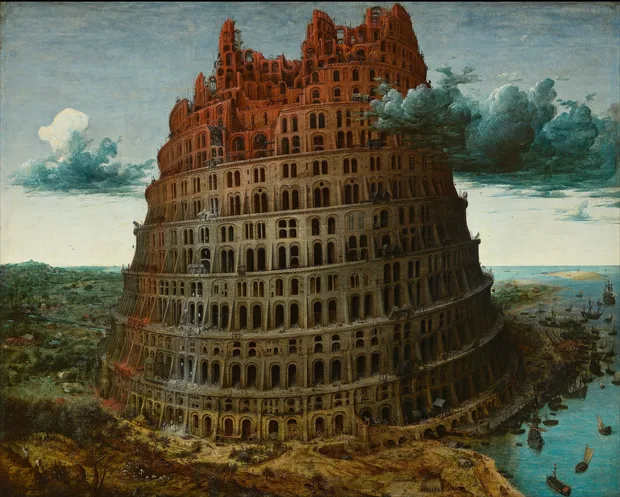
Like The Seasons, the tower belonged to Jongelinck and was among the paintings he pledged in 1566, and later it apparently passed to the city of Antwerp. By 1604 it was already Rudolf II's, since van Mander saw it in the imperial collection and wrote that one “can look into it from above”, and that a smaller one of the same subject hung beside it. No documents have been found to show whether Rudolf bought it or received it with the estate of his brother Ernst. After that the tower is recorded in Leopold Wilhelm's collection.
The smaller tower that van Mander wrote about eventually left the Habsburg collection and is now in the Museum Boijmans Van Beuningen in Rotterdam. Nimrod and his retinue are absent from it, and an X-ray showed that Brueghel at first painted it to look like the Vienna tower.
Rudolf II's collection (1585–1608)
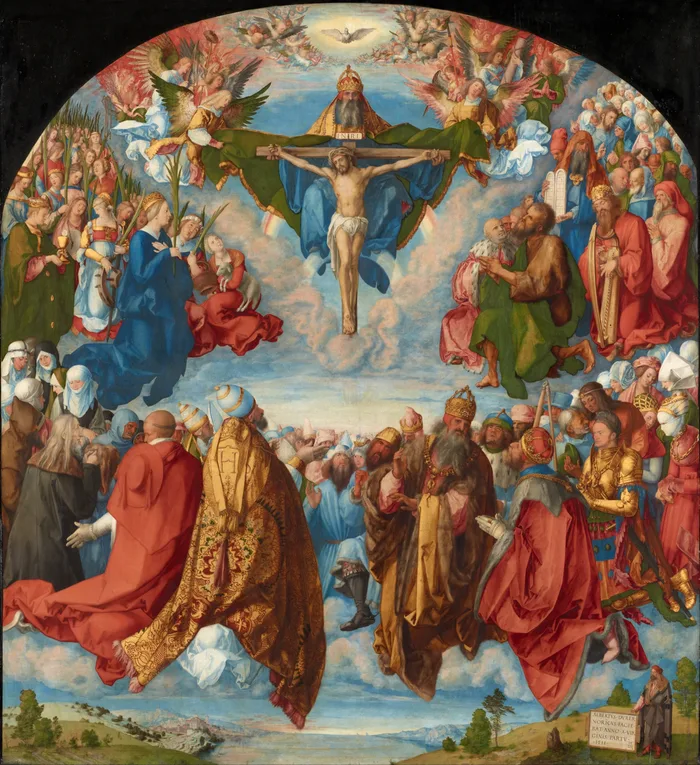
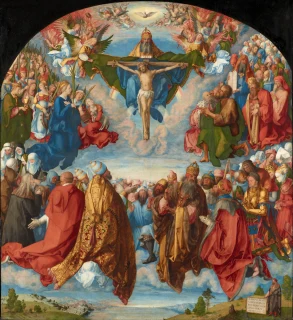
6. Adoration of the Trinity (Landauer Altarpiece) — Albrecht Dürer, 1511
The Nuremberg merchant Matthäus Landauer founded a house for 12 old craftsmen who had fallen into poverty through no fault of their own, and by 1508 a chapel dedicated to the Trinity and All Saints had been built beside it. The altarpiece for the chapel was commissioned from Dürer. His design of 1508 in pen and watercolour, frame included, is in France, at the Musée Condé in Chantilly. Dürer planned the altarpiece as a single panel in an architectural frame, the way it was done in Venice, which he had left to come home in 1507.
At the top a white dove hovers in a bright radiance, below it God the Father, in a gold crown and a gold cope, holds by its crossbar the cross with the crucified Christ, and angels on either side spread a broad green cloth with gold fringe behind him. On the left, on clouds, the Virgin leads a company of holy virgins with palm branches, and on the right John the Baptist leads Moses with the tablets, King David with his harp, and the prophets. Lower down, on a second tier of clouds, the Church on earth has gathered. A cardinal in red, his back to us, holds out a white-gloved hand to a grey-haired old man in a dark fur coat, and this is Landauer himself, being received into the company of the saved. A little right of centre stands a young man in gilded armour, his son-in-law Wilhelm Haller. Below the whole heavenly gathering stretches a bright lake with a town on its shore, and in the bottom right corner, on the grass, stands Dürer alone, in a fur coat and a red cap. His hand rests on a tablet with an inscription saying that Albrecht Dürer of Nuremberg made this in the year 1511 after the Virgin gave birth.
The carving on the frame is a Last Judgement, and the painting shows what comes after it, the eternal company of the saved around the Trinity. According to the museum, Emperor Rudolf II bought the painting from the almshouse foundation in 1585 and took it to Prague, while the frame was left in the chapel. In Vienna the panel was set into a carved and gilded copy of that frame, made around 1880, with the same Last Judgement at the top. The original frame is in Nuremberg, in the Germanisches Nationalmuseum, and a copy of the painting is set into it.
The copy was painted in 1891 by the Viennese artist Maria Schöffmann, and according to the Nuremberg museum she put her own self-portrait into its top left corner.
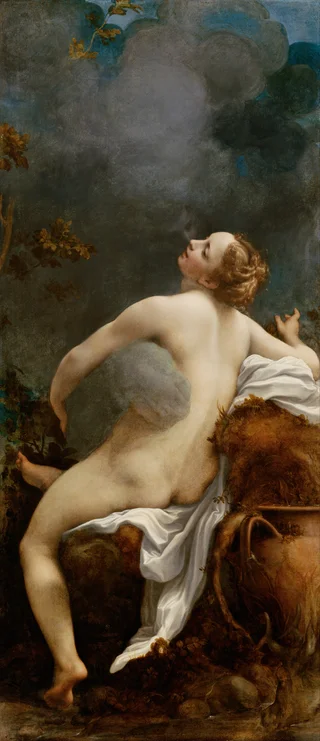
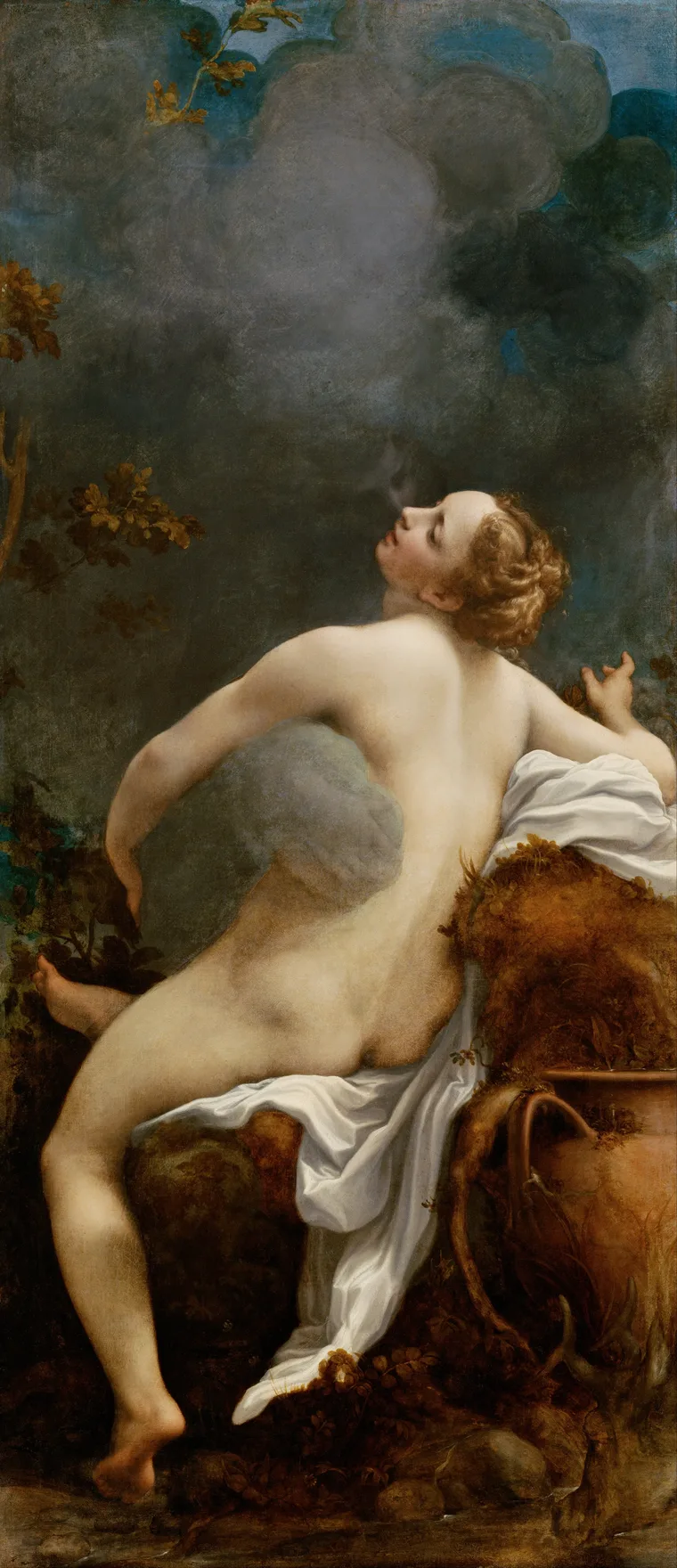
7. Jupiter and Io — Antonio da Correggio, c. 1530–1532
When the imperial ambassador in Madrid, Hans Khevenhüller, was buying this painting for Rudolf II in 1601, the sculptor Pompeo Leoni haggled with him and would not give way even to the emperor. Pompeo's father, Leone Leoni, had been sculptor to the Spanish crown, and in 1584 the painter and writer Lomazzo saw Jupiter and Io in Leone's house in Milan.
Correggio painted it around 1530 for Federico Gonzaga, Duke of Mantua, as one of four Loves of Jupiter. Vasari wrote that the duke ordered them as a gift for Emperor Charles V, and the museum allows that the painting went to Charles in 1532. Correggio died in 1534, so these are among his last paintings.
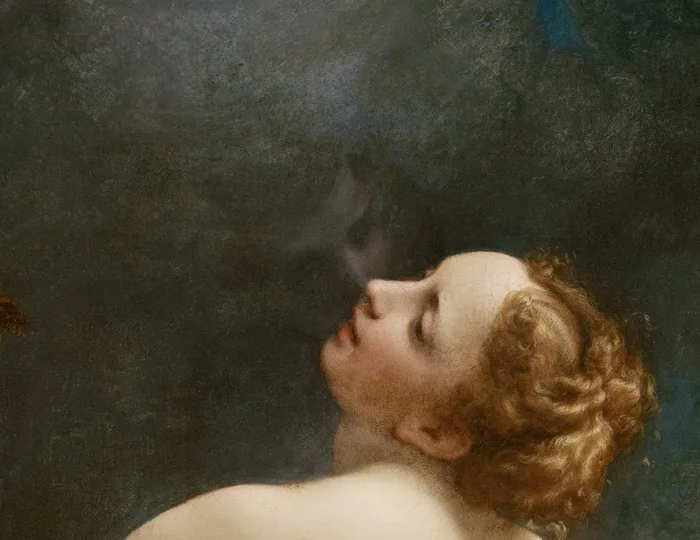
In Ovid, Jupiter covered the earth in a dark mist so that the nymph Io could not escape, and Correggio painted the god exactly so, as mist. A dense grey-brown cloud fills the upper half of the tall, narrow canvas. Io sits with her back to us on a white cloth, her head thrown back, eyes closed, lips parted. Right in front of her lips a barely visible face shows in the cloud, easy to miss, and a paw of cloud lies on her back and side, which Io pulls closer with her hand. The white cloth, the brightest place in the picture, falls in sharp folds down to the left. At lower right, in shadow, are the pale antlers of a stag and a clay jug.
A few years after this purchase Io was joined by its pendant of the same size, The Abduction of Ganymede. It came by a different route, from the disgraced Spanish secretary of state Antonio Pérez by way of King Philip II, and Rudolf acquired it in 1605.
The other two paintings of the series, Leda and Danaë, are in Berlin and in the Galleria Borghese in Rome.
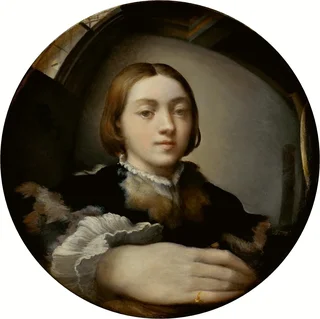
8. Self-portrait in a Convex Mirror — Parmigianino, c. 1524
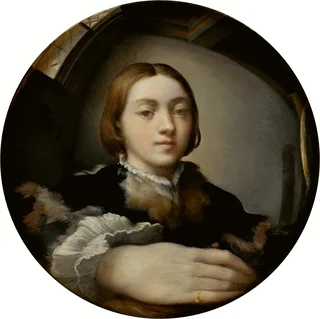
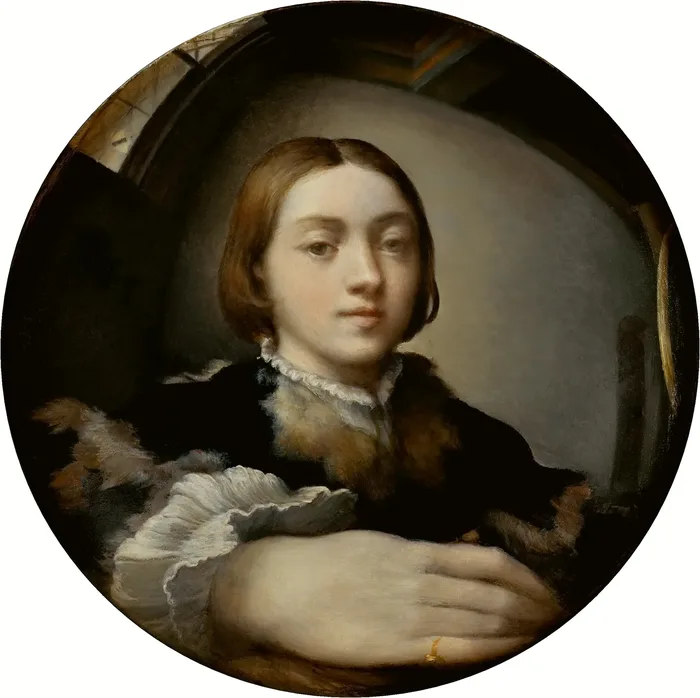
Vasari tells how Francesco Mazzola, a young painter from Parma known as Parmigianino, decided before setting out for Rome to paint himself in a convex mirror of the kind barbers kept. He had a turner make a wooden ball and cut it in half to the size of the mirror, and on the convex half he painted everything he saw, and since the mirror enlarges whatever is close to it, he made the hand a little large.
The young man's face in the middle of the circle is barely distorted. Along the bottom edge lies a huge pale hand emerging from a white pleated cuff, bigger than the face, and the ring on the lowest finger is set down in a few quick touches of gold. At upper left a window with glazing bars bends into an arc along the edge of the circle, the ceiling curves over the head, and at the very right edge a thin strip of a gilded round frame can be seen. Some take it for the frame of the mirror, while the museum reads it as the frame of a picture on an easel.
In the summer of 1524 Parmigianino, then 21, brought the portrait to Rome and presented it to Pope Clement VII. It did not win him the large commissions he had hoped for. The pope gave the portrait to the writer Pietro Aretino, and Vasari saw it as a boy in Aretino's house in Arezzo. Later the portrait came, “I know not how”, in Vasari's words, into the hands of the Venetian crystal engraver Valerio Belli, passed from Belli's son through the architect Andrea Palladio to the sculptor Alessandro Vittoria, and Vittoria, dying in 1608, bequeathed it to Emperor Rudolf II.
In Vienna the portrait was kept in the imperial treasury as a work by Correggio, who according to Vasari had been Parmigianino's teacher, and it was moved into the picture gallery only in 1777.
Archdukes on the market (1648–1662)
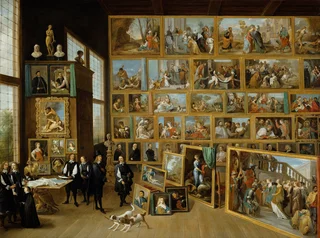
9. Archduke Leopold Wilhelm in his Gallery in Brussels — David Teniers the Younger, c. 1651
Archduke Leopold Wilhelm stands in the middle of his Brussels gallery in a tall black hat, pointing with a long cane at paintings propped against the floor. With him are three more men in black, one holding a sheet of paper, another clasping his hat in both hands. The back and right walls are hung from the floor to the ceiling beams with paintings in gilded frames, five rows, frame against frame, and in the middle of the floor two little white-and-ginger dogs tug at the same stick. On the right, set at a slant, stands a huge canvas with a staircase and a woman in gold and white before an Eastern king, Veronese's Esther before Ahasuerus, which later ended up in Florence, in the Uffizi.
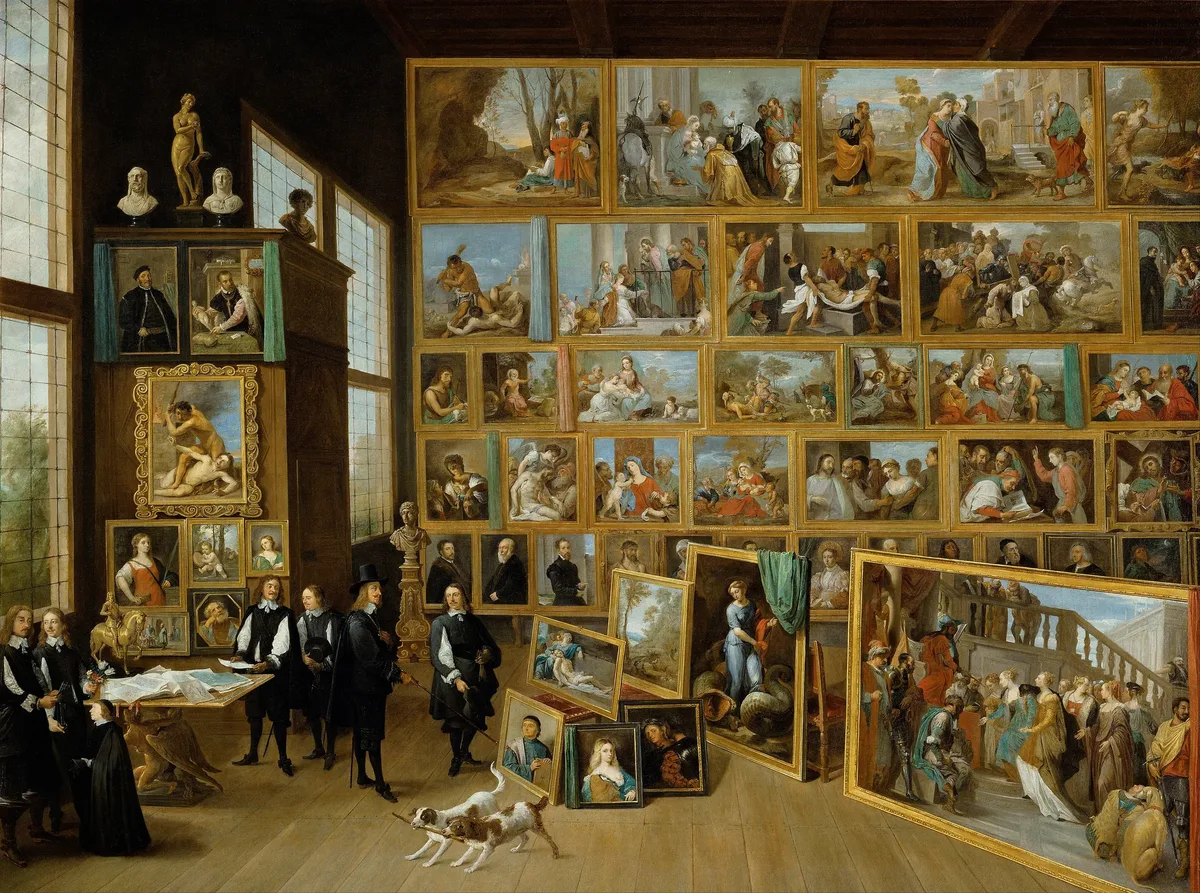
David Teniers the Younger became the archduke's court painter in 1651 and was in charge of his collection. The museum writes that Leopold Wilhelm is shown here among 51 Italian paintings from the Hamilton collection, which he had just bought. The hang in the picture is partly invented, since Teniers changed the proportions of the room and arranged the paintings in his own way. He painted about ten such views of the gallery, and an almost identical version is at Petworth House, an English country house.
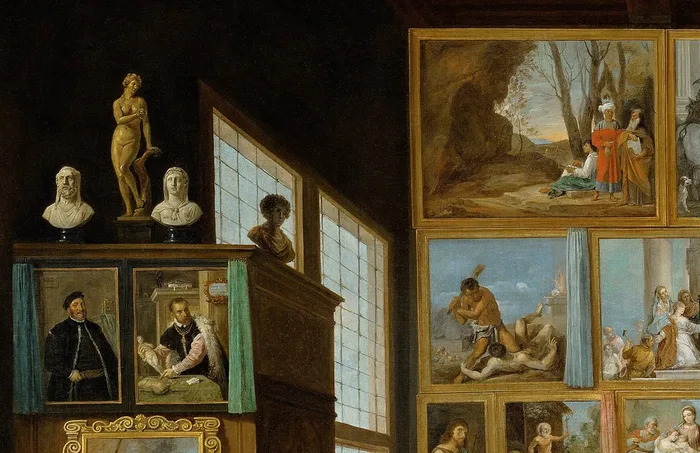
Two of the paintings on these walls come up again later in this article. At the far left of the top row is Giorgione's Three Philosophers, with a rock and three figures, and on the dark cabinet on the left hangs Titian's portrait of Jacopo Strada, a man in black with gold chains and a white statuette in his hands. Teniers painted the gallery picture itself for the archduke, by 1685 it was in the Prague gallery, and in 1781 it was brought to Vienna.
In 1660 Teniers published the Theatrum Pictorium, the “Theatre of Painting”, a book of engravings after 243 of the archduke's Italian paintings. For the engravers he painted a small oil copy of each one, and these copies are what scholars now use to judge how paintings looked before they were cut down or sawn apart.
10. The Three Philosophers — Giorgione, c. 1508–1509
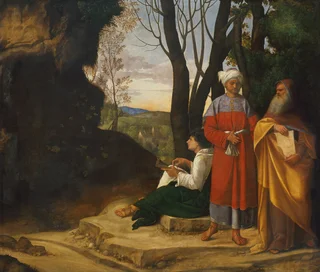
The painting owes its title to the Venetian connoisseur Marcantonio Michiel, who in 1525 described the collection of the wealthy patrician Taddeo Contarini and noted, among other things, “the canvas in oil of the three philosophers in a landscape, two standing and one seated, who contemplates the rays of the sun, with that rock so wonderfully painted”. According to Michiel, it was begun by Giorgione and finished by Sebastiano, the future Sebastiano del Piombo. Few records survive that link paintings securely to Giorgione, and this is one of them.
A dark overhanging rock with the black mouth of a cave fills the left part of the canvas. A young man sits in the centre, in a white shirt and a dark green cloak, holding a set square and a pair of compasses, and looks at the rock. Beside him stands a man in a white turban and a long red caftan, and on the right a grey-bearded old man in a yellow-gold cloak holds a sheet on which a circle with a crescent moon and the figure 7 are drawn. The light falls from the left on the faces and clothes, and the rock stays in shadow. Far off in a valley stand grey houses with a tower and a mill wheel, and the sky glows gold at the horizon.
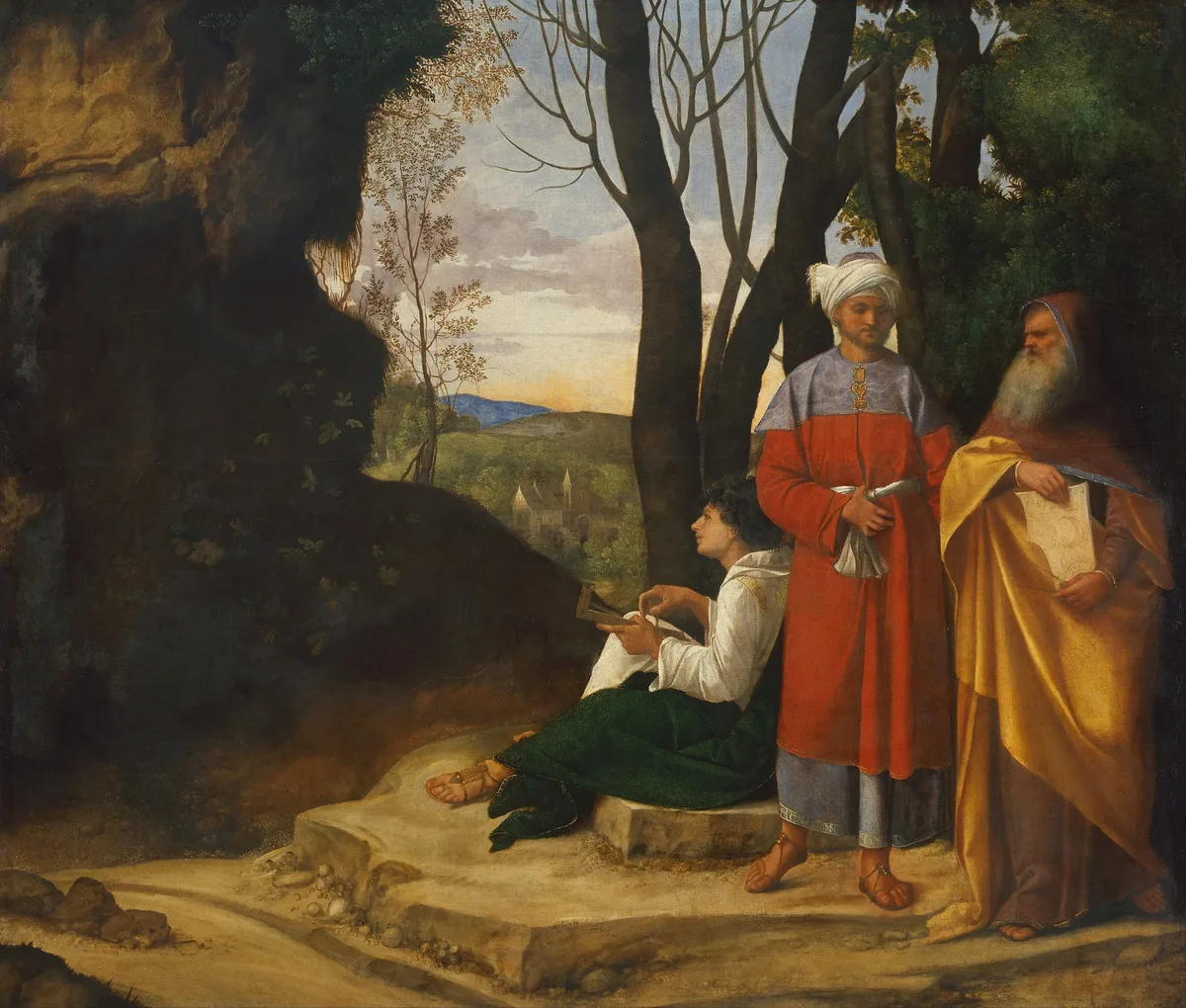
Who the three are has been argued over for several centuries. For a time they were called the Three Magi awaiting the star, and in 1978 the historian Salvatore Settis returned to that reading. Augusto Gentili proposed seeing them as Moses, Muhammad and the Antichrist. Karin Zeleny believes the seated young man is Pythagoras and the other two are his teachers Pherecydes and Thales, and the museum accepts her reading.
From Taddeo the painting passed to Dario Contarini, and by 1636 it belonged to the Venetian merchant and collector Bartolomeo della Nave. In 1638 his collection was bought for the Marquess of Hamilton by the English ambassador in Venice, Basil Feilding, a relative of the marquess. In 1649 Hamilton, a supporter of the king, was executed, his paintings were put up for sale, and Leopold Wilhelm bought most of them.
When the painting entered the archduke's Brussels collection, it was heavily cut down on the left, along the edge with the rock.
11. San Cassiano Altarpiece (fragments) — Antonello da Messina, 1475–1476
On 16 March 1476 the Venetian patrician Pietro Bon wrote to Galeazzo Maria Sforza, Duke of Milan, who was calling Antonello da Messina to his court as a portrait painter, and asked him to wait about 20 days longer. The painter was finishing the altarpiece Bon had commissioned for the Venetian church of San Cassiano, and Bon assured the duke that it would be one of the most excellent works of the brush in Italy and beyond.
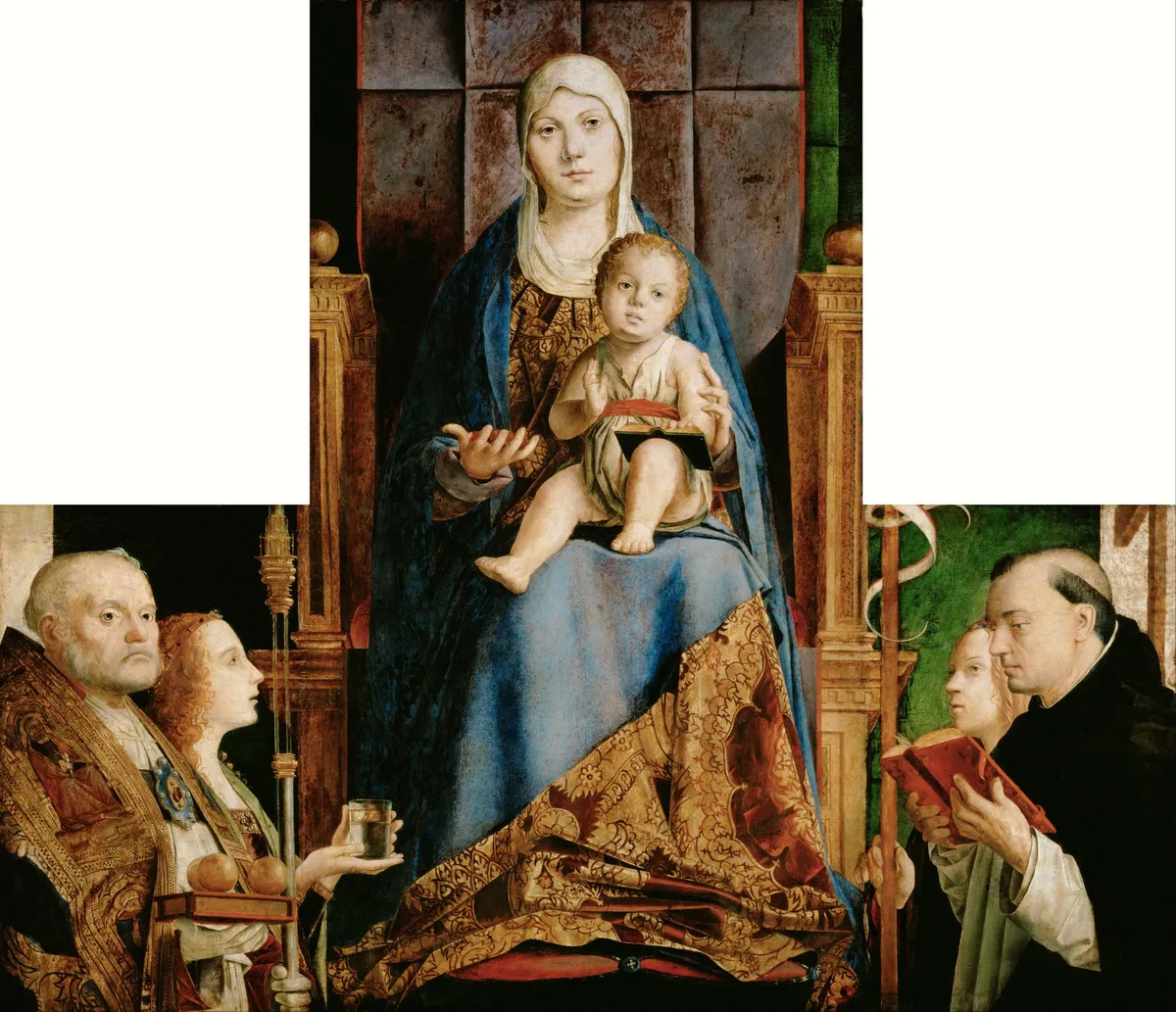
Antonello came from Sicily and had learned to paint in oil in Naples, where Flemish painting was collected and understood, and he spent about a year and a half in Venice. The museum holds that it was with this altarpiece that oil painting reached Venice. As planned, it was a tall panel in which the Madonna sat enthroned in a church interior among eight saints. In 1620 the altarpiece was sawn up and sold in pieces, and the best groups of figures went into collections as separate paintings.
The fragments passed through della Nave's hands, then Hamilton's, and in 1659 they are recorded with Leopold Wilhelm, where they were taken for the work of Giovanni Bellini. For the Theatrum Pictorium Teniers copied them as small pictures, and those copies preserve the saints that were later lost. The surviving pieces lay unrecognised in storage for a long time, until in 1928 Johannes Wilde, a curator at the Vienna gallery, realised that they came from a single altarpiece and joined them together.
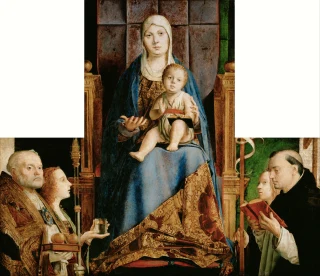
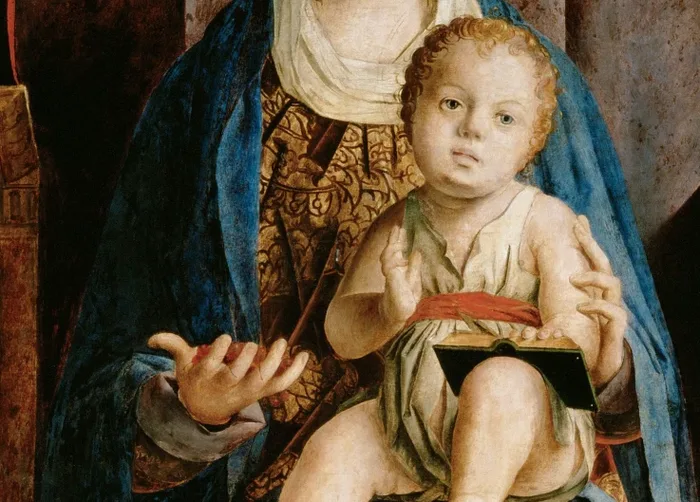
The three panels are butted together in an upside-down T, a tall one in the middle and two lower ones at the bottom on either side, and the corners above the side panels are left empty. The Madonna, in a blue mantle and a gold brocade dress, looks straight at us, and in her right hand, almost hidden by her fingers, lie red cherries on thin stalks. On the left stands a bald, grey-haired Saint Nicholas without his mitre, his white-gloved hand holding a book with three gold balls, and beside him a female saint in strict profile holds a clear glass on her open palm. On the right Saint Dominic lowers his eyes, and at the very edge the panel cuts off a narrow sliver of yet another face.
Wilde published his full reconstruction, with the architecture and the lost saints, on paper in 1929, and the panels are shown as they are, with nothing painted in.
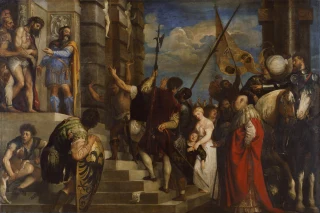
12. Ecce Homo — Titian, 1543
Titian painted this huge scene in 1543 for the Venetian Giovanni d'Anna, whom Vasari calls his compare, a friend bound to him by godparenthood. Around 1620 the English ambassador Henry Wotton bought the painting from d'Anna's heirs for the Duke of Buckingham. It soon became famous, and according to later accounts the Earl of Arundel offered Buckingham £7,000 for it and was turned down.
Christ is pushed into the upper left corner, onto a stone landing above a broad flight of steps, and stands almost naked, crowned with thorns, his hands bound. Beside him is Pilate, in pale blue armour of the Roman type and bright blue boots with bows. He points at Christ with his whole body and both hands while turning his face to the crowd, and by long tradition he has the features of Titian's friend, the writer Pietro Aretino. The crowd climbs the steps on the right. At lower left a frightened youth clutches a dog, beside him a soldier in green scale armour, his back to us, leans on a shield with a black double-headed eagle, and in the middle a girl in white satin glows, whom tradition, with nothing to support it, takes for Titian's daughter Lavinia. On a folded slip of paper on the lower steps is the signature “TITIANVS EQVES CES F 1543”, “Titian, knight of Caesar”, because in 1533 Emperor Charles V had made his court painter a knight.
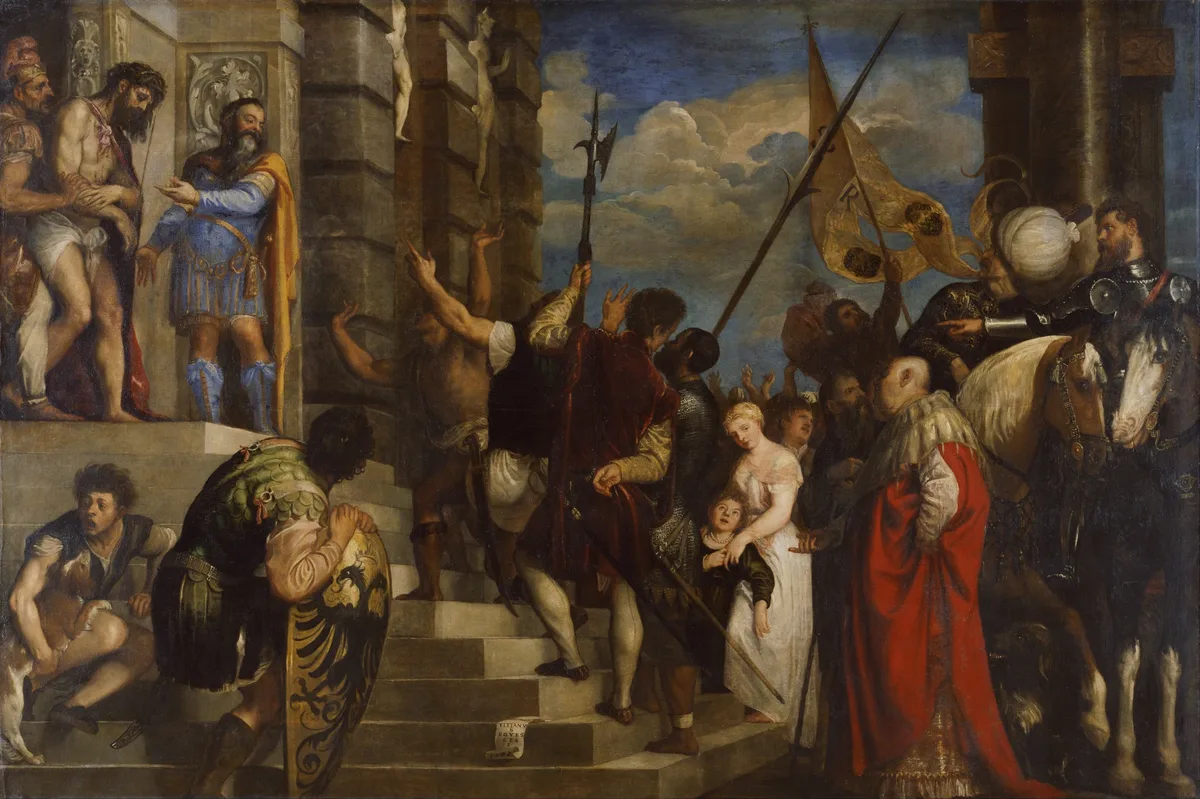
Buckingham was assassinated in 1628, and during the Civil War his collection was sequestered, and his heirs took most of it to the Netherlands and sold it off in Antwerp. In 1649 Ecce Homo was bought for the imperial collection, by most accounts for the emperor's gallery in Prague Castle. The Prague gallery was being restocked at the time, because in the summer of 1648 Swedish troops had taken Prague Castle and carried Rudolf II's collection off to Stockholm.
The painting was moved to Vienna in 1723.
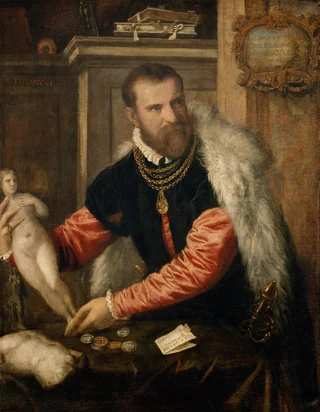
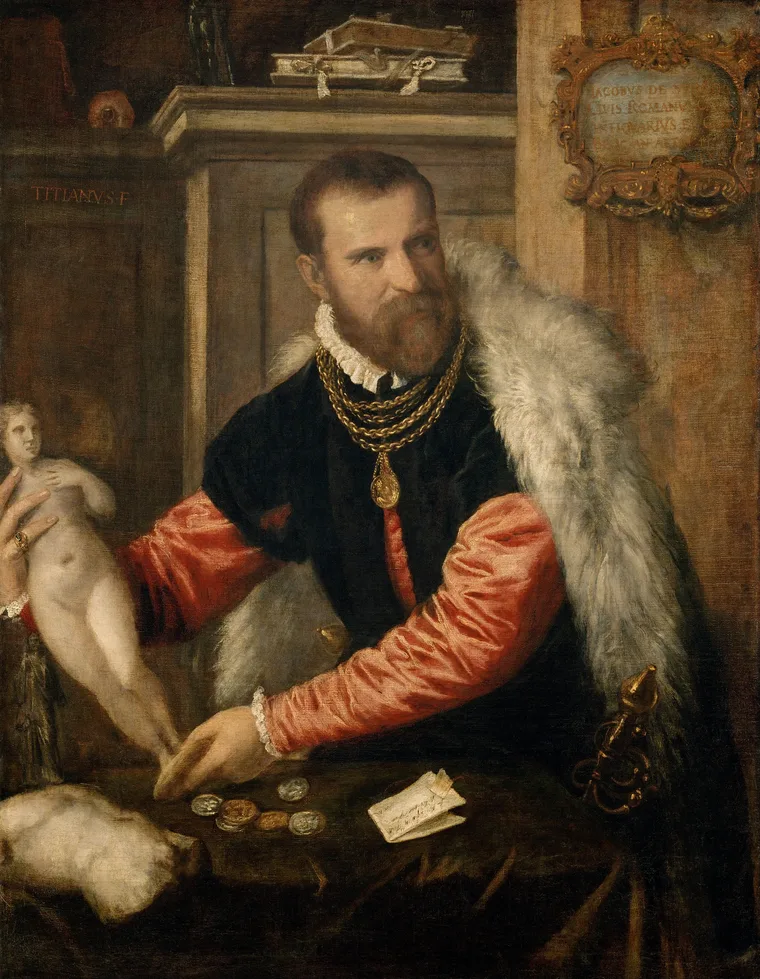
13. Portrait of Jacopo Strada — Titian, 1567–1568
Jacopo Strada dealt in antiquities, bought them for Duke Albrecht V of Bavaria and for the Habsburgs, and held the title of imperial antiquary. In 1567–1568, when he came to Venice on another buying trip, Titian painted him. Strada leans diagonally across a table holding a small white marble Venus in both hands, one round her breast and the other under her legs, while his head turns the other way and he looks to the right, past the viewer. The museum calls this counter-movement of hands and head unique among Titian's portraits. On the table lie silver and copper coins, a folded letter and a fragment of a marble torso, a grey long-haired fur lies over Strada's shoulder, and several heavy loops of gold chain with a medal hang on his chest.
Titian was about 80. He no longer travelled, his workshop was turning out repetitions of his mythologies for sale, and he was looking for buyers at the Habsburg court. Most of what is known about how the portrait came about comes from the letters of Strada's rival, the dealer Niccolò Stoppio, who had just lost to him in the purchase of the Loredan collection of antiquities in Venice, so he can be believed only with reservations. Stoppio wrote to one of the Fuggers, the family of Augsburg bankers, that Strada had undertaken to pass off workshop repetitions of Titian's mythologies to Emperor Maximilian II as the master's own work, and that in return Titian was painting his portrait and receiving a fur from him. In the same letters he passes on Titian's supposed verdict on Strada, that he was one of the most pompous ignoramuses.
Researchers have not established how the portrait came to Archduke Leopold Wilhelm. That it was in his collection is certain, because Teniers painted it on the cabinet in the Brussels gallery.
The cartouche with an inscription in the top right corner, which calls Strada a Roman citizen and imperial antiquary, was for a time thought to be a later addition, because its design seemed too Baroque. Recent research, however, argues against this.
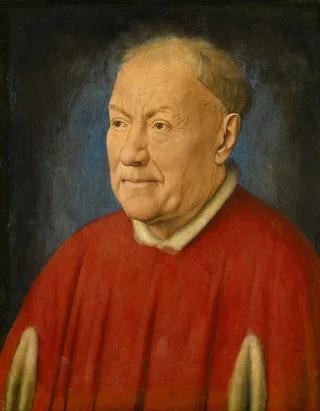
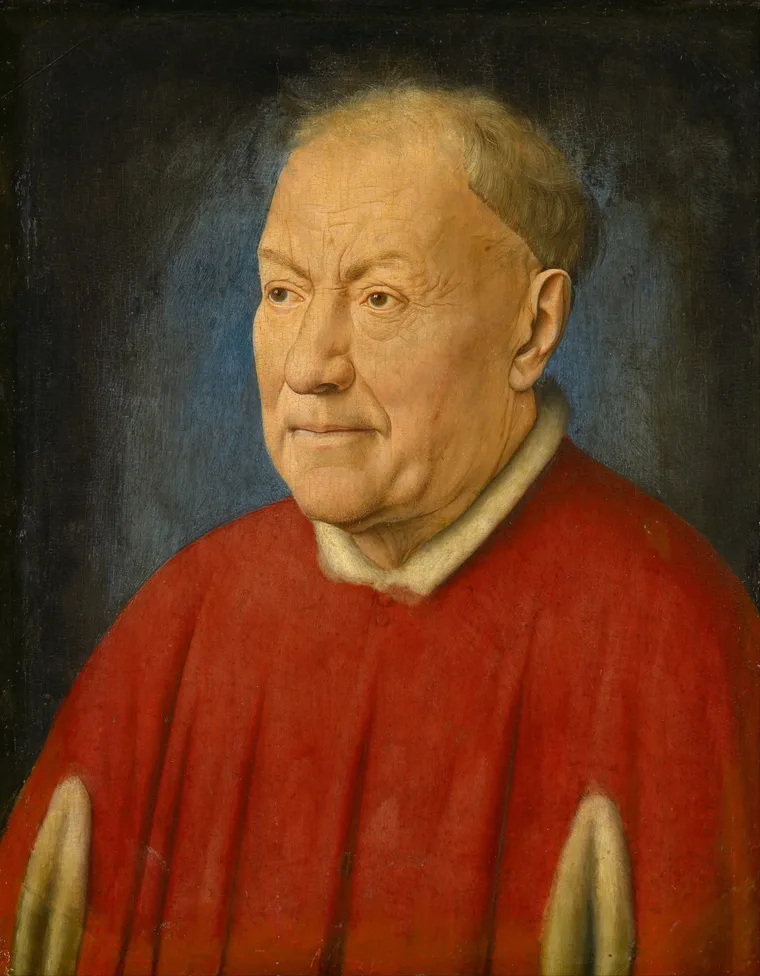
14. Portrait of a Man (Cardinal Niccolò Albergati?) — Jan van Eyck, c. 1435
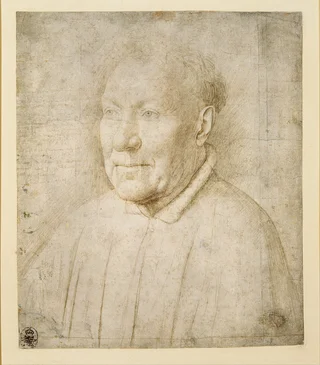
For over 300 years the old man in this portrait has been called Cardinal Niccolò Albergati, but there is no proof of it. The name first appears in the 17th century, when Archduke Leopold Wilhelm bought the panel from the Antwerp dealer Peeter Stevens.
The old man is painted to the chest, without hands, in three-quarter view, his face turned to the left, and his brown eyes look further left still, past us. The light comes from the upper left and falls on the forehead and the left half of the face, while the right cheek and the neck sink into soft shadow. Van Eyck rendered every wrinkle round the eyes, the bags beneath them, the large ear and the grey stubble on the chin, and laid out the red robe with its fur collar in broad folds. Low down, on the left and on the right, two tall pointed slits are cut into the robe, and the pale fur lining shows through them.
The doubts about the name Albergati go back a long way. Albergati was a Carthusian monk and would have had a tonsure, while the old man has short grey hair and secular dress. In 1990 Malcolm Vale proposed the English cardinal Henry Beaufort, the historian John Hunter doubts that the sitter is a cardinal at all, and the museum keeps a question mark in the title. The date depends on the identification as well. Our catalogue gives 1431, the year Albergati passed through Bruges according to the old account. The museum gives around 1435, the time of the peace congress at Arras, or 1438 with a question mark. In the 18th century the panel was made oval, and later it was given back its rectangular shape.
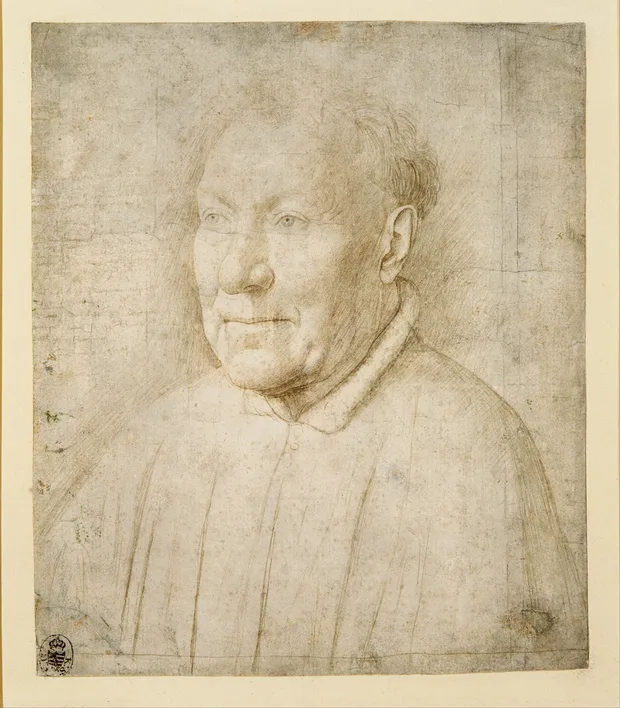
The preparatory drawing in silverpoint is in Dresden, and beside the face van Eyck noted down, in his native Maasland dialect, the colour of the old man's hair, his lips and the stubble on his chin.
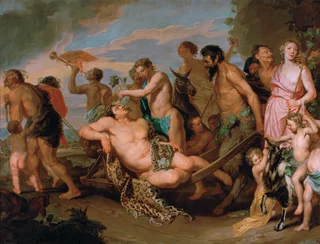
15. Triumph of Bacchus — Michaelina Wautier, before 1659
In 1903 Gustav Glück, curator of Flemish painting at the Vienna museum, read in an old inventory that The Triumph of Bacchus was by someone called Woutiers, and refused to believe it. He wrote that even in an age of women's emancipation hardly anyone would venture to ascribe to a woman's hand a painting of such a strong, almost coarse manner.
In Archduke Leopold Wilhelm's inventory of 1659 the painting is entered under a surname alone, Woutiers, with no first name. Michaelina Wautier, born in Mons, worked in Brussels together with her brother Charles, and the archduke, who governed from Brussels, owned four of her paintings. For three centuries The Triumph was attributed by turns to the school of Rubens, to Luca Giordano and to Cornelis Schut. In 1763, when the painting was in Prague Castle, it was cut down in width to fit one of the rooms.
Bacchus, muscular and heavy, sprawls on a long wooden barrow, on a spotted leopard skin. A young satyr with little horns squeezes a bunch of green grapes into his open mouth, a black-bearded satyr on goat's legs grins as he pushes the barrow by its handles, on the left a dark-skinned trumpeter blows a long gold trumpet, and behind him an old man hauls the barrow on a rope. On the right stands a fair-haired woman in pink, her left breast bare, holding a thyrsus twined with vine, and she looks calmly straight at us. The museum considers her a self-portrait of the painter. At her feet a curly-haired child hugs a black-and-white goat.
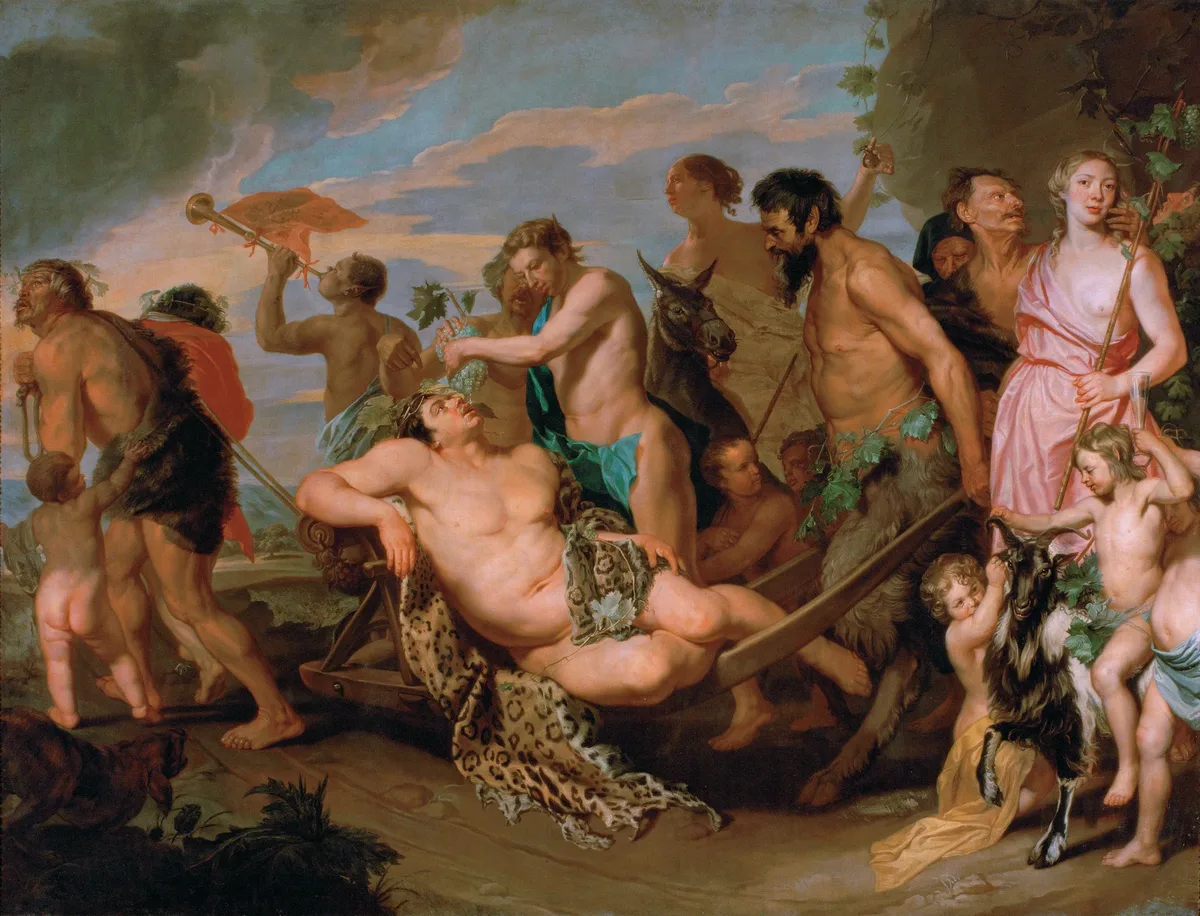
In 1967 the museum's curator Günther Heinz compared the handling with her signed Saint Joachim and Saint Joseph in the same collection and gave the painting back to Michaelina Wautier.
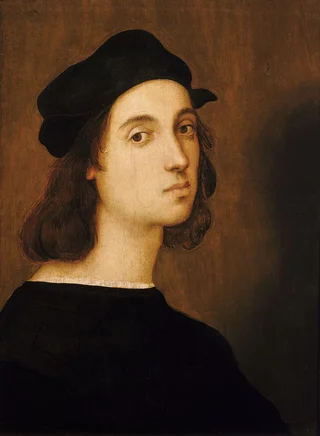
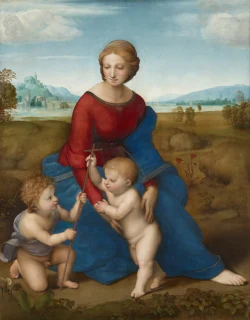
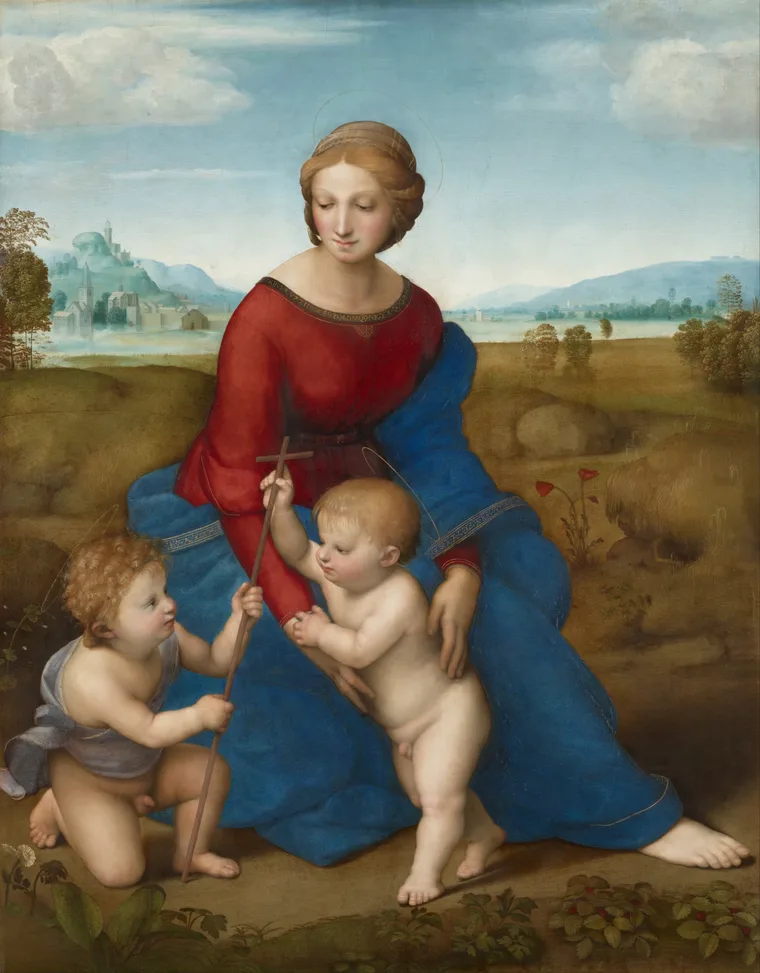
16. Madonna of the Meadow (Madonna del Prato) — Raphael, 1505–1506
Vasari writes that in Florence Raphael lived in the house of the patrician Taddeo Taddei and ate at his table, and then, “so as not to be outdone in courtesy”, painted two pictures for him. In them, Vasari says, one can still see the first manner of his teacher Perugino and already the new one he had learned in Florence. Raphael arrived there at the end of 1504 and took from Leonardo the habit of building a group as a triangle.
The Madonna sits low, right on the grass, with her head at the apex of the triangle, and the corners of its base are formed by the little John the Baptist kneeling on the left and her bare foot on the right. John holds a thin reed cross in both hands, and the Christ Child steps forward and takes hold of the cross just below the crossbar. Mary steadies her son by the chest and the side. At lower right, under her foot, grows a wild strawberry with red berries, on the left by John's knee a white daisy shows pale, and further right, level with Christ's head, red poppies glow. On the border at the neckline of her red dress, gold letters are traced among the ornament, and in the middle one can read “M.D.V.”, followed by a small circle and one more vertical stroke. So the date is read both as 1505 and as 1506, and our catalogue gives 1505.
The painting stayed with Taddei's heirs until 1662, when Archduke Ferdinand Karl of Tyrol bought it from the family. From 1663 it is recorded at Ambras Castle, in 1773 it was taken to Vienna and hung in the Belvedere, and that is where its second name comes from, the Belvedere Madonna.
In 2017, when the Albertina, Vienna's museum of works on paper, opened a Raphael exhibition, the Kunsthistorisches Museum did not lend the painting, to spare it the move, and a small reproduction was hung beside the preparatory drawings for it.
Portraits the family sent home (1659, 1779)
17. Infanta Margarita Teresa in a Blue Dress — Diego Velázquez, 1659
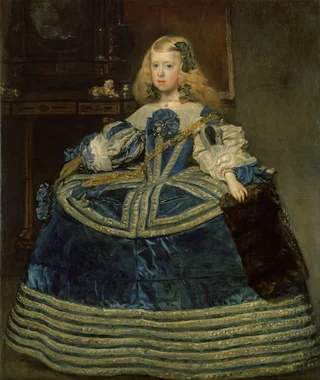
In November 1659 Spain and France concluded the Peace of the Pyrenees, and Philip IV's eldest daughter, the Infanta Maria Theresa, was to marry Louis XIV. Two years earlier a son had been born to the king, and that left the younger daughter, eight-year-old Margarita Teresa, for a marriage with the Vienna Habsburgs. Vienna was ruled by her uncle Leopold I, emperor since 1658, and she was meant to be his bride, although the betrothal was announced only in 1663.
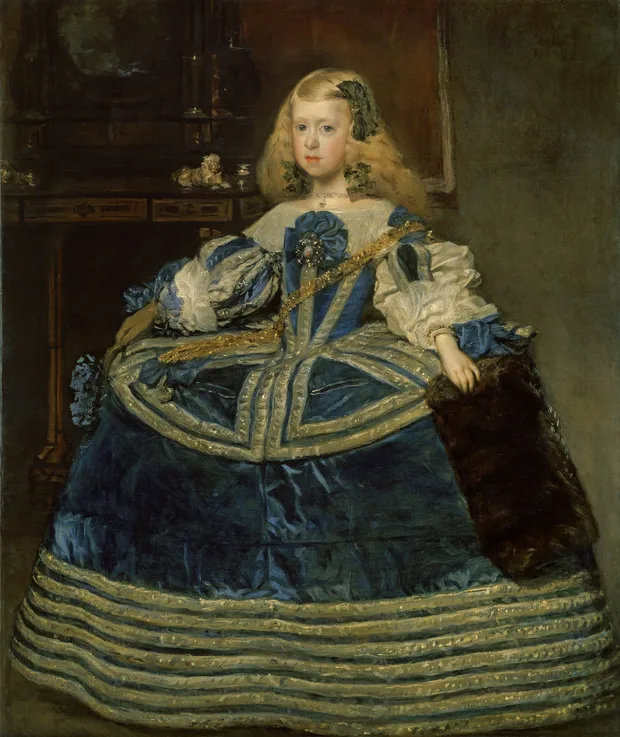
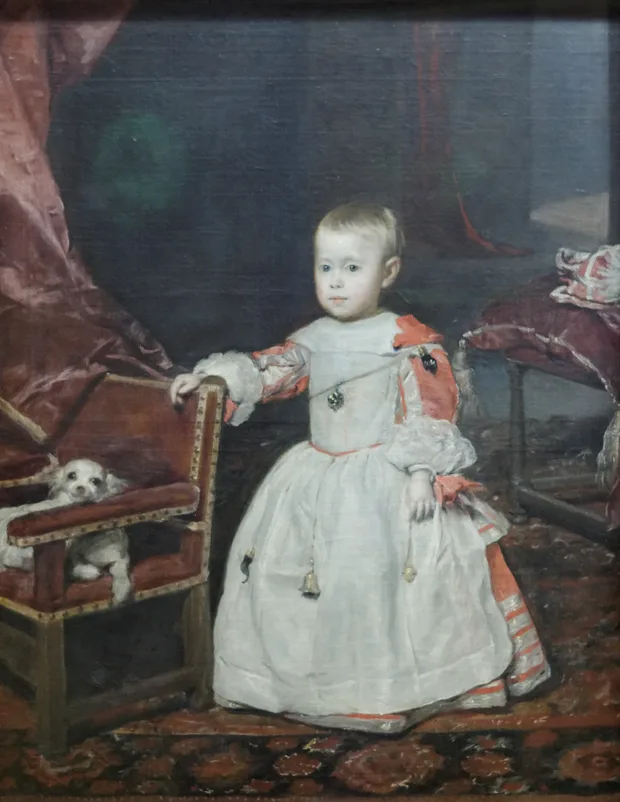
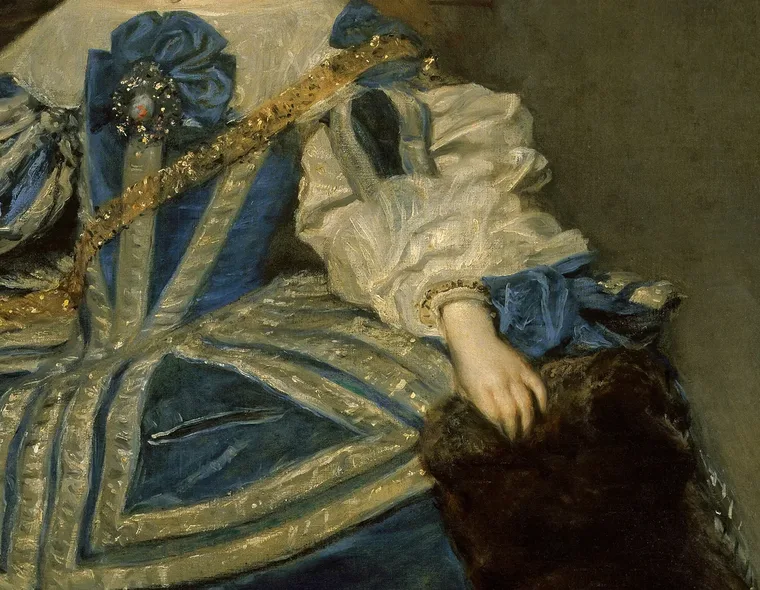
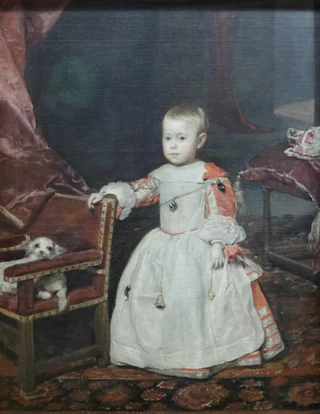
In 1659 Philip IV sent the Vienna court two portraits by Velázquez as a gift, one of her and one of her little brother Philip Prospero, so that Vienna could see how the girl was growing up. The museum calls this pair the last finished paintings of Velázquez, who died in August 1660.
The Infanta faces us, and her skirt, spread over its hooped frame, takes up almost the full width of the canvas. The blue silk is trimmed with silver braid, horizontal bands run across the skirt, a thick gold chain lies diagonally across the bodice, there are dark green bows in her hair, and her left hand rests on a large brown fur muff. The silver, the lace and the fur are painted in separate raised strokes, which remain strokes from close up and turn into fabric and metal only at a distance, while the face is painted smoothly. This is the same girl who stands at the centre of Las Meninas of 1656, three years older.
The portrait was kept in the imperial apartments, and in 1855 it was in the rooms of Archduchess Sophie, mother of Franz Joseph. In the 18th century the top of the canvas was cut into a semicircle, and after the painting was transferred from the Hofburg to the museum in 1922 it was given back its rectangular shape.
Margarita Teresa came to Vienna in December 1666 and married Leopold, and in 1673 she died at the age of 21, having borne four children in six years of marriage.
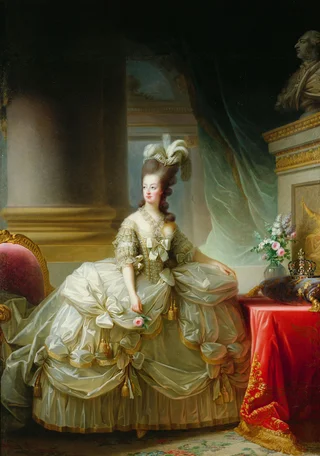
18. Marie Antoinette in Court Dress — Élisabeth Louise Vigée Le Brun, 1778
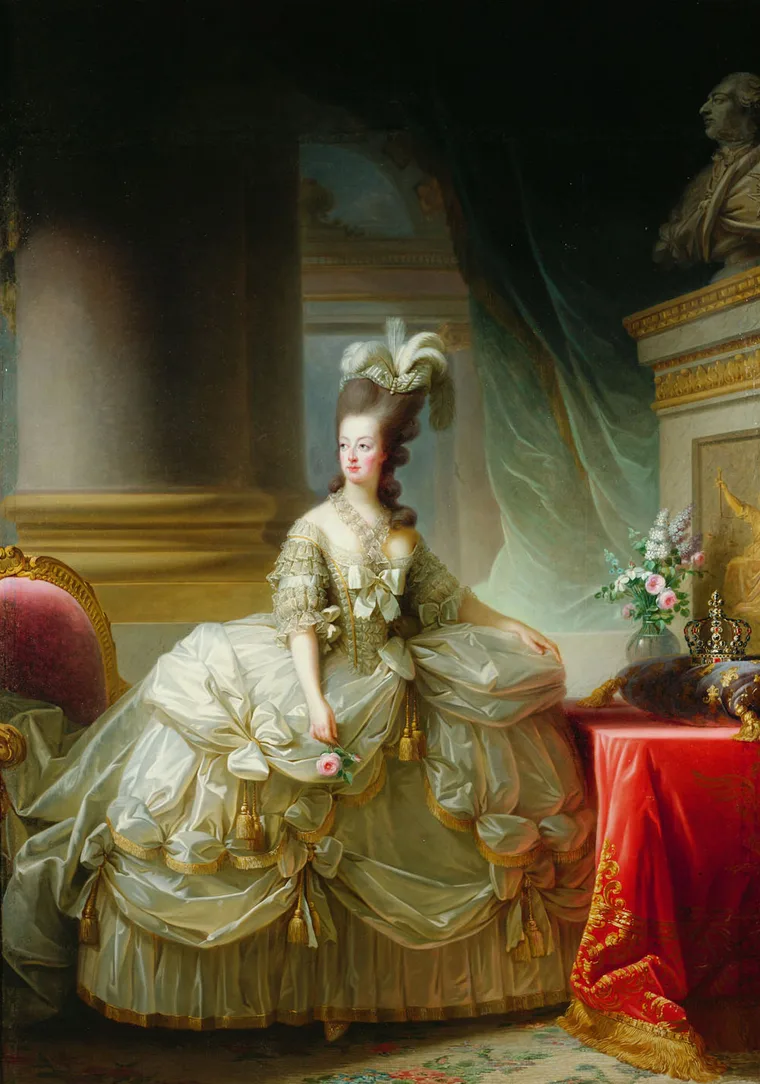
In 1778 the French queen Marie Antoinette commissioned a large state portrait as a gift for her mother, Empress Maria Theresa, and summoned Élisabeth Vigée Le Brun to Versailles to paint it. The painter was 23, almost the same age as the queen, and this was her first portrait of Marie Antoinette. Over the following years she painted the queen about 30 times, and in 1783, thanks to the queen, she was admitted to the French Royal Academy. In her memoirs Vigée Le Brun wrote that the queen's skin was so transparent that it took no shadows, and that she never managed to render it as she wished.
The queen stands full-length and life-size in a white satin court gown over enormously wide panniers, trimmed with festoons, bows and gold tassels, and on her head is a tall powdered coiffure with white ostrich feathers. In her lowered right hand she holds a single pink rose, and light from the left falls on her face, her shoulders and the satin. On the right, on a table covered in red velvet, the French crown lies on a lilac-blue cushion with gold lilies, and above it, on a tall pedestal, stands a bronze bust of Louis XVI in profile.
In February 1779 the portrait was sent to Vienna, and Maria Theresa wrote back to her daughter, “Your large portrait delights me!” She had it set up in the Hofburg, and it was transferred from the Hofburg to the museum in 1922. In memoirs written half a century later, Vigée Le Brun placed the first sitting in 1779 and wrote that the portrait was intended for the queen's brother, Emperor Joseph II.
The signature on the canvas, “Peint par Mde le Brun âgée de 22 ans, en 1780”, that is, “painted by Madame Le Brun, aged 22, in 1780”, was added later according to the museum, and both the year and the age in it are wrong.
The imperial gallery in the 18th century (1720–1786)
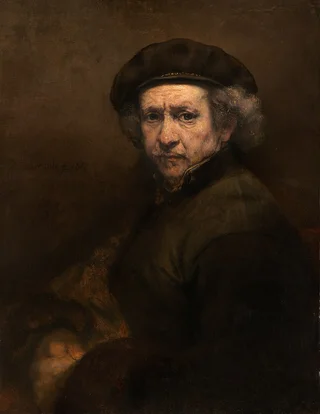
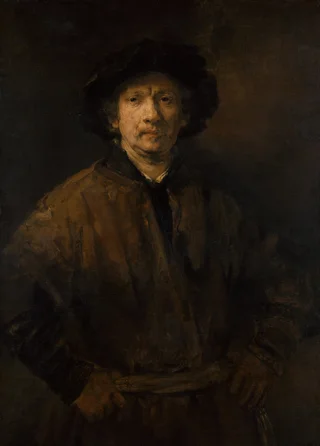
19. Large Self-Portrait — Rembrandt, 1652
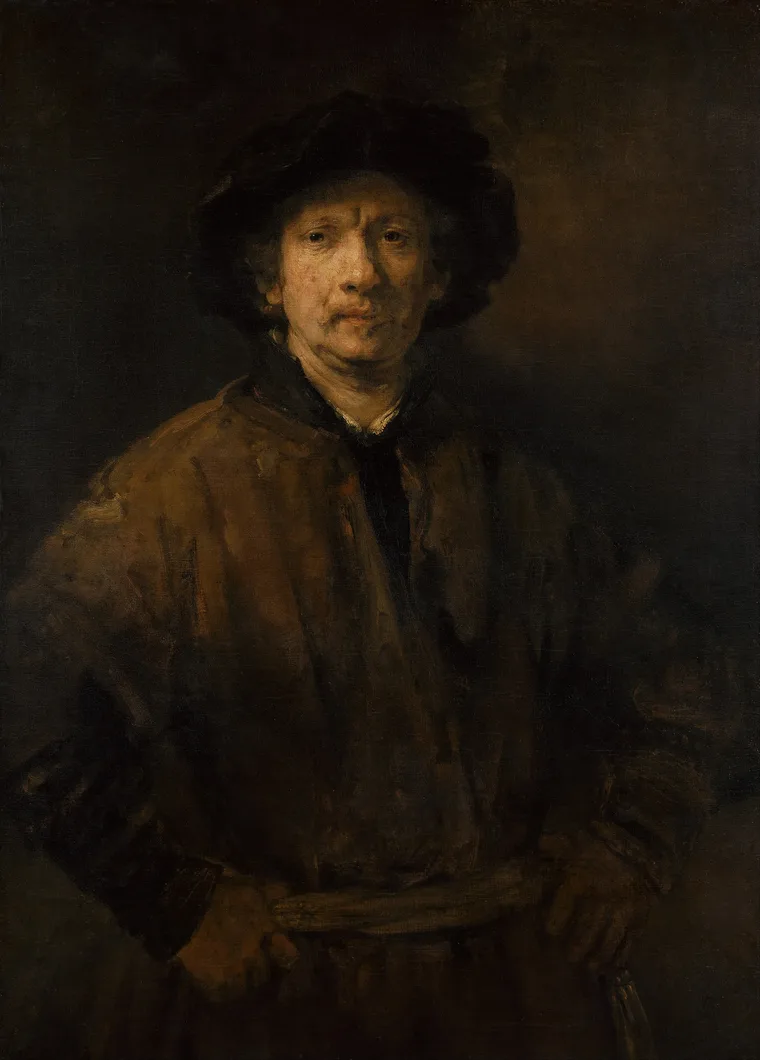
Rembrandt stands squarely in front of us with his hands on his hips, and his elbows almost touch the edges of the canvas. He wears a broad brown smock, held by a loosely tied pale sash, and a large soft black beret. The museum allows that this may be the very smock he wore to work in the studio. Light from the upper left falls on his face. The forehead is creased with horizontal lines, the brows are raised, the nose and cheeks are reddish, there are bags under the eyes, and the face is painted in more detail than anything else, while the smock and the warm brown background are laid in broadly and evenly. The canvas has been cut down on both sides, and of the signature at top left, according to the museum, only “…dt.f.1652” remains.
This is his first painted self-portrait since 1645 and the beginning of the late series that runs almost to his death. In these same years Rembrandt's finances were going downhill: in 1656 he declared himself insolvent, and then his property and his collection were sold off. According to the museum, the word “self-portrait” was not known in Holland at the time, and buyers were looking for “a portrait of Rembrandt painted by himself”, his face and a sample of his painting at once.
No document records how the painting came to Vienna. All the museum can say is that by 1720 it was already listed in the imperial gallery.
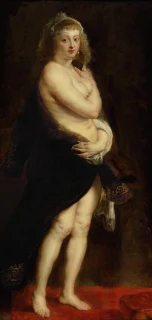
20. Het Pelsken (Helena Fourment in a Fur Robe) — Peter Paul Rubens, c. 1636–1638
Shortly before his death in 1640, Rubens excluded one painting from the division and sale of his estate and left it to his wife, Helena Fourment, in person, calling it in his will het pelsken, “the little fur”.
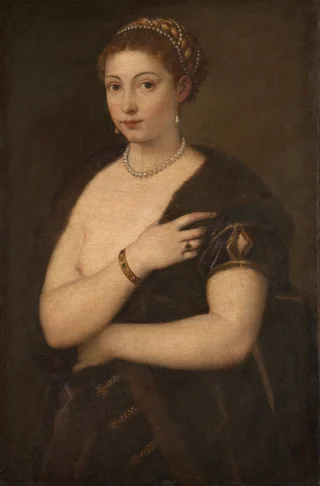
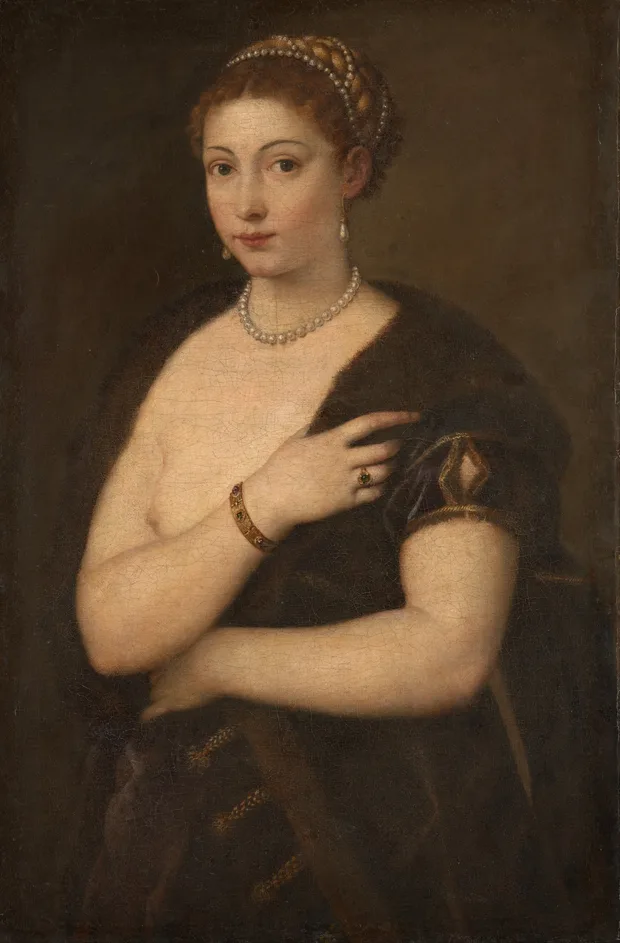
Rubens married Helena in December 1630. He was 53 and had been a widower for four years, and she was 16, the daughter of an Antwerp silk merchant and the niece of his first wife, Isabella Brant. The year before the wedding Rubens had been in London on a diplomatic mission, received a knighthood from Charles I and, in the royal collection, copied Titian's Girl in a Fur, a painting that is now also in this museum. In the 1630s he almost withdrew from diplomacy and painted Helena often, and Het Pelsken remained the only portrait of her nude as herself. Rubens died in Antwerp on 30 May 1640.
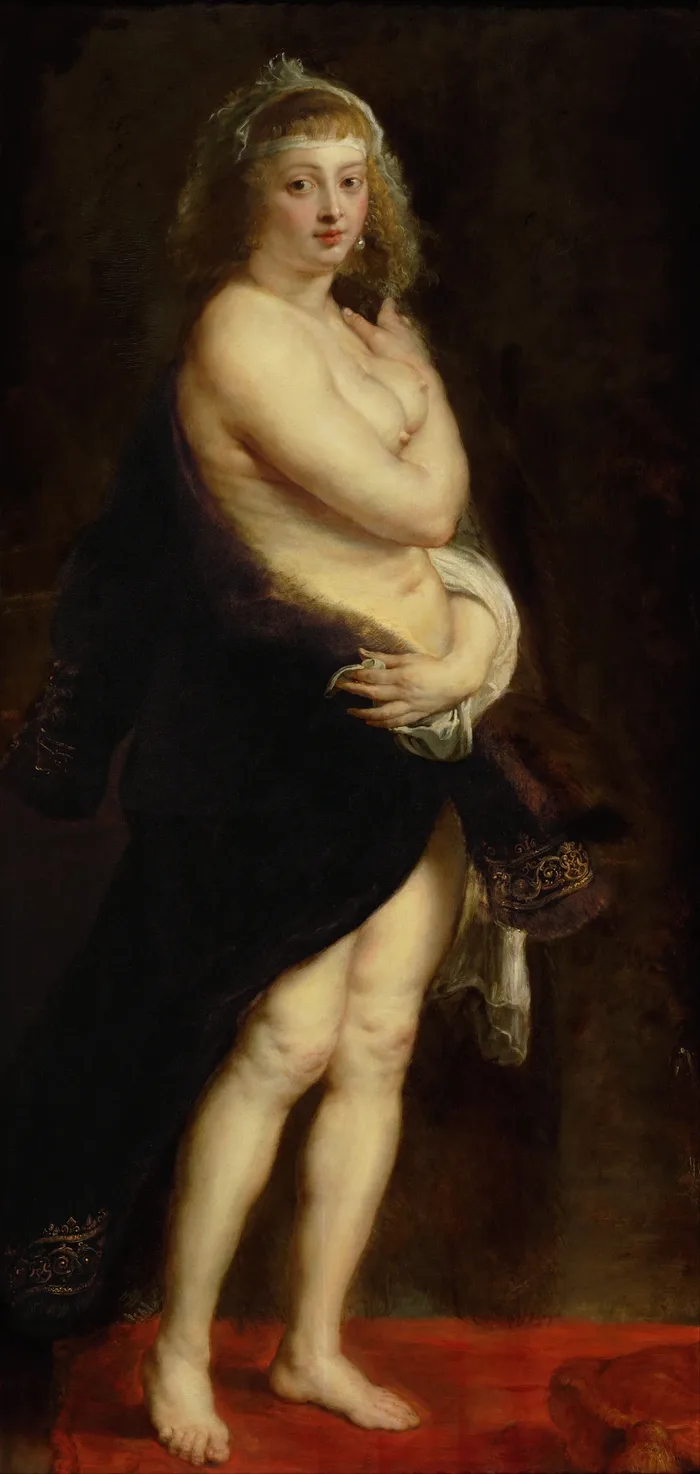
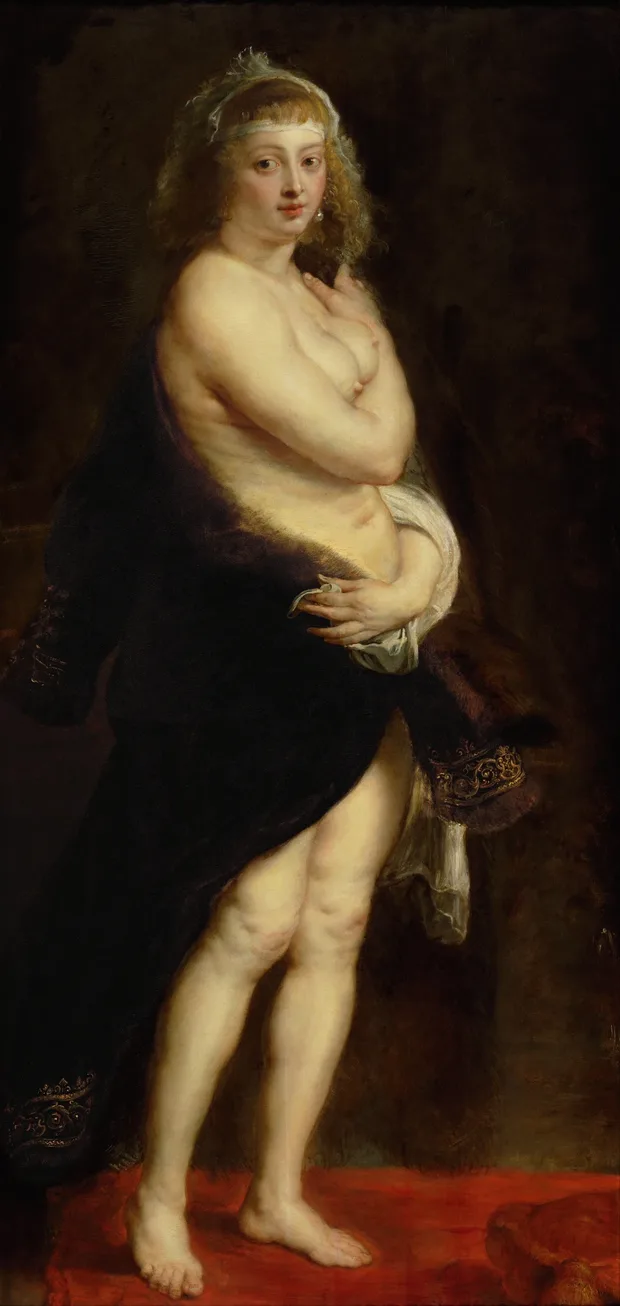
Helena stands full-length and life-size, barefoot on a red carpet, looking straight at us. With her right hand she covers her breast, and with her left she presses a white cloth to her belly, like the modest Venus of ancient statues, while a black cloak lined with brown fur covers her back and falls to the floor on the left, leaving her whole front uncovered. Rubens painted the dimples in her knees and the folds of her belly under her arm, and the warm pink skin glows against the black and the brown.
In 1645 Helena married again, and in her will of 1658 she left the painting to her second husband as a keepsake, then added a codicil saying that Het Pelsken should go to the children of her first marriage, Rubens's children. By 1730 the painting was in the imperial gallery in Vienna, and how it got there nobody knows.
In 2014 the painting was scanned with X-ray fluorescence, and under the dark background on the right a fountain in a niche was found, rising to Helena's shoulders, with a lion's head spouting water from its mouth and a little stone boy urinating on a pedestal. Fountains like this stood in gardens, so Rubens apparently first pictured his wife in the open air and then painted the fountain out himself.
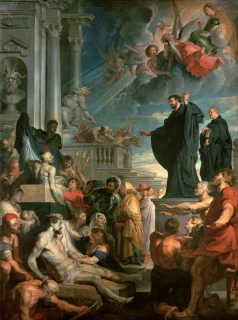
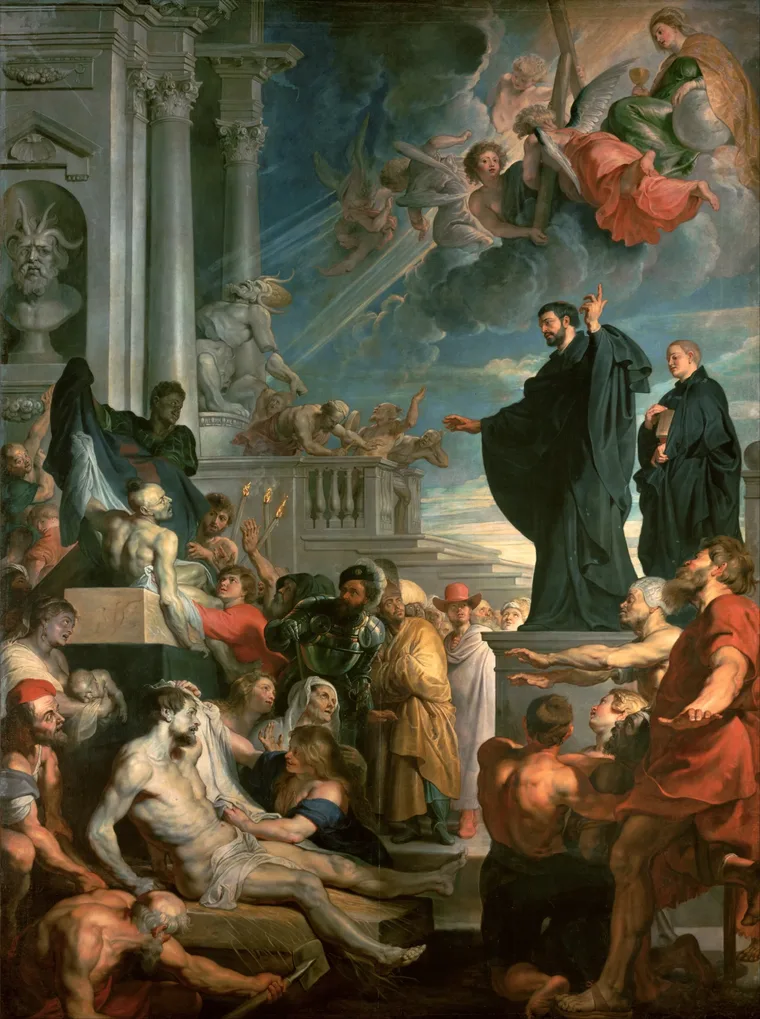
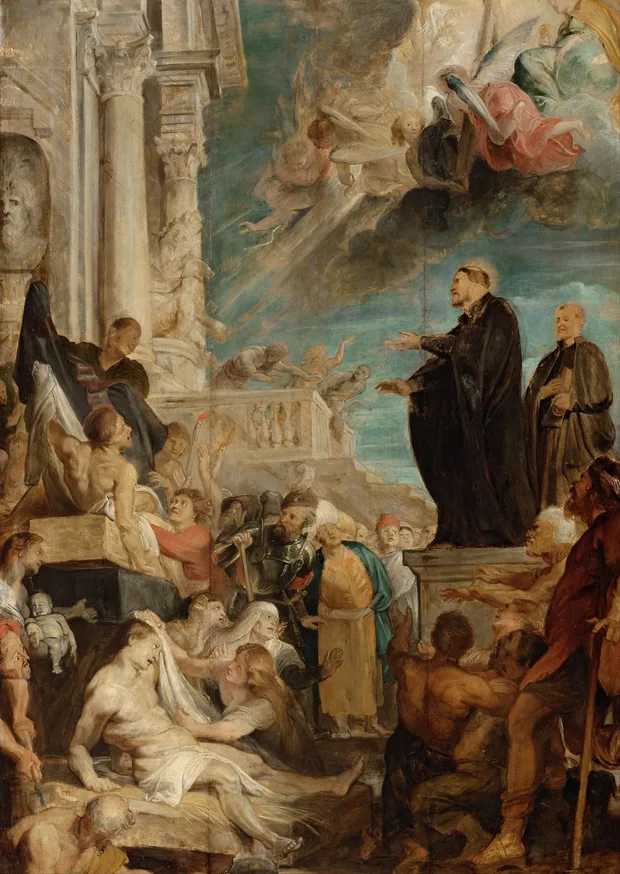
21. Miracles of St. Francis Xavier — Peter Paul Rubens, c. 1617–1618
The pope suppressed the Jesuit order in 1773, and in the Southern Netherlands, which then belonged to Austria, the Jesuits' property passed to the state. Their church in Antwerp, built in 1615–1621, had two large altarpieces by Rubens, one with Saint Francis Xavier and one with Saint Ignatius of Loyola, and they were swapped on the high altar according to the church calendar with ropes and pulleys. In 1718 a fire started by lightning destroyed 39 ceiling paintings made after Rubens's sketches, while the altarpieces survived. In 1776 both altarpieces were bought for Vienna.
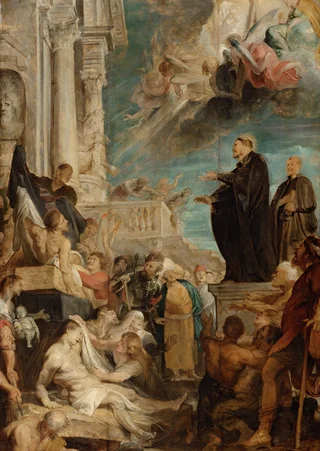
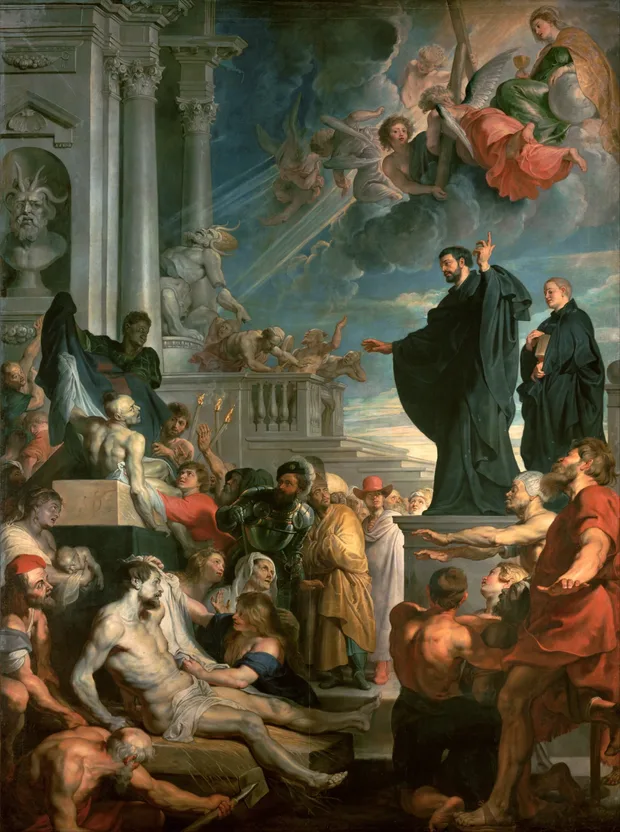
The canvas is more than three times a man's height, and it was painted to carry across the whole church. Francis Xavier, one of the first Jesuits, preached in India and Japan, and when Rubens painted him he was not yet a saint. He was beatified in 1619 and canonised in 1622. Xavier, in a black cassock, stands on the right on a stone platform, pointing upward with one hand and stretching the other towards the crowd. In the top right corner Faith sits on clouds with a chalice and a globe, rays strike from the angels with the cross at a pagan idol at upper left, and the horned idol, its mouth gaping, splits apart and topples. Below, a dead man sits up on a straw litter and pulls the shroud off his head, a woman holds an infant face down on her arm with water running from its mouth, and on the right a blind man walks forward with his arms outstretched. Among the onlookers stands a man in a yellow robe and a tall transparent conical hat. Rubens also drew him separately, and that drawing was long thought to be a portrait of a Korean, until in 2016 researchers proposed that it shows the Chinese merchant Yppong, who sailed into Middelburg in 1600.
According to the museum, most of the canvas was painted by assistants, and Rubens went over the main passages himself. A small oil sketch on oak is also in the museum, and in it the scene with the drowned infant is only roughed in.
In 1776, together with the altarpieces, a view of the Jesuit church painted in 1665 by the artist Gheringh was bought from the Jesuits, and in it Rubens's Saint Ignatius altarpiece hangs over the high altar.
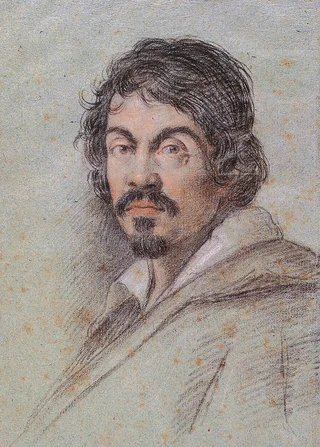
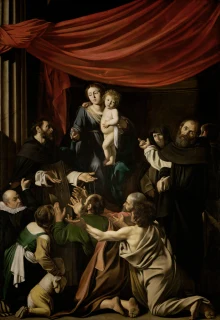
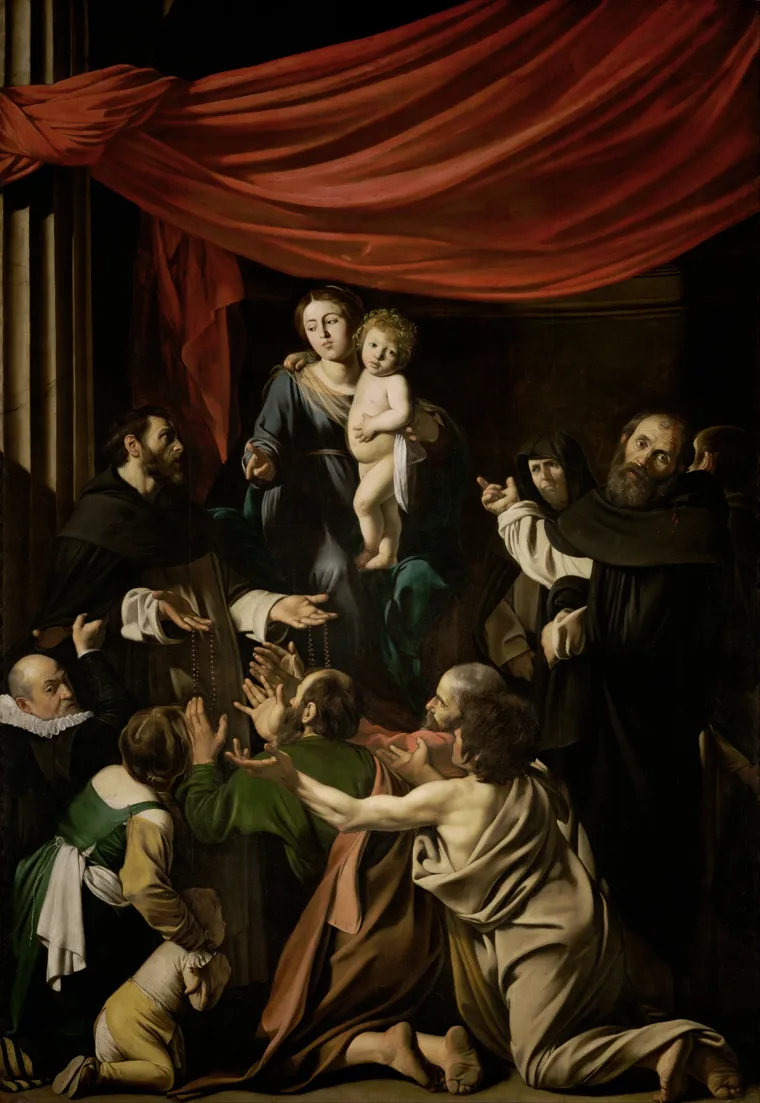
22. Madonna of the Rosary — Caravaggio, c. 1601–1607
The Flemish painter Frans Pourbus the Younger, court painter to Duke Vincenzo Gonzaga of Mantua, reported to him from Naples in 1607 that he had seen two very beautiful paintings by Caravaggio for sale there, one of them with a rosary. The asking price was 400 ducats, and the duke did not buy it. The painting was owned jointly by two Flemish painters and dealers, Louis Finson and Abraham Vinck. Nobody has ever identified the man who commissioned it, although he is in the painting: at lower left a grey-haired, balding man in black with a large white pleated ruff, who looks at us and holds on to the edge of Saint Dominic's cloak. Historians disagree on the date as well, some placing it in Caravaggio's Roman years, around 1601, others in his Neapolitan year of 1607.
A huge crimson curtain is slung across the whole top, knotted round a tall column on the left. The Madonna, with the Child on her knee, points down at Dominic, and from his open hands hang rosaries, towards which the hands of kneeling poor people reach. On the right Saint Peter Martyr, with a bloody gash right at his hairline, looks straight at us and points to the Child. In the centre at the bottom, with his back to us, kneels a man in a rust-brown cloak, the bare, dirty soles of his feet turned towards the viewer.
Finson took the painting north and died in Amsterdam in 1617. There it was bought for 1,800 guilders by several Antwerp artists and art lovers, Rubens among them, who gave it to the Dominican church of Saint Paul in Antwerp. According to a record of 1651, the friars were later offered 4,000, then 6,000 and finally 13,000 to 14,000 guilders for it, and they replied that the painting was not for sale at any price.
In 1781 Emperor Joseph II visited the church, and the painting was given to him. The Dominicans were left with a copy, painted at the emperor's expense by Andreas Bernardus de Quertenmont, director of the Antwerp Academy, and the original was taken to Vienna in 1786.
The state builds a home for the collection (1822–1891)
23. Theseus Slaying the Centaur — Antonio Canova, 1804–1819
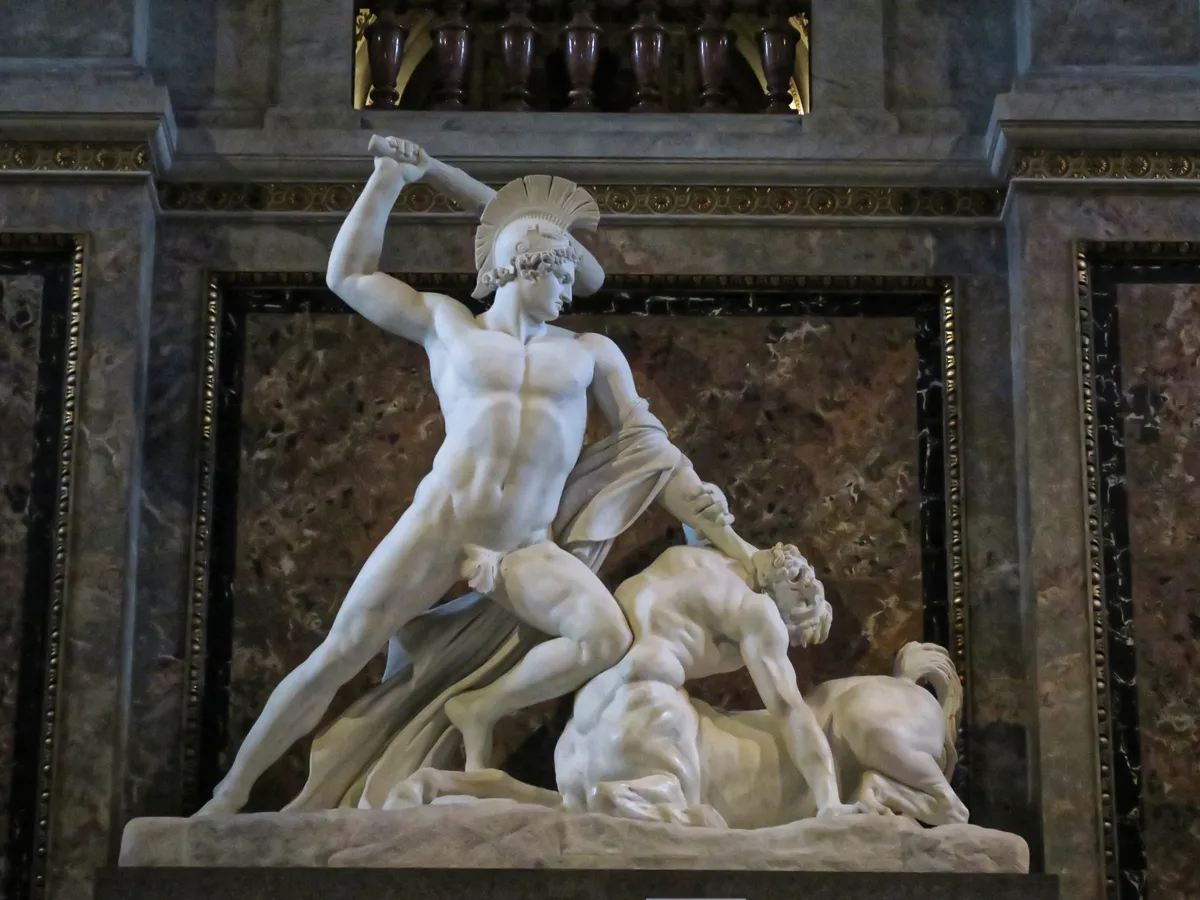
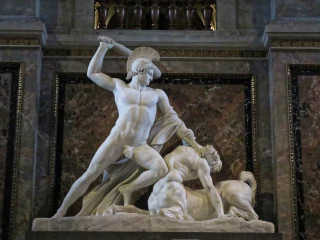
Theseus grips the centaur by the throat and beard with his left hand and drives his knee into its back, where the human body turns into the horse's, and with his right he raises a knotted club above his head, the blow not yet struck. He wears only a crested Greek helmet and a cloak that hangs in long folds from his left shoulder right down to the rock. The centaur has sunk to the ground and thrown its head back, mouth open, with one hand clutching Theseus's forearm and the fingers of the other scraping at the stone. In the myth the centaurs, invited to the wedding of Pirithous, got drunk and tried to carry off the bride, and Theseus, the groom's friend, killed one of them.
The Napoleonic Italian Republic commissioned the sculpture for Milan in 1804, to glorify Napoleon and his victory over Austria at Marengo in 1800. The group, twice the height of a man, was made as a monument for a city square. The marble blocks reached Antonio Canova's studio in Rome in 1810, by 1814 the group was almost finished, and by then Napoleon had fallen. Canova began looking for a buyer, and in 1817 the Austrian emperor Francis I agreed to pay the last quarter of the price, keeping for himself the choice of where it would stand.
For the group the court architect Peter von Nobile built a scaled-down copy of the Temple of Theseus in Athens in Vienna's Volksgarten, which opened in 1823. Canova had died the year before. In Vienna the monument conceived to celebrate a victory over Austria was read as the victory of lawful order over revolution. In 1890 the group was moved to the new museum and set up on the landing of the main staircase.
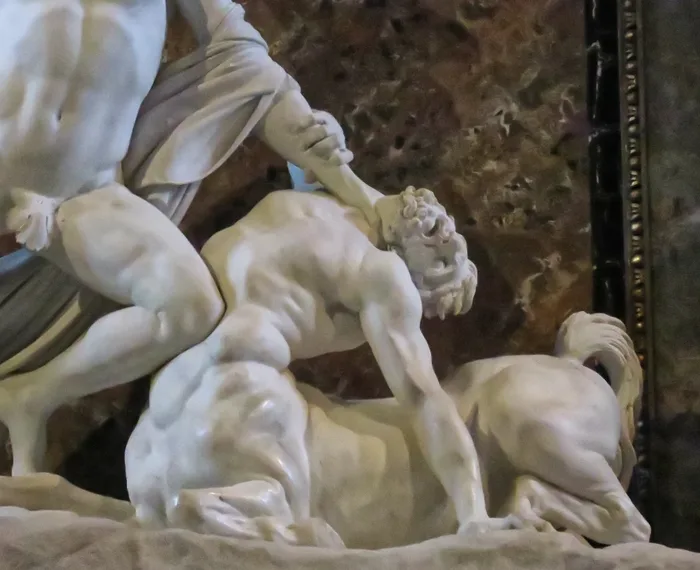
During the move Theseus's right arm broke off, and it was mended free of charge by Johannes Benk, one of the sculptors working on the museum building.
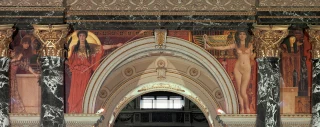
24. The staircase paintings — Gustav Klimt, Ernst Klimt and Franz Matsch, 1890–1891
In February 1890 the young “Company of Artists”, Gustav and Ernst Klimt and Franz Matsch, were commissioned to paint the last 40 fields of the main staircase of the new museum. Originally Hans Makart was to have painted the whole staircase, but he died having finished only the lunettes. Hans Canon, who had been given the ceiling, died as well. So below Mihály Munkácsy's ceiling painting and Makart's lunettes a further layer of paintings appeared, the youngest of them all.
The programme was drawn up by the museum's curator Albert Ilg as a history of art from Egypt and Greece to the Baroque, and the paintings were to show objects from the imperial collections. Gustav, who was 28, was given the north wall and the first arch of the west wall, 13 fields. He painted Egypt from books, above all from a black-and-white photographic album by the French Egyptologist Mariette, so the turquoise, red and gold colours were his own invention.
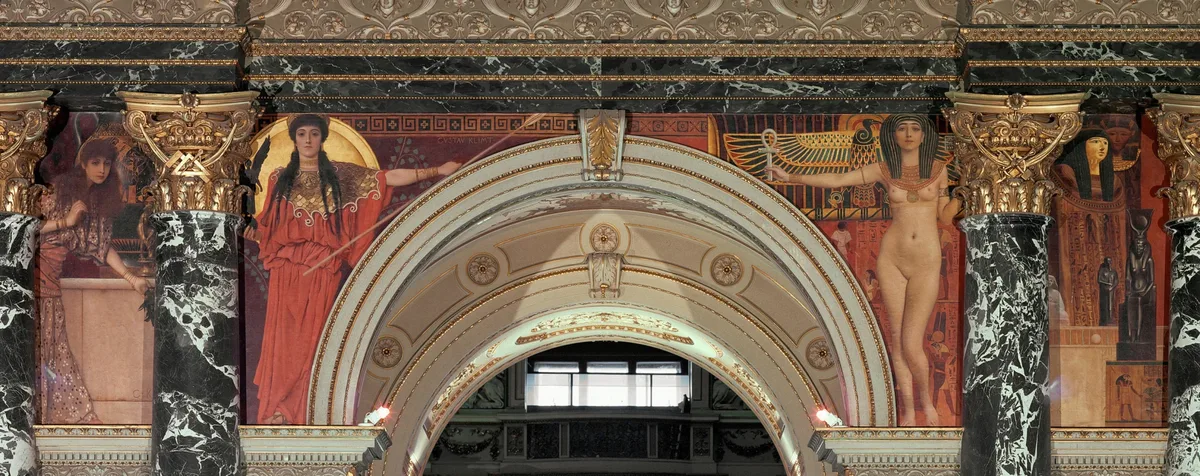
In the tall, narrow field of Egypt a young naked woman stands upright, facing us. In her arm, stretched out to the side, she holds a white ankh, the Egyptian sign of life, by its lower end, on her head is a heavy black Egyptian wig threaded with fine gold, and her face is pale and modern, with dark eyes that look straight at the viewer. Behind her shoulders a vulture, the bird of the goddess Nekhbet, spreads its wings in rows of turquoise, gold, black and red feathers, and at the top left, above the tip of a wing, is the signature “GVSTAV KLIMT”. In the neighbouring field Athena, in a crimson robe with a golden scaly aegis, holds a long spear and a small dark statuette of Nike.
In 2012, for Klimt's 150th anniversary, a steel bridge was put across the stairwell at the height of a four-storey building, and for the first time visitors could see these paintings close up, and in 2018 the bridge was put up again.
After the empire (1940–2011)
25. The Art of Painting — Johannes Vermeer, c. 1666–1668
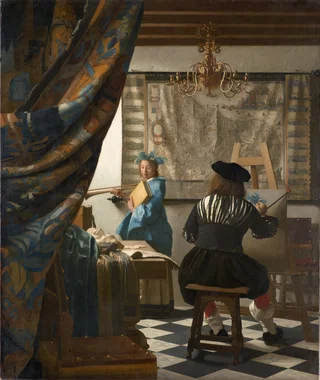
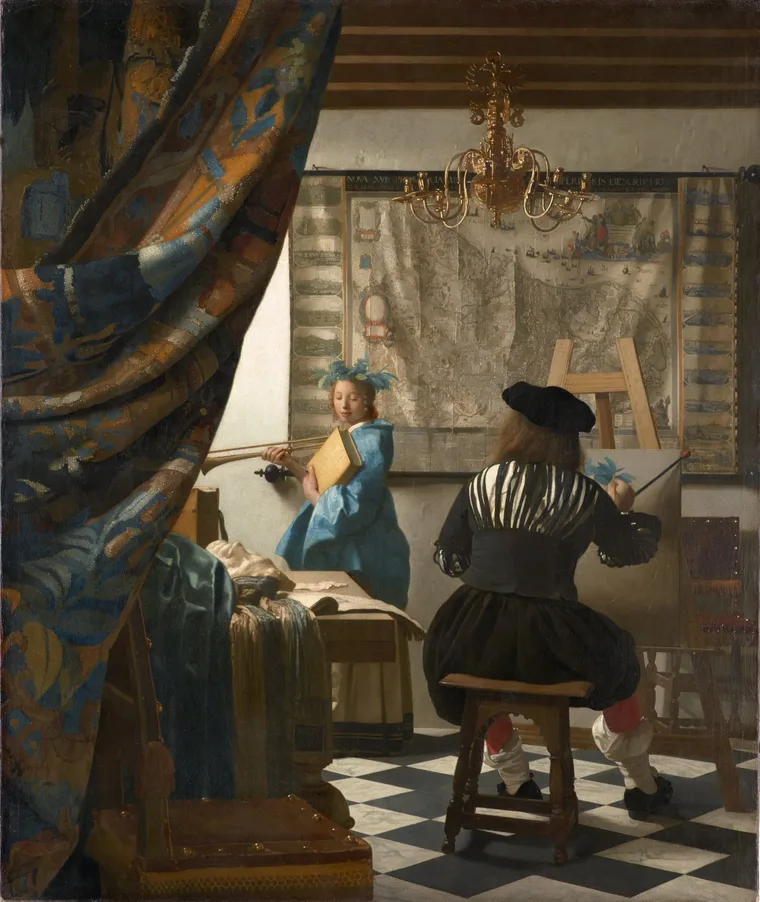
In February 1676, two months after Johannes Vermeer's death, his widow Catharina Bolnes handed The Art of Painting over to her mother, Maria Thins, a few days before the inventory of the estate was drawn up. Vermeer had died in Delft in debt, and this was an attempt to keep the painting out of the creditors' reach. In the autumn of that year the naturalist Antonie van Leeuwenhoek, known for his microscopes, was appointed trustee of the insolvent estate. He took the painting, Maria Thins protested, and on 15 March 1677 it was sold at auction at the Delft Guild of Saint Luke. The buyer's name has not survived in the documents.
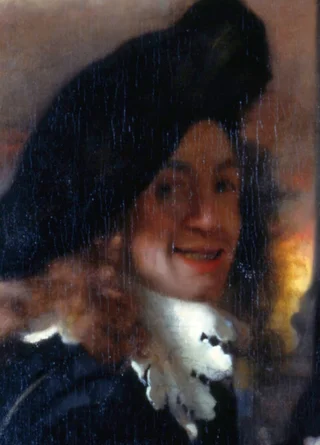
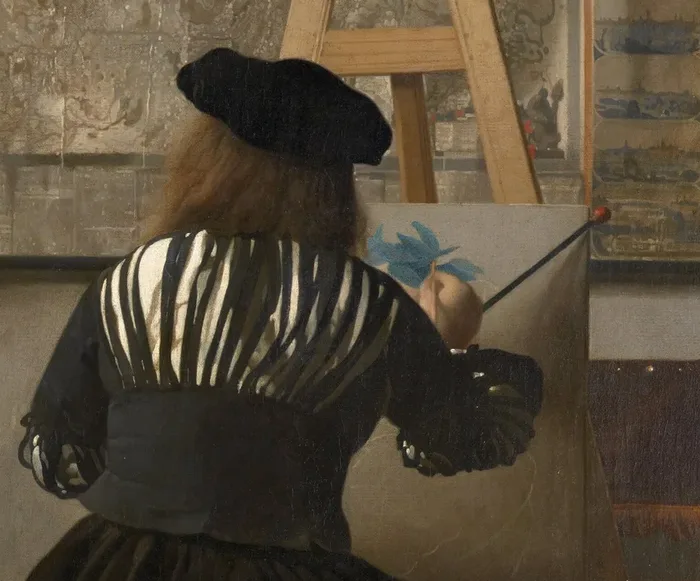
A heavy tapestry curtain is drawn back on the left, and behind it a studio opens up. The painter sits with his back to us, in a black beret, a black doublet with slashes showing white beneath, and red stockings, and his face stays hidden. So far only the blue leaves of the model's laurel wreath are painted on his canvas. The model stands by the window as Clio, the muse of history, wearing a wreath and holding a long brass trumpet and a thick yellow book, with her eyes lowered. On the back wall hangs a large map of the Seventeen Provinces, that is, the Netherlands before their division, creased, with a vertical fold down the middle, and from the ceiling hangs a brass chandelier without candles, crowned with a double-headed eagle.
The next known owner of the painting, Gottfried van Swieten, a diplomat and prefect of the court library, lived in Vienna at the end of the 18th century, and historians explain in different ways how it came to him. In the early 19th century Count Johann Rudolf Czernin bought it from his estate as a work by Pieter de Hooch, and around 1860 the connoisseurs Thoré-Bürger and Gustav Waagen gave it back to Vermeer. In 1940 Jaromir Czernin sold the painting to Hitler for 1.65 million Reichsmarks for the museum planned in Linz. Czernin's heirs later argued that the sale had been made under duress. In 2011 Austria's restitution board unanimously found no grounds to regard it as coerced.
In 1945 the American army found the painting in the salt mine at Altaussee, that November it was handed over to Austria, and in 1946 it came to the museum.
Beyond the list
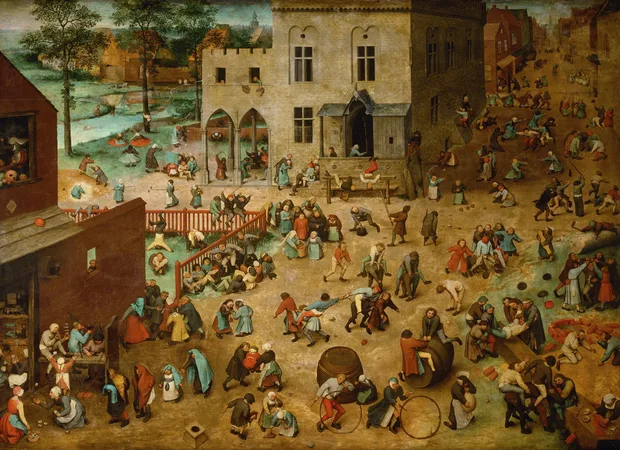
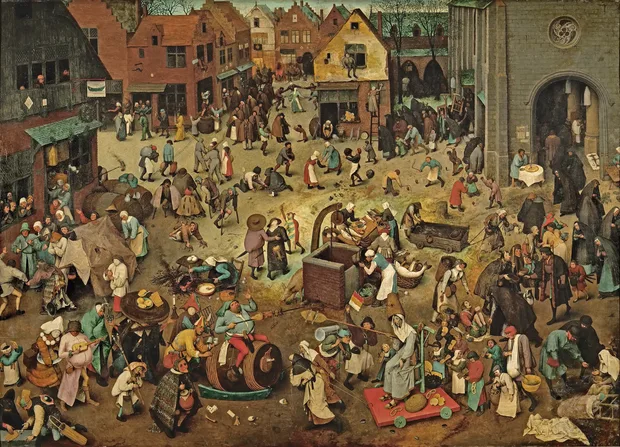
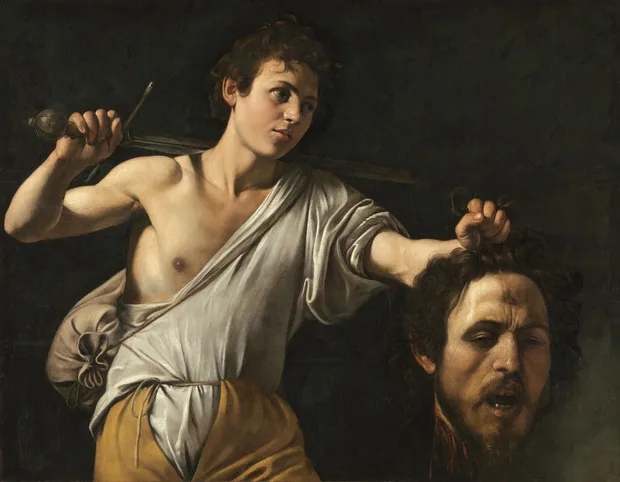
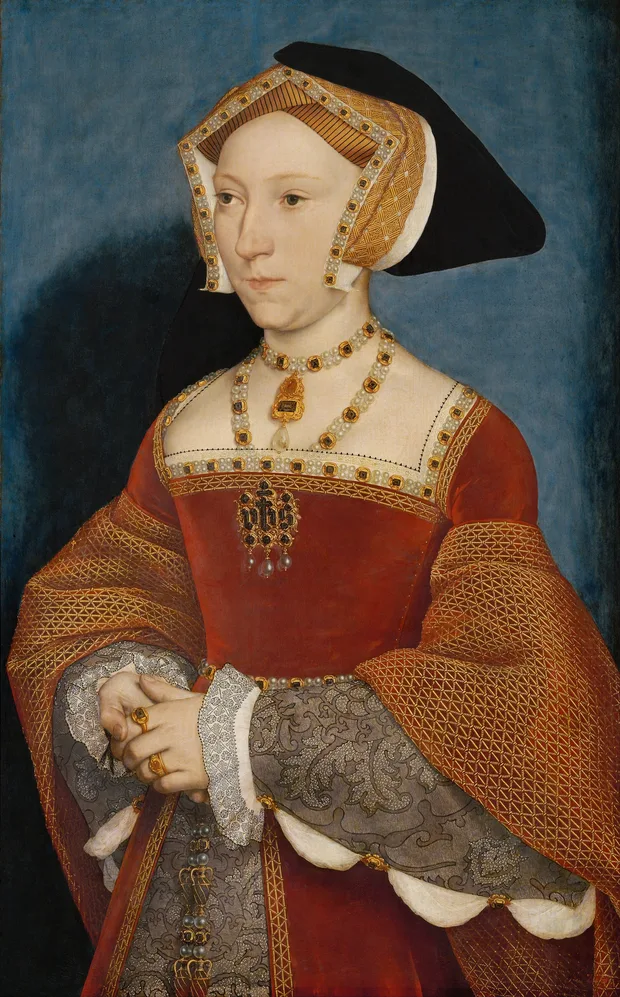
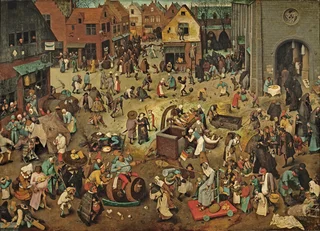
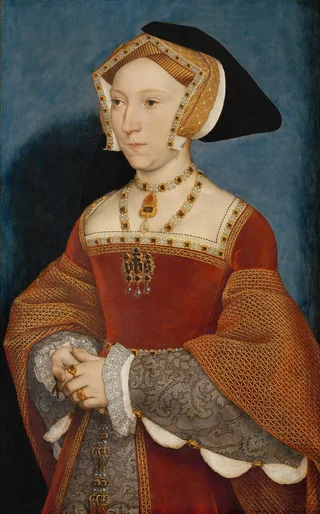
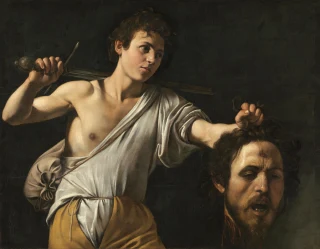
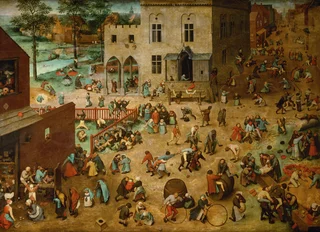
We chose works through which one can trace how the Vienna collection came together, from the gifts and purchases of the Habsburgs to acquisitions made after the end of the empire. For two of the paintings, Rembrandt's self-portrait and Rubens's Het Pelsken, part of that route is lost. Left out of the list are Brueghel's Children's Games and The Fight Between Carnival and Lent, Caravaggio's David with the Head of Goliath, Holbein's portrait of Jane Seymour and Titian's Girl in a Fur, on which Rubens modelled his own Het Pelsken. On a second visit to the museum it is worth starting with the Kunstkammer, where besides Cellini's salt cellar you will find the Krumau Madonna and the vessels Charles IX gave along with the salt cellar. The Gemma Augustea, a cameo for which Rudolf II paid 12,000 ducats, is in the Collection of Antiquities.