Berlin Painter
Ancient Greece · Archaic Greek art, Classical Greek art
The story
In 1911 a young Oxford scholar, John Beazley, published an article about a painter who had never signed a single vase. He named him after a large lidded amphora in the Berlin museum, and it was among the first of his identifications. Beazley went on to sort thousands of Athenian vases by the way their painters drew eyes, ankles and the folds of clothing, and the names he coined are still in use.
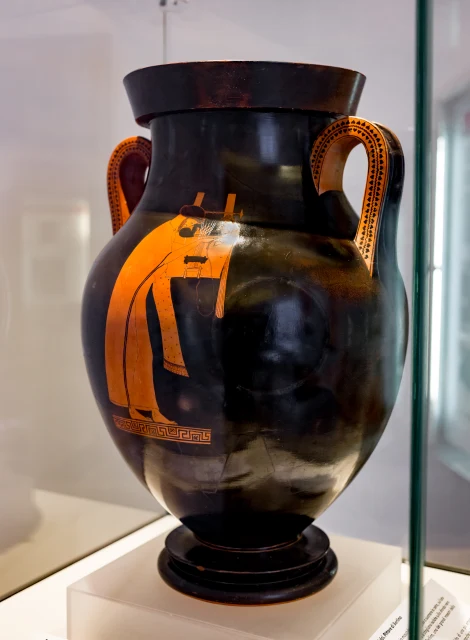
On that amphora Hermes strides along with a wine cup and his herald's staff, a satyr holding a lyre stands before him, and a fawn looks up between them. There is no frame around the group and no line for it to stand on, only the figures against the glossy black. One or two figures alone on a dark field, often rising over the shoulder of the vase, became the mark of his work.
He was active in Athens from about 505 BC into the 460s, through the years of the Persian Wars, and more than 400 vases and fragments are attributed to him. Most were found in Italy, in Etruscan tombs at Vulci and in Greek cities of the south such as Nola and Locri, so much of what he painted seems to have been made for buyers overseas. He also decorated prize amphoras for the Panathenaic games in Athens, the only vases he painted in the older black-figure technique.