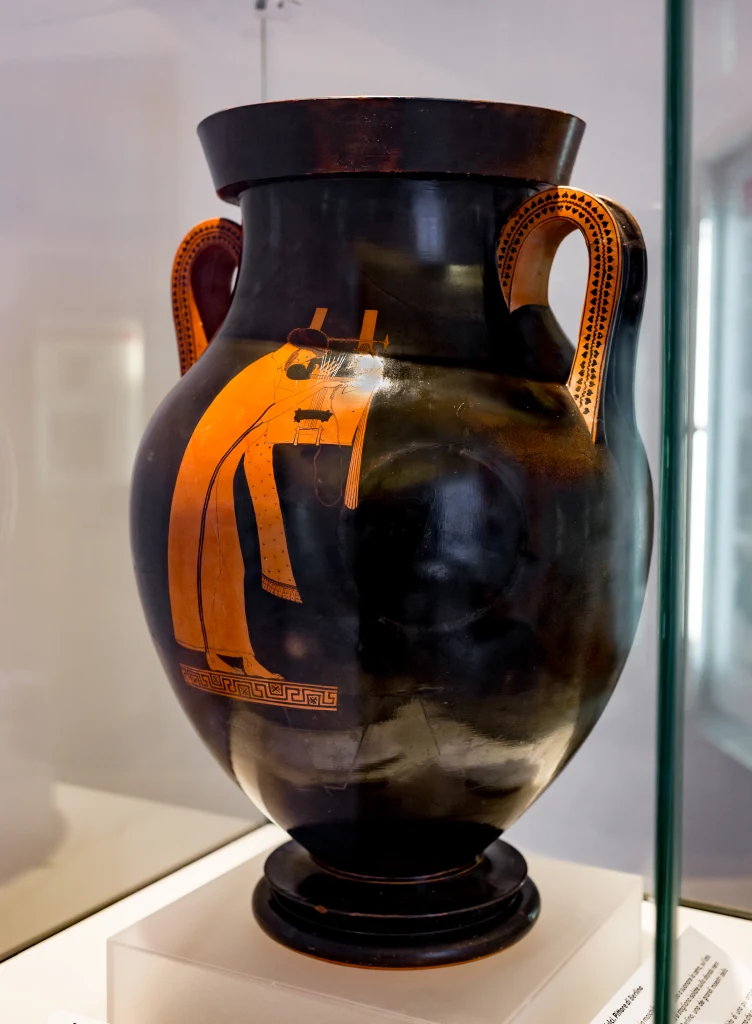
Amphora with a Kithara Player and a Listener
Details
The story
On 21 February 2006 the director of the Metropolitan Museum of Art in New York, Philippe de Montebello, signed an agreement in Rome with the Italian Ministry of Culture. The museum gave up title to six antiquities whose acquisition Italy had contested, while the agreement recorded that the Met had bought them in good faith, and Italy promised long-term loans of comparable works in return. Two of the best-known pieces, a krater and a set of Hellenistic silver, were allowed to stay in New York for a few more years. The rest were to go back as soon as possible.
This amphora was one of them. The Met had acquired it in 1985, and the inventory number it carries at the Villa Giulia today, MET 3, still records those years. The museum's label gives Vulci, the Etruscan city north of Rome, as its origin.
It was painted in Athens around 490 BC by the Berlin Painter. On one side a man in a long robe plays the kithara, the large lyre of professional musicians. On the other a young man wrapped in a cloak stands holding a staff and listens.