Franz Xaver Messerschmidt
1736–1783 · Holy Roman Empire · Neoclassicism, Baroque
The story
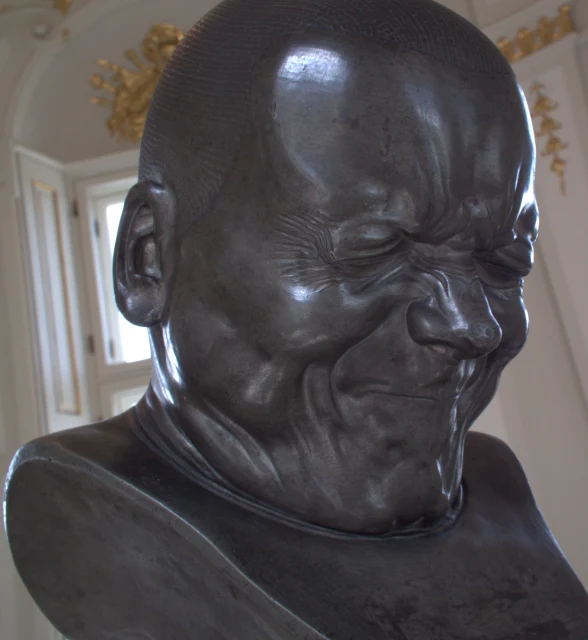
In 1781 Friedrich Nicolai, a Berlin publisher and a leading voice of the German Enlightenment, visited a sculptor in Pressburg, today's Bratislava. He found Franz Xaver Messerschmidt among dozens of heads in metal and alabaster, each pulling a different face. Nicolai wrote that the artist modelled them on his own face in a mirror, pinching himself to provoke the grimaces, and that he told of spirits that troubled him. It is the only contemporary account of how the heads were made.
The man Nicolai met had been a star of imperial Vienna. Trained by his uncles, the Straub family of sculptors, Messerschmidt made the fire-gilded statues of Empress Maria Theresa and her husband Franz Stephan, and portrayed scholars and doctors, among them Franz Anton Mesmer, the physician of animal magnetism. In 1774 the Vienna Academy passed him over for a professorship, and he soon left the capital for good.
He worked on the heads from about 1770 until his death in 1783. Some 69 were found in his studio. In 1793, 49 were shown in Vienna under names he never gave them, such as The Yawner and A Hypocrite and Slanderer. In 1932 the art historian and psychoanalyst Ernst Kris read the heads as symptoms of mental illness, and that reading dominated the 20th century.
The Belvedere's 2025 exhibition set it aside. Its curators placed the heads among the 18th century's own studies of facial expression, next to the prints of William Hogarth, the English satirist, and presented Messerschmidt as a court artist responding to a changing society. The Belvedere owns 16 of the heads, and eight of them were shown there.