Giambologna
1529–1608 · Habsburg Netherlands, Grand Duchy of Tuscany · Mannerism
The story
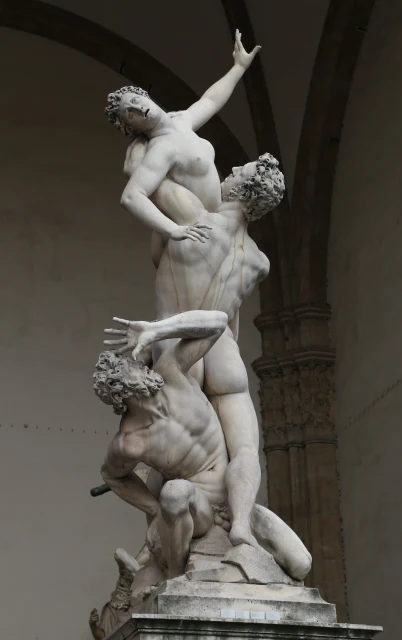
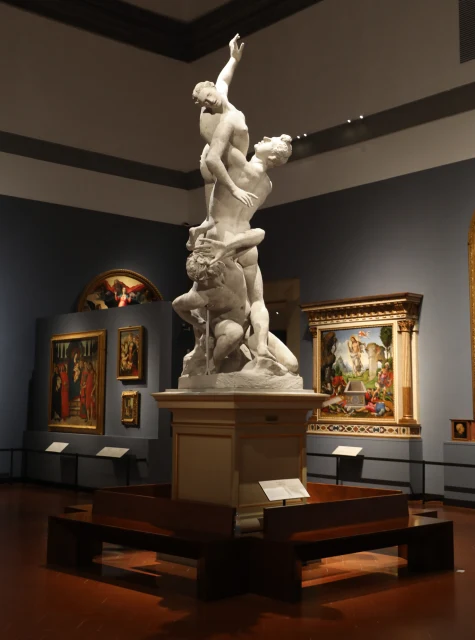
In the first hall of Florence's Accademia Gallery, just before the corridor that leads to Michelangelo's David, stands a tangle of three bodies more than four metres high, built of unfired clay packed with straw over a frame of wood and metal. It is Giambologna's full-size model for the marble Rape of the Sabine Women, which still stands in the Loggia dei Lanzi, the open arcade on Florence's main square. He modelled it around 1579 without a commission and without a fixed subject, as a study in making three figures spiral upward so that no single viewpoint shows everything. The ancient Roman story was attached to it afterwards, and the marble, carved from one block, was unveiled in 1583.
Florence's leading sculptor after Michelangelo came from Flanders. Jean de Boulogne was born in Douai in 1529 and went to Rome as a young man. The biographer Filippo Baldinucci tells a story, probably polished in the retelling, that he showed the elderly Michelangelo a carefully finished wax model, and the old master crushed it, reshaped it and told him to learn to model before learning to finish. On his way home he stopped in Florence, found a patron in the collector Bernardo Vecchietti, and stayed for the rest of his life.
He went on to serve three Medici grand dukes. His Neptune fountain in Bologna, the bronze Mercury poised on one foot now in the Bargello museum, and the equestrian statue of Cosimo I in Piazza della Signoria made his name, and small bronze versions of his figures were sent by the Medici as diplomatic gifts to courts across Europe. He died in Florence in 1608 and is buried in the church of Santissima Annunziata, in a chapel he designed for himself.