Giovanni di ser Giovanni Guidi
1406–1486 · Republic of Florence · Italian Renaissance, Florentine school
The story
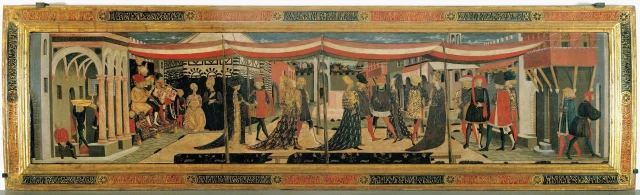
A long panel in the Galleria dell'Accademia shows a Florentine party in the open air. Couples in rich clothes dance hand in hand under a striped canopy, musicians blow long trumpets, and behind them rises the green and white marble of the Baptistery. For a long time it was called the Cassone Adimari and tied to the 1420 wedding of Boccaccio Adimari and Lisa Ricasoli. Scholars now doubt both halves of that name. The marriage may be a later one, and the panel may have been a spalliera, a painted board set into the wall of a bedroom.
Its painter was Giovanni di ser Giovanni Guidi, nicknamed Lo Scheggia, the splinter. He was the younger brother of Masaccio, born in 1406 in San Giovanni Valdarno, and he was barely 22 when Masaccio died in Rome in 1428. Scheggia trained in the busy shop of Bicci di Lorenzo, opened his own workshop in 1429, and spent a long career on the luxury furnishings of Florentine homes, painted chests, wall panels and birth trays, the round painted trays given to new mothers.
The best known of those trays was made in 1449 for the birth of Lorenzo de' Medici, later called the Magnificent. It shows the Triumph of Fame, and the inventory taken at Lorenzo's death in 1492 records it in his own rooms in the Medici palace. Today it is in the Metropolitan Museum of Art in New York. Scheggia lived to about 80 and was buried in Santa Croce in 1486.