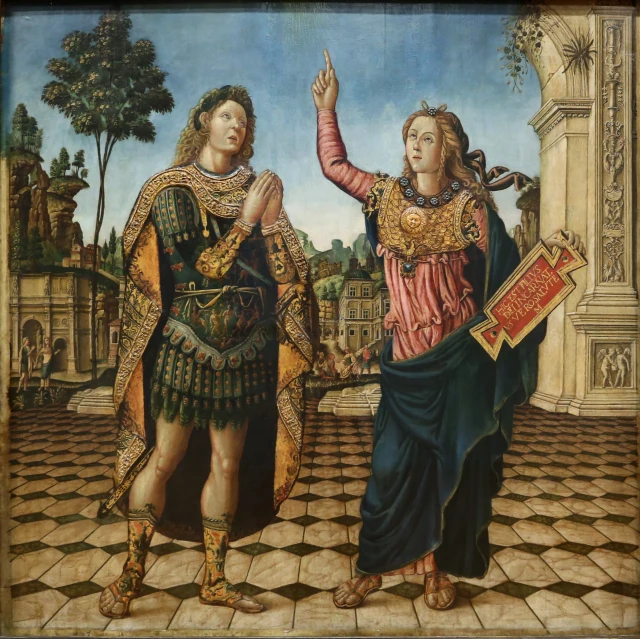
Giovanni Maria Falconetto
Republic of Venice · Renaissance, Veronese school
The story
On 8 January 1535 someone in Padua made a list of the few things Giovanni Maria Falconetto had left in the house of his patron, Alvise Cornaro. Among them were drawings, eight of monuments in Verona, four of the Roman town of Pola in Istria, and 20 of Rome. He had died within the previous days or weeks, in his middle sixties.
He was the son of a Veronese painter, and in the 1490s he spent some time in Rome studying the ancient ruins, a stay the biographer Giorgio Vasari later stretched to 12 years. Back home he painted chapels and the frescoed settings of two altars in Verona Cathedral. While Emperor Maximilian held Verona, Vasari says, Falconetto painted the imperial arms on the city's public buildings and then had to flee when Venice took the city back in 1517. Documents place him in Verona in 1517 and 1518 all the same.
His second career began in Padua, where Cornaro, a rich landowner who later wrote a much-read treatise on the sober life, took him into his house. In 1524 Falconetto signed and dated a loggia in Cornaro's courtyard in the form of an ancient Roman arcade. He went on to design city gates, and Porta San Giovanni of 1528 and Porta Savonarola of 1530 still stand in the walls of Padua.