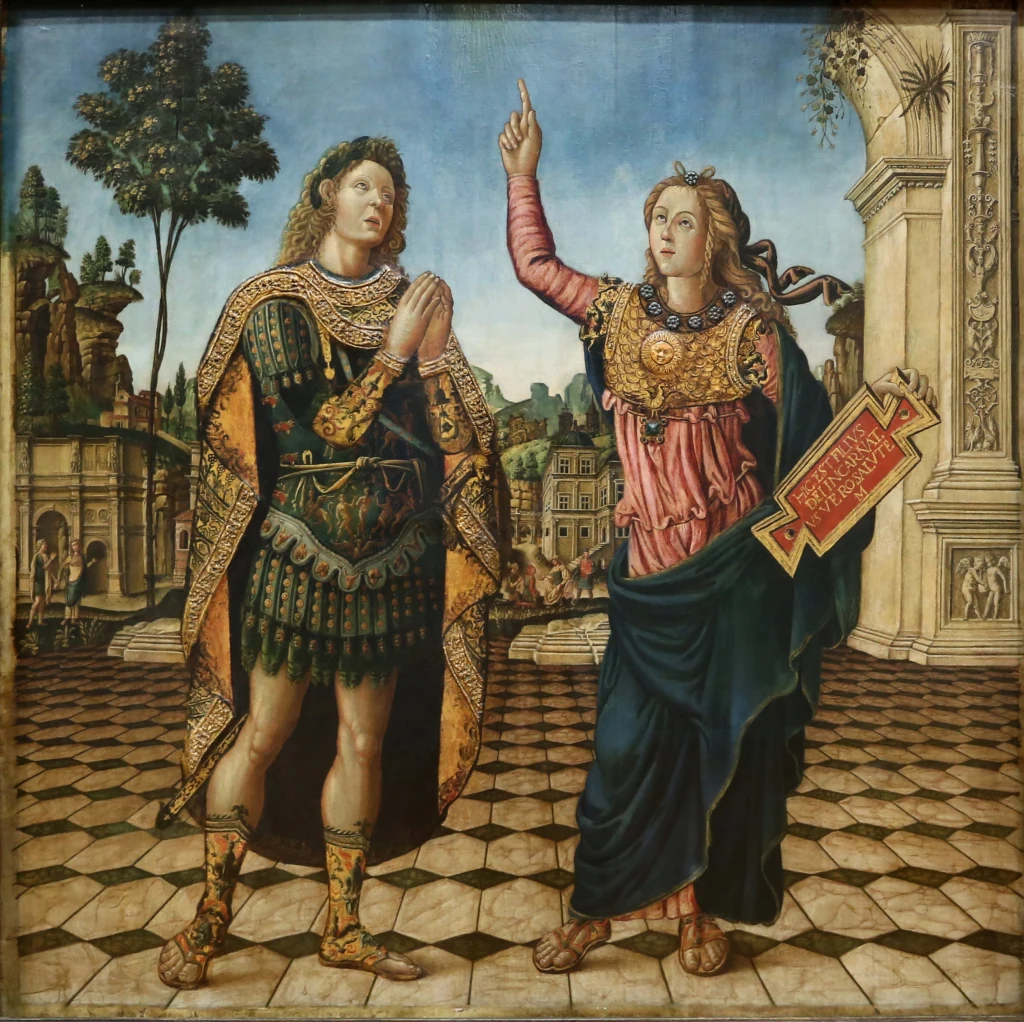
Augustus and the Sibyl
Details
The story
A medieval legend, retold in the Golden Legend, the widely read 13th-century book of saints' lives, says the Roman Senate wanted to worship the emperor Augustus as a god. Augustus asked the Sibyl of Tibur, a prophetess, whether anyone greater would ever be born. On the day of Christ's birth she showed him a vision in the sky, a young woman holding a child above an altar, and a voice declared it the altar of the Son of God. The church of Santa Maria in Aracoeli on Rome's Capitoline Hill was said to stand where Augustus then raised an altar of his own.
Falconetto painted the scene around 1520 for the convent of the Santissima Trinità in Verona, and it is one of his rare panel paintings. The museum sees in it a culture still bound to Gothic habits, close to the late work of the Veronese painter Liberale, together with the interest in archaeology and the theatre that runs through all of Falconetto's work. The figures stand as if on a stage, with classical buildings behind them. In 1511 Fra Giocondo, a Veronese friar and architect, had published in Venice the first illustrated edition of Vitruvius, the Roman writer on architecture, and artists were trying to picture what an ancient stage had looked like. In 1940 the art historian Roberto Longhi denied the panel to Falconetto, and the museum still gives it to him.