Jacob Ochtervelt
1634–1682 · Dutch Republic · Dutch Golden Age
The story
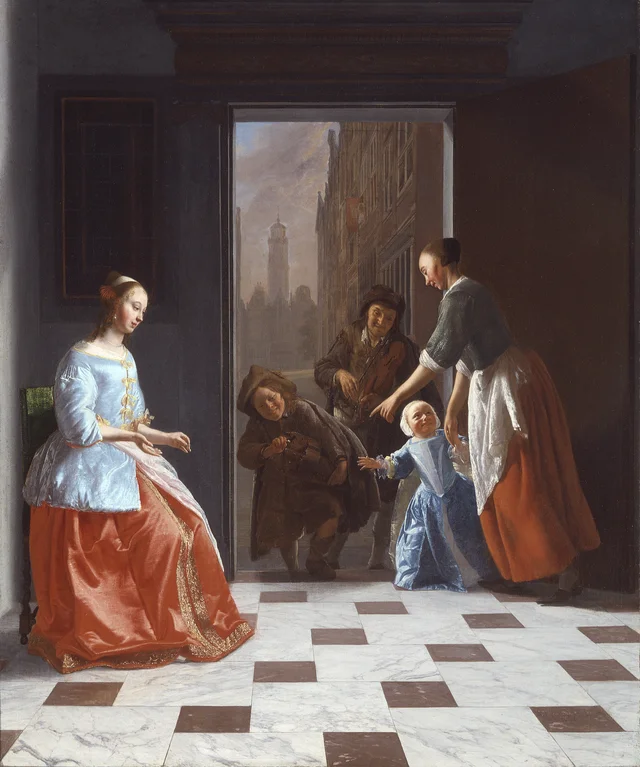
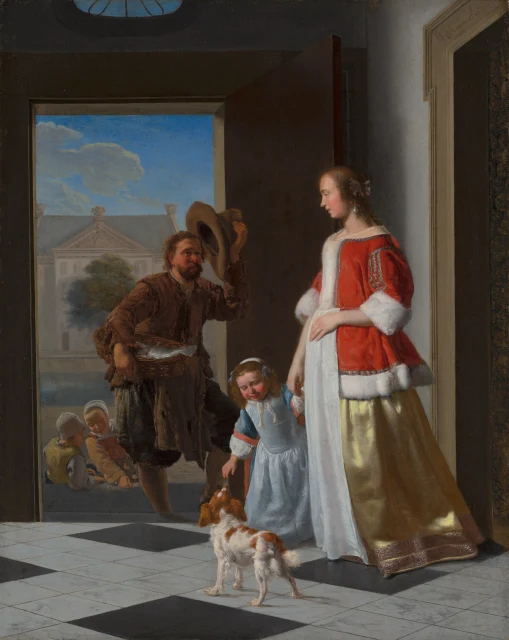
Jacob Ochtervelt found a small corner of Dutch painting and made it his own: the front hall of a wealthy house, seen from inside, with the street door standing open. In these 'entrance-hall' scenes a well-dressed family meets whoever has come to the threshold, and the outside world is allowed a few feet into a place of marble floors and silk.
His best-known example, 'Street Musicians at the Door' from about 1665, sets two ragged musicians on the step while the household children look out. The gap between the family's satin and the players' worn clothes is the whole subject, laid out without a sermon. Ochtervelt worked mostly in Rotterdam, in the same generation as Vermeer and Pieter de Hooch, and like them he loved the fall of daylight across a tiled floor.
He painted silks and satins with a polish that matched his finest rivals. After 1672, the disaster year when a French invasion wrecked the Dutch economy, he moved to Amsterdam, where the money for such refined pictures was drying up. He was buried there in 1682. His name faded so completely that for centuries some of his best paintings hung under other artists' signatures.