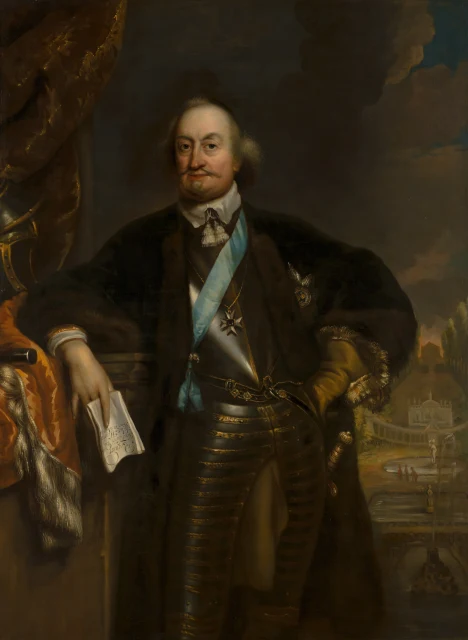
Jan de Baen
1633–1702 · Dutch Republic · Dutch Golden Age painting
The story
In 1667 the Dutch fleet sailed up the Medway in England, burned English warships and towed away the flagship Royal Charles. The town council of Dordrecht wanted its own man, Cornelis de Witt, who had gone with the fleet as the government's representative, honoured for it, and it turned to Jan de Baen, a portrait painter in The Hague. His allegory of de Witt as the man behind the victory was hung in the Dordrecht town hall in 1670. Two years later, in the disaster year 1672, a mob pulled it off the wall and tore the canvas apart, and that summer Cornelis and his brother Johan were lynched in The Hague. A small, grim picture of the brothers' bodies, now in the Rijksmuseum, is usually attributed to de Baen.
He was born in Haarlem in 1633, lost his parents young and was raised by an uncle in Emden, who gave him his first lessons. After training in Amsterdam with the painter Jacob Backer, he settled in The Hague and spent the rest of his life painting the powerful. He turned down an invitation to the Brandenburg court in Berlin, and was buried in The Hague on 8 March 1702.