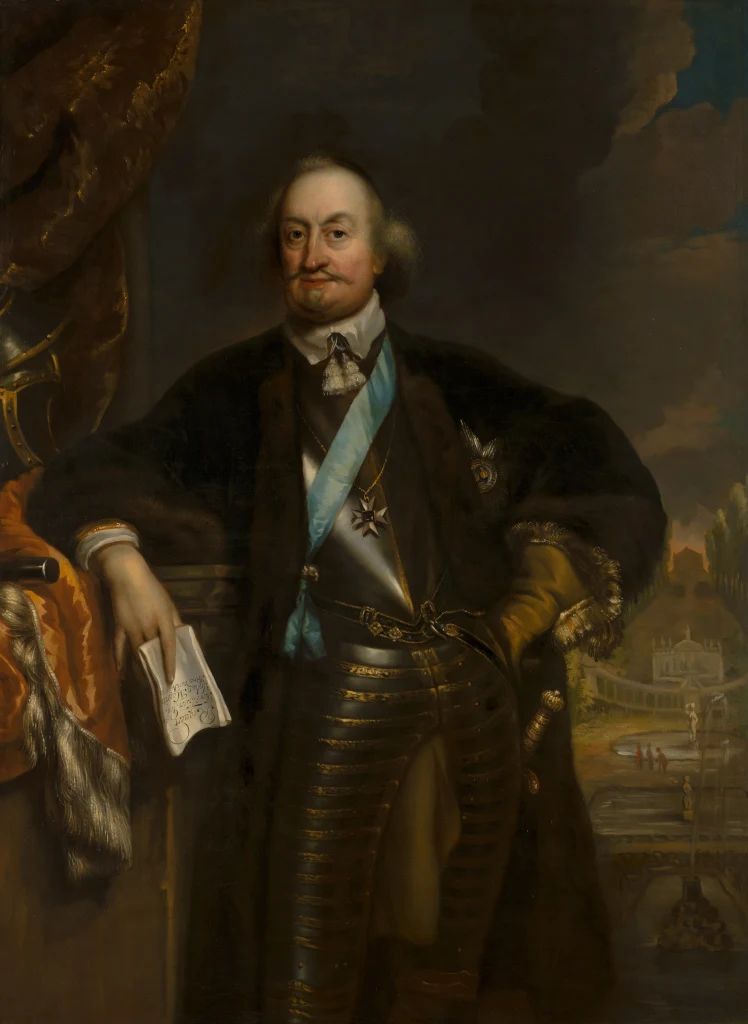
Portrait of Johan Maurits (1604-1679), Count of Nassau-Siegen, Founder of the Mauritshuis
Details
The story
Jan de Baen painted Johan Maurits of Nassau-Siegen around 1668 to 1670, when the count was in his mid-sixties. His years as governor of Dutch Brazil lay a quarter of a century behind him, and he now governed Cleves, just over the German border, for the Elector of Brandenburg. That is where this portrait was made, and the park behind him is the garden he laid out there. He stands in armour under a fur-lined cloak, one arm resting beside a helmet and a commander's baton. In his hand is a folded paper, a petition addressed to His Princely Grace Johan Maurits, Prince of Nassau, a title he had held since the Emperor made him a prince in 1652. The museum says the portrait shows exactly how he wanted to be remembered, and that this image of power left his part in the slave trade in the shadow for centuries. The canvas is one of the few in the Mauritshuis still in its original 17th-century frame. King William I bought it in 1820 for the house Johan Maurits had built, which opened as a museum two years later.