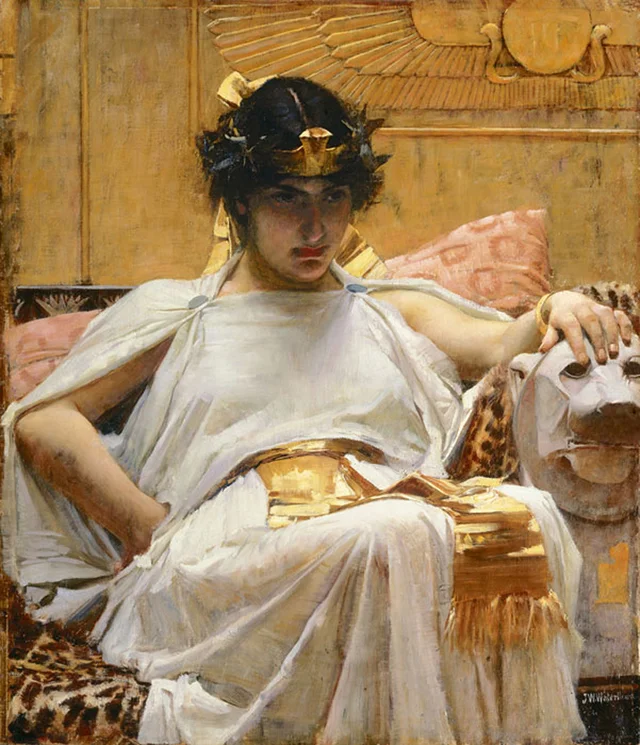
John William Waterhouse
1849–1917 · United Kingdom of Great Britain and Ireland · Pre-Raphaelite Brotherhood
The story
A young woman sits alone in a boat among the reeds, loosing the chain that holds it, her lips parted on the last notes of a song. This is Waterhouse's 'The Lady of Shalott' of 1888, taken from Tennyson's poem about a woman under a curse who may only see the world through a mirror, and who dies the moment she turns to look straight at the knight Lancelot and drifts downriver toward Camelot.
Waterhouse painted it in a Pre-Raphaelite spirit, all bright detail and literary yearning, even though the original Pre-Raphaelite Brotherhood had broken up around the time he was born. He belongs to a later Victorian generation that revived their look. Small clues carry the story: three candles at the boat's prow, two of them already blown out.
He came back to the Lady of Shalott twice more, in 1894 and 1915, painting the tale roughly backward through its scenes. The 1888 canvas was bought for the nation almost at once and hangs today in Tate Britain in London.