Juan de Espinosa
Spain · Baroque
The story
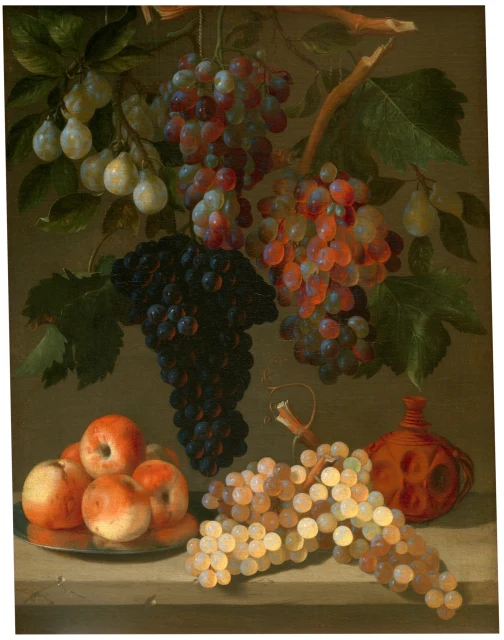
In 1872 the Prado catalogued a still life of grapes, apples and plums under the name Juan de Espinosa. Pedro de Madrazo, who wrote that catalogue, recorded a signature on the canvas. Nobody has been able to read it since.
That is roughly the shape of everything known about the man. His name turns up beside other Madrid painters in documents of 1628 and 1659, and there the record stops. No birth year, no death year, no workshop. At least three 17th-century Spanish painters were called Juan de Espinosa, and sorting their pictures out from one another is still unfinished work. The separation was proposed in 1983 by Alfonso Pérez Sánchez, an authority on Spanish Golden Age painting who became director of the Prado that same year, and reworked two years later by the American scholar William Jordan. It is the accepted position today. Ismael Gutiérrez Pastor, who accepts it himself and has published on these homonymous painters, wrote that the problem is still far from a definitive solution.
What survives is a small body of still lifes, fruit above all, and grapes more than any other fruit. One of them hangs in the Louvre, near enough to the Prado picture in size and arrangement to have been painted as its companion, and that one is signed.