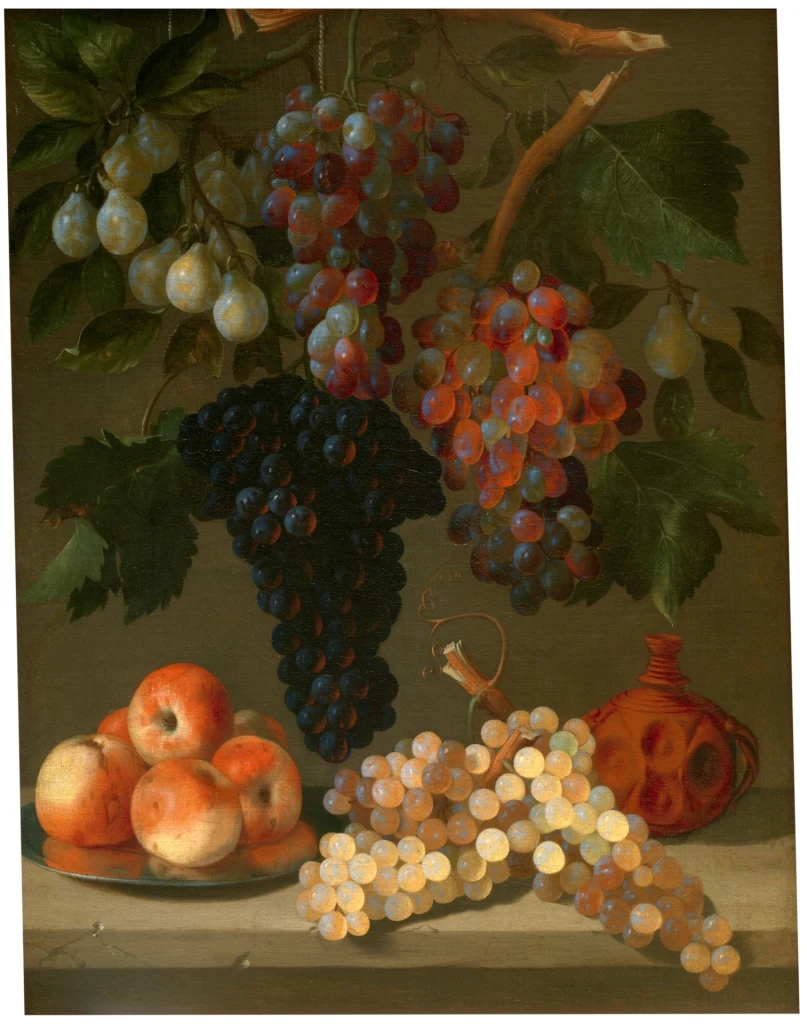
Still Life with Grapes, Apples and Plums
Details
The story
The red jar at the right of this picture is a búcaro, unglazed clay shipped into Spain from Tonalá in New Spain, near what is now Guadalajara in Mexico. The porous body cooled the water kept in it and gave it a scent, and fashionable women at the Madrid court chewed fragments of the pottery, which was believed to pale the complexion. A painter working in Madrid around 1630 could set one on a ledge and be understood at once.
Very little else here is fixed. The museum dates the canvas to about 1630 with no document behind the guess, and the first certain record of the picture comes in 1745, when it hung in the country house of Philip V outside Madrid. The painter has no birth year and no death year. His name turns up in Madrid papers of 1628 and 1659, and at least three Spanish painters of the 17th century were called Juan de Espinosa, whose works are still being separated from one another. The attribution here rests on a signature read on the canvas in 1872 and illegible ever since, and on a nearly matching still life that the Louvre bought in 1973, which is signed.
Six apples lie on a metal plate below, and the grapes hang from cords, the way Sánchez Cotán had suspended quinces in a window frame a generation earlier.