Marcello Venusti
1510–1579 · Duchy of Milan · Mannerism
The story
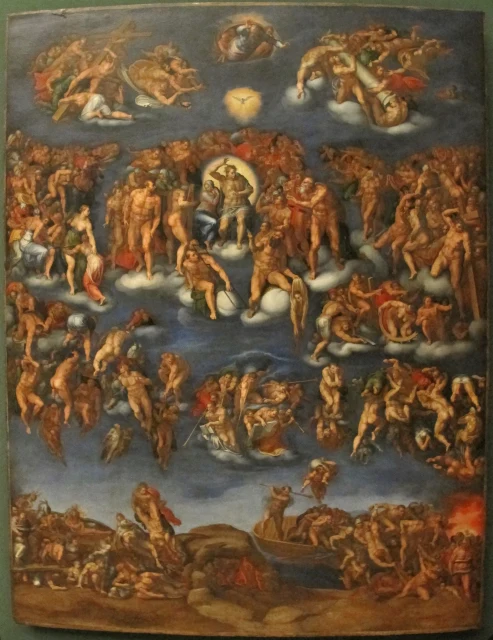
On 5 August 1542, Nino Sernini, the Rome agent of Cardinal Ercole Gonzaga of Mantua, sent the cardinal a piece of news. He had come across a young Mantuan copying the Last Judgment, the vast fresco Michelangelo had unveiled in the Sistine Chapel the previous autumn. Michelangelo himself, Sernini wrote, said he knew no young man of that age to equal him, and that he would become a great man. The copyist was Marcello Venusti. He came from the Valtellina, an Alpine valley in Lombardy, trained in Mantua, and worked under Perino del Vaga, once Raphael's assistant, whom he followed to Rome in the late 1530s.
Venusti stayed in Michelangelo's orbit for the next two decades. From the mid-1540s he turned Michelangelo's drawings into small, carefully finished paintings of religious scenes. The Purification of the Temple in London's National Gallery is one of them. Michelangelo left only quick sketches of Christ driving out the traders, and Venusti built the finished picture around them, adding a setting of twisted columns. The trust ran both ways. Venusti named his first son Michelangelo, and the older artist held the boy at his baptism. In 1553, when frescoes by Daniele da Volterra, another painter in Michelangelo's circle, had to be valued at the church of Trinità dei Monti, Michelangelo declined the task and Venusti went in his place.
His best-known picture is a copy. In 1549 Cardinal Alessandro Farnese, grandson of the reigning Pope Paul III, paid Venusti for a painted version of the Last Judgment. After Michelangelo's death in 1564, Daniele da Volterra was hired to paint draperies over many of the naked figures in the fresco, and the Farnese copy, now in the Capodimonte museum in Naples, still shows them as Michelangelo left them.