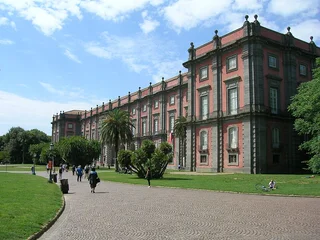
The palace on the Capodimonte hill, above Naples, was built to house pictures. Charles of Bourbon, King of Naples, had inherited the collection of the Farnese family and from 1735 was moving it south from Parma, and on 10 September 1738 work began on the foundations of the palace on the hill, to designs by the architect Giovanni Antonio Medrano. The first pictures were hung in its rooms around 1758, and in 1759 Charles left to become King of Spain, leaving the collection in Naples to his son, Ferdinand IV.
In December 1798 Ferdinand fled from the French to Palermo, and some of the pictures went there with the court. In 1799 French troops carried off part of what remained. After the Napoleonic years the collection was moved down from the hill into the city, to the Palazzo degli Studi, where the Real Museo Borbonico opened (the building now houses the Archaeological Museum), and the palace became a royal residence. Under the House of Savoy, in 1862–1864, about 900 pictures were brought back up the hill, and the rest of the pictures in the city museum followed in 1957, when the national museum opened at Capodimonte.
We begin with a family portrait that Titian never finished for Pope Paul III Farnese, and end with a painting by Caravaggio that the museum has kept since 1972, although it belongs to another state body.
Rome: a pope's family and its librarian (1545–1600)
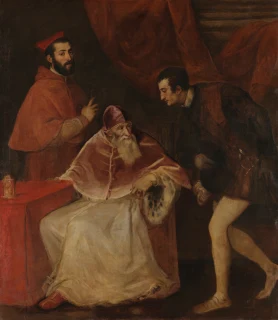
1. Pope Paul III and His Grandsons Alessandro and Ottavio Farnese — Titian, 1545–1546
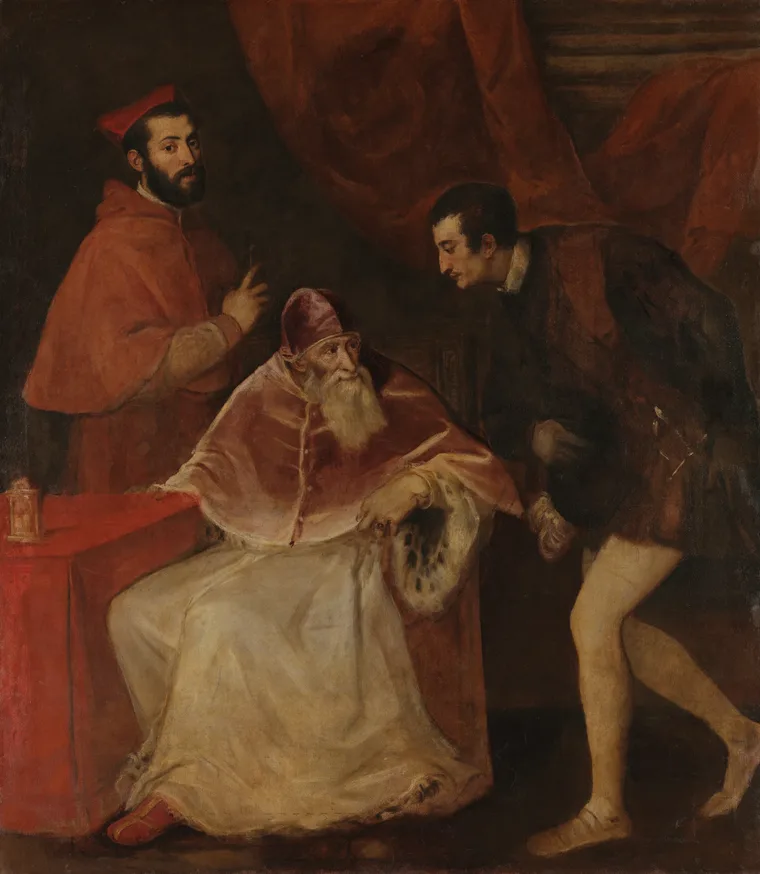
Pope Paul III was 77 when Titian painted him in Rome with two of his grandsons. On the left, behind the chair, stands Cardinal Alessandro Farnese, who received his cardinal's hat at 14, in 1534, the year his grandfather became pope. Leaning towards Paul is the younger brother, Ottavio, married since 1538 to Margaret of Austria, the illegitimate daughter of the Emperor Charles V. In August 1545 their father, Pier Luigi, the pope's son, became Duke of Parma and Piacenza.
Titian came to Rome in the autumn of 1545 at Cardinal Alessandro's invitation. He was born, probably around 1489, at Pieve di Cadore, trained in Venice in the Bellini workshop, then took up the manner of Giorgione, and by the 1540s he was the most sought-after portraitist in Europe, working for Charles V and for the pope at the same time. This was his first and only visit to Rome. Vasari and the Venetian painter Sebastiano del Piombo showed him the city and its antiquities, and on 19 March 1546 Rome made him a citizen. He had also come on business: he wanted church revenues, benefices, for his son Pomponio.
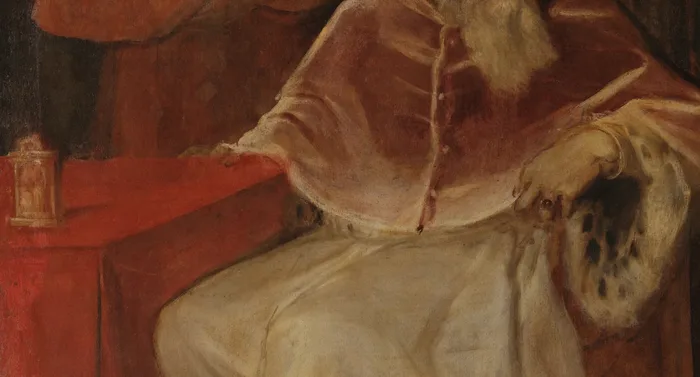
Paul sits in the centre in a high-backed chair, small and hunched, with a long white beard, wearing a crimson velvet cap, the camauro, and a short red cape, the mozzetta. He has turned his head towards Ottavio and looks up at him sidelong. Alessandro looks straight out at the viewer, his right hand raised beside the very top of the chair back, the index finger pointing upward. Ottavio has stepped towards his grandfather and bent one leg as if about to kneel. Titian painted the pope's face and beard, and his left hand with its ring hanging over the armrest, finely and in detail. The pope's right hand on the edge of the red table is only sketched in with thin brown strokes, and Ottavio's legs, the pope's white robe and the tablecloth are laid in just as broadly and quickly.
Historians explain in different ways why the portrait was left unfinished. Roberto Zapperi, in a book of 1990, reads it as a state portrait about who in the family would inherit power, and believes that while Titian was working, Farnese policy swung away from the emperor towards France and the picture was no longer needed. Others connect it with the benefices. In March 1546 Pomponio was granted a benefice near Venice and never obtained the richer abbey near Serravalle. Some think Titian left because he had got what he came for, others that he left once he saw he would get no more.
The unfinished portrait stayed with the family. Until the middle of the 17th century it was in Palazzo Farnese in Rome. Before 1680 it was moved to Parma, to the Palazzo del Giardino, and later to the ducal gallery in the Pilotta palace. In 1731 the last Farnese Duke of Parma, Antonio, died childless, and his heir was his niece Elisabetta Farnese, the second wife of King Philip V of Spain. Her son Charles of Bourbon received Parma that same year, became King of Naples in 1734 and from 1735 had the Farnese pictures brought south, and later this portrait went to Palermo with the court as it fled the French.
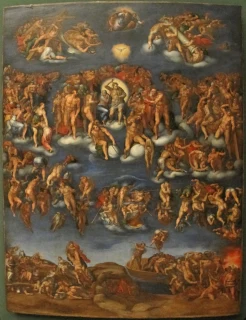
2. The Last Judgement (copy after Michelangelo's fresco) — Marcello Venusti, 1549
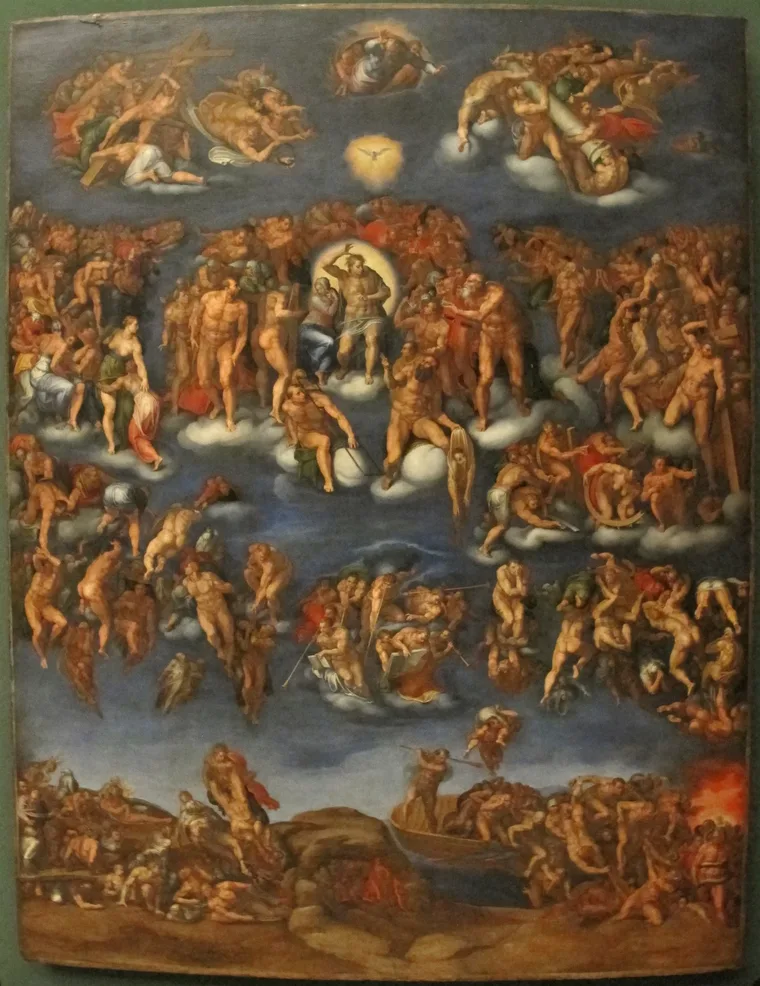
On 5 August 1542 Nino Sernini, the Roman agent of the Mantuan cardinal Ercole Gonzaga, wrote to him that he had come upon a young Mantuan copying Michelangelo's new work in the Sistine Chapel. According to Sernini, Michelangelo said that he knew of no young man of that age who could equal him and that he would become a great man, and Sernini promised to get the cardinal the young man's drawing of Charon's boat. The Mantuan was Marcello Venusti, and Sernini's letter is still the earliest document that connects him with Michelangelo.
Michelangelo's Last Judgement on the altar wall of the Sistine Chapel was unveiled on 31 October 1541. Venusti soon joined his circle, and from the mid-1540s he painted small pictures from Michelangelo's drawings.
In 1549, the last year of Paul III's life, his grandson Cardinal Alessandro Farnese received from Venusti a copy of the whole wall, painted on panel in an oily tempera. Venusti did away with the two semicircular lunettes at the top of the fresco and made the field rectangular, so that the angels with the Cross ended up in the upper left corner and the angels with the Column in the upper right. Between them he added figures that Michelangelo had not painted. At the top God the Father floats in an oval of billowing cloak, below him is the dove of the Holy Spirit in a round yellow glow, and below that is Christ, so the Trinity lines up along the axis of the panel, whereas in Michelangelo's fresco Christ judges alone. The sky above all the figures is an even, deep blue.
In December 1563 the Council of Trent issued its decree on images, and on 21 January 1564 it was decided in Rome to cover the “obscene” passages on the chapel wall. Michelangelo died less than a month later, on 18 February. In 1564–1565 Daniele da Volterra painted drapery over the naked figures. Saint Catherine and Saint Blaise he redid entirely: he hacked off the plaster, painted both figures afresh, dressed Catherine in green and turned Blaise's head upward, towards Christ.
An engraving by Giulio Bonasone from the 1540s and other early copies also show the figures uncovered, but Venusti's panel is the best known of them, a copy in colour made for a patron before the fresco was painted over. According to the restorer Gianluigi Colalucci, who led the cleaning of the fresco, Michelangelo's plaster under Catherine and Blaise no longer exists, and how he painted them is known only from copies. In Venusti's panel a naked Catherine leans forward inside her broken wheel, and behind her, where Blaise stands on the wall, a figure in red bends over and looks down.
3. The Farnese Casket — Manno di Bastiano Sbarri and Giovanni Bernardi, 1540s – c. 1561
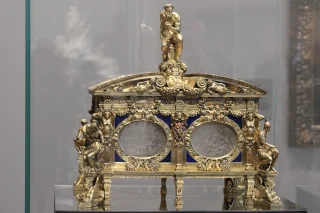
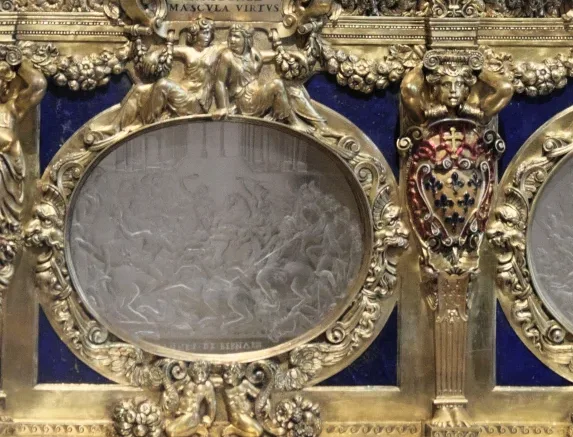
Cardinal Alessandro Farnese's casket is made in the shape of a small building. It is a rectangular box of gilded silver on curved legs, with a cornice and a broken pediment for a lid, and the walls between the gilt frames are filled with blue lapis lazuli. On top, in the break of the pediment, sits a muscular, bearded Hercules with a fruit in his hand. Two ovals of rock crystal are set into the long side, and the battles cut into the clear stone, with horsemen and falling bodies, read as a frosted grey-white drawing. Above the ovals, cartouches carry Latin mottoes, on the lower rim of the left oval the signature “…ANNES·DE·BERNARDI” can be read, and between the ovals an enamel coat of arms hangs on a herm, the six blue Farnese lilies on gold. Above the arms is a red cardinal's hat with tassels, the sign that these are the arms of Cardinal Alessandro himself.
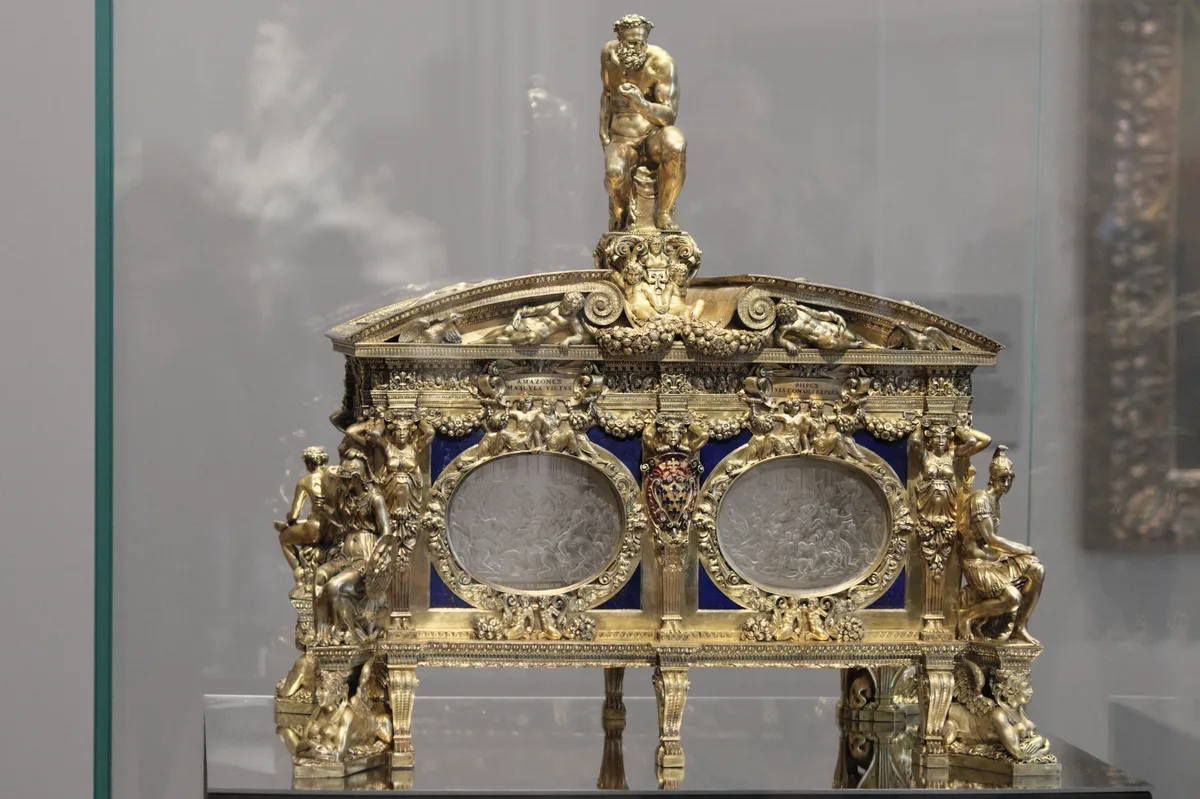
The gem engraver Giovanni Bernardi entered the cardinal's service after 1535, and in letters of 1543 and 1544 he was already reporting to him on the crystal plaques. The first mention of the silverwork by the Florentine goldsmith Manno di Bastiano Sbarri dates from 1548, and the casket was finished around 1561, when Bernardi had been dead for several years. The scenes on the crystals were cut after designs by Perino del Vaga and other masters, as Vasari writes, and Vasari also claims that no other work was ever made with such perfection.
Historians disagree about what the casket was made for. There is no velvet lining inside, and it was apparently never used for jewellery. The museum has suggested that it may have held the book of hours that the miniaturist Giulio Clovio illuminated for the cardinal. According to the museum, in 1565 the cardinal gave the casket as a wedding present to Maria of Portugal, the bride of his nephew Alessandro, the future Duke of Parma, some 20 years after work on it had begun.
In the 19th century the Real Museo Borbonico showed the casket as the work of the goldsmith and sculptor Benvenuto Cellini, whose pupil Sbarri is said to have been. During its restoration in 2018 it was taken apart into every one of its pieces for the first time, and according to press reports the restorers found a hidden lock that opens through a tiny hole in the ornament, and a rolled-up document of 1564 pushed into a cavity in the base. At first it was taken for a message, and it turned out to be plain packing, stuffed in to fill a gap.
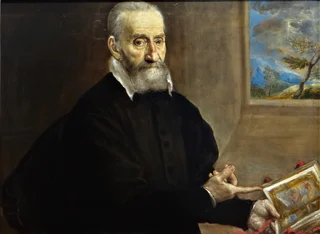
4. Portrait of Giulio Clovio — El Greco, c. 1571
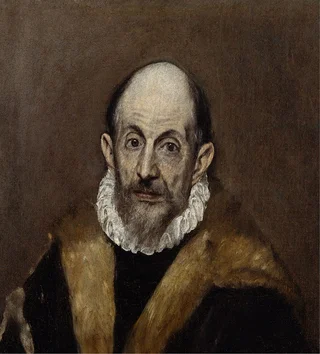
On 16 November 1570 the miniaturist Giulio Clovio wrote to Cardinal Alessandro Farnese that “a young Candiote, a pupil of Titian” had arrived in Rome, who in his judgement was rare in painting and had painted a self-portrait that astonished all the painters of Rome. Clovio asked no money for his keep, only a room in Palazzo Farnese for a while, and he asked the cardinal to tell the majordomo, Count Ludovico, to find him a room upstairs. The Candiote, that is, the man from Crete, was Domenikos Theotokopoulos, who would later be called El Greco.
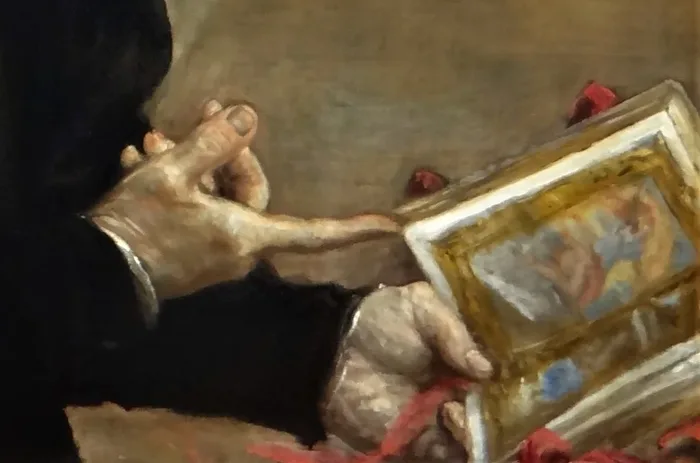
Clovio was born in 1498 in Croatia and from about 1540 lived in Palazzo Farnese as the cardinal's miniaturist, and Vasari called him “a small new Michelangelo”. El Greco painted him as an old man, half-length, on a horizontal canvas. Clovio's body is turned to the right and his head turns back towards the viewer, with white hair, a grey beard, a reddened nose and heavy eyelids. With the index finger of one hand he points to a small, thick book that he holds open towards us with the other, and on its page is a miniature in a broad gold frame, painted in quick strokes. The state catalogue identifies the book as the book of hours that Clovio illuminated for the cardinal and finished in 1546, and that book of hours is in New York, in the Morgan Library. In the upper right corner a window opens onto a stormy sky with a band of light, blue mountains and a slender tree bent by the wind.
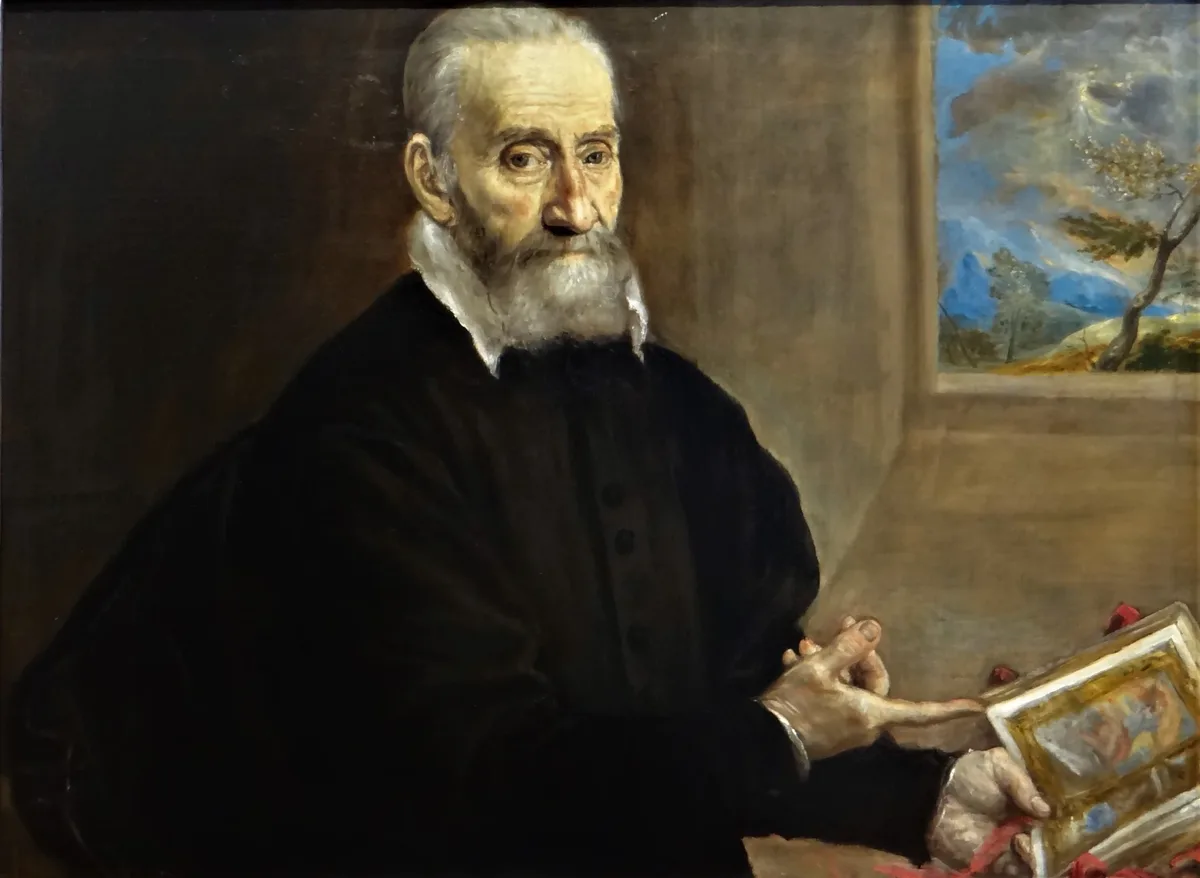
This is probably the earliest of El Greco's surviving portraits, since the self-portrait Clovio wrote about is lost. Cardinal Alessandro is nowhere recorded as the patron. The first known owner of the portrait was Fulvio Orsini, the librarian of Palazzo Farnese, and in 1600 Orsini left his collection, and the portrait with it, to Cardinal Odoardo Farnese.
In the summer of 1572 El Greco was turned out of Palazzo Farnese. On 6 July he wrote to the cardinal that the majordomo, Count Ludovico, had dismissed him “by order, as he says, of Your Most Illustrious Lordship”, that he could find in himself no fault for which he deserved such an insult, and that he would very much like to know what it was. Around 1620 Giulio Mancini, who gathered information about artists, recorded that El Greco had offered to knock Michelangelo's Last Judgement off the wall and paint it again with propriety and decency. Some scholars connect the dismissal with this, although Mancini names neither a date nor the Farnese. On 18 September 1572 El Greco enrolled in the Academy of Saint Luke, the Roman association of artists, as a miniaturist.
Parma: the pictures of executed conspirators (1612)
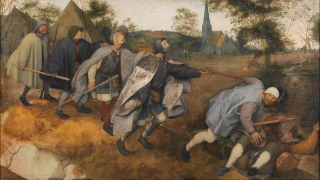
5. The Blind Leading the Blind — Pieter Brueghel the Elder, 1568
Giovanni Battista Masi was executed in Parma on 19 May 1612. He was one of the noble conspirators who had planned to kill Duke Ranuccio I Farnese. He was arrested on 10 November 1611, and on 3 January 1612 he confessed “for fear of torture”. Together with the estates and money of the executed, the duke took their pictures, and Masi's property included two canvases of 1568 by Pieter Brueghel the Elder, The Blind Leading the Blind and The Misanthrope.
The pictures had been collected by his father, Cosimo Masi, a Florentine in the service of Alessandro Farnese, the cardinal's nephew and the future Duke of Parma. Cosimo was his principal secretary, was with him at Lepanto in 1571, from 1577 handled much of his business in the Spanish Netherlands, and in 1591 was made a count in the Parma territory. After Alessandro's death he was held in Brussels until September 1594, and in the mid-1590s he came back to Parma with Netherlandish pictures. Along with the pictures, the son inherited his father's debts.
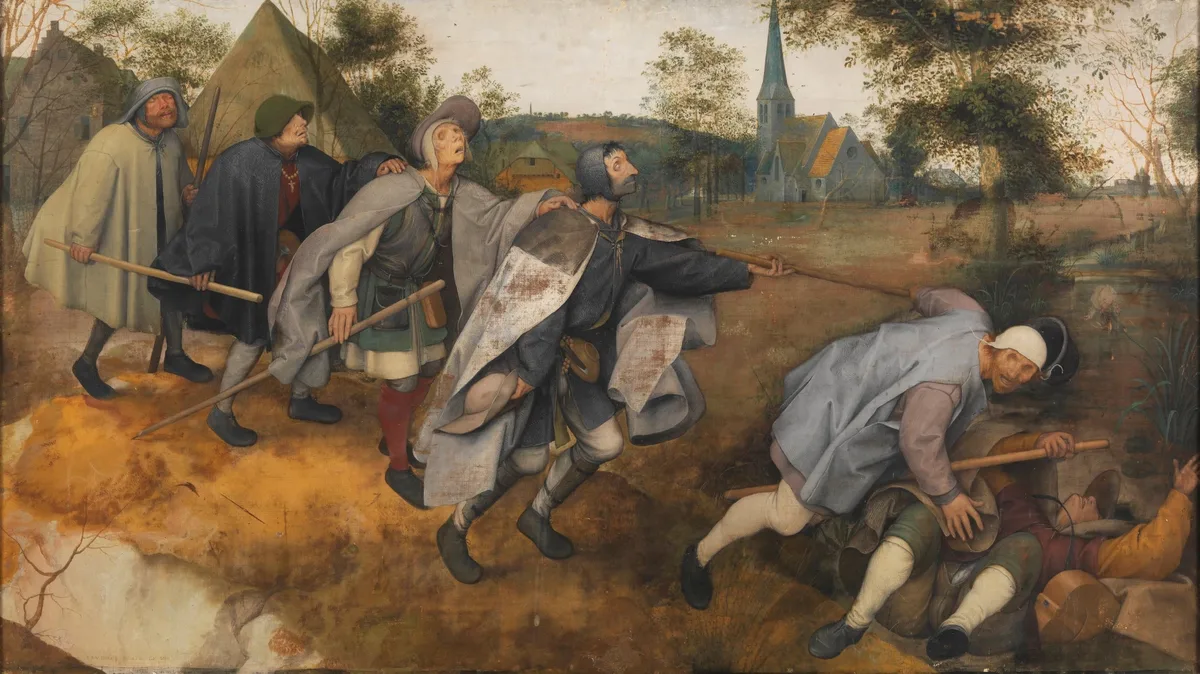
Six blind men walk in a line on a diagonal, from upper left down to lower right, and each holds the shoulder or the shared staff of the man in front. The one at the far left, in a hood, still walks calmly, his eyes closed. An old man in a broad hat has thrown his head back, his whitened eyes turned to the sky. The fifth is already pitching forward and has turned towards us a face with an open mouth and empty eye sockets, and the leader lies on his back in the ditch in the lower right corner. Between the staff of the fourth man and the falling fifth stands a village church with a tall, thin spire.
Brueghel painted the picture a year before his death, in glue tempera on linen canvas. Canvases like this were made quickly and cheaply, most of them perished, and only a few of his survive. The paint here is thin, and on the pale cloak of the fourth blind man the weave of the cloth shows through it. In the lower left corner, in small letters, is “BRVEGEL M.D.LXVIII”. In the autumn of 1943, when German soldiers near Spoleto were opening crates of Neapolitan pictures (more on this in the entry on Titian's Danaë), The Blind Leading the Blind lay in crate number 1.
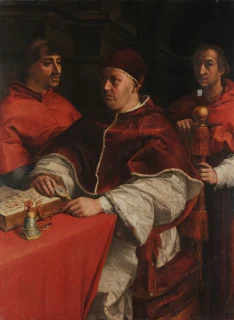
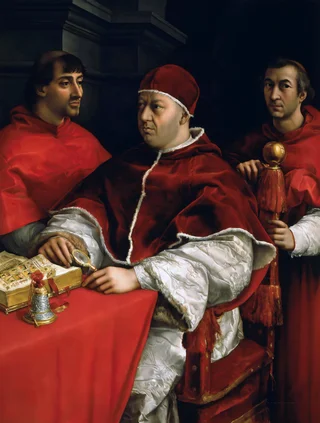
6. Portrait of Pope Leo X with Cardinals Giulio de' Medici and Luigi de' Rossi (copy after Raphael) — Andrea del Sarto, c. 1525
This story was told by Vasari, and there is no other witness to it. As a boy he grew up in Florence under the protection of Ottaviano de' Medici and, by his own account, saw Andrea del Sarto at work on the copy. In the mid-1520s Federico II Gonzaga, ruler of Mantua, passing through Florence on his way to Pope Clement VII, saw Raphael's portrait of Leo X over a door in the Medici house and asked the pope for it, and Clement agreed. Ottaviano de' Medici, who ran the family's affairs in Florence, did not want to part with the portrait. He said the frame was poor and he would have a new gilded one made, and in the meantime the Florentine painter Andrea secretly painted a copy in his house, repeating everything down to the spots of dirt. Ottaviano himself could not tell it from the original. The copy went to Mantua in an identical frame, and Raphael's pupil Giulio Romano, who had worked on the original himself, praised it.
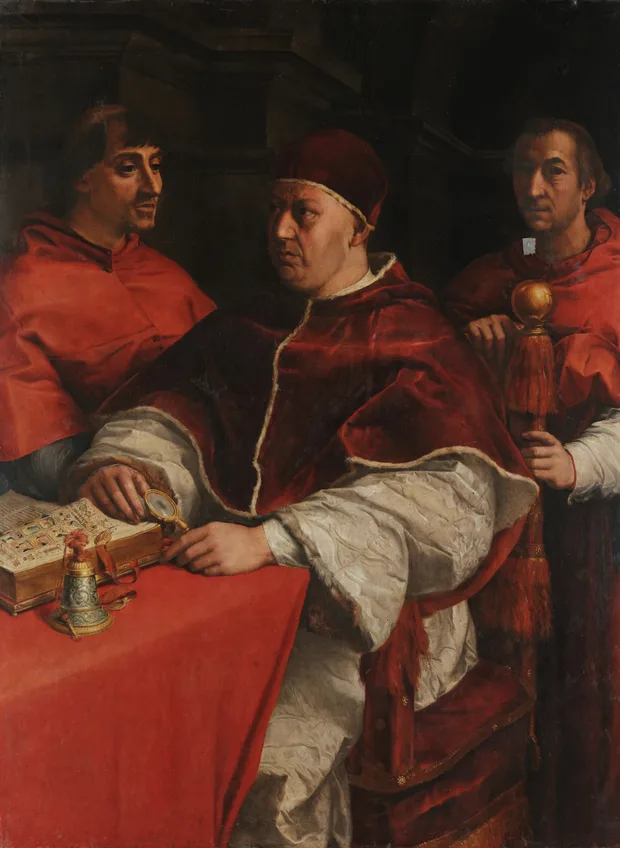
Years later Vasari told Giulio the truth. Giulio did not believe him and asked whether he did not recognise the strokes he had put on it himself. Vasari then had the picture turned round and showed him a mark on the back that had been made in Florence, and Giulio, Vasari says, answered that he valued it no less than if it were by Raphael's hand, even more, because it was against nature for an excellent master to imitate another man's manner so well.
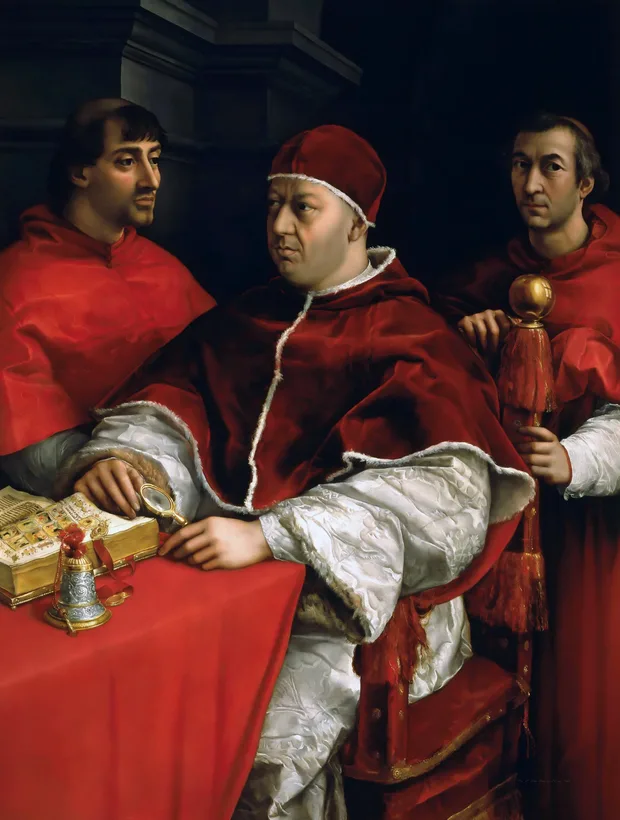
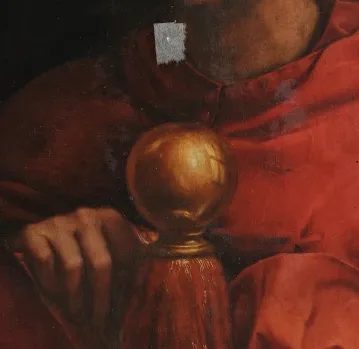
Leo X sits in a red velvet cap and a cape trimmed with white fur over a white damask robe. One of his hands rests on an open illuminated manuscript, the other holds a magnifying glass in a gold mount, and in front of the book stands a silver-gilt bell with a red silk tassel. On the left stands Cardinal Giulio de' Medici, the future Pope Clement VII, the same man who gave the portrait to Gonzaga, and behind the chair on the right is Cardinal Luigi de' Rossi. The back of the chair ends in a gilt ball, and a window is reflected in the ball.
Historians have not established how the copy got from Mantua into the collection of Barbara Sanseverino at Colorno. Sanseverino was arrested on 12 February 1612 in the same conspiracy against Ranuccio I. On 19 May, the same day as Masi, she was the first of the condemned to be executed, and her collection, the copy with it, passed to the duke. On the back of the panel, written with a brush, is “p. leon. X / ma[no] di rafaelo d'urbino”, that is, “Pope Leo X, the hand of Raphael of Urbino”. In 1841 Niccolini, in his description of the Real Museo Borbonico, maintained that the Naples picture was in fact Raphael's original and took the Florence one for del Sarto's copy.
Naples: the move, a king and a revolution (1734–1803)
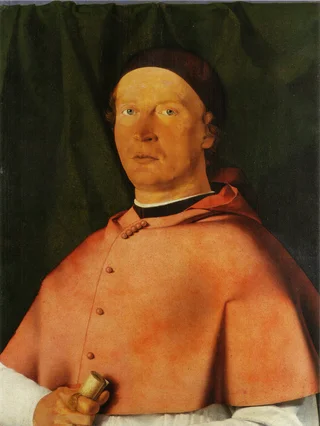
7. Portrait of Bishop Bernardo de' Rossi — Lorenzo Lotto, 1505
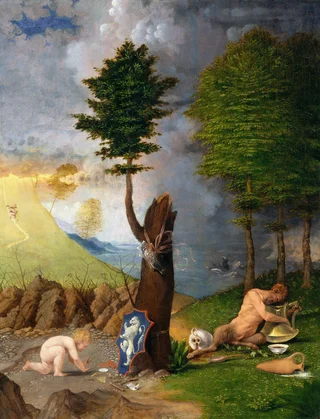
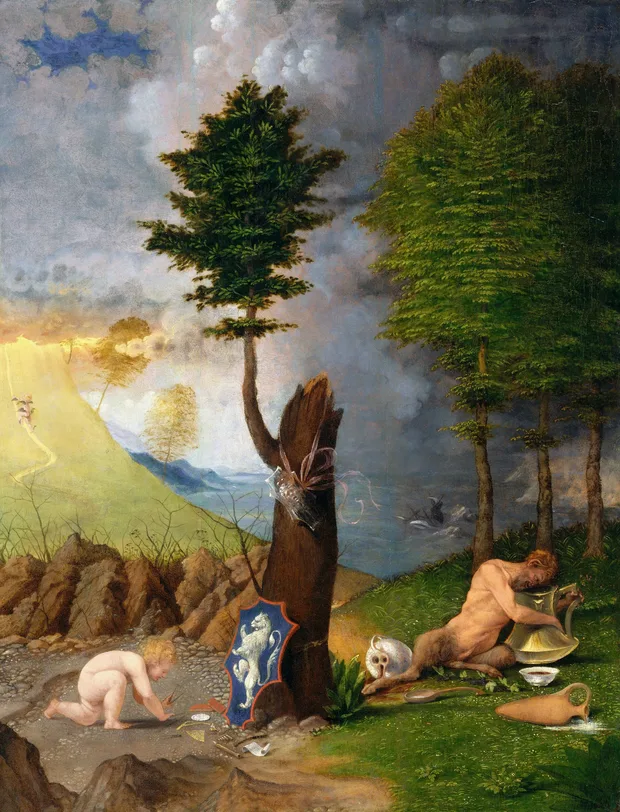
The young Venetian Lorenzo Lotto painted Bernardo de' Rossi, Bishop of Treviso, in 1505 and made a cover for the portrait, a separate panel with an allegory. In the middle of the cover stands a tree with the bishop's coat of arms hanging from it. On one side a putto is busy with books and instruments, and a steep, stony path climbs to a summit. On the other a drunken satyr sprawls among wine vessels, and in the distance there is a storm at sea and a ship going down. Scholars disagree about whether the cover slid out of a groove in the frame or was hinged to the portrait.
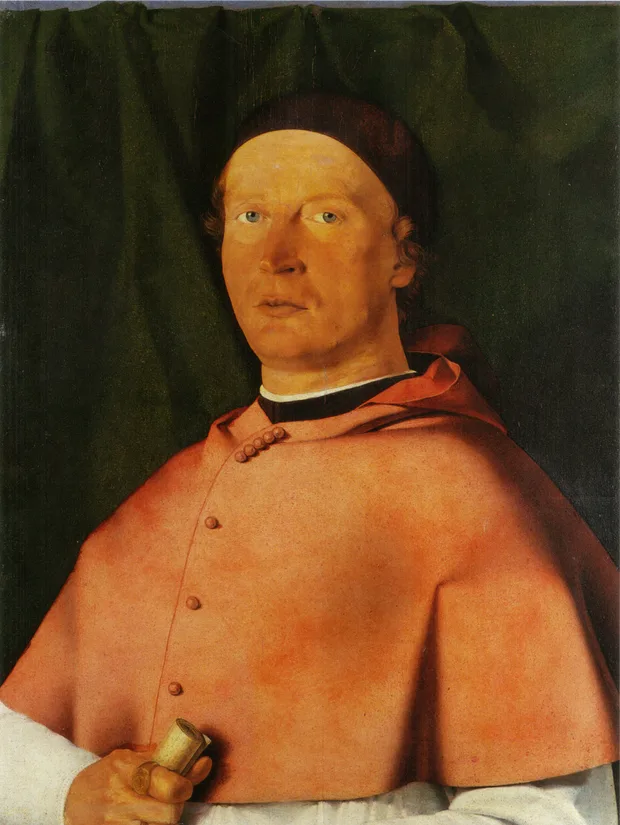
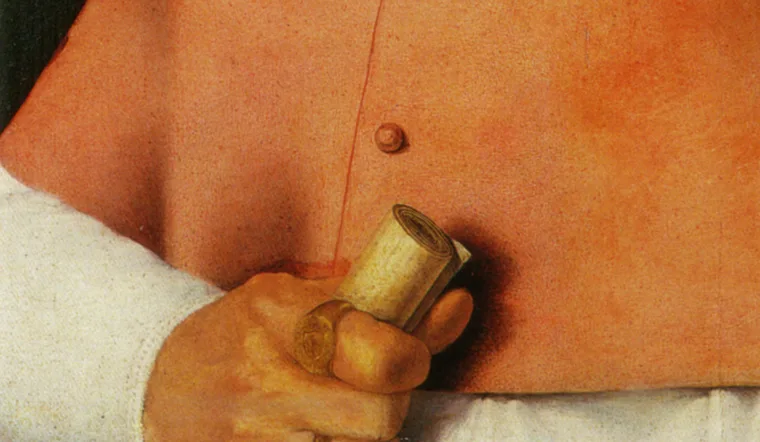
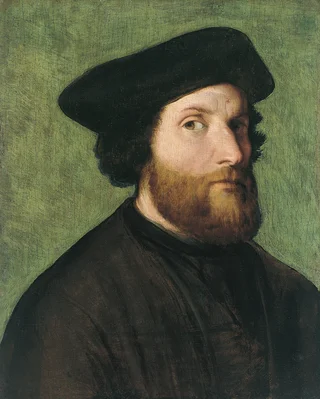
Under the cover was a half-length portrait. The bishop has turned to the left but looks straight at the viewer with pale grey-blue eyes. His face is ruddy and full, with a heavy chin, and reddish curls escape from under his dark cap at the ears. He wears a salmon-red cape with small round buttons, with his right hand he presses a small rolled sheet of paper to his chest, and on his finger is a heavy engraved gold ring. A dark green curtain fills the whole background.
Rossi was born in 1468 and became Bishop of Treviso in 1499. In 1509 he was removed to Venice, from 1511 he served at the papal curia in Rome, and after the Sack of Rome in 1527 he left for Parma, where he died on 24 June that same year. No documents have been found on how the portrait reached the Farnese.
When the Farnese pictures were taken from Parma to Naples in 1734–1739, the portrait went and the cover stayed behind. By 1791 the cover was in the private collection of Antonio Bertioli in Parma, and it was still recorded there in 1803, and no inventory notes when it was separated from the portrait. Around 1880 the cover was in Bergamo, in 1935 the Kress Foundation in New York bought it, and in 1939 it entered the National Gallery of Art in Washington.
In Naples the portrait lost its author's name, and the art historian Cavalcaselle thought it was by Giovanni Bellini. Joseph Lindon Smith, who drew the portrait in 1886, inscribed his drawing “Hans Holbein Naples Museum”, and that drawing is now in the Harvard Art Museums.
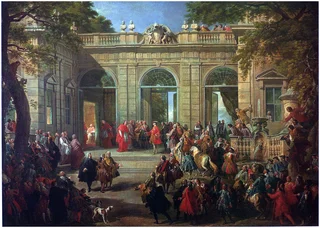
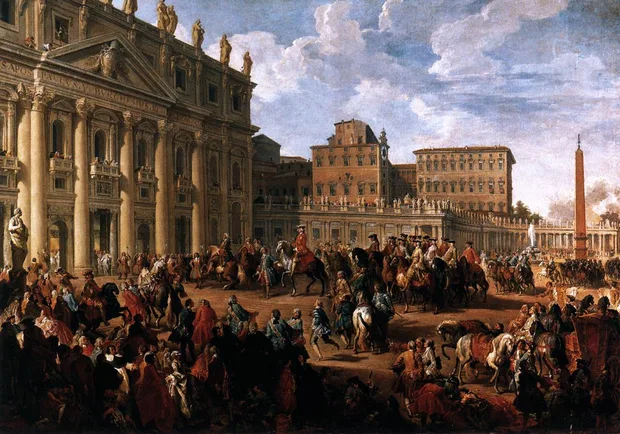
8. Charles of Bourbon Visiting St Peter's Basilica — Giovanni Paolo Panini, 1745
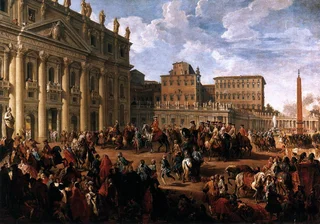
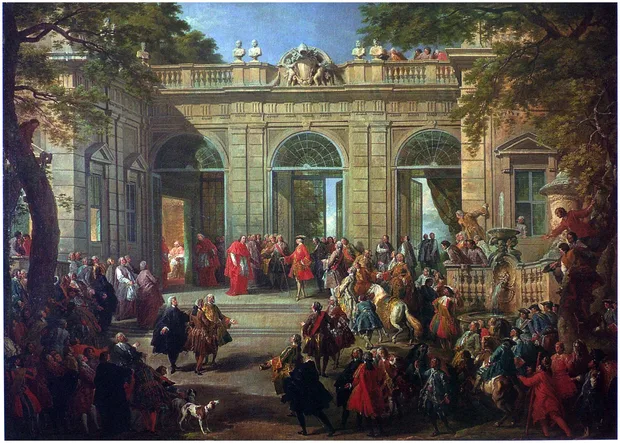
On 11 August 1744 the troops of Charles of Bourbon, King of Naples, held off the Austrians at Velletri, in the Papal States south of Rome, and the victory kept the Neapolitan throne for him. On 3 November that year Charles, the same king who had brought the Farnese inheritance south and begun building the palace on the hill, came to Rome, rode into the square in front of St Peter's and paid a visit to Pope Benedict XIV. In 1745 he commissioned two pictures of that day from the Roman painter Giovanni Paolo Panini.
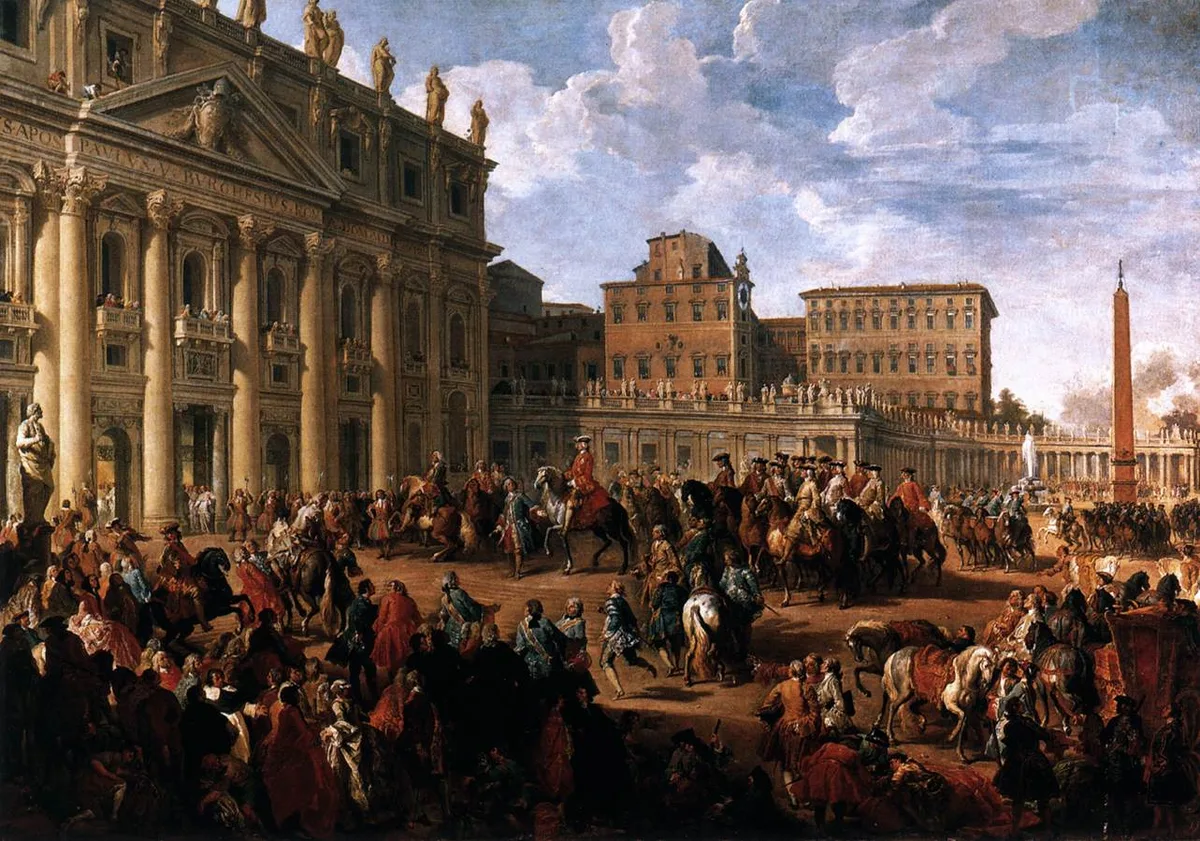
Panini showed Charles in the square in front of the basilica. On the left, cut off by the edge of the canvas, the façade rises steeply, part of the inscription “PAVLVS V BVRGHESIVS” can be read on its frieze, and the balconies and windows are filled with tiny spectators. In the centre the brick Apostolic Palace with its small clock tower rises above the straight arm of the colonnade, and on the right are the obelisk and the jet of a fountain. Riders in red coats and tricorns cross the square from right to left, a little left of centre a rider in red sits on a pale grey horse, and a man in blue, his hat in his hand, reaches towards the horse. The crowd in the foreground is left in shadow, while the square, the riders and the façade are in full sun.
Panini signed the picture with the year 1745, and inventories often call it Charles III at St Peter's, although he became Charles III only in 1759, when he inherited the Spanish throne. In 1943 it was taken out of crate number 3 at Spoleto together with Titian's Danaë. The pope himself is not in this picture. Panini painted the meeting with Benedict XIV, in the coffee house in the gardens of the Quirinal Palace, in a companion picture signed 1746.
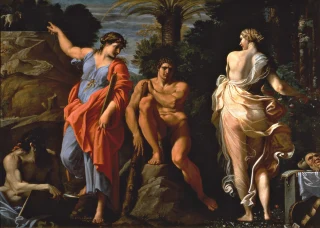
9. The Choice of Hercules — Annibale Carracci, 1596
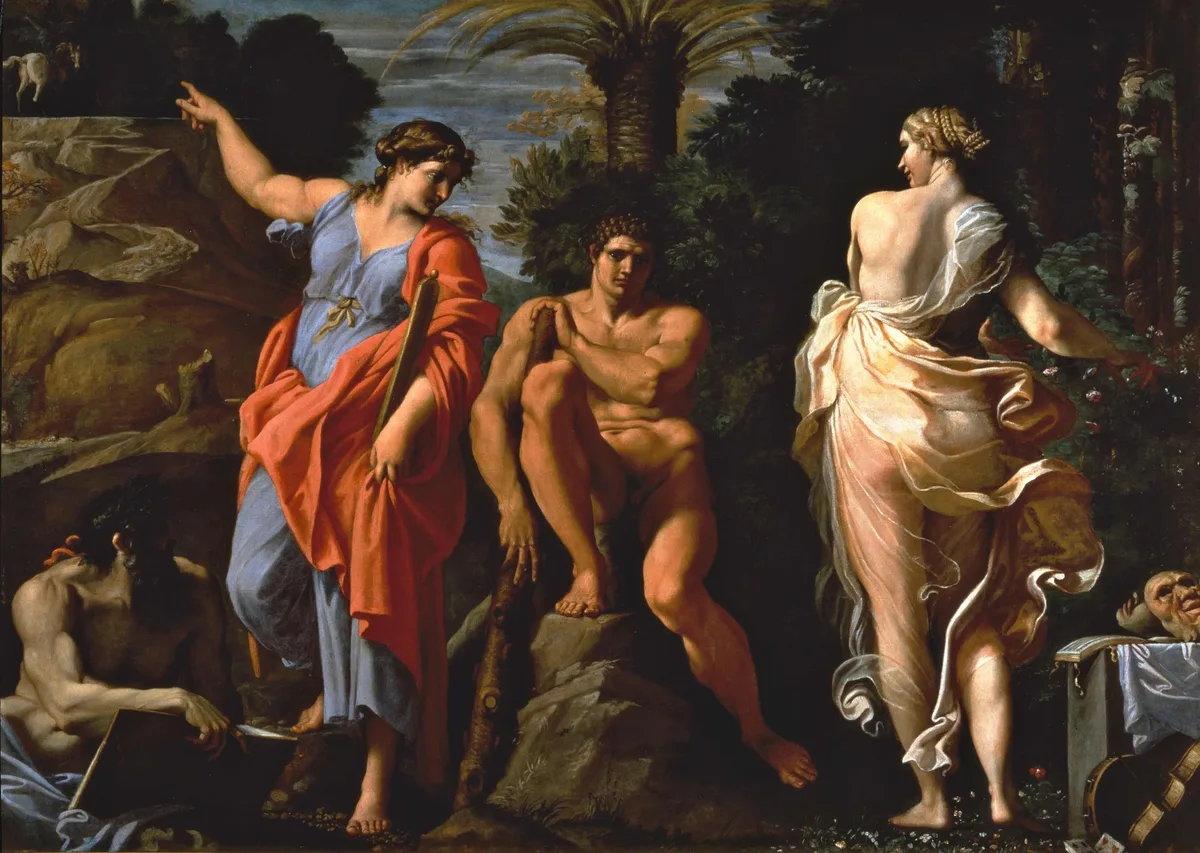
In 1662, when the Farnese were moving their Roman pictures to Parma, Annibale Carracci's canvas was taken down from the ceiling of a small study in Palazzo Farnese and a copy was put in its place. Annibale had painted it in 1596 for Cardinal Odoardo Farnese, for the centre of the vault, and the walls and vault around it were frescoed with Hercules, Ulysses and Perseus. According to the museum, the subject was suggested by Fulvio Orsini, the same librarian who left Odoardo the portrait of Clovio. For Annibale, a Bolognese who had moved to Rome in 1595 and lived in the same palace, it was his first Roman commission, before he painted the Farnese Gallery.
The subject comes from the ancient Greek philosopher Prodicus as retold by Xenophon: the young Hercules chooses between Virtue and Pleasure. Hercules, young and naked, sits on a rock under a palm tree, holds his club and looks straight out at the viewer, past both women. On the left stands Virtue in a pale blue dress and a red-orange cloak, holding a short sword, and with her raised hand she points up to a bare slope with a path, where a white horse stands on the summit. On the right is Pleasure, her back to us, in transparent white and pink drapery, looking round at Hercules over her shoulder. In the lower right corner a grinning mask and an open book lie on a table, with a tambourine, a violin and playing cards below, and in the lower left corner a man crowned with laurel, a pen in his hand, has lifted his head towards the three figures.
The canvas came from Parma to Naples with the Farnese inheritance. In 1799 the French carried it off, and, according to the museum, Domenico Venuti tracked it down in Rome, and by 1801 the picture was back in Naples. In about 1801–1802 the royal porcelain factory in Naples painted the whole composition of The Choice of Hercules on a large tray, a plateau, copying it from an engraving by Pietro Aquila of 1674, and in 2021 the Friends of Capodimonte bought the tray with money raised from donors and gave it to the museum.
The museum grows beyond the Farnese inheritance (1808–1827)
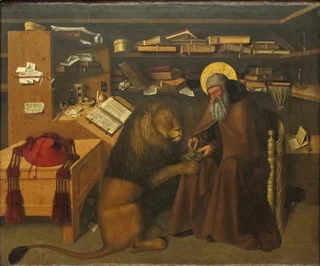
10. Saint Jerome in His Study — Colantonio, c. 1444–1446
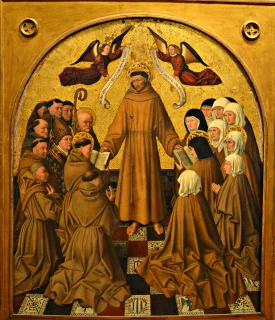
Colantonio's panel was taken from the sacristy of the Franciscan church of San Lorenzo Maggiore into the museum in the Palazzo degli Studi in 1808, when the French ruled Naples and the religious orders in the kingdom were suppressed. It had reached the sacristy around 1639, when the large altarpiece of which it was the lower part was taken apart. Above it had stood a panel of Saint Francis handing the Rule to his orders, and at the sides ten small panels of beatified Franciscans.
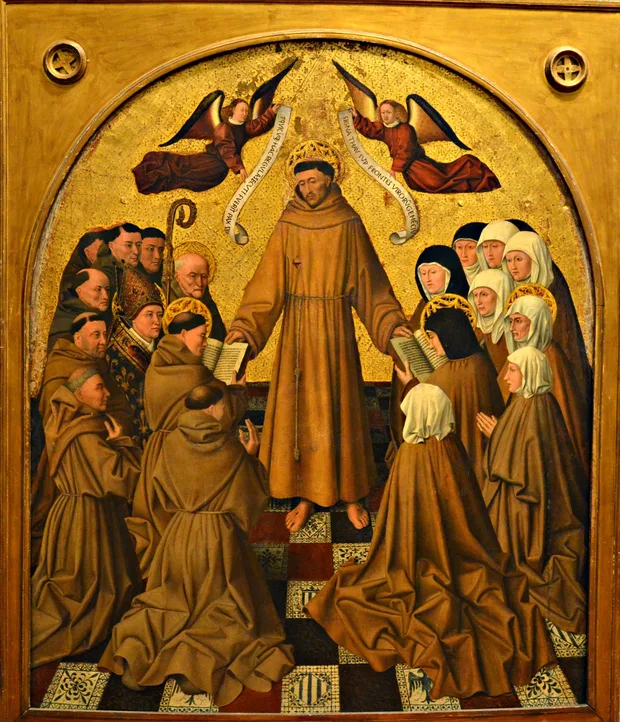
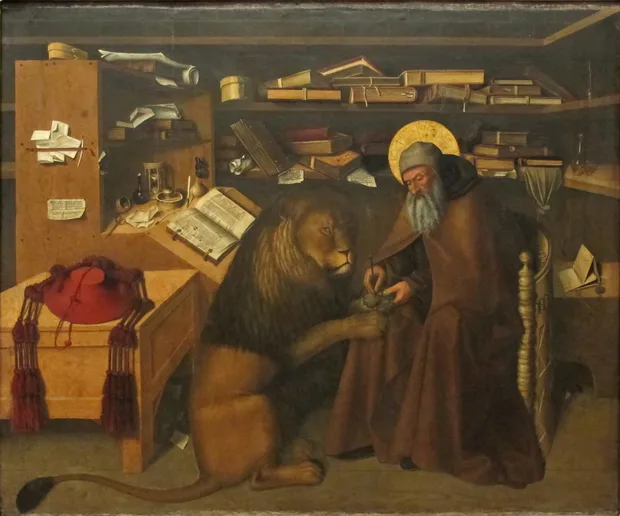
Almost everything known about Colantonio comes from a letter of 1524 by Pietro Summonte to the Venetian Marcantonio Michiel. According to Summonte, Colantonio wanted to go to Flanders to study, and René of Anjou, who was in Naples at the time and was a painter himself, kept him there and showed him the Flemish way of painting. Summonte also names him as the teacher of Antonello da Messina. The altarpiece, according to the museum, was probably commissioned by King Alfonso of Aragon. Alfonso owned a lost triptych by Jan van Eyck, and the court humanist Bartolomeo Facio wrote of it in 1456 that Jerome sat there in a library “like a living being”. Many scholars suppose that Colantonio took that Jerome as his model. In the middle of the 19th century the Naples museum considered the Saint Jerome itself to be by van Eyck or his circle.
The upper panel of the altarpiece came to the same museum only in 1922 (more on this in the entry on Simone Martini). In 1943 the Saint Jerome lay at Spoleto in crate number 10 with Raphael's Madonna of Divine Love, and in 1957 both halves of the altarpiece were moved to Capodimonte. Of the ten small panels of beati, scholars have found eight, in private collections in Italy and the United States, and in December 2024 the state bought two of them for Capodimonte, the panels of the Blessed Morico and the Blessed Leone.
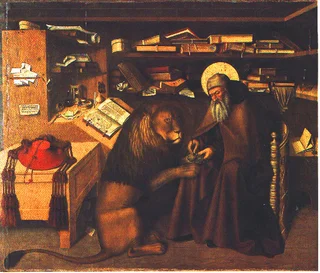
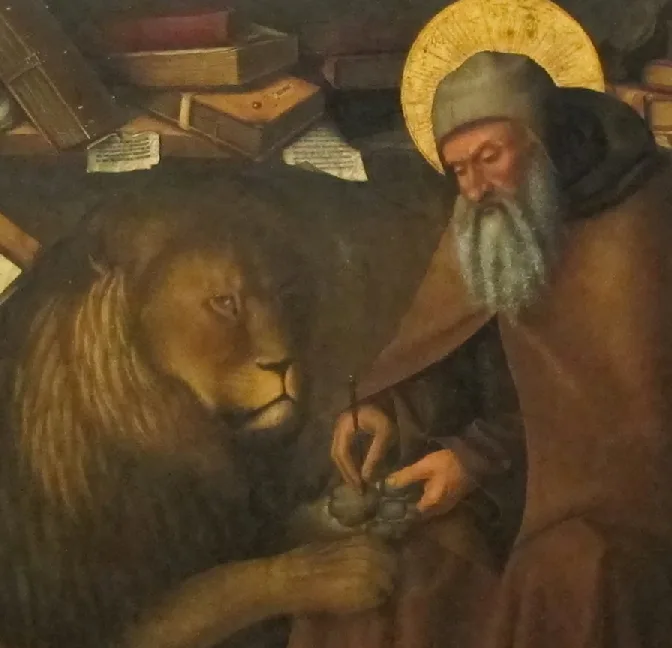
According to legend, Jerome pulled a thorn from a lion's paw. Here the grey-haired saint in a brown habit sits in a chair with his head bowed, a lion almost his own height has laid its paw on his knee, and Jerome holds the paw pad upward with his left hand while his right brings a thin, sharp instrument to it. His cardinal's hat lies on the lid of a chest, the only bright patch of red on the panel. The shelves around him are crowded with books lying flat, tilted and tied with straps, along with an hourglass, flasks and scissors, and on the side of the cupboard a note is fixed with four dots of red wax. In the lower right corner, in a dark arch by the leg of the chair, sits a small grey mouse with a crust in its mouth.
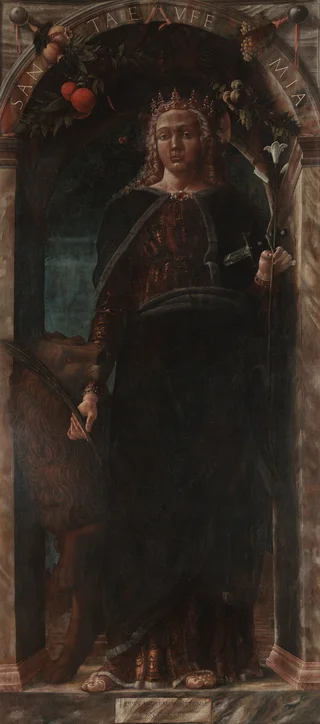
11. Saint Euphemia — Andrea Mantegna, 1454
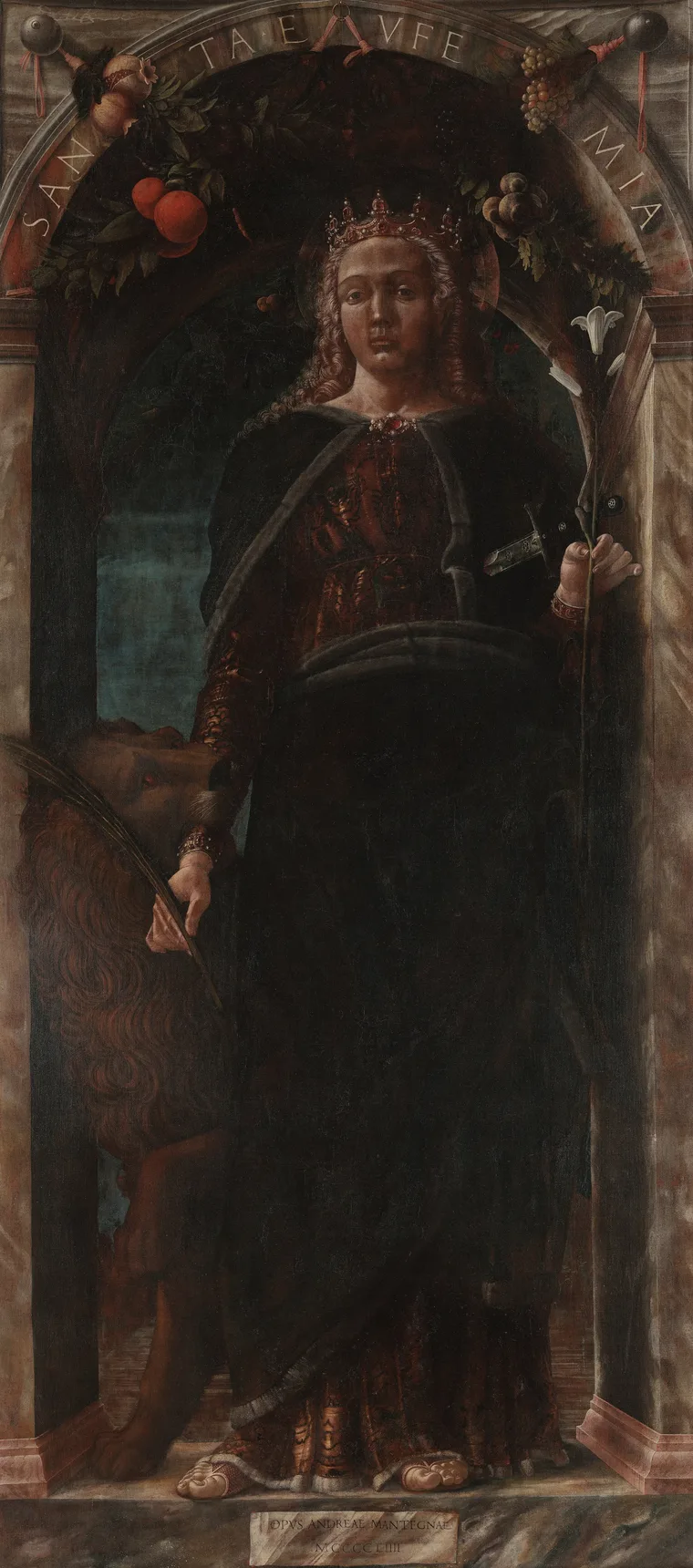
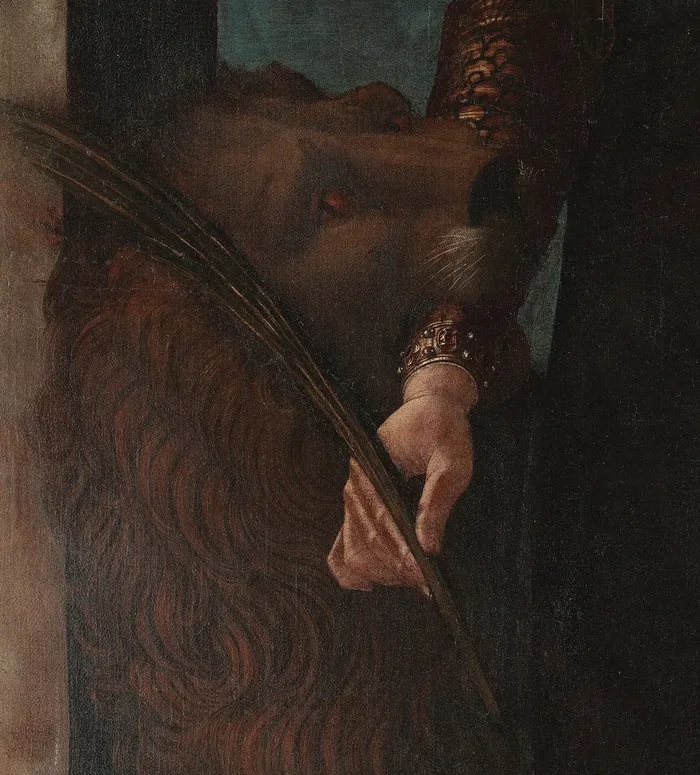
The lion in the lower left corner of the picture has closed its jaws on the right arm of the martyr Euphemia, just above her gold bracelet, and its eye can be seen, rimmed in red. Euphemia herself stands full length in a stone niche and looks calmly at the viewer. In her raised left hand she holds a white lily, in her lowered right a palm branch, and a short sword is driven into her side at the level of her breast. Her name is written in pale letters on the arch above her, a garland of pomegranate, apples, grapes and pears hangs from the arch, and on the step under her feet is a pale tablet with “OPVS ANDREAE MANTEGNAE” and the date MCCCCLIIII, 1454.
Mantegna was about 23. He had trained in Padua under Francesco Squarcione, who adopted him. Around 1448 he broke with Squarcione after a lawsuit over his earnings, and in these years he was painting the Ovetari Chapel in the Paduan church of the Eremitani. The fruit garlands came into his painting from Squarcione's workshop. The picture has darkened badly, the pattern on the dress has almost vanished, and everywhere the weave of the thin canvas shows through the paint.
The picture is first reliably recorded in the collection of Cardinal Stefano Borgia, who kept a family museum at Velletri. In 1814 Joachim Murat, Napoleon's King of Naples, decided to buy that collection, after Murat's fall the returning Ferdinand approved the purchase, and in 1817 the cardinal's heirs sold him almost the whole collection for the Real Museo Borbonico. The Borgia antiquities are now in the Archaeological Museum of Naples, and the paintings at Capodimonte.
How the picture reached the cardinal is not recorded in any document, and in the 1980s a possible earlier history turned up. A Latin poem on Saint Euphemia written in 1592 by the archdeacon Pasquale Verrone was found in the Vatican archives. It tells how in 1454 the prelate Roberto de Mabilia, a native of Montepeloso, today Irsina in Basilicata, brought pictures by sea from Venice for the cathedral of his home town, among them two works by Mantegna. Several writers identify the Naples Euphemia with one of them, although there is no inventory to confirm it. In Irsina cathedral stands a painted, life-size stone statue of Saint Euphemia, close to the picture in its pose, and in 1996 Clara Gelao published it as a sculpture by Mantegna himself, while other scholars take it for a work by Pietro Lombardo made after the painting.
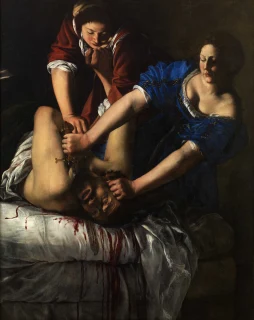
12. Judith Slaying Holofernes — Artemisia Gentileschi, c. 1612–1613
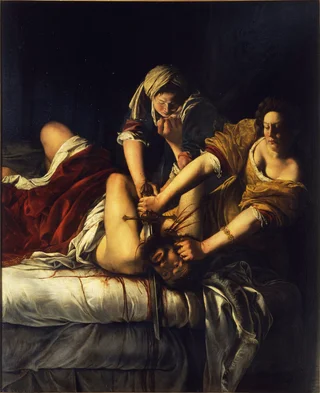
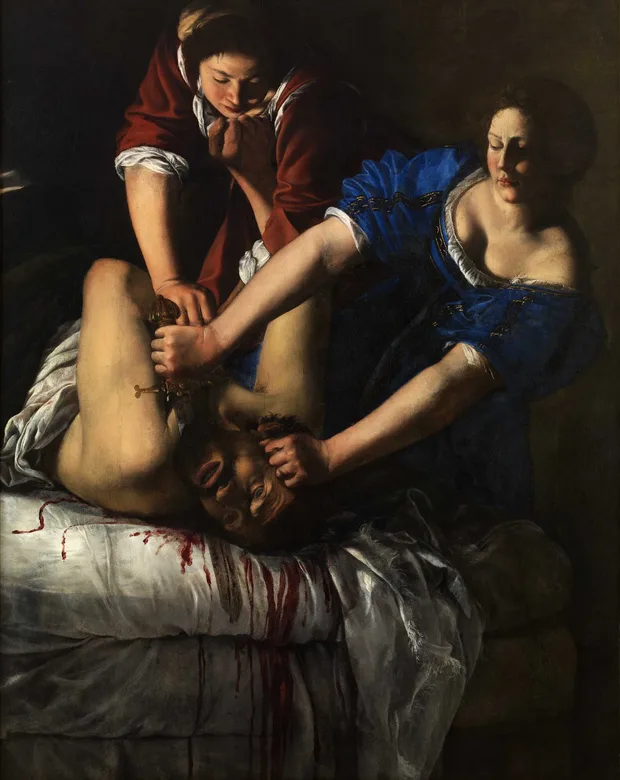
The picture was bought for the Bourbon royal collection in 1827 from the collection of Saveria De Simone in Naples, and at the time of the purchase it passed as a work by Caravaggio. It hung under that name in the Real Museo Borbonico until 1916, when the art historian Roberto Longhi gave it back to Artemisia Gentileschi. Longhi, however, took it for a repetition of the Florence Judith, larger and signed, which Artemisia painted around 1620 for Grand Duke Cosimo II de' Medici. Later Mary Garrard showed from X-rays that the Naples picture has many changes in the position of Judith's arms and in the drapery, where the Florence one has none, and concluded that the Naples picture came first.
Three figures fill the canvas from edge to edge against a dark ground. The maidservant, young and round-faced, in a dark red dress, has thrown her weight on Holofernes from above and pins him to the bed, while he pushes his fist up under her chin. Judith, in a dark blue dress with gold braid, her arms bare, holds him by the hair with one hand and presses his head into the mattress, and with the other, stretched right across the picture, grips the hilt of a sword held upright, its blade going into his neck. The arms of all three meet in the centre of the picture. Judith's face is calm and intent, and the blood runs down the white sheet in long trickles.
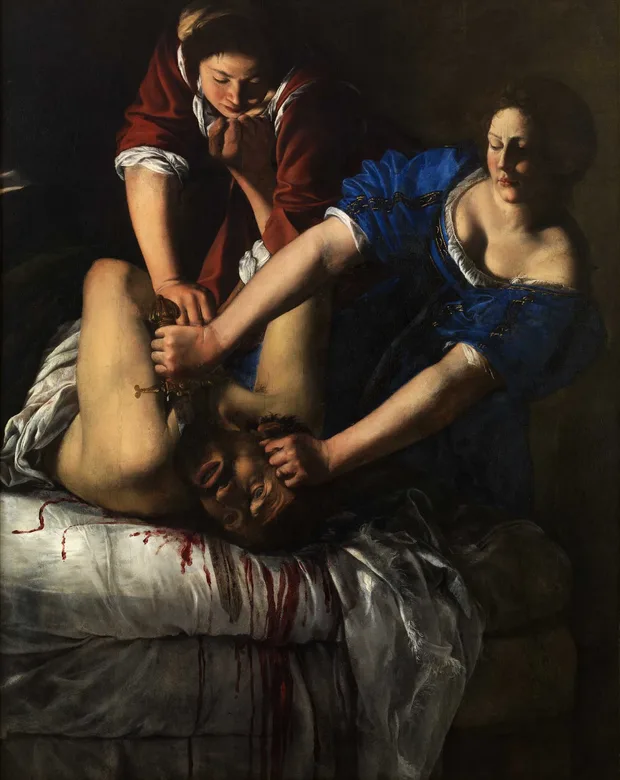
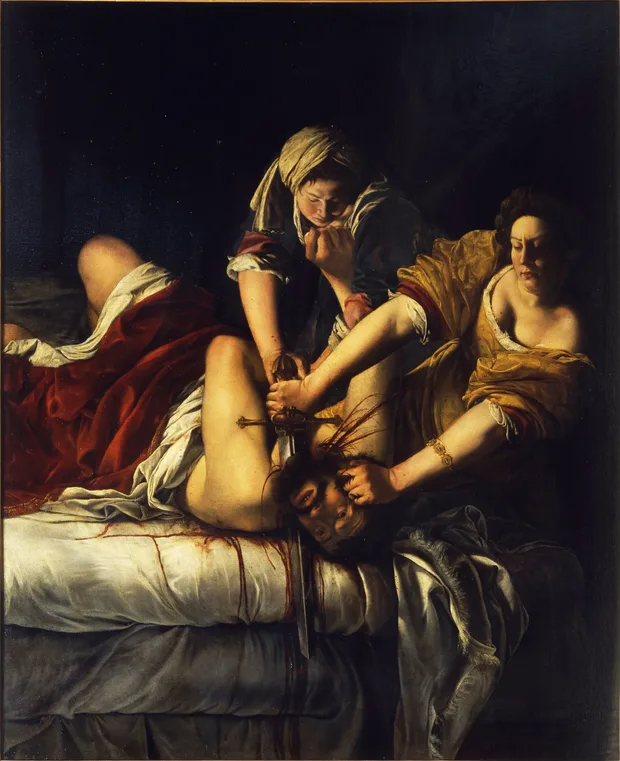
Artemisia was born in Rome in 1593 and trained with her father, Orazio Gentileschi, a follower of Caravaggio, so by the museum's dating she painted this picture when she was about 20. Around 1630 she settled in Naples and worked there for the rest of her life.
The new state gathers gifts, rooms and church panels (1862–1921)
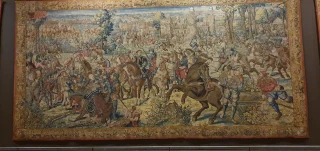
13. The Battle of Pavia tapestries — Bernard van Orley or his workshop (designs), Willem and Jan Dermoyen (weaving), c. 1528–1531
On 24 February 1525, at Pavia, the imperial army of Charles V defeated the French and took King Francis I prisoner. In March 1531 the States General of the Netherlands presented Charles, at the Coudenberg Palace in Brussels, with seven tapestries of the battle, woven in Brussels in the workshop of Willem and Jan Dermoyen to designs by Bernard van Orley or made under his direction.
Charles did not take the tapestries to Spain, and they stayed with his sister Mary of Hungary, regent of the Netherlands. In 1549, at her palace at Binche, they were hung for the visiting Prince Philip, the future Philip II, in his rooms and in the antechamber, because seven tapestries would not fit into one room. In February 1556, when a truce with France was being concluded at the Coudenberg, they were hung in the great hall, and the French envoy, Admiral Coligny, complained that he was being shown how his king's father had been taken prisoner. That same year Mary took the tapestries to Spain, and under her will they passed to Don Carlos, the son of Philip II.
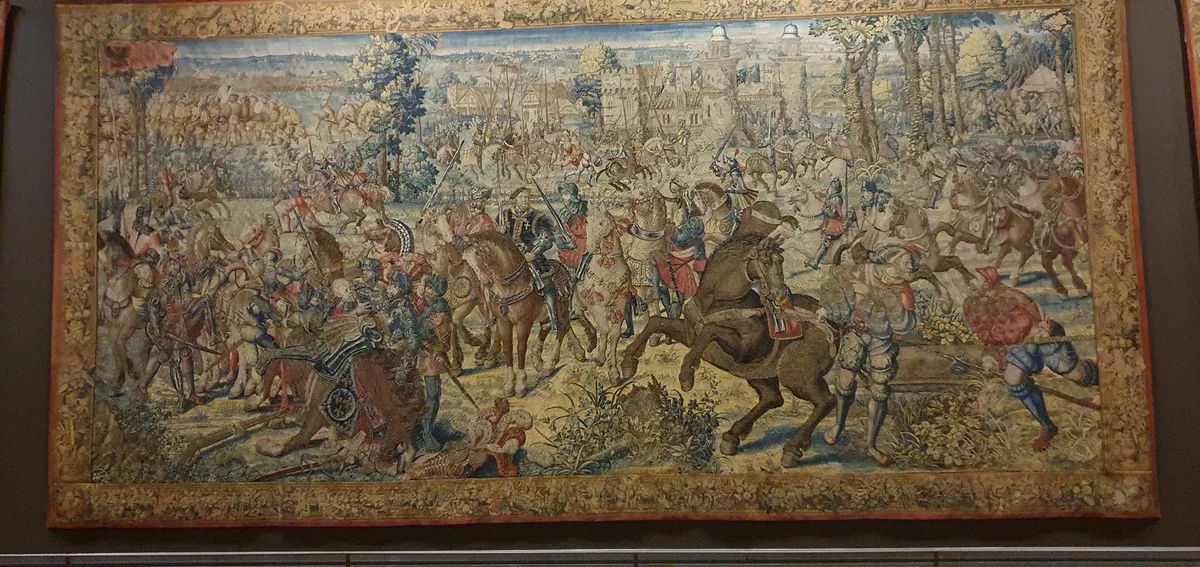
In the spring of 1568 Don Carlos, whom his father was by then keeping under arrest, gave the seven tapestries to the Marquis Francesco Ferdinando d'Avalos in exchange for 66 gold buttons set with cameos, an enamelled gold ring with the heads of Octavian and Livia, and a gold medal. The d'Avalos were heirs of the Marquis of Pescara, who had commanded the imperial army at Pavia. Around 1701 Cesare Michelangelo d'Avalos fled Naples after a failed conspiracy and pawned the tapestries in Venice. King Philip V of Spain, the future husband of Elisabetta Farnese, tried to buy them, but his ambassador feared that the king would not like seeing his ancestor humiliated, and the purchase did not go ahead. Later the tapestries came back to the d'Avalos, in 1862 the last of the line, Alfonso d'Avalos, left them with the whole of his collection to the National Museum in Naples, and in 1957 they were moved to Capodimonte.
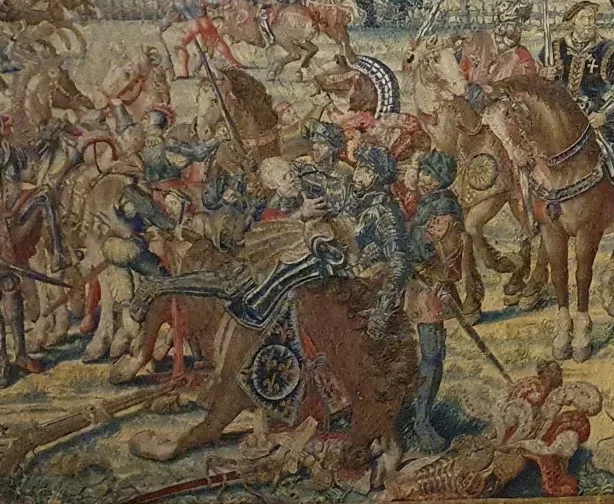
On the tapestry of the king's capture, a little left of centre, a horse in a dark blue caparison with gold fleurs-de-lis lies on the ground, and beside it several men in armour hold up a rider in a plumed helmet. The commanders' names are woven in gold thread on harness and scabbards. Vicente Álvarez, who saw the tapestries at Binche in 1549, remarked that every captain was labelled with his name except the Spaniards, who must have been asleep that day.
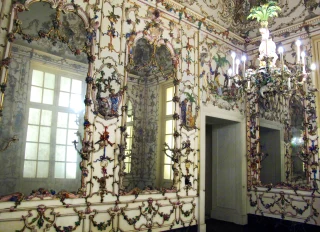
14. Porcelain Cabinet of Queen Maria Amalia — Giovanni Battista Natali and Giuseppe Gricci, 1757–1759
Maria Amalia of Saxony, wife of Charles of Bourbon, was a granddaughter of Augustus the Strong, Elector of Saxony, whose factory at Meissen was the first in Europe to make hard-paste porcelain. In 1743 Charles and Maria Amalia founded a porcelain factory of their own in the park of the palace on the Capodimonte hill, and it made soft-paste porcelain to its own recipe. In 1757–1759 the factory put together a whole room for the queen in the country palace at Portici, at the foot of Vesuvius, from about 3,000 porcelain pieces. The design was by the painter Giovanni Battista Natali, and the reliefs were modelled by the factory's chief modeller, Giuseppe Gricci.
The cabinet was finished in 1759, a few months before Charles inherited the Spanish throne and left with his wife for Madrid. With him went 52 of the factory's craftsmen, Gricci among them, together with the moulds, machinery and materials, and in Madrid the factory started up again under the name of Buen Retiro. There Gricci made a second porcelain cabinet, for the palace at Aranjuez.
The walls of the cabinet are faced entirely with white glazed porcelain, crossed by a thin lattice of gilded bars and pink-lilac rocaille frames, and over it flowers, fruit, leaves and ribbons are modelled in relief and painted. Bundles of musical instruments hang from the ribbons. Inside the frames sit Chinese figures in long yellow and blue robes, a woman with a white fan beside a man in a dark wide-brimmed hat under a palm, and small dark monkeys perch on the lattice. All of this China was invented in Europe. The mirrors in porcelain frames with garlands have clouded and become spotted. From the ceiling hangs a chandelier, a white porcelain trunk topped with bright green palm fronds. In 1943 the blast of a bomb shattered the chandelier, the fragments were gathered into two crates, and restorers spent two years putting it back together.
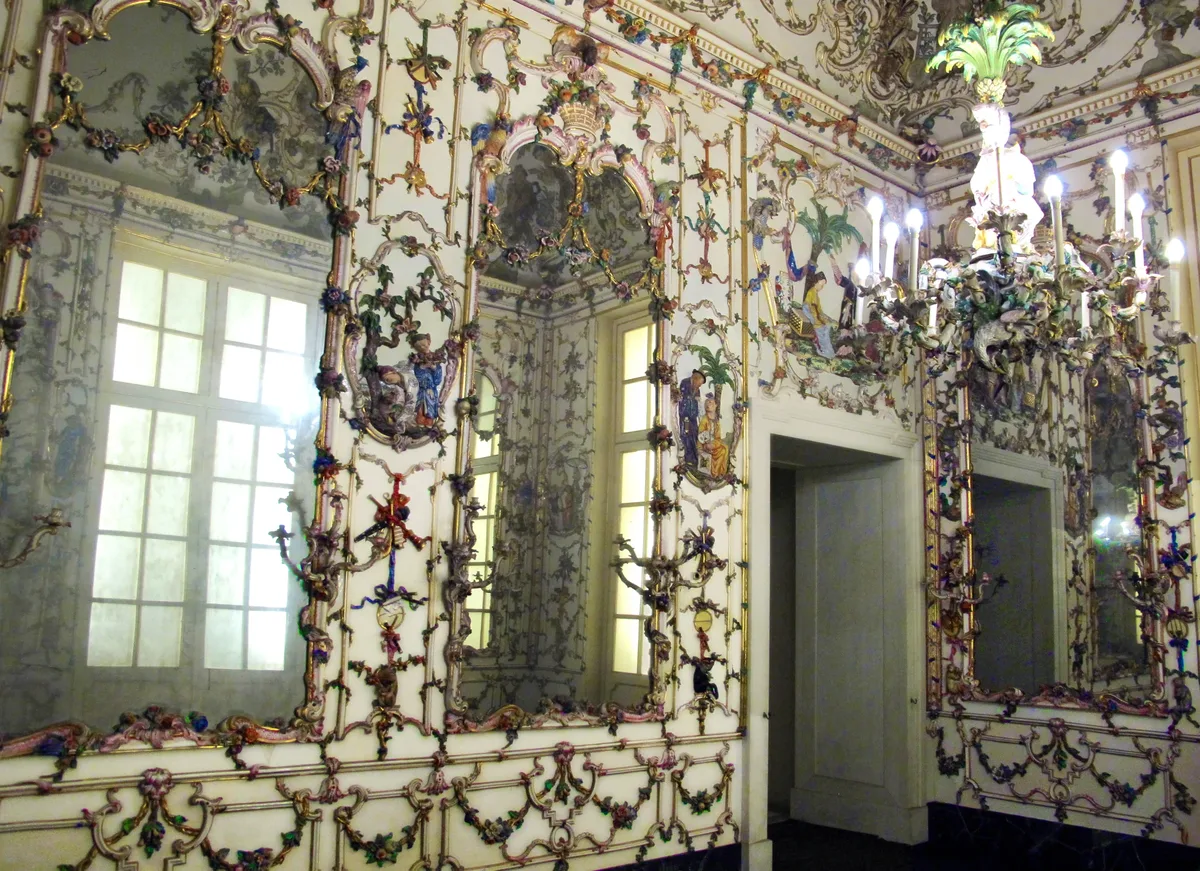
In 1866, under the House of Savoy, Annibale Sacco, who ran the royal household in Naples, decided to gather the treasures of the Bourbon residences at Capodimonte. The cabinet was taken apart piece by piece at Portici and reassembled on the hill where its porcelain had been made more than a hundred years earlier. The moulded ceiling by Mattia Gasparini, painted and gilded to look like porcelain, could not be taken down at the time, and it stayed at Portici until 1957, when it was sawn into 18 sections, brought to Capodimonte and joined to the walls.
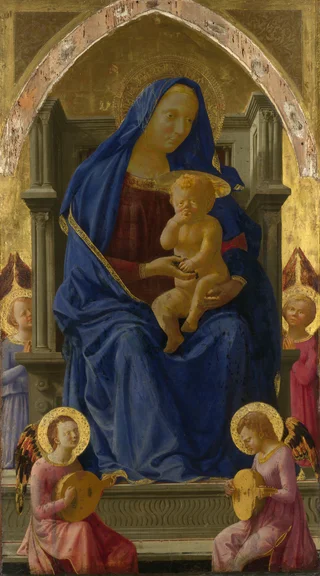
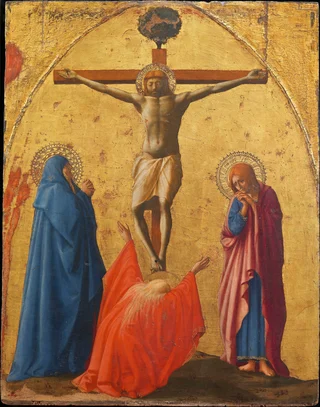
15. Crucifixion — Masaccio, 1426
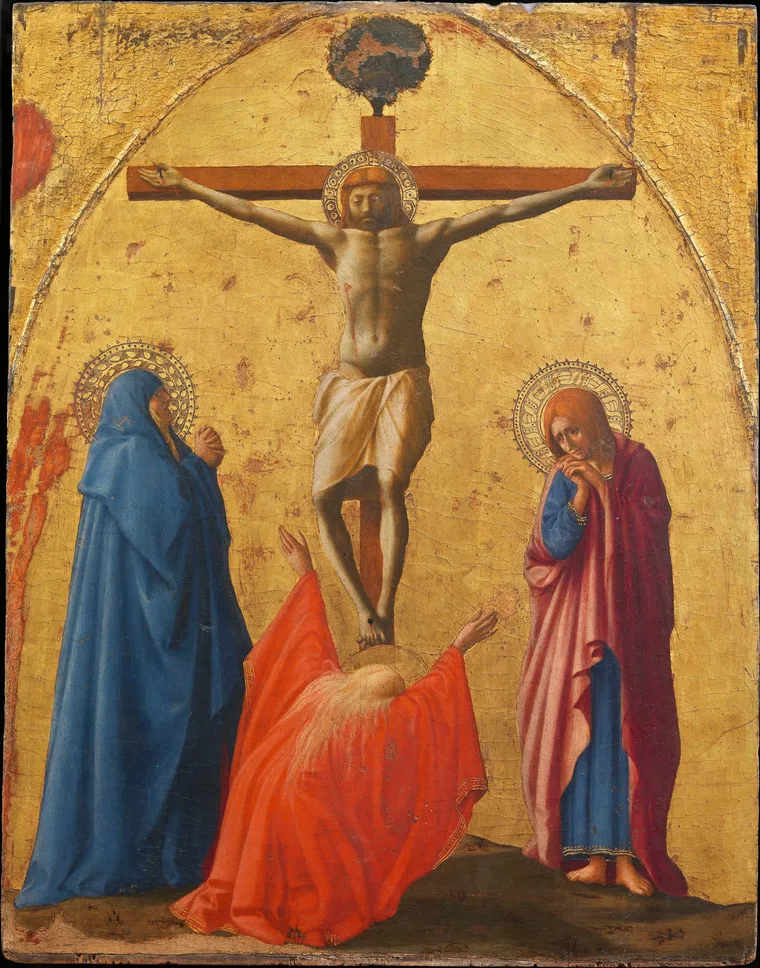
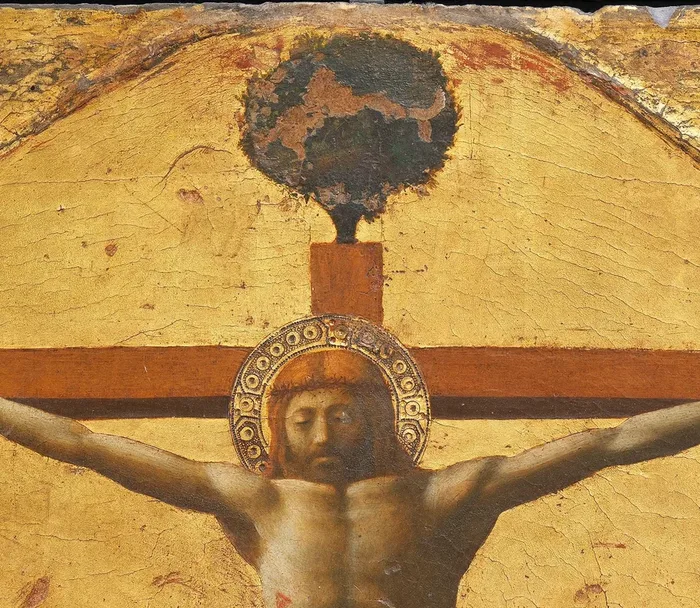
In 1901, after long negotiations, the National Museum in Naples paid 800 lire for a small panel of the Crucifixion on a gold ground as the work of an unknown 15th-century Florentine. Later it was recognised as a Masaccio, and in 1906 the art historian Wilhelm Suida established that it was the top of the altarpiece Masaccio had painted in 1426 for the church of Santa Maria del Carmine in Pisa.
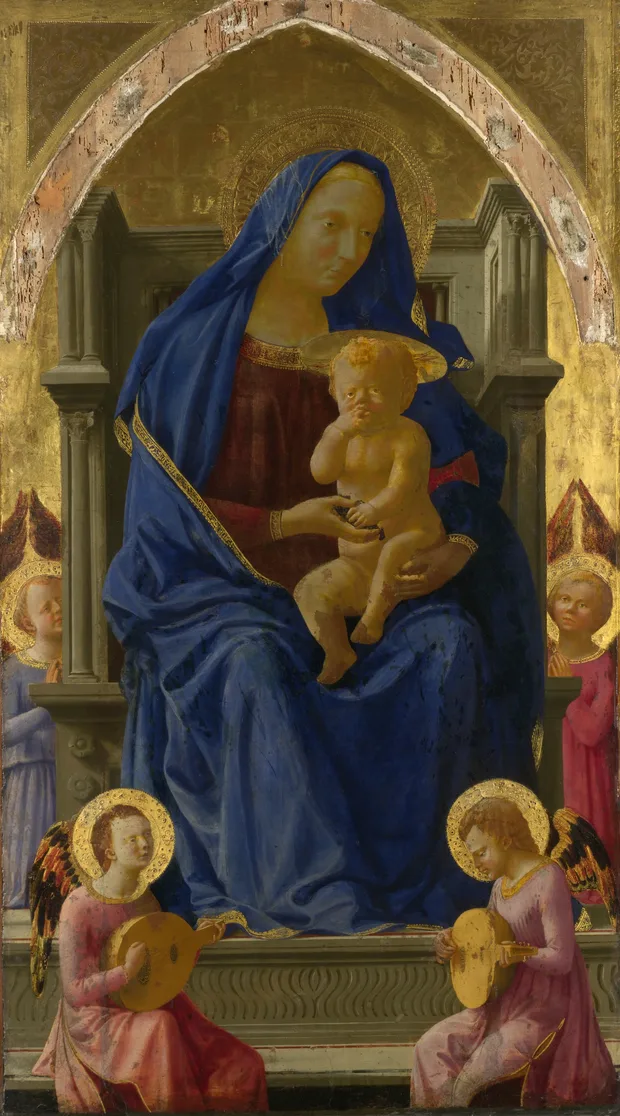
More is known about this altarpiece than about any other work by Masaccio, because the records of the payments survive. It was commissioned by the Pisan notary Giuliano di Colino degli Scarsi for his chapel. The agreement was made on 19 February 1426, the whole altarpiece was priced at 80 florins, out of which both the gold and the ultramarine had to be paid for, and the last payment was made on 26 December that year. Masaccio was 24 at the time, and he died in Rome at about 26. Vasari saw the altarpiece whole and described it in 1568, and soon afterwards, possibly before 1574, when the church was being rebuilt, it was taken apart. The central Madonna and Child is now in the National Gallery in London, the saints Paul and Andrew are in Pisa and Los Angeles, the predella is in Berlin, and in X-rays the wood grain of the Naples panel runs on into the grain of the London one.
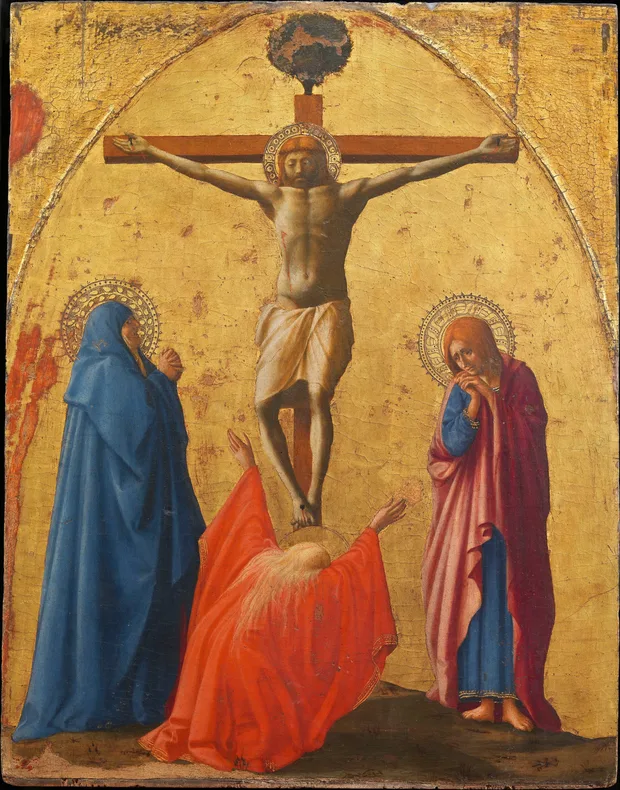
The panel stood at the very top of an altarpiece about five metres high, and Masaccio painted Christ as he would be seen from below. The head is sunk between raised shoulders, there is almost no neck, the knees jut forward and the legs look short. At the foot of the cross Mary Magdalene kneels with her back to us in a flame-orange cloak, her arms flung wide, her long fair hair falling down her back. Her halo is thin and plain, without the tooled pattern on the haloes of Christ, the Virgin and John, and Roberto Longhi thought the Magdalene was added a little later, because the patterns in the gold were tooled before the painting began.
Above the cross Masaccio painted a small round tree, which is read as the Tree of Life. In the 17th century it was covered with an ordinary tablet bearing the letters INRI, and the tablet was removed only in 1956–1957, when the restorer Leonetto Tintori was preparing the panel for the opening of the museum at Capodimonte.
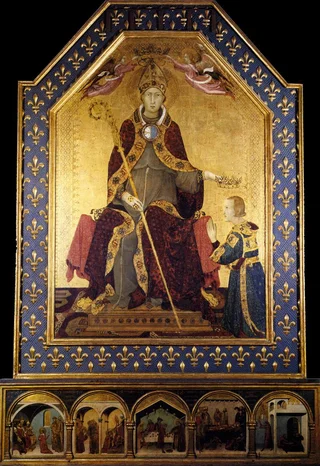
16. Saint Louis of Toulouse crowns Robert of Anjou — Simone Martini, c. 1317
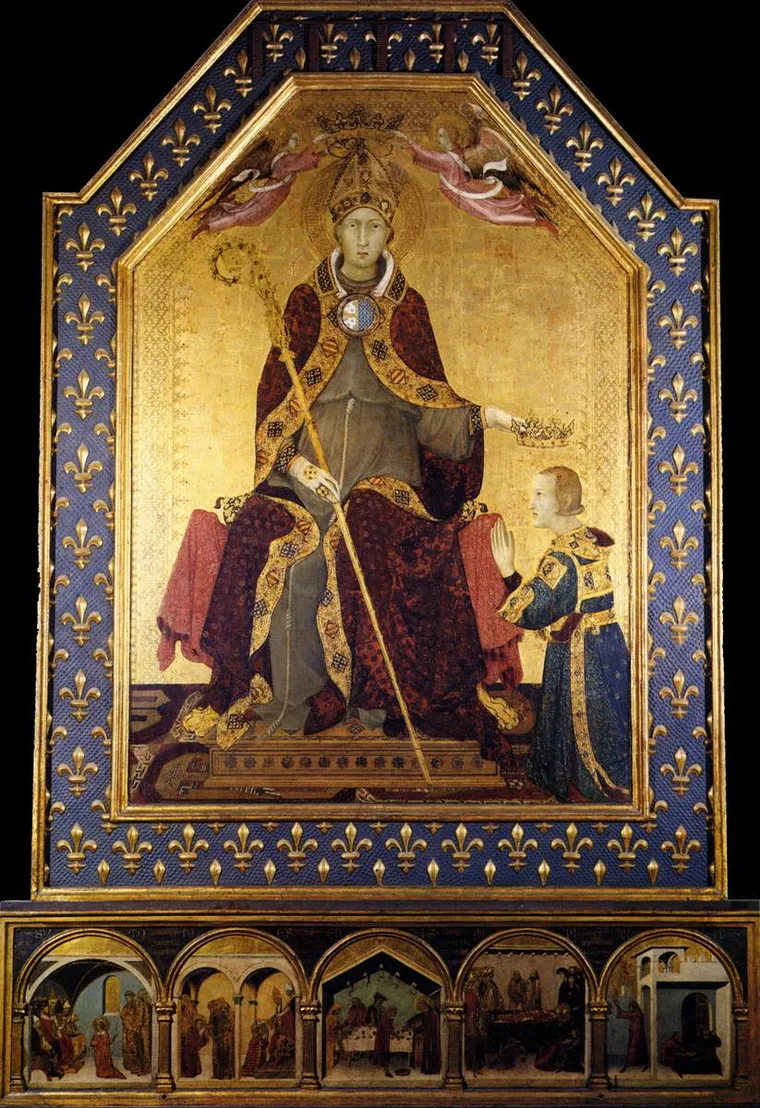
Louis, the second son of Charles II of Anjou, King of Naples, gave up his right to the throne, in December 1296 secretly took his vows as a Franciscan, six days later was appointed Bishop of Toulouse, and died in August 1297, aged 23. On 7 April 1317 Pope John XXII made him a saint. The canonisation had been pressed for by his younger brother Robert, King of Naples since 1309, and it was Robert who commissioned from the Sienese painter Simone Martini a picture in which the new saint hands him the crown.
Robert's right to the crown was disputed. By primogeniture it belonged to Carobert, King of Hungary, the son of their elder brother Charles Martel, and in 1309 Robert hurried to Avignon, where Pope Clement V crowned him. The art historian Julian Gardner writes that the panel ruthlessly abridges this history: the saintly brother himself holds the crown over Robert's head.
Louis sits upright, facing the viewer, two small angels hold a crown above his mitre, and he himself, with his left hand, holds a small gold crown over the kneeling Robert, who is turned in profile, his hands joined, and looks tiny beside his brother. Under the bishop's cope with its broad gold border the brown Franciscan habit shows, and a white knotted cord hangs down its middle. The frame is strewn with gold fleurs-de-lis on a blue-green ground, below are five scenes from the saint's life, and above them is written the painter's name. Gardner also wrote that the cope was once covered with glass stones and shimmering silver foil, that almost all the stones have fallen out and that the foil has oxidised to a reddish brown.
Where the picture first stood is disputed. Gardner thinks it was in the chapel of Saint Louis in the church of Santa Chiara, and there is also a version that puts it in a chapel by the cathedral. By the end of the 16th century the panel is recorded in the Franciscan church of San Lorenzo Maggiore, in 1921 it went from there to the National Museum, and in 1957 it moved to Capodimonte. A year after it, the same church sent the museum Colantonio's panel of Saint Francis, the upper half of the altarpiece whose lower half, the Saint Jerome, had reached the museum in 1808.
From Montecassino to a salt mine in Austria (1943–1947)
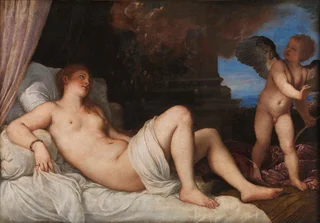
17. Danaë — Titian, 1544–1546
Crate number 3, which soldiers of the German Hermann Göring Division opened near Spoleto in the autumn of 1943, held three Neapolitan pictures: Battistello Caracciolo's Flight into Egypt, Panini's Charles of Bourbon at St Peter's and Titian's Danaë. From 1940 the pictures from Naples had been stored at Cava de' Tirreni and Mercogliano, on 6–7 September 1943 the crates were moved to the abbey of Montecassino, and in October the division took them north by truck to the Villa Marignoli near Spoleto. The division later handed most of the crates over to the Italian authorities in Rome, and on 4 January 1944 a handover ceremony was held in Piazza Venezia, but before that the best pictures had been taken out and sent to Germany.
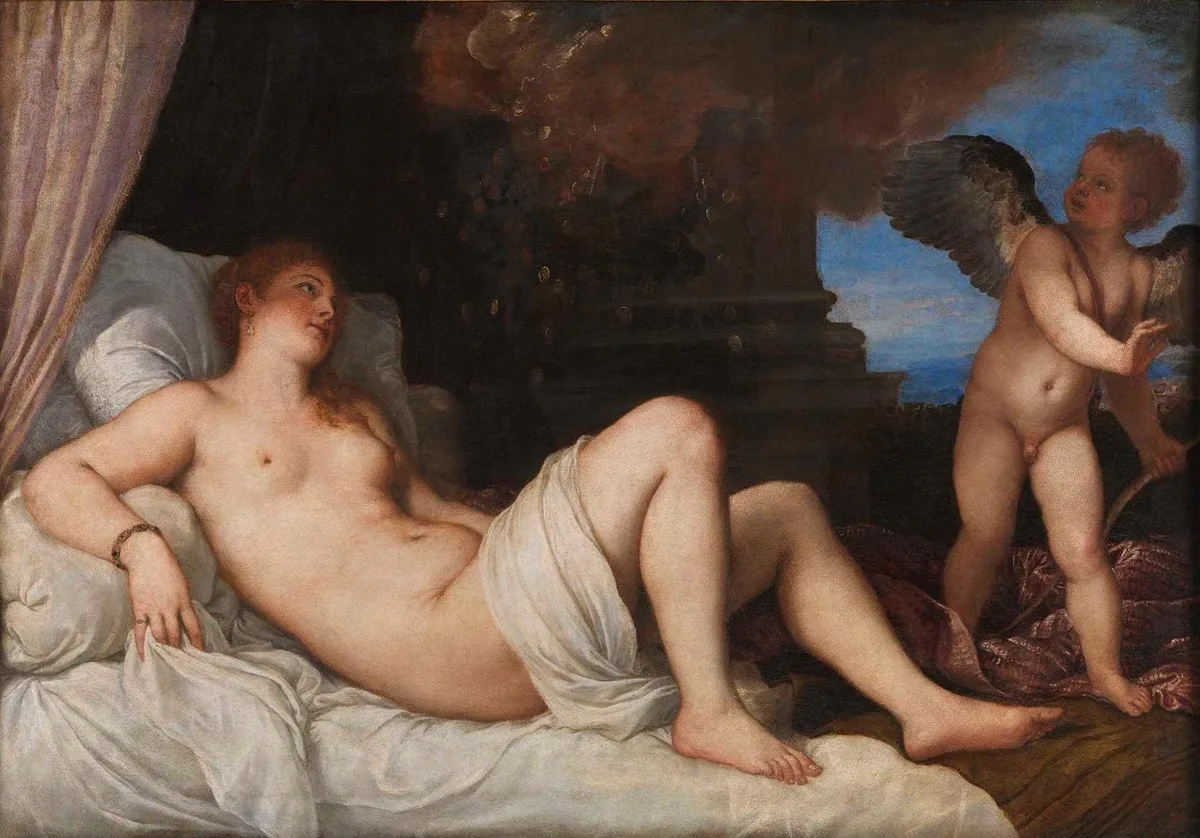
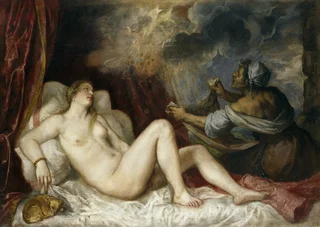
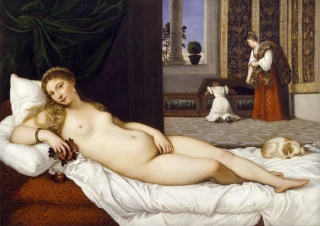
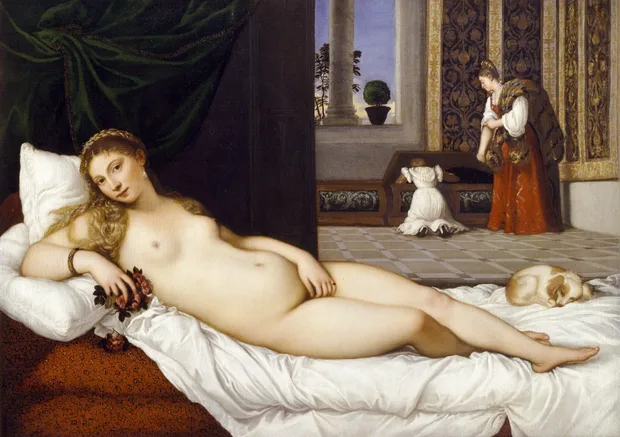
Titian painted the Danaë for Cardinal Alessandro Farnese. On 20 September 1544 Giovanni della Casa, the papal nuncio in Venice, informed the cardinal that Titian had almost finished a nude for him, and that beside it the nude the cardinal had seen at Pesaro, in the rooms of the Duke of Urbino, would look like a nun of the strict Theatine order. That nude from Pesaro is now known as the Venus of Urbino. Della Casa also suggested, in jest, that Titian might give the new picture the face of the courtesan Angela, the cardinal's mistress. X-rays show under the Danaë a first composition resembling the Venus of Urbino, a room with maidservants and a little dog, which Titian then painted over and turned into a myth. He finished the picture in Rome, in the Belvedere, in 1545–1546, while he was also painting the portrait of the pope with his grandsons. Vasari relates that he and Michelangelo came to see the Danaë, that Michelangelo praised the colour and, once they had left, said what a pity it was that in Venice they were not taught to draw well from the start.
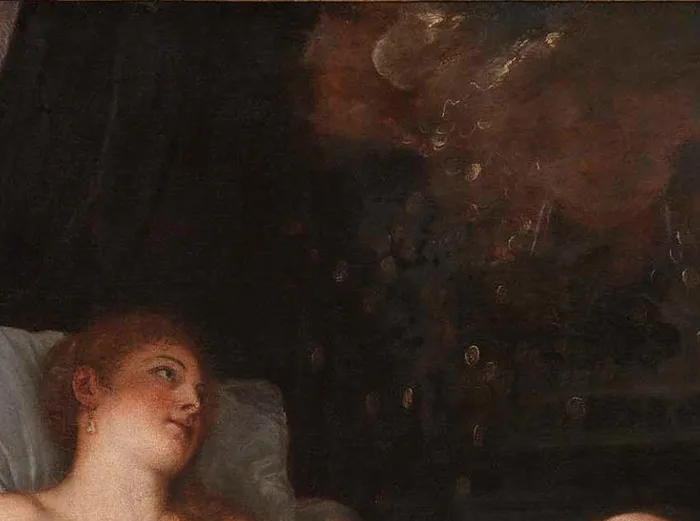
Danaë lies diagonally on white sheets, propped on her right elbow, and with a faint smile looks up at a dark cloud from which small gold coins are falling, almost invisible from a distance. On her wrist is a gold bracelet set with dark red stones, and in her ear a pearl earring. On the right stands a naked Cupid with dark wings. He has turned away from her, looks up at the cloud and holds his bow lowered. In Titian's later Danaës, painted for Philip II and other patrons, Cupid gives way to an old servant catching the coins in her apron.
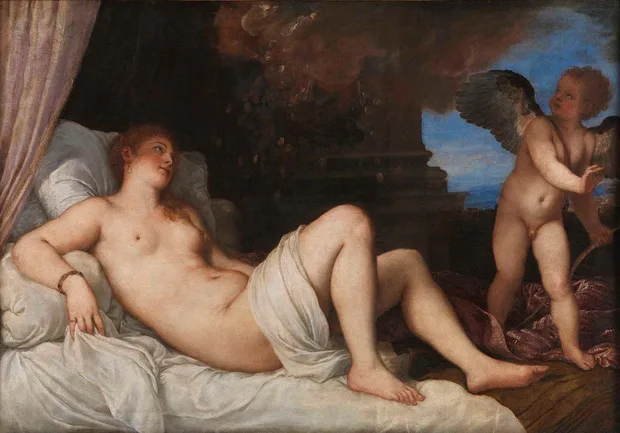
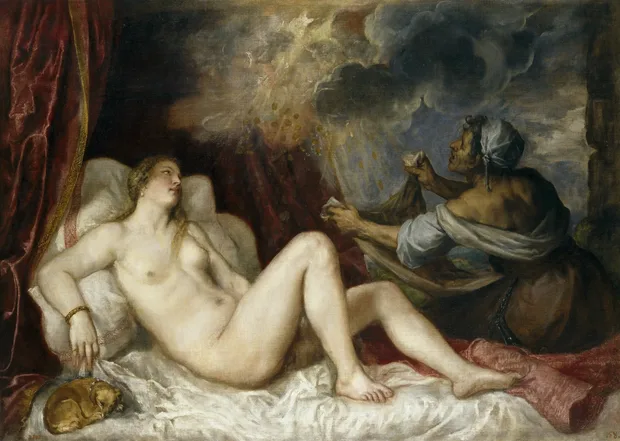
The Danaë came from Parma to Naples with the Farnese inheritance, the court took it to Palermo when it fled the French, and after its return it was locked away as obscene in a closed cabinet of the Real Museo Borbonico.
According to the historian Elena Pirazzoli, in December 1943 the Danaë was brought to Carinhall, Göring's country estate near Berlin, as a present from officers of the division for his 51st birthday on 12 January 1944. A story by Rodolfo Siviero is often repeated that Göring had it put on the ceiling of his bedroom, but photographs of the bedroom contradict it, showing Europa and the Bull by the German painter Werner Peiner above the bed. In 1945, as the Red Army approached, Göring's pictures were sent to the salt mine at Altaussee in Austria, where the Allies found them, and on 7 August 1947 the Neapolitan pictures were handed over to the Italians in Munich. Siviero, who headed the Italian office for the recovery of works of art, recalled that the Danaë was covered in mould. In November 1947 it was shown in Rome at the Villa Farnesina among the recovered pictures, and Pirazzoli points out that this villa was bought in 1579 by the same Cardinal Alessandro Farnese for whom the Danaë had been painted.
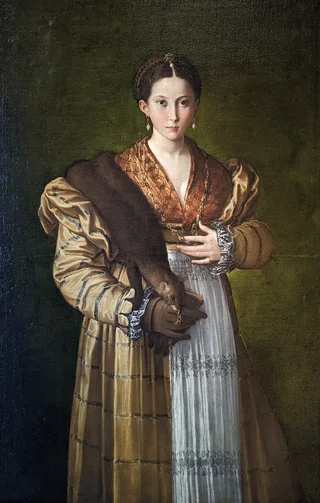
18. Portrait of a Young Woman (“Antea”) — Parmigianino, c. 1535
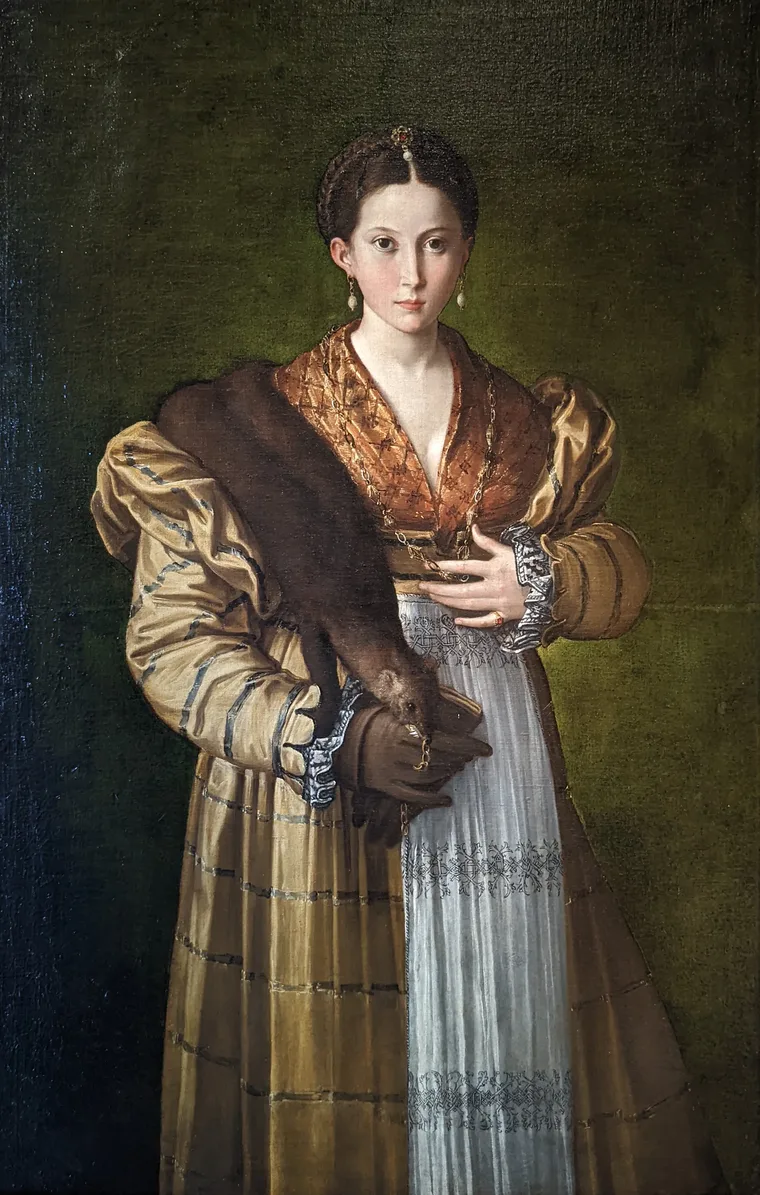
The name Antea was first written down in 1671 by Giacomo Barri, in a guide for lovers of painting in which he described, in the Palazzo del Giardino in Parma, “the portrait of the beloved called Antea, by Parmigianino's own hand”. The Farnese inventory of 1680 calls her “a woman called Antea”, and in 1784 the painter's biographer Ireneo Affò decided that she was the famous Roman courtesan Antea. Scholars have since dismissed the courtesan, although the name has stayed with the picture.
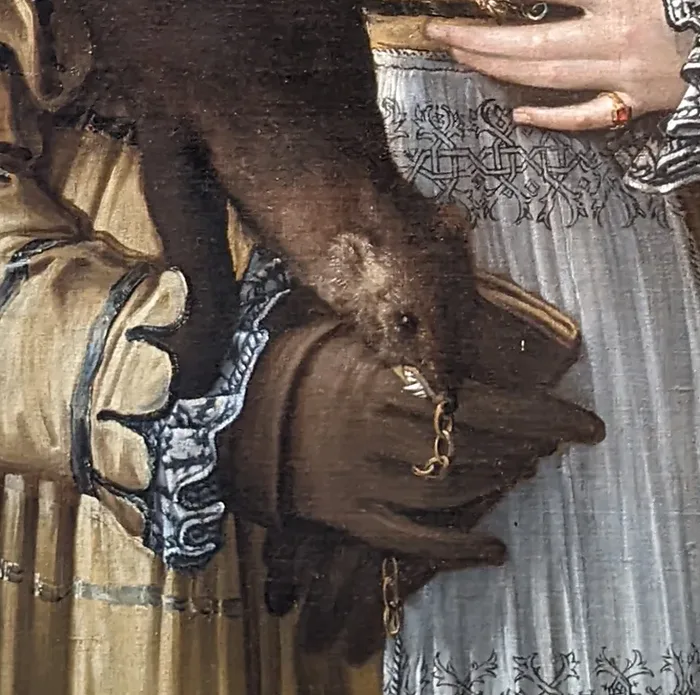
The young woman stands upright, facing us, cut off below the knees, against a flat olive-green ground. Her face is small and pale, her dark eyes look straight out, her hair is braided round her head, and at the parting above her forehead a pearl hangs from a gold brooch with a red stone. Her dress is of golden-yellow satin with enormous sleeves, a long gold chain hangs from her neck to her waist, and her bare left hand lies flat on it. A marten fur is thrown over her right shoulder, and the shoulder and arm beneath it look disproportionately large. Lower down, the animal's head, with a round ear, a shining black eye and small white teeth, has her brown-gloved hand in its mouth, and a gold chain hangs from its muzzle across the glove. In the same hand she holds the second, empty glove.
Brigitte Daprà, who wrote about the return of the Neapolitan pictures after the war, says that in 1943 the Antea was taken out at Spoleto from crate number 29, where it lay on its own. It went north with the others, was found at Altaussee after the war, was handed over to the Italians in Munich on 7 August 1947, and in November was shown in Rome at the Villa Farnesina.
Scholars still argue about who sat for Parmigianino. She has been taken for a bride, a servant and various noble ladies of Parma, and in 2008 Christina Neilson argued that she is an ideal beauty, because the fur, the chain, the brooch, the ring and the earrings were the usual gifts of lovers. In 2023 Mary Vaccaro pointed out that girls in Parma were christened Antea, and found in the Parma baptismal registers an Antea Smeraldi, born in 1516.
19. Madonna of the Veil — Sebastiano del Piombo, c. 1533–1535
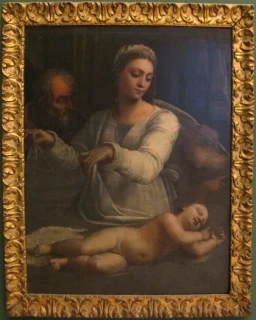
Sebastiano del Piombo took up painting in oil on stone, and Vasari explained that patrons liked it because such pictures seemed to become eternal, safe from both fire and woodworm. Vasari adds that they were so heavy they could hardly be moved, and that Sebastiano himself preferred talking about his method to painting with it.
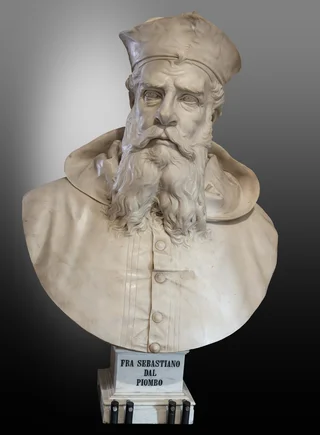
Sebastiano Luciani, a Venetian, came to Rome in 1511 at the invitation of the banker Agostino Chigi and painted lunettes in his villa, which is now called the Farnesina. In Rome he sided with Michelangelo against Raphael, Michelangelo gave him drawings, and he painted from them. In 1531 Pope Clement VII gave him the office of keeper of the papal lead seals, hence the name “del Piombo”, and, according to Vasari, once he had the income he rested more than he worked.
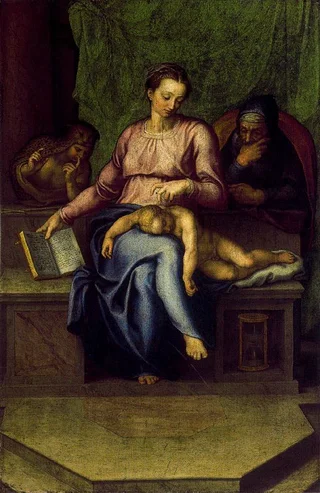
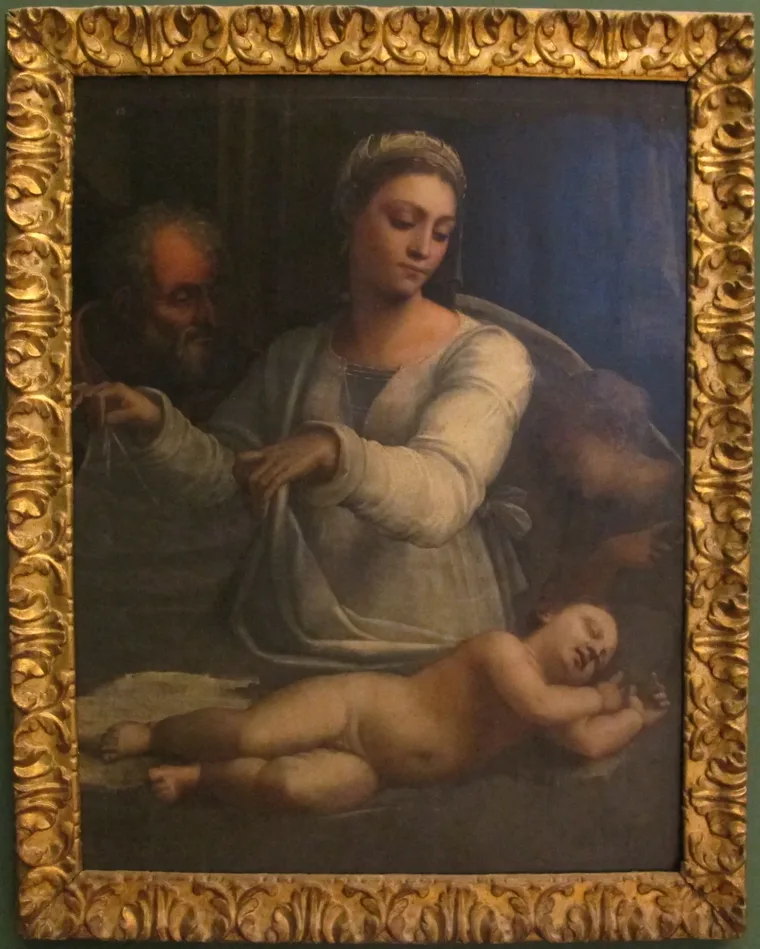
He painted the Madonna of the Veil on a slab of slate around 1533–1535. Mary, her eyes lowered, bends over the sleeping Child, who lies naked across the lower edge of the picture, his head on his folded arms and his mouth a little open. With her right hand she reaches towards the left edge and holds between two fingers a transparent veil, which hangs there as a faint pale triangle, and with her left she grips a grey-green cloth that falls towards the Child. At the upper left the grey-haired Joseph looks out from behind her arm, and on the right an angel almost disappears into the dark, with only his curly head and a lit hand visible. The colours are cold: greys, whites and grey-greens on an almost black ground. In 1568 Vasari wrote that Sebastiano's Madonna covering the Child with a cloth was in Cardinal Farnese's wardrobe, and this passage is taken to refer to the Naples picture.
In 1943 the picture was taken out of crate number 57 at Spoleto. When it was found after the war, Rodolfo Siviero wrote that the very beautiful Madonna of the Veil had given them more grief than anything else, and that the Madonna's face had disappeared under an oxidation that could not be removed at the time. Brigitte Daprà writes that in August 1947 at Bolzano two restorers from Florence, Lo Vullo and Sokolov, managed to remove this crystallisation from the picture.
A picture from a church (1972)
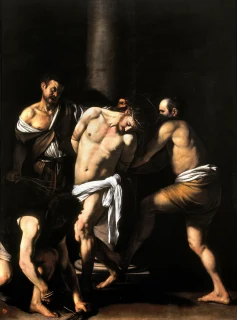
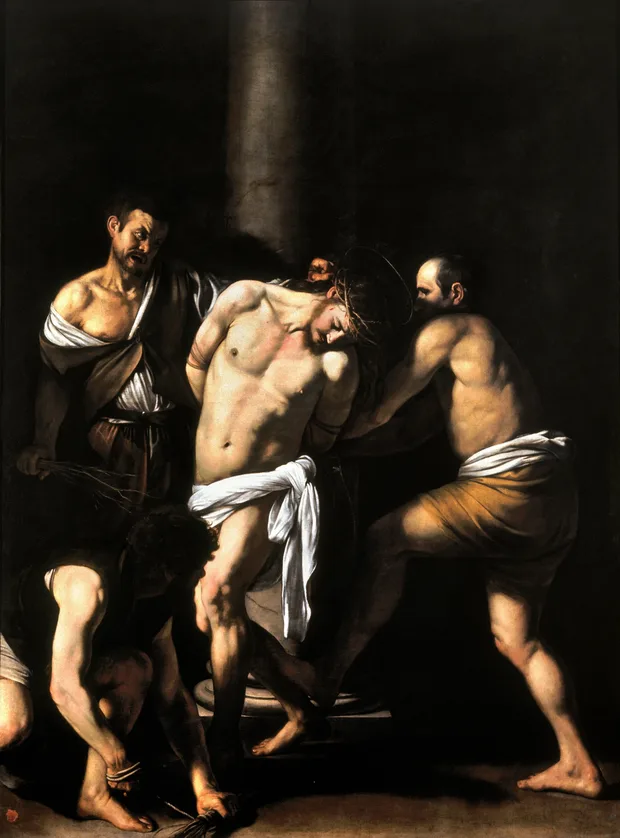
20. The Flagellation of Christ — Caravaggio, 1607
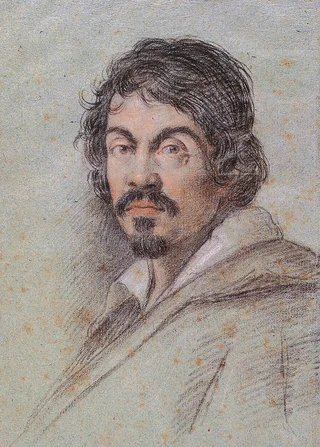
Tommaso de' Franchis, from a Genoese family recently ennobled in Naples, paid Caravaggio in May 1607 for an altarpiece for his family chapel in the church of San Domenico Maggiore, 100 ducats on 11 May and about 40 more on 28 May. Caravaggio had been living in Naples since the autumn of 1606, after fleeing Rome over a killing, left for Malta in the summer of 1607 and came back in the autumn of 1609. So some historians, following Roberto Longhi, think he finished the picture during his second stay, while others hold to 1607.
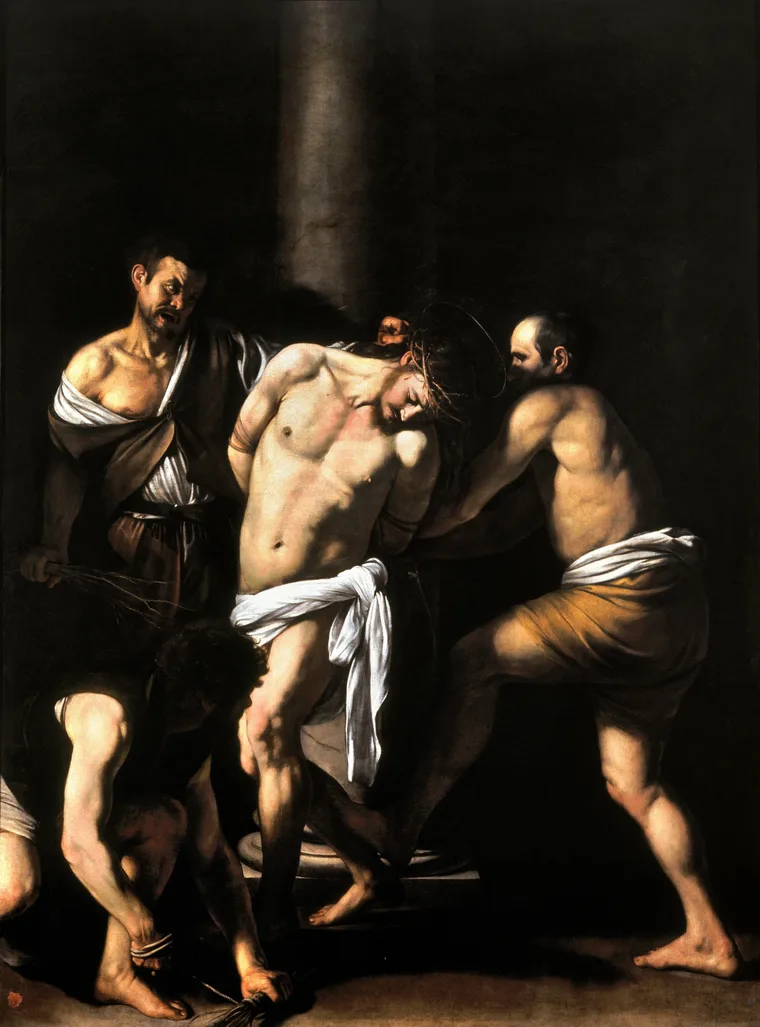
Almost the whole of the tall canvas is dark. A grey column rises in the middle, and Christ is tied to it with his hands behind his back. Light falls from the upper left in a band across his chest, his head has dropped onto his left shoulder, his eyes are closed, and behind his head a thin gold ring of halo can just be made out. The tormentor on the left, his mouth open in a shout, has his fist in Christ's hair, the balding tormentor on the right has hooked his arm under Christ's arm and drives his foot into the back of Christ's calf, and a third, bent double at the lower left, holds a bundle of rods. All three wear plain working clothes.
X-rays and the restoration of 1998–1999 found under the right-hand tormentor a finished male head that had been painted over. It is most often taken for a portrait of de' Franchis himself, less often for a Dominican friar.
In 1827 the Bourbons bought Artemisia Gentileschi's Judith under Caravaggio's name, while his real picture came up the hill only in 1972. Until then it had been moved from chapel to chapel inside San Domenico Maggiore, and after the third attempt to steal it, at the end of 1972, the Capodimonte museum took it into safe keeping. It belongs to the Fund for Buildings of Worship of the Italian Ministry of the Interior, the state body that owns the churches and their contents that passed to the state when the monasteries were suppressed. In San Domenico Maggiore a copy attributed to Andrea Vaccaro remains in its place.
What else to see
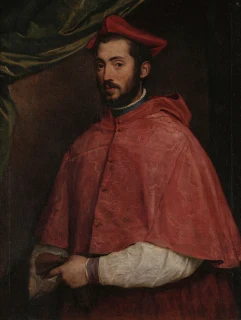
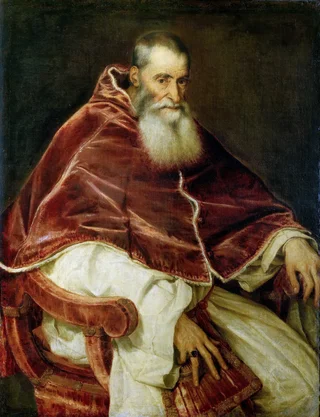
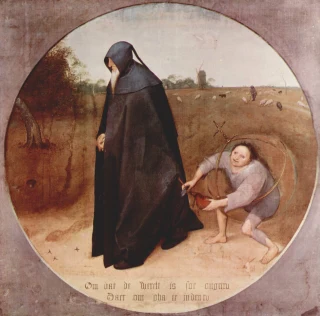
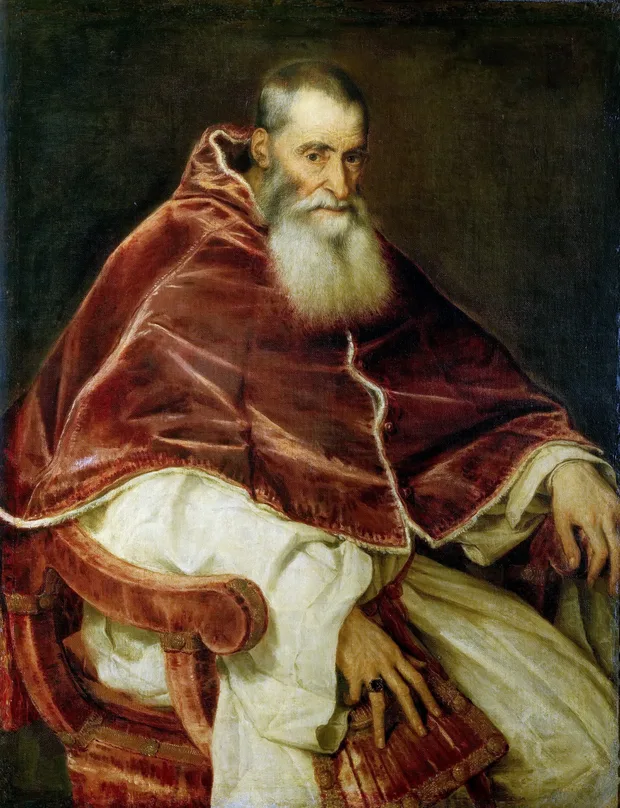
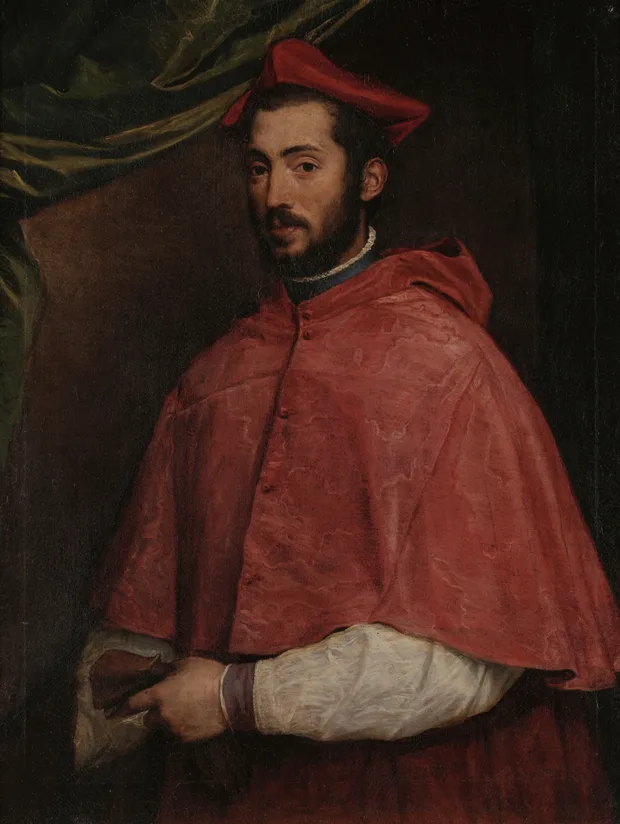
Among Titian's portraits of the Farnese, Capodimonte also has a single portrait of Paul III of 1543, in which the pope is bareheaded, and a portrait of Cardinal Alessandro, and Brueghel's The Misanthrope came into the collection by the same route as The Blind Leading the Blind. The confiscation of 1612 also brought the Farnese Correggio's Mystical Marriage of Saint Catherine. Giovanni Bellini's Transfiguration is recorded in Palazzo Farnese in Rome by 1641. The Neapolitan painting of the 17th century, Jusepe de Ribera, Luca Giordano and Mattia Preti, is best left for a second visit. Parmigianino's Portrait of Galeazzo Sanvitale was long thought to be a portrait of Christopher Columbus.