Master of the Pala Sforzesca
Duchy of Milan · Milanese school, Early Renaissance
The story
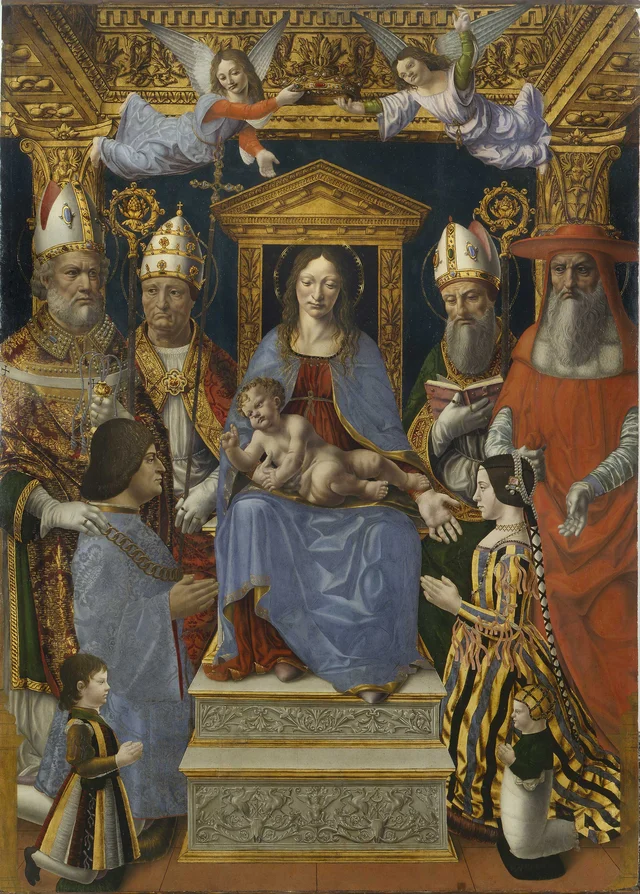
This painter has no name. He has a picture. The Sforza Altarpiece is a large panel of 1494 to 1495, made for the Milanese church of Sant'Ambrogio ad Nemus and now in the Brera, and since nobody has ever matched it to a documented artist, art historians file its author under the title of the painting itself.
From that one fixed point they worked outward. A small group of works has been gathered around it by eye, frescoes in the choir of San Giorgio at Annone Brianza near Lecco, a Madonna and Child in the Gemäldegalerie in Berlin, a crowded little panel of the Virgin with saints and 12 kneeling worshippers in the National Gallery in London, and a drawing in the Louvre. The hand stays recognisable. Heavy gilded ornament in the old late Gothic taste, and faces studied with the plain realism of Vincenzo Foppa, the leading Lombard painter of the previous generation.
Names have been proposed and dropped for over a century, Foppa's among them, along with those of Bernardo Zenale and Ambrogio de Predis, both Milanese contemporaries. In 2021 the art historian Carlo Cairati came at the problem from the archives instead and put forward Giovanni Angelo Mirofoli da Seregno, a painter documented in Milan who was paid in 1491 for the organ shutters of the cathedral. Sale catalogues have begun printing that name after the old one, with a question mark.