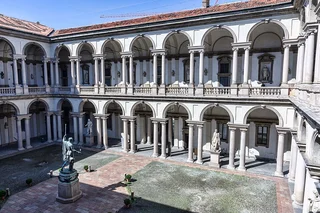
The Pinacoteca di Brera opened in Milan in 1809 as the principal art museum of Napoleon's Kingdom of Italy. Its collection was built from pictures taken out of the churches and monasteries that the new authorities were suppressing all over northern Italy. That is why so many works in the Brera were never painted for a museum: they are parts of altarpieces, huge canvases made for confraternities, and frescoes that were once one with their walls.
For almost every work here you can pin down the moment it changed place or status. Some pictures were taken when monasteries closed, others were exchanged, bought or accepted by bequest. Frescoes were cut from walls, polyptychs were taken apart into separate panels, and sometimes the museum later tried to put them back together.
We begin with the bronze Napoleon in the courtyard of the palazzo and end with a picture by Umberto Boccioni that hangs across the street, in Palazzo Citterio.
Napoleon's Museum
The first pictures were brought to the Brera from suppressed churches, monasteries and confraternities. Nearly every one of them had been painted for a particular altar, chapel or hall.
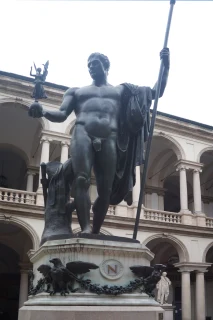
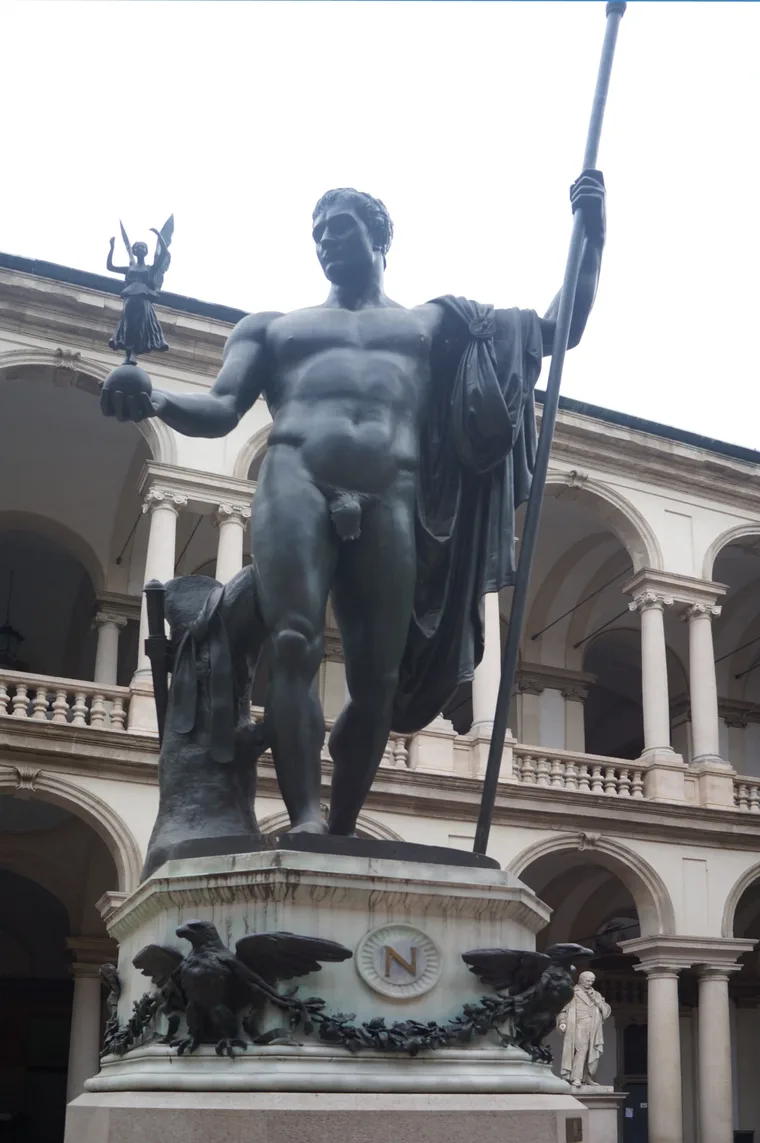
1. Napoleon as Mars the Peacemaker — Antonio Canova, 1807–1811
In October 1810, at Fontainebleau, Canova argued with Napoleon over whether the emperor could be shown naked. The marble statue the sculptor had worked on from 1803 to 1806 was at that moment on its way to Paris by sea, and Canova later wrote the conversation down himself. In French breeches, he told Napoleon, not even God Almighty could have made anything beautiful. The sculptor's language was the nude body and fitting drapery, as the poet's language was verse, and modern dress in sculpture sounded like the speech of the street.
The bronze replica for Milan was commissioned in the spring of 1807 by Eugène de Beauharnais, who had seen the marble in Canova's studio in Rome. It was cast in Rome by Francesco Righetti and his son Luigi, from the metal of melted-down cannon from Castel Sant'Angelo. The first casting failed, the second was finished by 1811, and in 1812 the bronze arrived in Milan. It was meant to stand in the courtyard of the Senate, but Napoleon fell in 1814 and the statue was put away in the academy's cellars. In 1857 the Austrian emperor, on a visit to Milan, ordered it set up in the public gardens at state expense, and the order had still not been carried out when the war of 1859 broke out.
Lombard patriots raised the statue in the courtyard of Palazzo Brera on 14 August 1859, two months after Napoleon III had entered Milan.
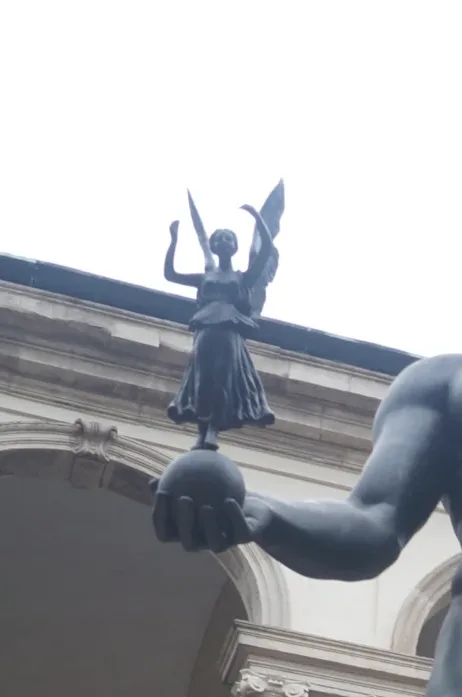
The body faces straight ahead, while the head turns sharply and bends towards the outstretched right hand, which holds an orb with a small winged Victory. In his left hand Napoleon holds a long staff high, his cloak is fastened at the shoulder with an eagle clasp, and from the tree stump behind his right leg hangs a sheathed sword with its baldric. That put-away weapon is what makes this Mars the Peacemaker. When the statue was restored in 2013–2014 it was weighed and turned out heavier than expected, more than three tonnes, because the casting earth from the Roman foundry was still inside it. The winged Victory was stolen from the orb in 1978 and never found, and the present figure was made from photographs in the early 1980s.
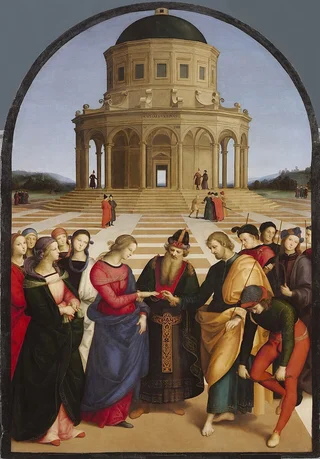
2. The Marriage of the Virgin — Raphael, 1504
On 29 January 1798 the authorities of Città di Castello, a small town in Umbria, handed Raphael's altarpiece from the church of San Francesco to General Giuseppe Lechi, who had arrived there with his troops. Historians disagree over whether they did so willingly: letters of the Lechi family published in 2022 describe a gift from the municipality, while other writers believe the town had no choice. Lechi took the picture to Brescia and sold it to a Milanese count, Giacomo Sannazzari della Ripa, who on his deathbed in 1804 left everything he owned to Milan's main hospital, the Ospedale Maggiore. In 1806 the viceroy's government bought the picture from the hospital and gave it to the academy.
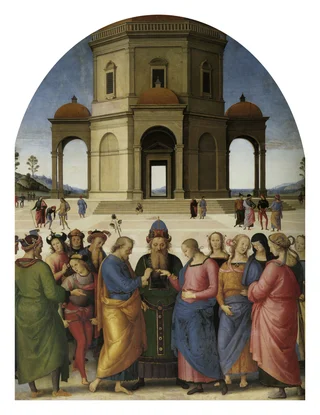
The Albizzini family commissioned it for their chapel of Saint Joseph, which is why Joseph is brought to the foreground. Raphael was 21, and he took as his model the Marriage of the Virgin that his teacher Perugino had painted for the cathedral in Perugia. Raphael pushed the temple further back, set the figures in an arc that echoes the temple's round plan, and left a vast empty piazza between them and the building.
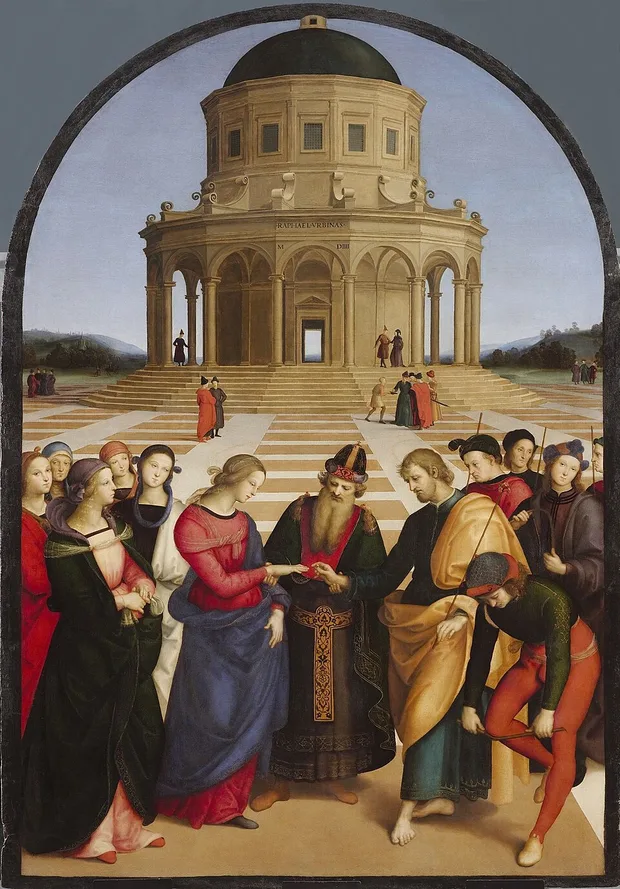
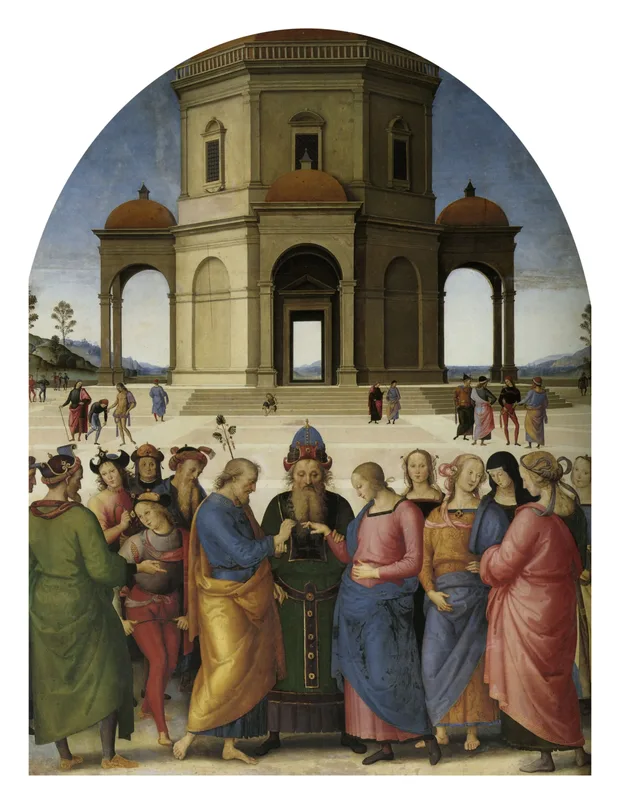
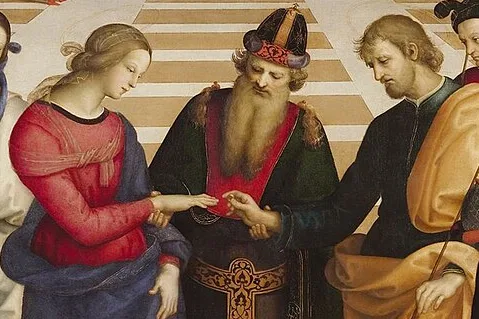
The high priest holds Mary and Joseph by the wrists as Joseph puts the ring on her finger, and the ring falls at the exact centre of the picture, directly below the door of the many-sided temple. The door stands open, the sky shows through the building from the far side, and every line of the paving runs to that door. The frieze above the arcade reads RAPHAEL VRBINAS, and the date is split on either side of the arch below, M on the left and DIIII on the right. Joseph holds a rod that has burst into flower, the sign that the lot has fallen to him, and in the lower right corner a rejected suitor in scarlet hose breaks his own flowerless rod over his knee.
In June 1958 the painter Nunzio Guglielmi smashed the double protective glass with a hammer, struck the panel twice with an awl, by Mary's elbow and in the middle of the temple steps, and stuck a leaflet on it reading “Long live the Italian revolution, down with the clerical government!” The glass took most of the force, and Guglielmi himself was held for about a year in the psychiatric hospital at Volterra.
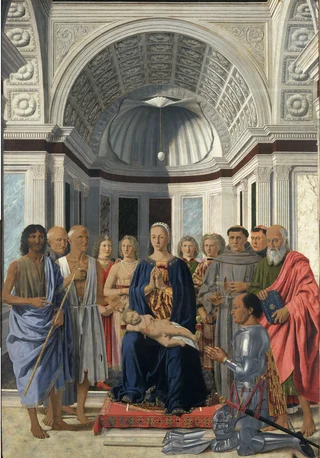
3. Brera Madonna — Piero della Francesca, 1472–1474
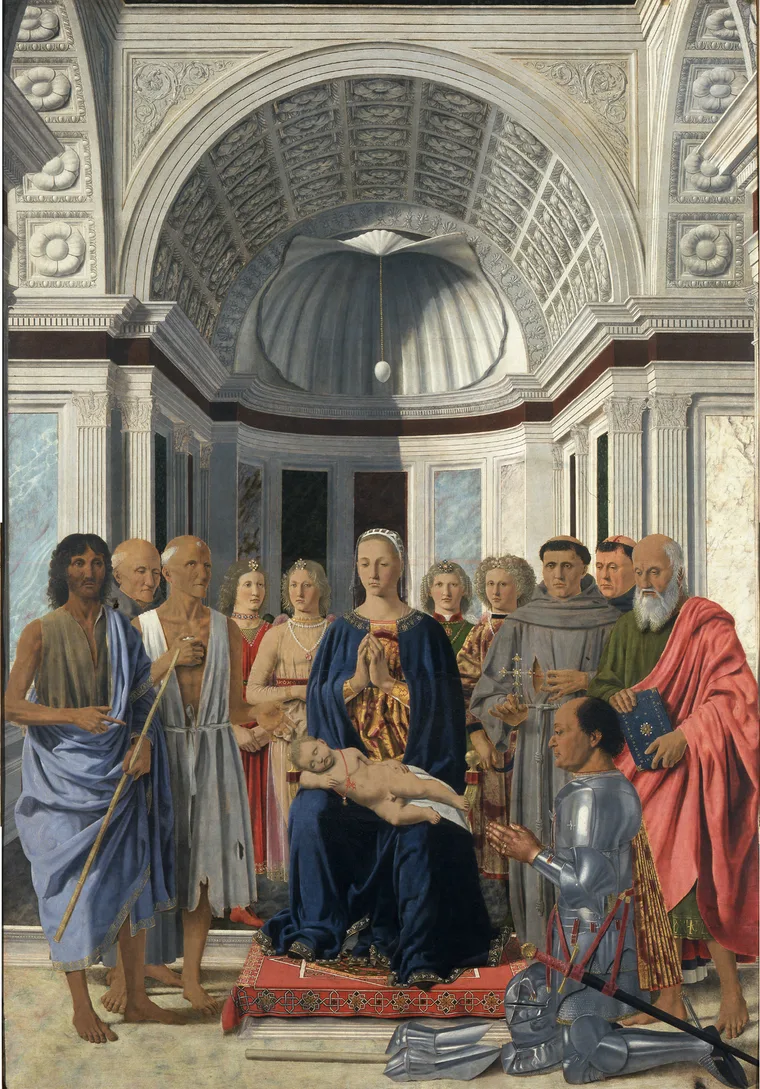
A white egg hangs on a thin chain above the Madonna's head. The chain drops from the top of the apse, whose half-dome is carved as a huge shell, and the egg hangs exactly on the picture's central axis, looking small against the grey stone. The American art historian Millard Meiss took it for an ostrich egg, a symbol of the virgin birth, because ostrich eggs were hung in churches. The ostrich was also an emblem of Federico da Montefeltro, ruler of Urbino, and the museum's text brings the two meanings together, miraculous motherhood and the patron's heraldry.
Federico himself kneels on the right in full plate armour, in left profile, as he was always painted, because he had lost his right eye in a tournament. His helmet, gauntlets and commander's baton lie on the floor in front of him. In the view of scholars, the hands joined in prayer were repainted by another of the painters working in Urbino, most likely the Spaniard Pedro Berruguete. Federico's wife, Battista Sforza, died in July 1472, six months after the birth of their son Guidobaldo, and the museum sees a foreshadowing of death in the Child asleep on the Madonna's lap, and reads the whole picture as a funerary one.
Piero painted it in tempera on panel for Federico, probably for the church of San Donato degli Osservanti outside Urbino, where the duke was first buried. Later the panel stood on the high altar of San Bernardino, the church built over his tomb in 1482–1491, after his death. At some unrecorded date it was cut down at the sides and along the bottom. You can see this in the upper corners, where the vaults and cornices break off halfway, and at the lower edge, which runs almost right up against the armour on the floor. In 1811, after the monasteries were suppressed, the panel was taken down from the altar of San Bernardino and carried off to the Brera.
4. Pala Sforzesca — Master of the Pala Sforzesca (Giovanni Angelo Mirofoli), 1494–1495
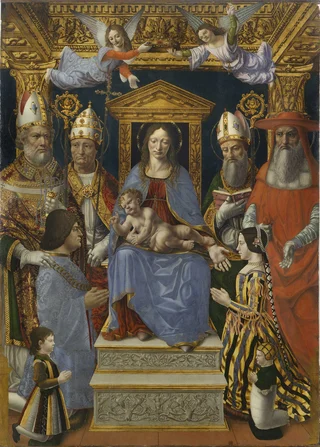
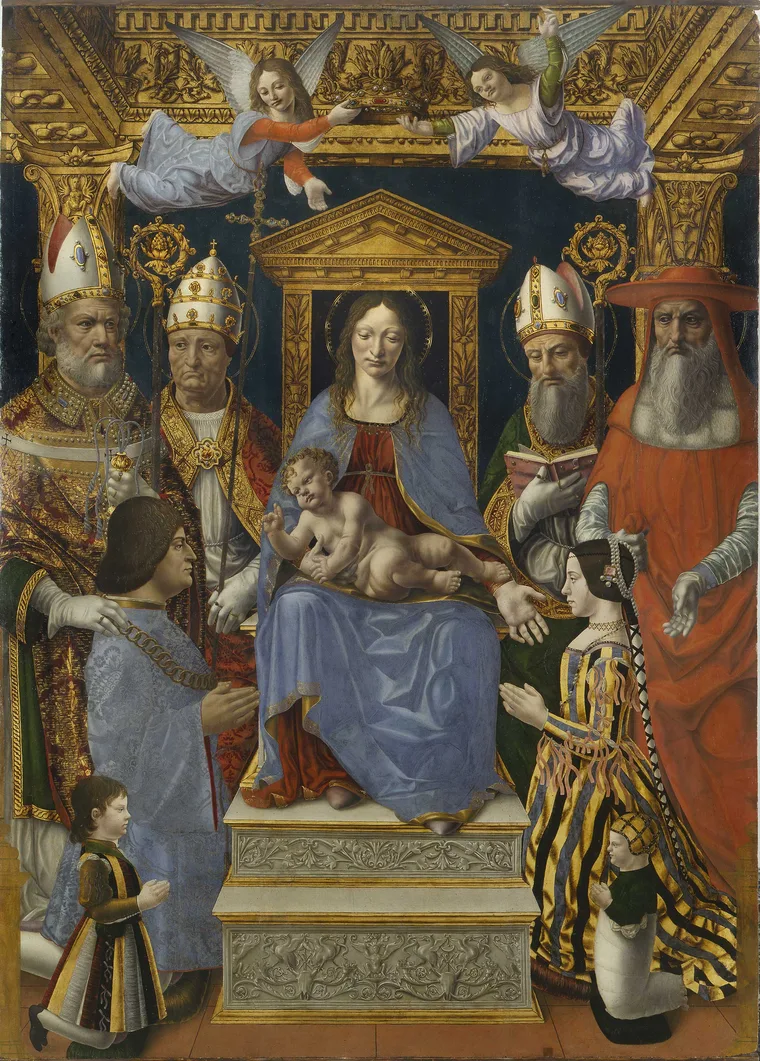
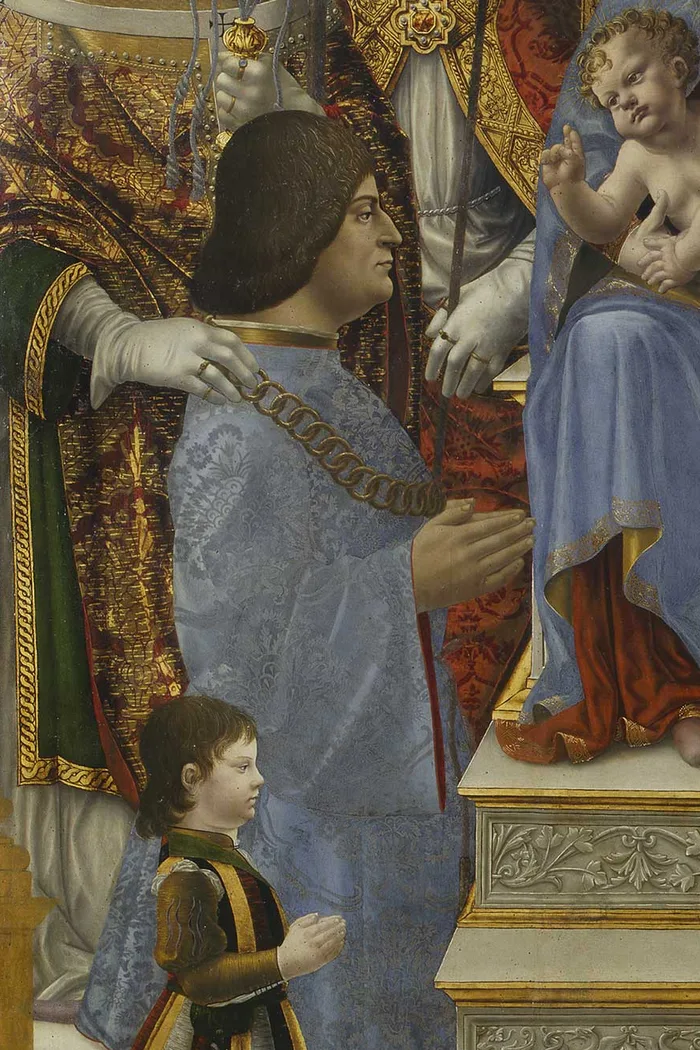
Ludovico Sforza, known as il Moro, kneels on the left in strict profile, in a blue damask gown with very wide sleeves and a heavy gold chain, and Saint Ambrose, the patron saint of Milan, lays a white-gloved hand on his shoulder. The museum singles out this gesture as the heart of the picture. The altarpiece was painted in 1494 for the church of Sant'Ambrogio ad Nemus outside the city walls, dedicated to the same Ambrose. In October that year Duke Gian Galeazzo Sforza died, and Ludovico pushed the duke's small son aside and pressed Emperor Maximilian to recognise Ludovico himself as duke. The museum calls the altarpiece an operation of political propaganda, in which the city's own patron saint presents the new ruler to the Madonna.
Beatrice d'Este, Ludovico's wife, kneels on the right, also in profile. Her hair is pressed smooth over her ears, a thin band with a pendant crosses her forehead, a long plait bound with cord hangs down her back, and her dress is in broad vertical stripes of gold, black and blue. Behind the father kneels a boy of about four, behind the mother a baby in white swaddling bands, and both are tiny beside the adults. Even the museum gives no single answer as to who these children are. Its collection record allows for Ludovico's illegitimate son Cesare, while its educational material names Beatrice's legitimate sons.
The painter's name was long unknown, and he was called the Master of the Pala Sforzesca, after this picture. The Brera catalogue names him as Giovanni Angelo Mirofoli. The monastery attached to Sant'Ambrogio ad Nemus was suppressed in 1798, and the altarpiece came to the Brera with the other church pictures removed under the Napoleonic suppressions. According to the museum, the pattern on Ludovico's blue fabric repeats his emblem, the houseleek, with the German motto MIT ZEIT, “in time”.
5. Saint Mark Preaching in Alexandria — Gentile and Giovanni Bellini, 1504–1507
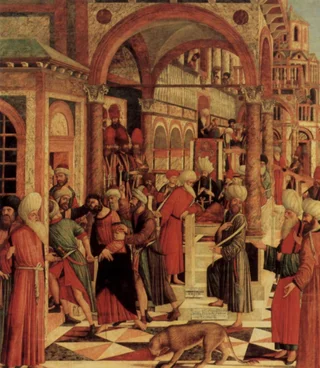
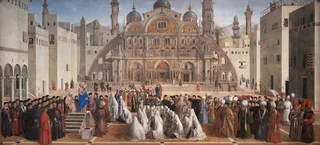
A giraffe walks across the huge square in front of a domed church, a camel stands at the left edge, and another lies in the shade on the right. The canvas is far wider than it is tall, and the crowd fills its whole lower third. On the left, Venetians in black caps and dark or scarlet robes stand in a dense wall, members of the confraternity the picture was painted for. In the centre sit women in a tight wedge, wrapped from head to foot in white veils, the brightest patch in the lower part of the picture. On the right are men in huge white turbans and tall red caps. Saint Mark preaches from a small platform, and the church behind him looks like the basilica of San Marco in Venice.
Gentile Bellini had never been to Egypt. He took his motifs from Erhard Reuwich's woodcuts for Breydenbach's book on the pilgrimage to the Holy Land, published in 1486, and from what he had seen for himself in the East. In 1479–1480 Venice sent him to Constantinople at the request of Sultan Mehmed II, and the sultan gave him a gold chain. The museum's audio guide points out Gentile himself among the brothers in the foreground, dressed in red and wearing that chain.
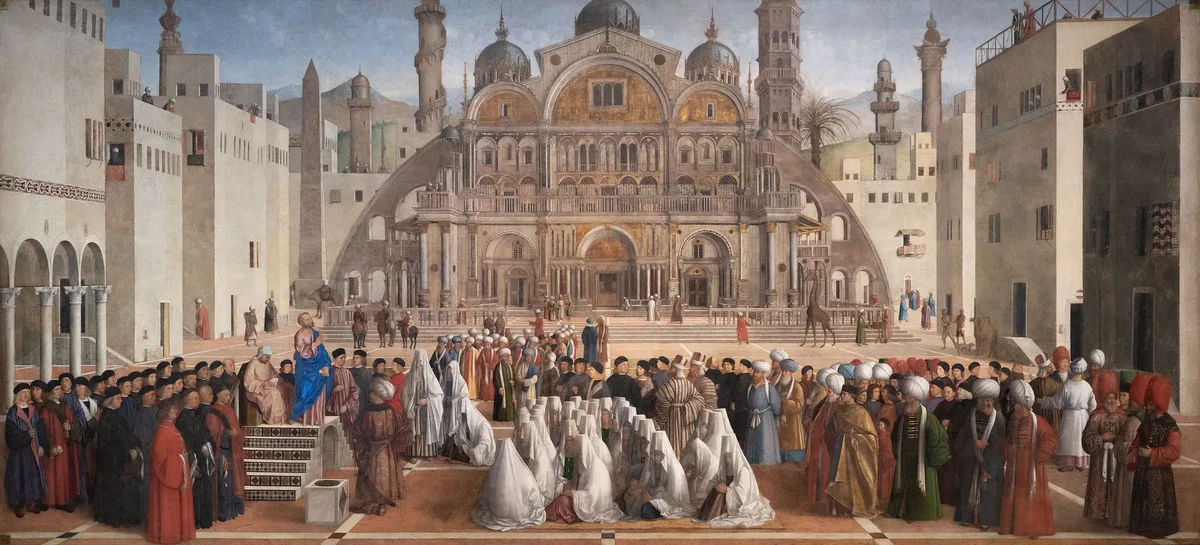
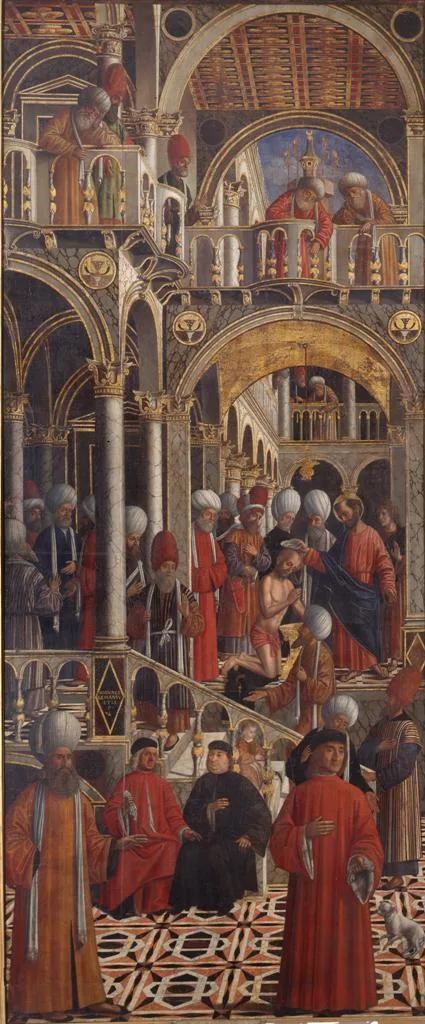
The picture was commissioned by the Scuola Grande di San Marco, one of the great Venetian confraternities, for the room where its officers met, after a fire in 1485 had destroyed the earlier decoration. Gentile was a member of the confraternity, and in 1504 the Scuola accepted his offer to paint new pictures. After the confraternity was suppressed under Napoleon, the canvas was taken to the Brera in 1809 together with Giovanni Mansueti's Saint Mark Baptising Anianus from the same room, while the other pictures of the cycle stayed in Venice.
Gentile did not live to finish it. On 19 February 1507, already ill, he made his will and charged his brother Giovanni with completing the canvas, and the museum attributes to Giovanni the portraits of confraternity members on the left. Four days later Gentile died, and as payment for the work he left Giovanni the book of drawings by their father, Jacopo.
6. Finding of the Body of St Mark — Jacopo Tintoretto, 1562–1566
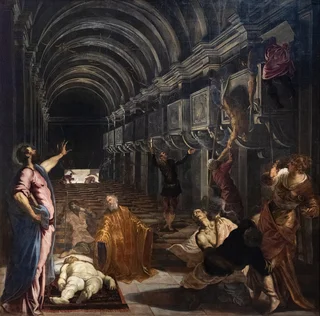
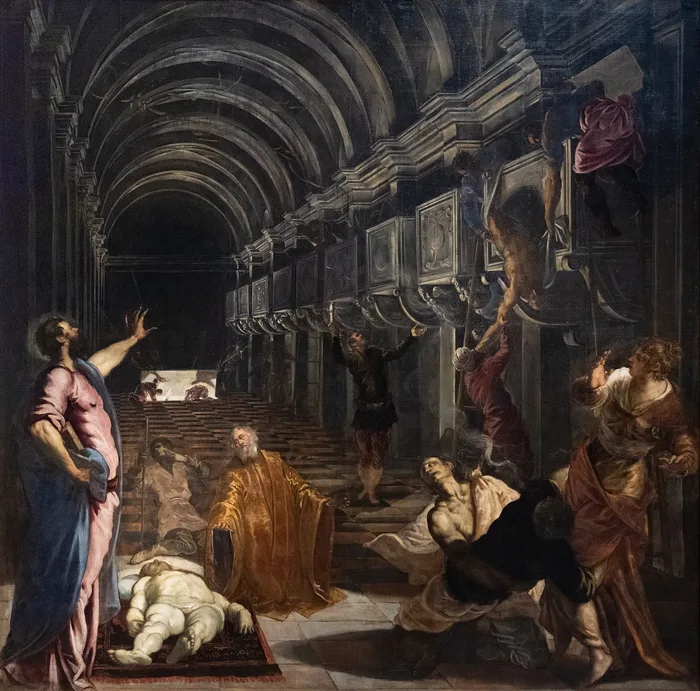
On 21 June 1562 Tommaso Rangone, a physician from Ravenna and head of the same Scuola Grande di San Marco, asked the brothers' leave to commission, at his own expense, three pictures of the miracles of Saint Mark, and they agreed. Tintoretto put Rangone himself into all three. Here he kneels in the middle, grey-bearded, in a heavy robe of gold brocade, the only person in the picture dressed as a nobleman of the painter's own day. It is often said that the brothers grew tired of how prominent the patron was and sent the canvases back to the painter to have the figure of “the man from Ravenna” taken out. If so, the canvases came back to the Scuola unchanged.
A long vaulted hall recedes diagonally into the distance. On the right, men are opening tombs in the wall and lowering a naked body head first down a ladder. At the left edge stands Saint Mark himself, pale, taller than anyone else, raising his arm in command, and at his feet his own body lies on a carpet, feet towards the viewer. In the lower right corner a possessed man writhes on the floor, and thin grey wisps rise above him as the demon leaves him in a trail of smoke. The traditional title goes back to the 17th century, and the museum follows the reading of the historian Augusto Gentili, in which the picture shows Mark's miracles in the church at Alexandria: healings, raisings of the dead and the casting out of a demon.
The Scuola was suppressed under Napoleon. The painter Andrea Appiani, who was in charge of the fine arts in the Kingdom of Italy, chose the canvas for the new gallery in Milan, and on 30 July 1811 it arrived in Milan, where it was not put on show. In 1847 the parish priest of the Milanese church of San Marco asked to have the picture on deposit, and the academy's commission let it go, granting it “rare merits” but finding it too large and burdened with an “uninteresting architectural background”. Rangone's two other canvases remained in Venice and reached the Gallerie dell'Accademia only in 1920. In 1886 the Brera's director, Giuseppe Bertini, brought the Finding back to the gallery as one of his first decisions, calling it “a miracle of tragic power”.
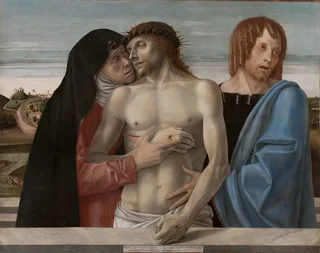
7. Pietà — Giovanni Bellini, c. 1460–1470
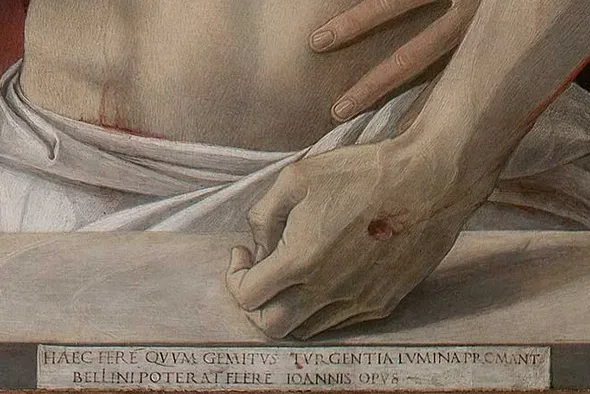
At the bottom, on the front face of the marble parapet, a small slip of paper is painted as if stuck to the stone, with two lines of Latin verse on it. Bellini reworked a line by the Roman poet Propertius and wrote his own name into it. Roughly, the inscription says that this scene fills the viewer's eyes with tears, and that Bellini's painting itself seems able to weep.
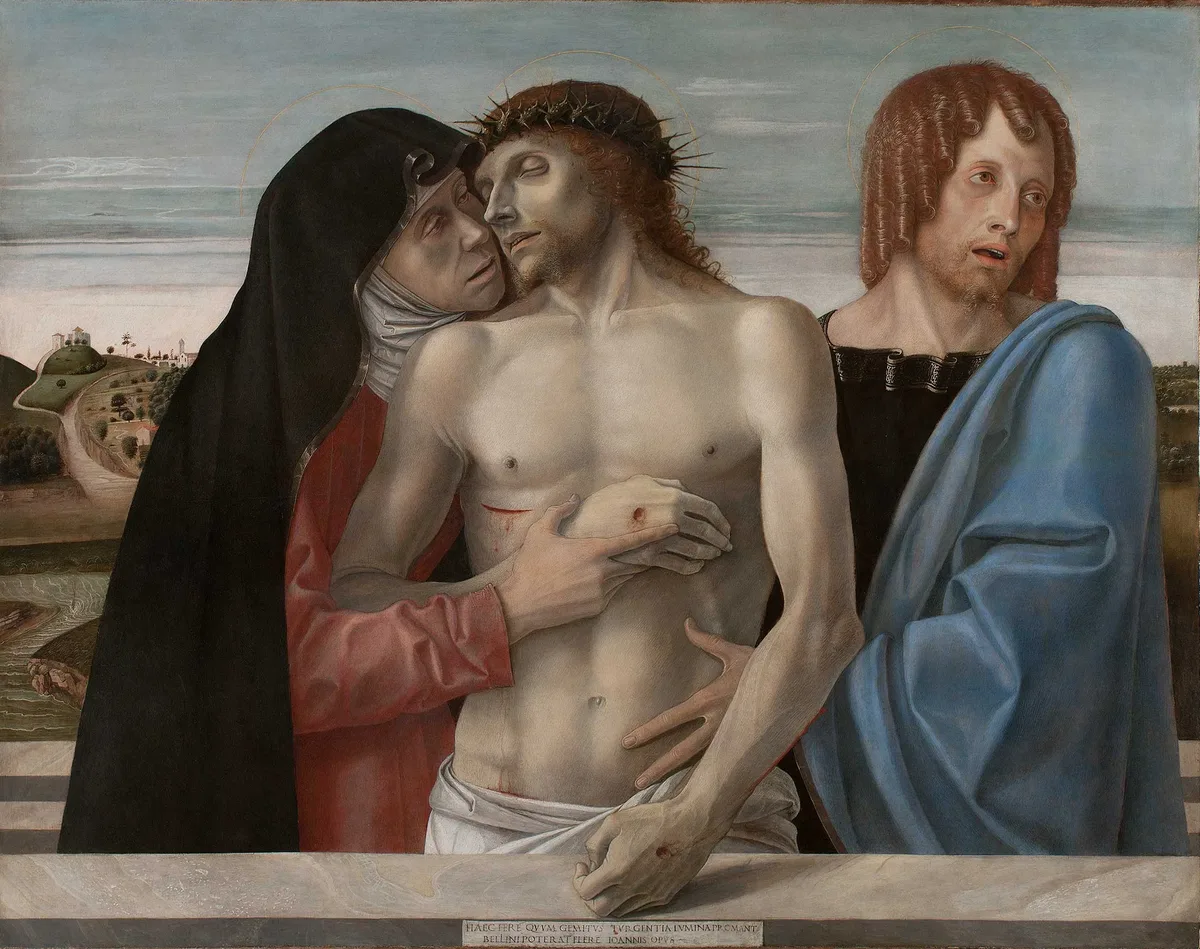
Three figures are seen waist-high behind the parapet. The dead Christ stands in the middle, held up from both sides, his head in its crown of thorns fallen against his mother's face. Mary presses her cheek to his and with both hands holds his right hand to her breast, so that the nail wound falls at the centre of the picture. John, on the right, turns away, his mouth open and his eyes red. Christ's left hand rests on the parapet, and its wounded fingers hang over the edge of the stone towards the viewer. The sky is cold and pale blue with long streaks of cloud, and in a small landscape on the left, water swirls round a dead tree stump.
Bellini's sister was married to Andrea Mantegna, and the hard, almost stony drawing of Christ's body is often linked to his influence.
Scholars have not established who commissioned the Pietà or where it was meant to go. It is known from the collection of the Sampieri family in Bologna. In 1811 the Sampieri sold off their collection, and that same year the viceroy Eugène de Beauharnais gave the Pietà from it to the Brera.
Taken Apart, Taken Down, Put Back Together
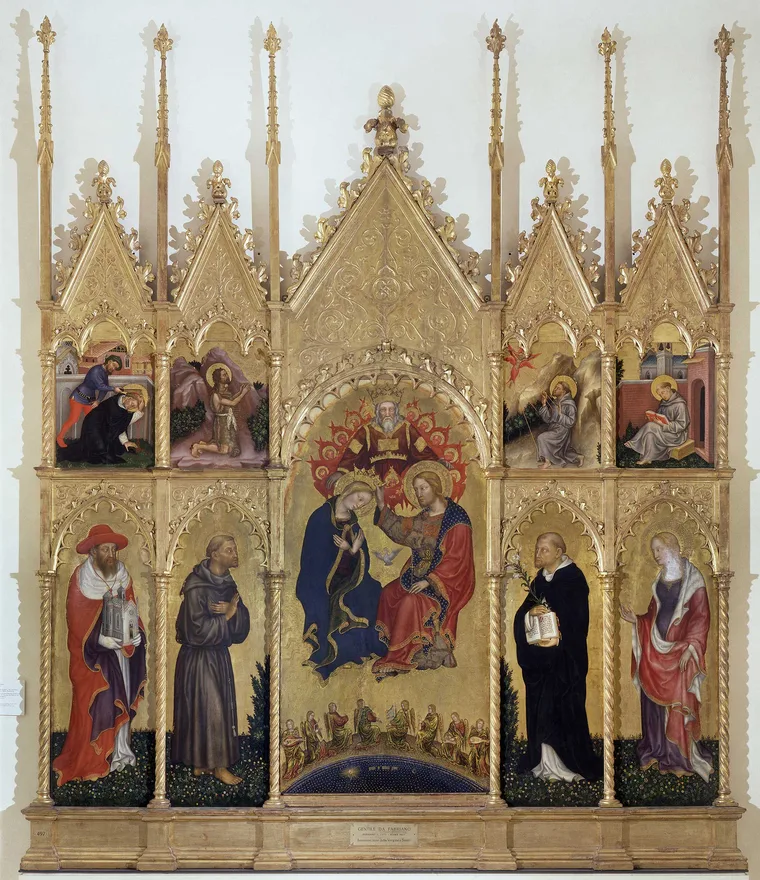
Once they reached the Brera, altarpieces were often dismantled. Polyptychs were split into separate pictures, panels that were not wanted were traded for works of other schools, and frescoes were taken off the walls and transferred to new supports.
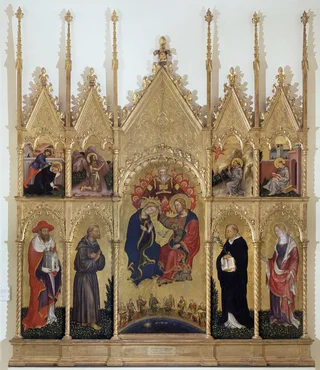
8. Coronation of the Virgin with Saints (Valle Romita Polyptych) — Gentile da Fabriano, c. 1406–1410
The Observant Franciscan hermitage of Santa Maria di Valdisasso near Fabriano, known as Valle Romita, was suppressed on 4 June 1810, and the inventory of its property was drawn up by a Napoleonic official, Carlo Rosei. He kept for himself the four small panels from the upper tier of the altarpiece, and they stayed with his descendants for almost a century. On 24 September 1811 three large panels reached the Brera: the Coronation of the Virgin and two panels each painted with a pair of saints. At the museum the paired panels were sawn apart, each saint was given a frame of its own and hung separately, and so three panels became five pictures. In October 1901, on the advice of its director Corrado Ricci, the Brera bought the four small scenes from Rosei's heirs, and in 1925 all the parts were fixed onto new supports and assembled in a new neo-Gothic gilt frame.
Gentile da Fabriano, a native of the area, painted the altarpiece in the years when he was living and working in Venice. No documents about the commission survive, and most scholars take the patron to have been Chiavello Chiavelli, lord of Fabriano, who in 1405 bought the abandoned hermitage to make a family burial place there.
Christ in a red cloak sets the crown on Mary's deeply bowed head, above them is God the Father in a ring of red seraphim, and between them the dove. Below the pair small angels sing and play, and lower still runs a dark blue arc scattered with gold stars, so that the coronation takes place above the starry sky. The gold ground is scratched with fine rays, and the haloes are punched with a floral pattern. Jerome, Francis, Dominic and Mary Magdalene in the lower tier stand on a dark meadow in which every tiny flower is painted separately.
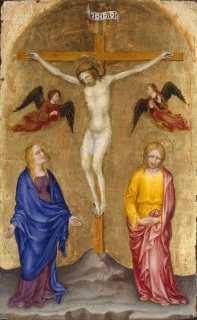
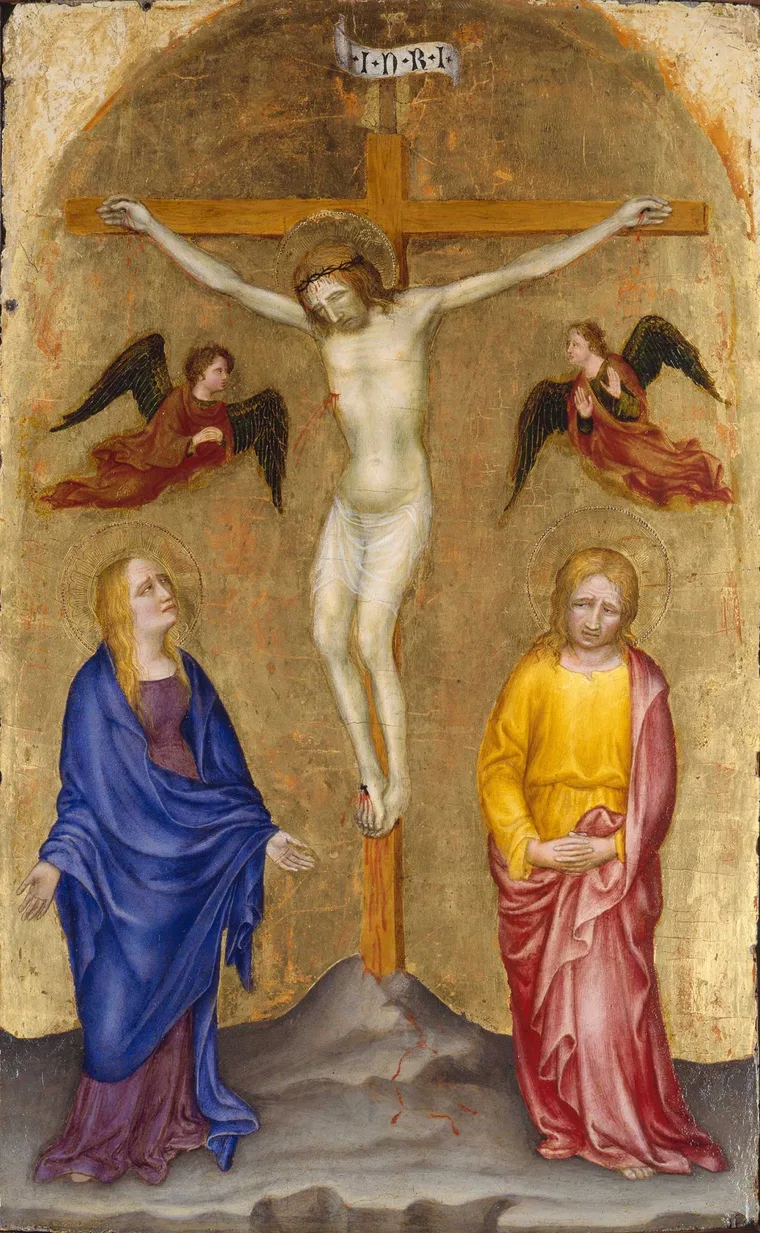
The gable of the frame above the Coronation is filled with carving alone. A lost top panel once stood here, and on circumstantial grounds, without documentary proof, the space is linked with Gentile's Crucifixion, which the Brera bought on the London market in 1994 and keeps as a separate work.
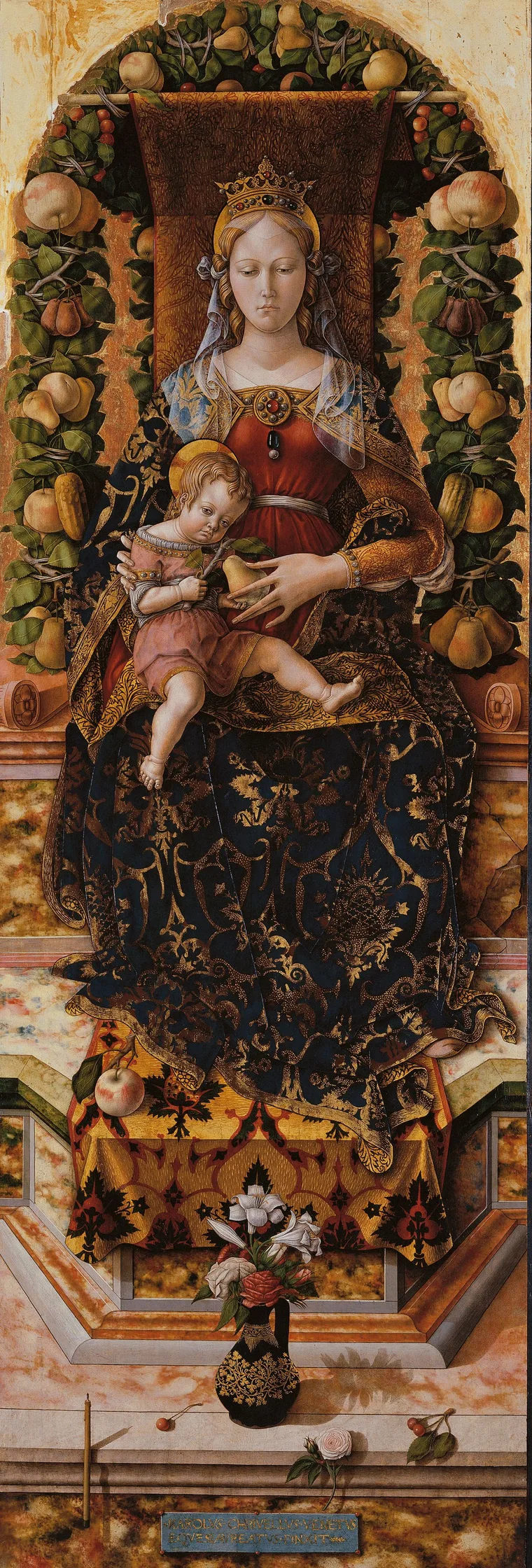
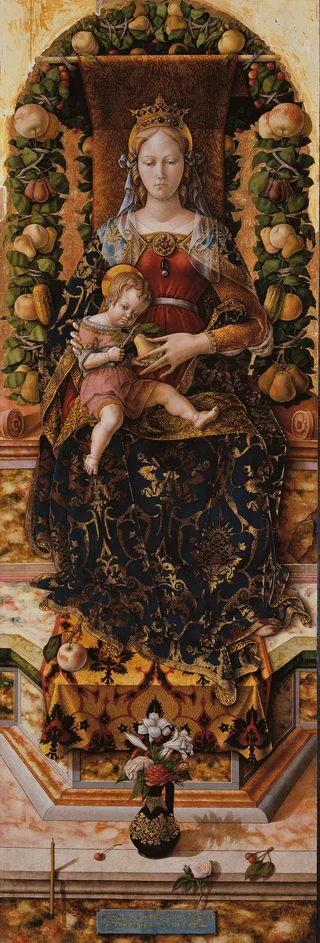
9. Madonna della Candeletta — Carlo Crivelli, c. 1490
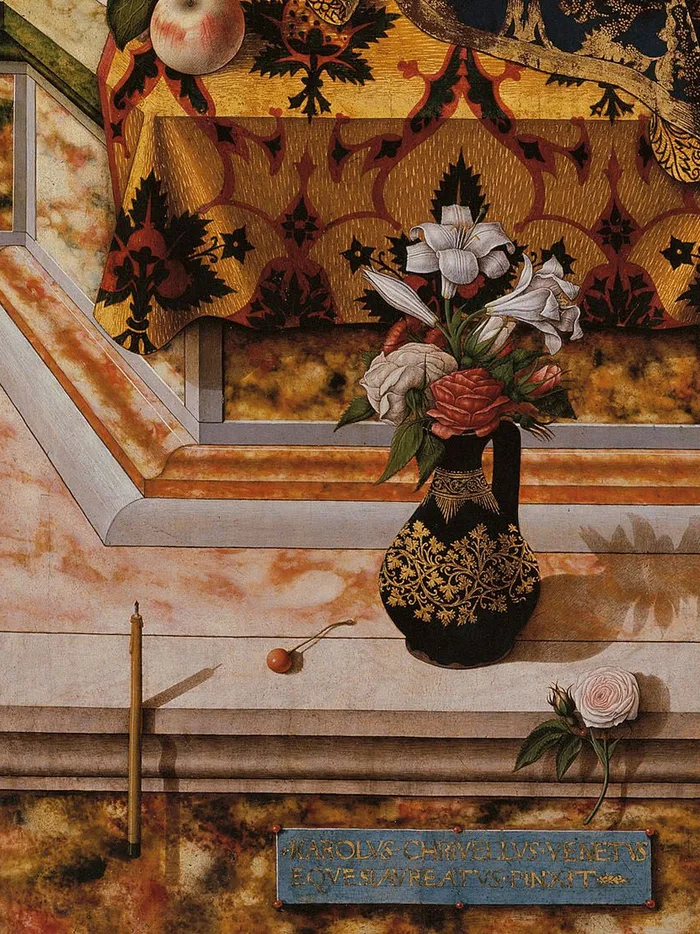
On the step of the throne, at the left edge, stands a thin unlit candle held upright by a single drop of wax. The candle gives the picture its name, the Madonna of the Little Candle, and the museum's text describes it as the viewer's own offering, left on the threshold of the painted world. Above it, on a marble throne, sits the crowned Madonna in a dark blue cloak covered in a large gold pattern, holding out a pear to the Child. Across the top runs a heavy garland of leaves, pears, apples, cucumbers and cherries, and the fruit is painted as if it were hanging out of the picture. On the lowest step stands a dark vase of lilies and roses, with cherries and a single rose lying beside it. On a small slip at the bottom centre is the signature, in which Crivelli calls himself a knight. He was knighted in 1490 by Ferdinand, Prince of Capua, and that word in the signature is what dates the picture.
Crivelli, a Venetian by birth, was convicted by a Venetian court in 1457 for an affair with a married woman and afterwards left Venice for good. He worked in Dalmatia, then in the Marche, and from the early 1480s lived in Camerino. For the high altar of Camerino cathedral he painted a large two-tier polyptych, but as early as 1548 the bishop, rebuilding the presbytery, most likely removed it from the altar. The earthquake of 1799 destroyed the cathedral, and the surviving parts of the polyptych were moved to the church of San Domenico. On 24 September 1811 the Napoleonic commission delivered 13 of Crivelli's panels to the Brera, 12 of them from Camerino.
From 1820 the museum began to treat these panels as separate pictures, decided it had too many of them and, in the words of the Brera's own 2009 exhibition text, swapped them like trading cards for pictures from the schools the collection lacked. A few decades later it was the turn of the panel with Saints Ansovinus and Jerome, which had stood beside the Madonna: it went to the Gallerie dell'Accademia in Venice, which had no Crivelli of its own. The other side panel, with Peter and Paul, had been found separately under the ruins of the cathedral, and it too ended up in Venice. So of the whole polyptych the Brera kept only the central panel.
In April 2026 the town council of Camerino formally asked the Ministry of Culture to return the Crivelli panels taken in 1811, eight in all. Five of them are in the Brera and the others in Venice and Berlin, and one of them reached Berlin because the Brera itself traded it away in the 19th century.
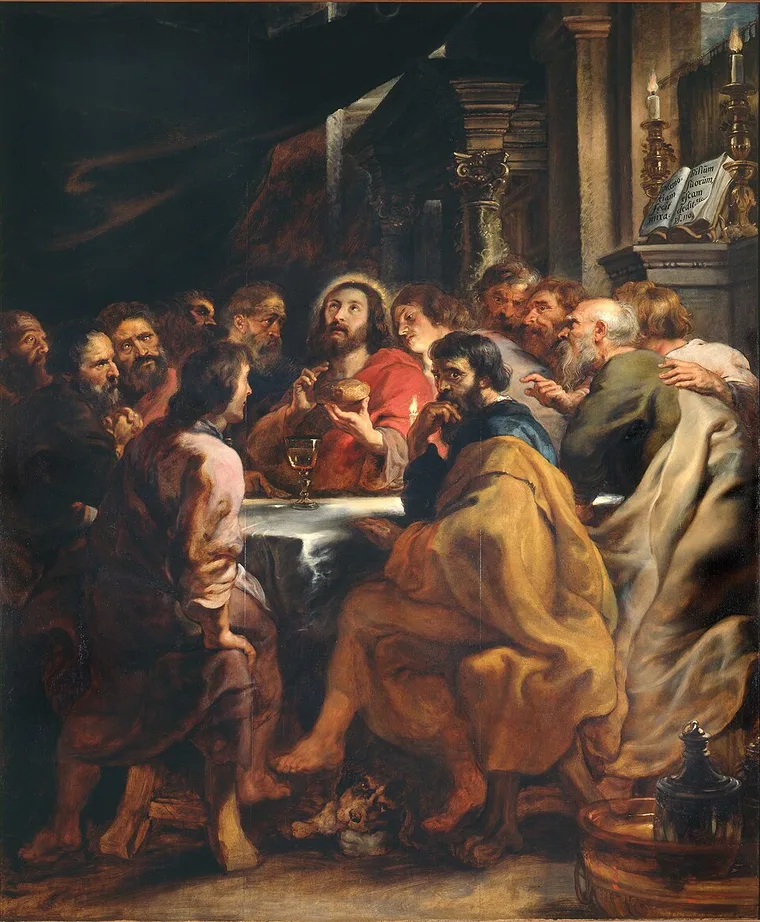
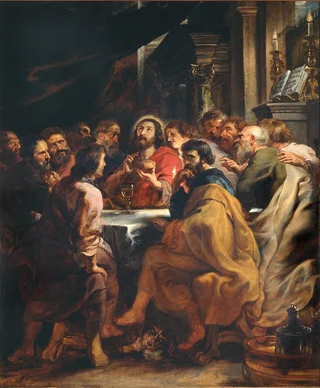
10. Last Supper — Peter Paul Rubens, c. 1631–1632
In 1812 the director of the Louvre, Vivant Denon, proposed an exchange to the Brera, five Italian pictures for five northern European ones. The academy's commission was against it, but the viceroy Eugène de Beauharnais approved the deal. Among the pictures that went to the Louvre were Carpaccio's The Sermon of St. Stephen and two panels by Moretto that the Brera itself had taken not long before from a Venetian confraternity and from a church.
Rubens painted the Last Supper for the altar of the chapel of the Holy Sacrament in St Rumbold's Cathedral in Mechelen, and it was commissioned by Catherine Lescuyer in memory of her father, who was buried beneath that chapel. In 1794 French revolutionary commissioners took the picture from Mechelen to the Louvre. The two predella panels, Christ Enters Jerusalem and The Foot Washing, were sent in 1803 to the provincial museum at Dijon, and during the exchange, it is thought, they were forgotten, so they stayed in Dijon.
Christ sits at the table in red, blessing the bread and looking upwards, past the apostles, with a candle burning beside him. In the right foreground sits Judas, the largest figure, in a blue tunic and a huge ochre-yellow cloak. He holds his hand to his mouth and turns round to face the viewer, the only one of them who looks at us. Under the table, almost at his foot, a dog gnaws a bone.
Of the five pictures received from Denon, two turned out to be something other than what they had been taken for. The Sacrifice of Isaac, which the French had removed from the Prussian palace of Sanssouci as a Rubens, was recognised at the Brera as the work of Jacob Jordaens, and the Portrait of a Young Woman, sent as a Rembrandt, is now given to a follower of his.
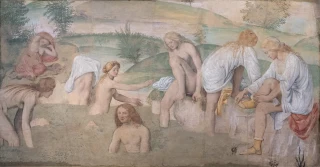
11. Nymphs Bathing, a Fresco from the Villa Pelucca — Bernardino Luini, c. 1514
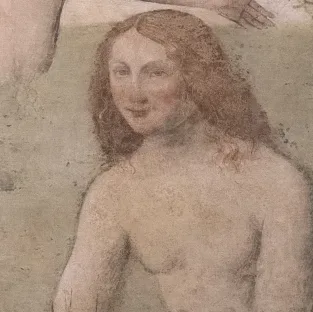
The Villa Pelucca near Monza, where the viceroy Eugène de Beauharnais had lived in the Napoleonic years, passed in 1816 to the treasury of the Lombardo-Venetian Kingdom, and soon afterwards it was decided to sell it into private hands. Before the sale, the Brera academy's standing commission on painting ordered the frescoes taken off the walls “to enrich the Pinacoteca”. The restorer Stefano Barezzi detached them in 1821–1822, and the bathing scene arrived at the Brera on 27 June 1822. The frescoes were taken from a building that still belonged to the treasury, so there was nothing to pay for them. The Brera had been taking frescoes off church walls before this, since 1808, but this was the first time a whole secular cycle from a country villa had come into the museum. Other fragments from the same villa later reached the Louvre, Chantilly and the Wallace Collection in London, each by its own route.
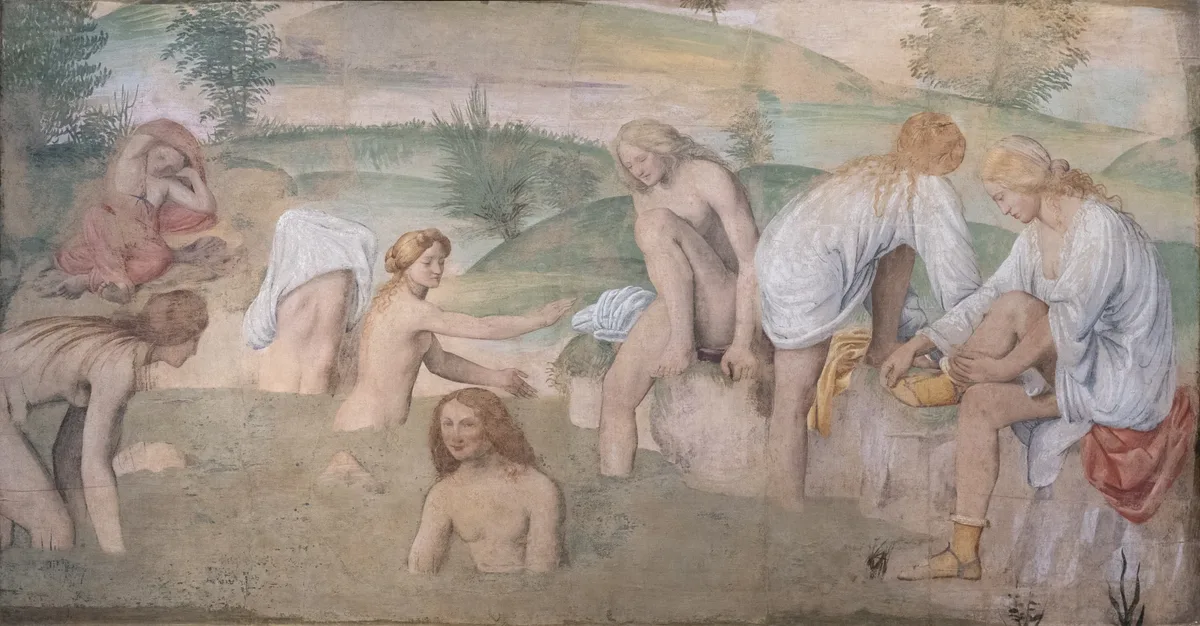
The villa was painted by Bernardino Luini for the Milanese aristocrat Gerolamo Rabia, who had inherited it around 1506. Mythological and sacred scenes ran through several rooms and the chapel. The frescoes are dated anywhere from 1509 to the early 1520s, and the choice of date decides whether this is the young Luini of Bramantino's circle or an already mature master. The Brera catalogue gives “about 1514”.
Eight girls are bathing in a stream. One sleeps on the bank at the left with her head on her arm, and another stands in the water with her back to us, pulling a white shift over her head so that her face is hidden. In the middle the head and shoulders of a girl with loose reddish hair rise out of the water, and she alone looks straight at the viewer. The museum allows that this may be Diana with her nymphs and Callisto, from Ovid's Metamorphoses. The whole surface is crossed by a network of fine cracks left by the transfer of the fresco to a new support. During a later restoration by Pinin Brambilla Barcilon the 19th-century wooden supports were deliberately kept as evidence of how the frescoes had been taken off the wall.
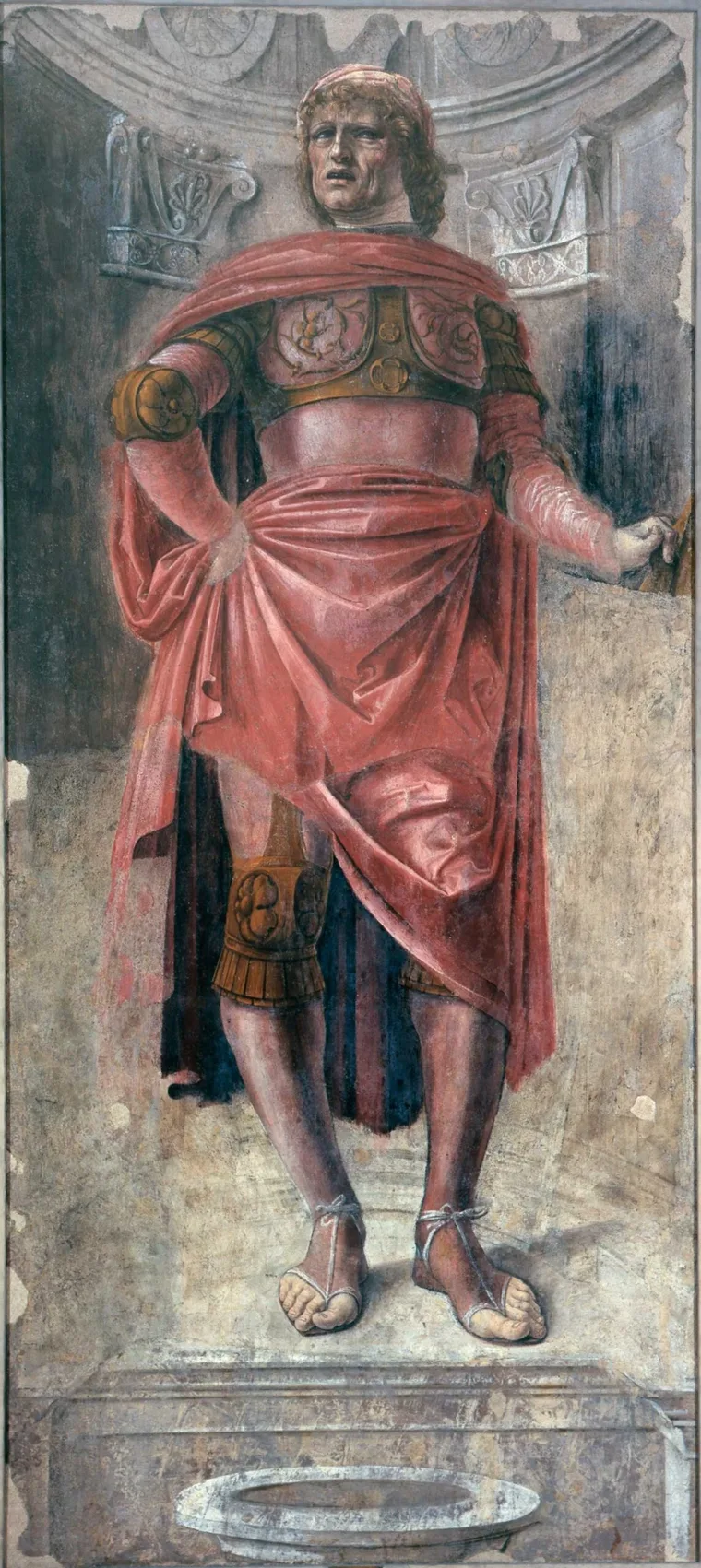
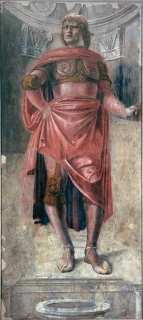
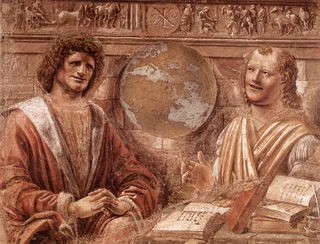
12. Men at Arms from the Casa Panigarola — Donato Bramante, c. 1486–1488
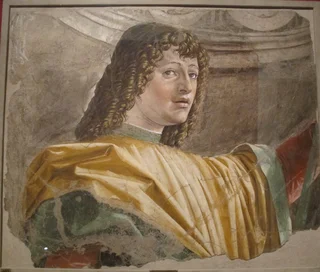
In 1486 the poet and humanist Gaspare Ambrogio Visconti, a counsellor at the court of Ludovico il Moro, bought a house on what is now Via Lanzone, not far from the basilica of Sant'Ambrogio. The architect Donato Bramante lived with him in the house, in 1487 he is recorded there as witness to a transaction, and the two friends exchanged sonnets. In one of the rooms Bramante filled fictive niches with armed men taller than life. The painter and writer Gian Paolo Lomazzo, who saw the room intact in the 16th century, writes that these were the most famous warriors of the day and that each had his name beside him. The museum points out that their armour is antique and their faces good-natured or comic, and takes the irony to be deliberate. The name Panigarola, by which the house is known, only became attached to it in 1548.
Over a door in another room Bramante painted two philosophers on either side of a large globe. Heraclitus on the left weeps, with a tear painted on his cheek, and Democritus on the right laughs, showing his teeth, and points at the globe. It has been suggested that the weeping Heraclitus is Leonardo and the laughing Democritus is Bramante himself. Of the figure known as the Man with a Halberd only a bust-length fragment with ragged edges survives, a young man with tight golden curls and parted lips, and the halberd itself can no longer be seen.
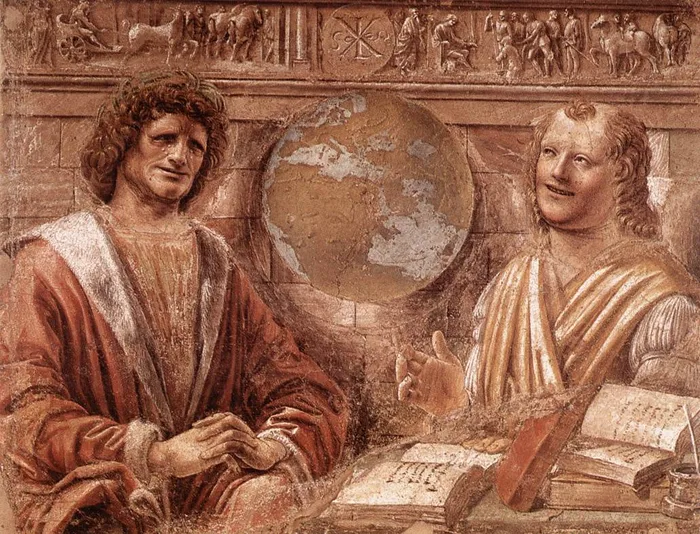
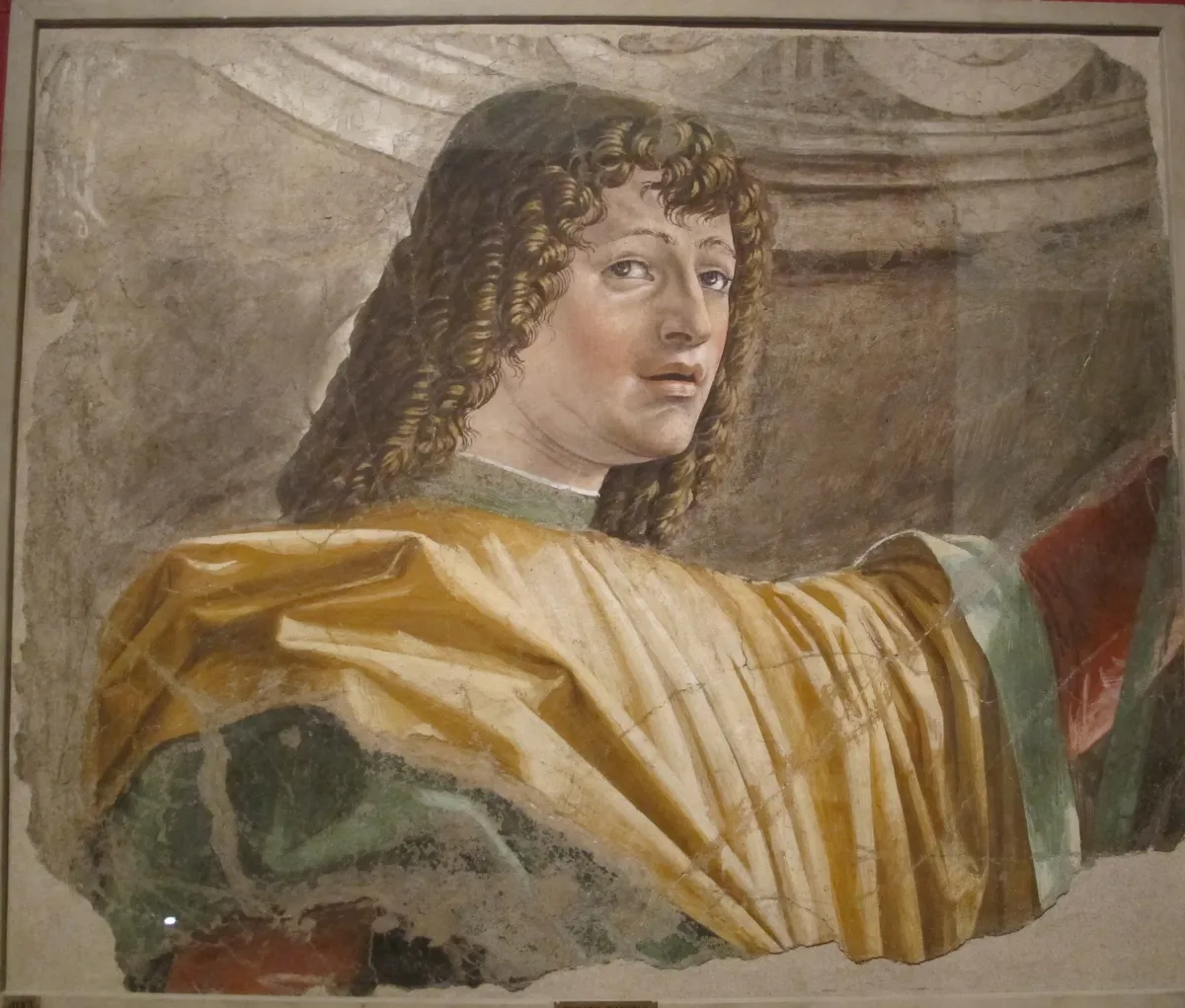
In 1901 the Annoni brothers, under the direction of the architect Luca Beltrami, took the paintings off the walls by the strappo method, in which the paint layer is pulled away from the wall on glued-on cloth and transferred to canvas, and in 1901–1902 the Brera's director Corrado Ricci bought them for the museum. The eighth standing figure was thrown away during the removal, on the assumption that it had been painted in the 19th century.
13. Frescoes from the Porro Oratory at Mocchirolo — Master of Mocchirolo, c. 1360–1370
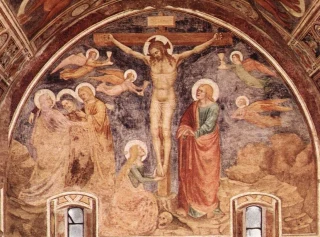
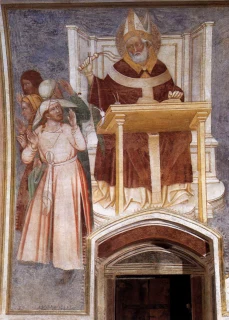
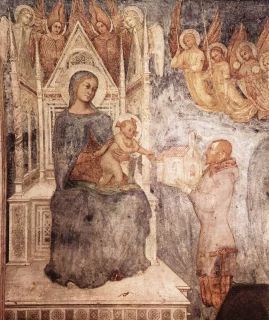
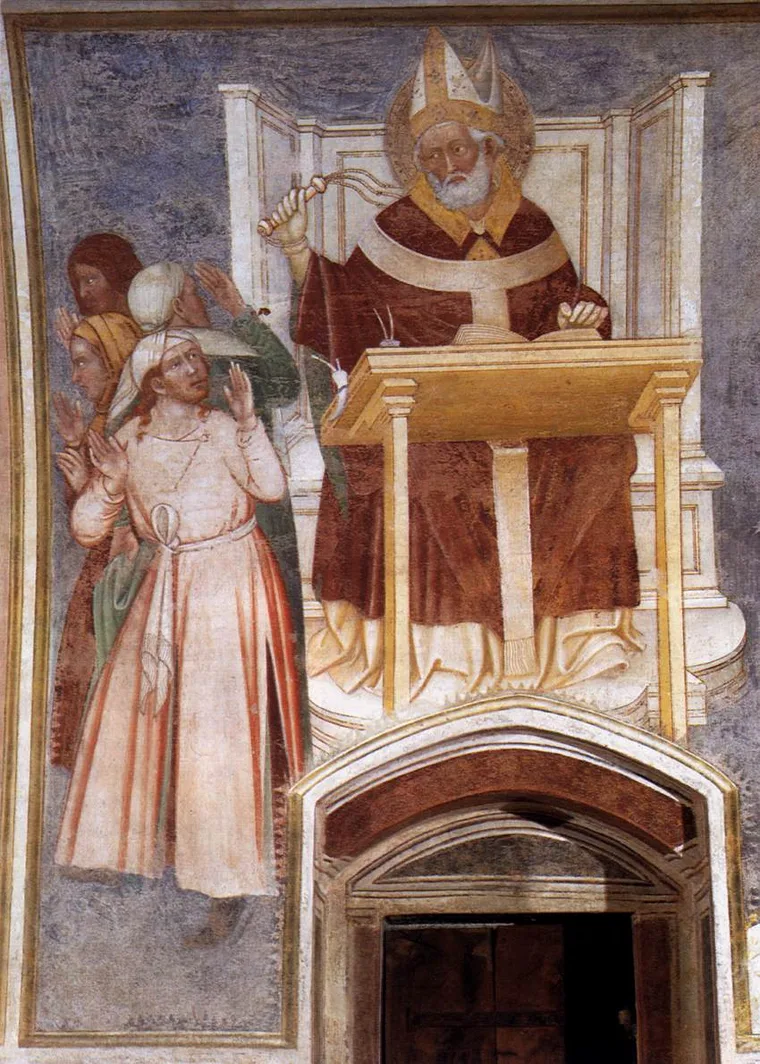
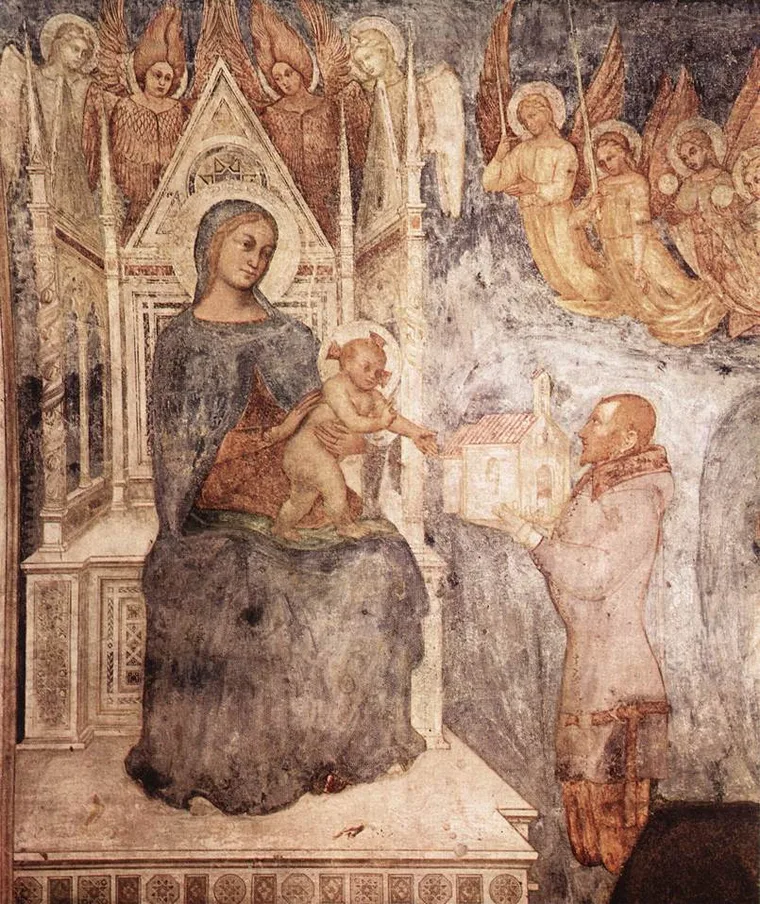
You can walk into the small vaulted 14th-century apse that was reassembled inside the Brera from frescoes taken off the walls. On the vault Christ in a pointed mandorla gives a blessing and holds an open book, with the symbols of the four Evangelists around him on a deep blue ground. On the back wall under the arch is the Crucifixion, and on either side of the cross two narrow lancet windows are cut into the wall, real ones, as in the oratory itself, so that the light falls as it did there. A long crack runs down through the blue from the crown of the vault, and the seams of the transfer have been left visible. On the side walls Saint Ambrose, enthroned, flogs two heretics, beside him is the Marriage of Saint Catherine, and opposite, the patron's family stands crowded together, offering their chapel to the Madonna.
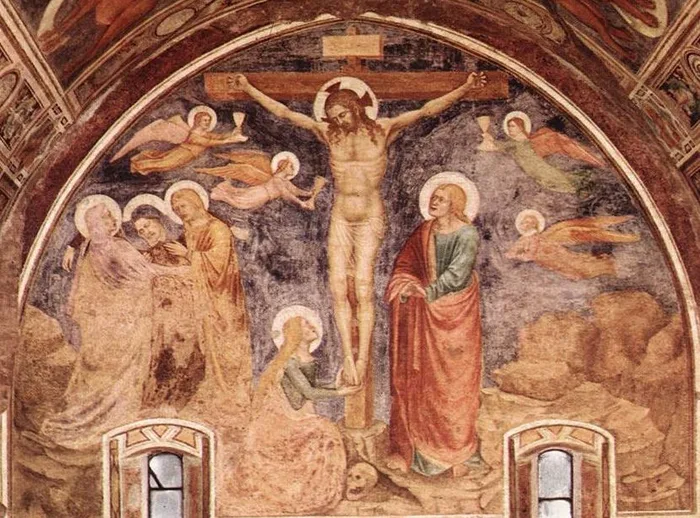
The paintings decorated the presbytery of an oratory built onto the houses of the Porro family at Mocchirolo, in Brianza, north of Milan. The Porro served the Visconti, and the Brera names the patron as Stefano Porro, a counsellor of Gian Galeazzo Visconti, while local historians name Lanfranco Porro. The museum leaves the painter anonymous and calls him the Master of Mocchirolo. The art historian Miklós Boskovits proposed identifying him as the Bergamo painter Pecino da Nova, but the Brera rejects the attribution because the dates do not match.
Damp was destroying both the building and the paintings. In 1949 the owners of the estate gave the frescoes to the state, and the Brera's director, Fernanda Wittgens, obtained permission in Rome to detach them and move them to the museum, which had just reopened after the bombing of August 1943. The paintings were taken down by Mauro Pellicioli, and the decision was controversial even then, because it went against the rule of keeping wall paintings where they had been painted. In 2000 full-size photographs of the frescoes were hung in the empty oratory. During repairs, sinopie, the preparatory drawings beneath the frescoes, were found on its walls, along with remains of figures of prophets that had been left in place when the rest was moved.
After Napoleon
After 1814 the collection grew more slowly and by other routes. Pictures were bought from heirs and dealers, received as gifts and accepted on deposit.
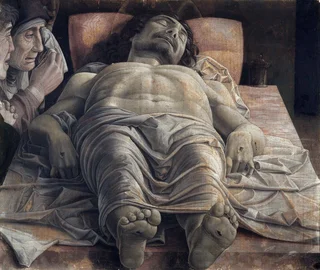
14. Lamentation of Christ — Andrea Mantegna, c. 1483 (date disputed)
On 2 October 1506, three weeks after the death of his father Andrea Mantegna, court painter to the Gonzaga of Mantua, Ludovico Mantegna wrote to the Marquis of Mantua, Francesco II Gonzaga, offering him the pictures left in the studio so that the family could pay off its debts. Among them was a “foreshortened Christ”, and by November of the following year the picture had passed to Cardinal Sigismondo Gonzaga. Documents of the 17th century in Rome mention another “foreshortened Christ”, and scholars disagree over which of the two is the one in the Brera. The museum links its picture to Ludovico's letter, believes Mantegna painted it for himself, and dates it to about 1483, whereas the national catalogue gives 1470–1474.
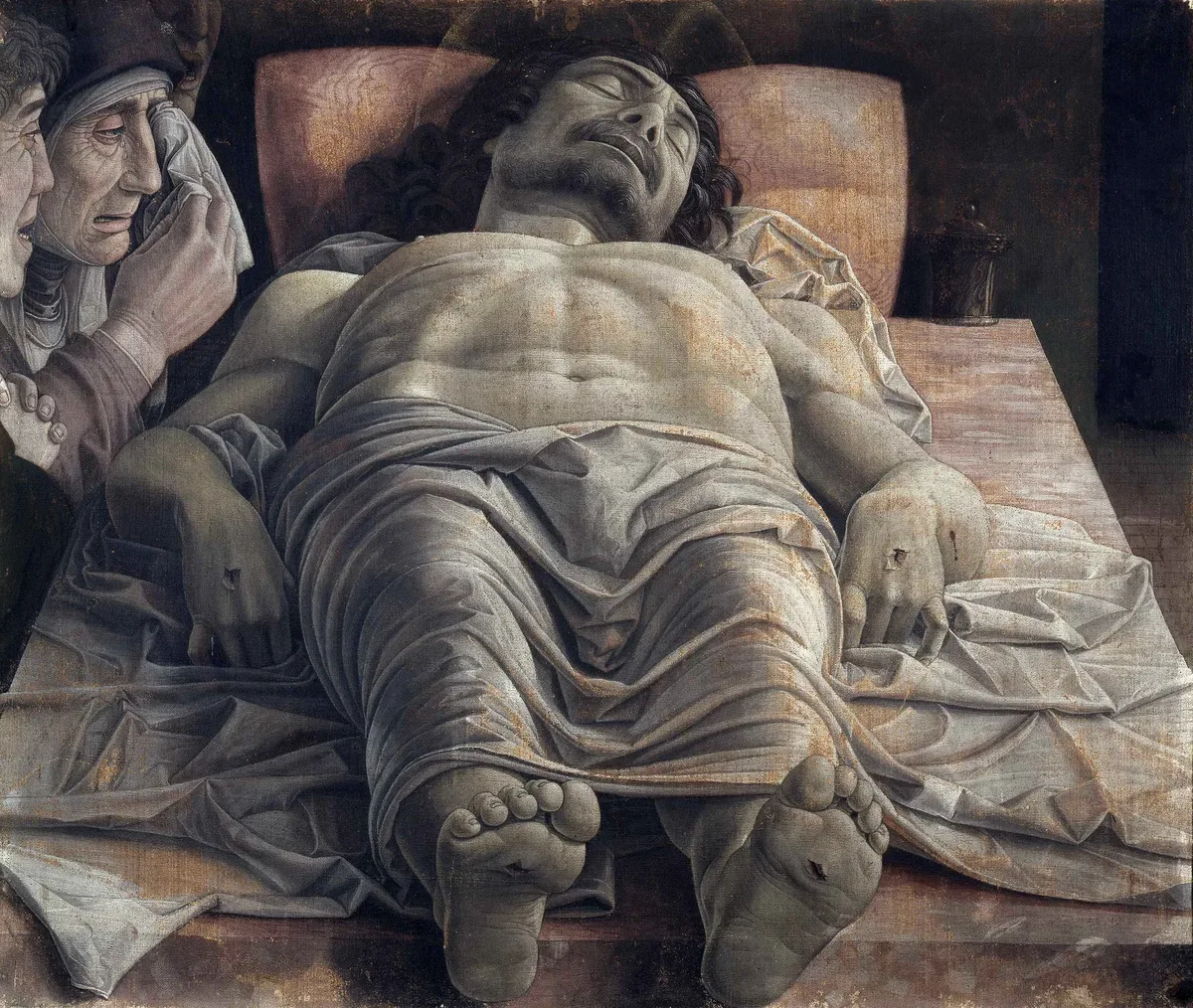
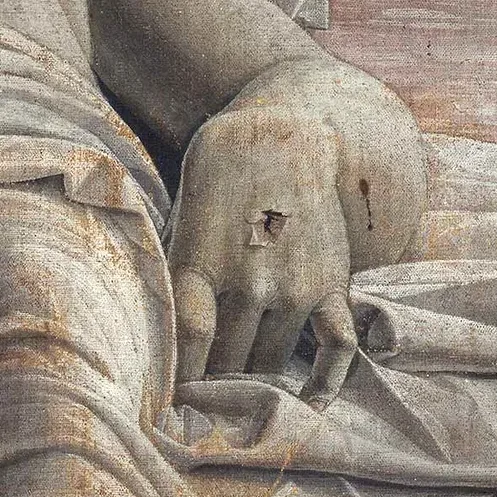
The body lies on a slab of red marble with its feet towards the viewer. The feet with their nail wounds project over the edge of the slab at the bottom centre, and they are smaller than true perspective would make them, so they do not hide the body. The wounds in the backs of the hands are painted as small torn holes with raised edges of skin. At the left edge three mourners are crowded together: John, the aged Mary wiping her eyes, and a third figure of whom only the nose and open mouth can be seen. The halo round Christ's head is drawn as a single thin line, and in the upper right corner stands a small stone jar of ointment.
Giuseppe Bossi, secretary of the Brera academy, acquired the picture for his own collection. According to one of the museum's texts he bought it in Rome in 1801. According to another, the purchase was made in 1806, with Canova as go-between. Bossi died in 1815, and on 3 July 1824, after long negotiations, the academy bought the picture from his heirs.
In 2013 Ermanno Olmi hung the picture very low in a dark niche to heighten its unusual foreshortening. The decision caused controversy, and in 2016 the display was changed.
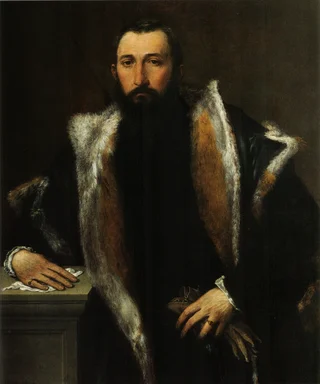
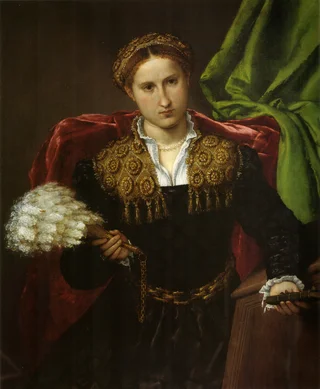
15. Portraits of Febo da Brescia and Laura da Pola — Lorenzo Lotto, 1543–1544
On 19 April 1543 Lorenzo Lotto recorded in his account book that “magnifico messer Febbo da Bressa” had paid him ten ducats on account for “two large portraits from life, half-length”. The agreed total was 30 ducats and a pair of peacocks. Lotto was then living in Treviso, where he had moved six months earlier for “a quieter life”, and he was short of money. In March 1544 he noted that Febo's payment did not cover the time spent on the work, but he accepted it all the same.
Febo came from a Brescian family settled in Treviso and was about forty, and his wife Laura, of the Pola family, was about twenty. The portraits always stayed together as a pair. The Pola inventory of 1596 lists them together, and together they came onto the market in the 19th century. In 1859 they were bought from a Milanese dealer for the Brera academy, and the painter Francesco Hayez was among the buyers. The museum stresses that Hayez was afraid the portraits would go to the National Gallery in London. In 1860 King Victor Emmanuel II reimbursed the academy for the cost.
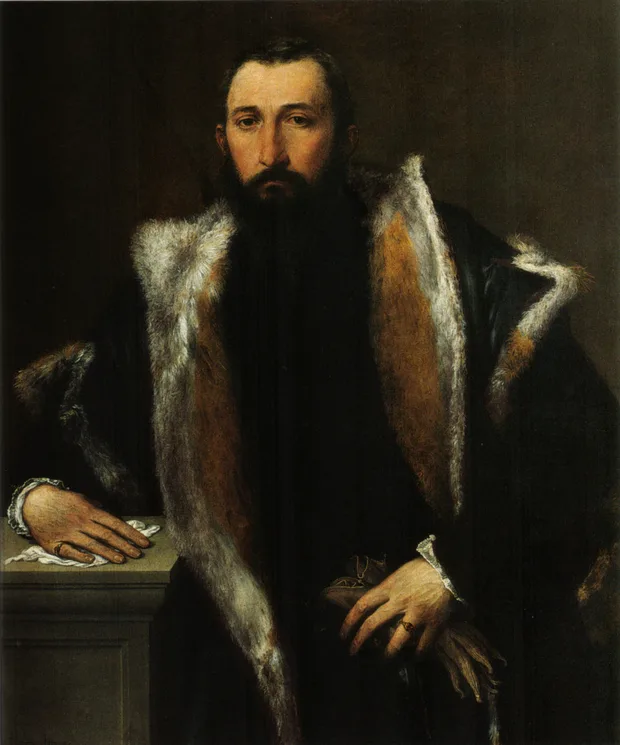
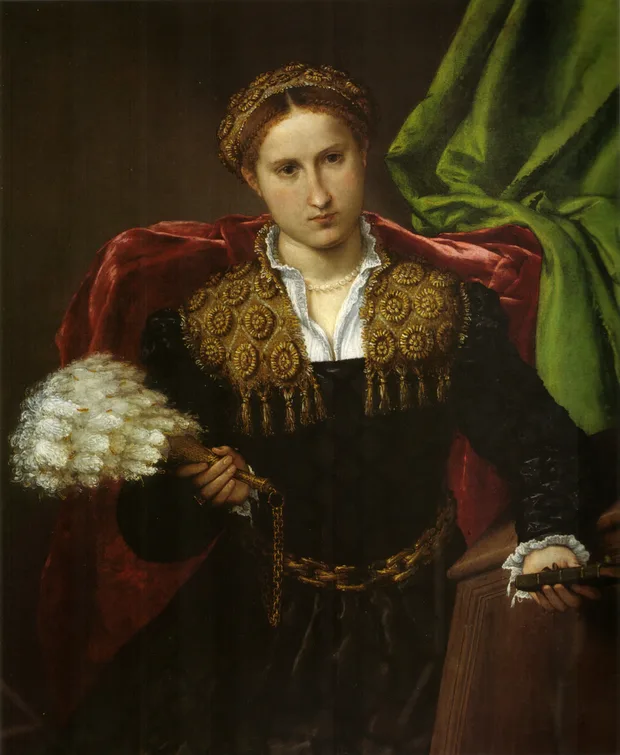
Laura looks out directly and calmly. Across her shoulders is an embroidered gold yoke with tassels, there are pearls at her neck, a heavy gold chain is wound round her waist, and in her right hand she holds a fan of white feathers on a chased gold handle, with a small chain running from the handle to her belt. Behind her shoulder is dark red velvet, and at the upper right a bright green silk curtain, the strongest colour in either picture. Febo is dressed almost entirely in black, in a wide fur-trimmed gown, one hand resting on a stone ledge over a crumpled white handkerchief, the other holding gloves. His head almost touches the top edge because his canvas was at some point cut down along the top.
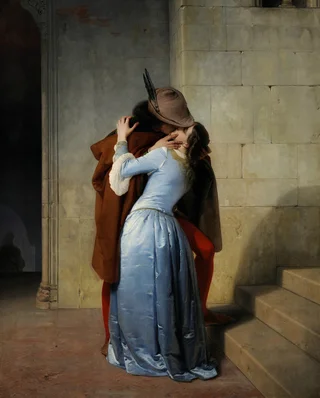
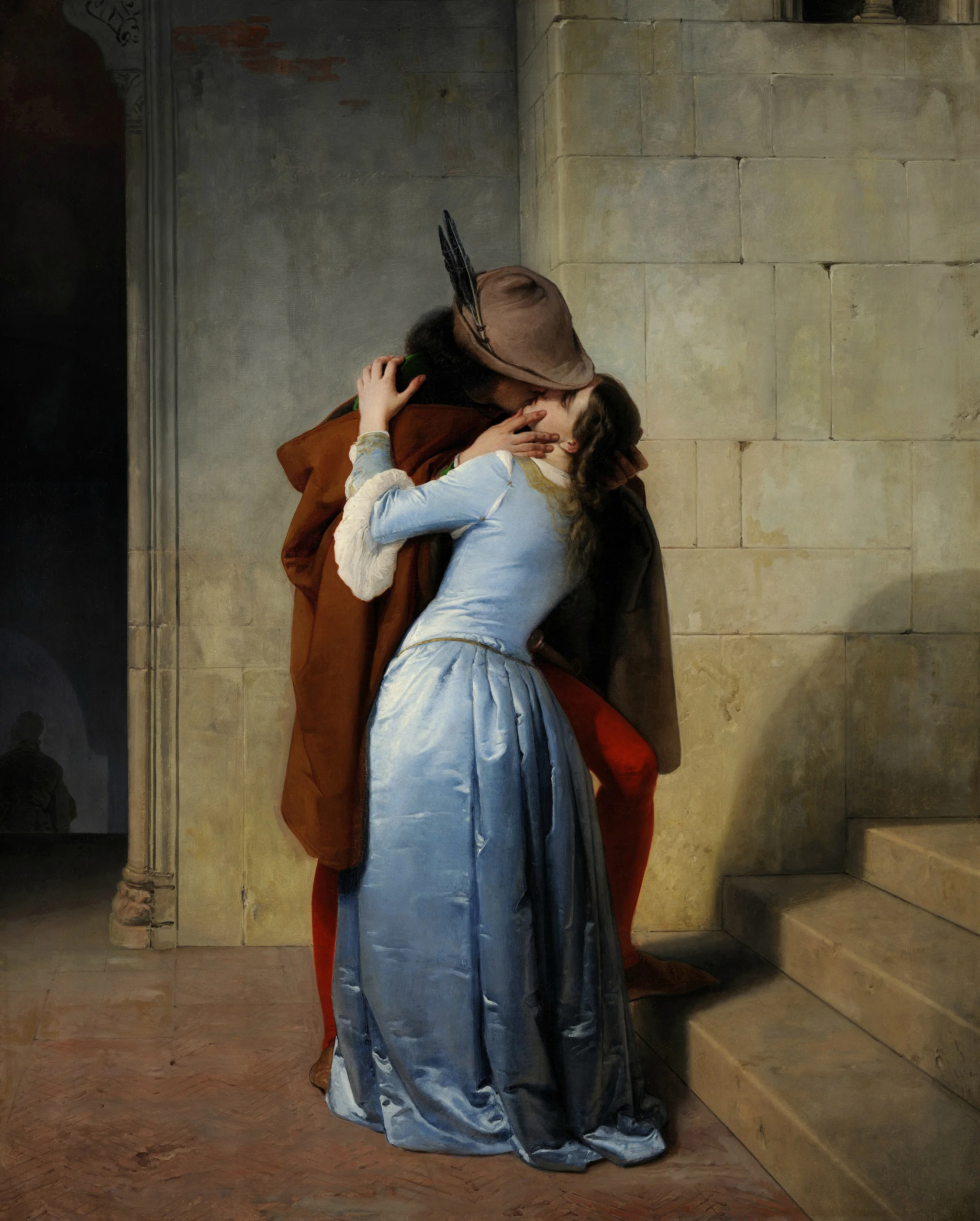
16. The Kiss — Francesco Hayez, 1859
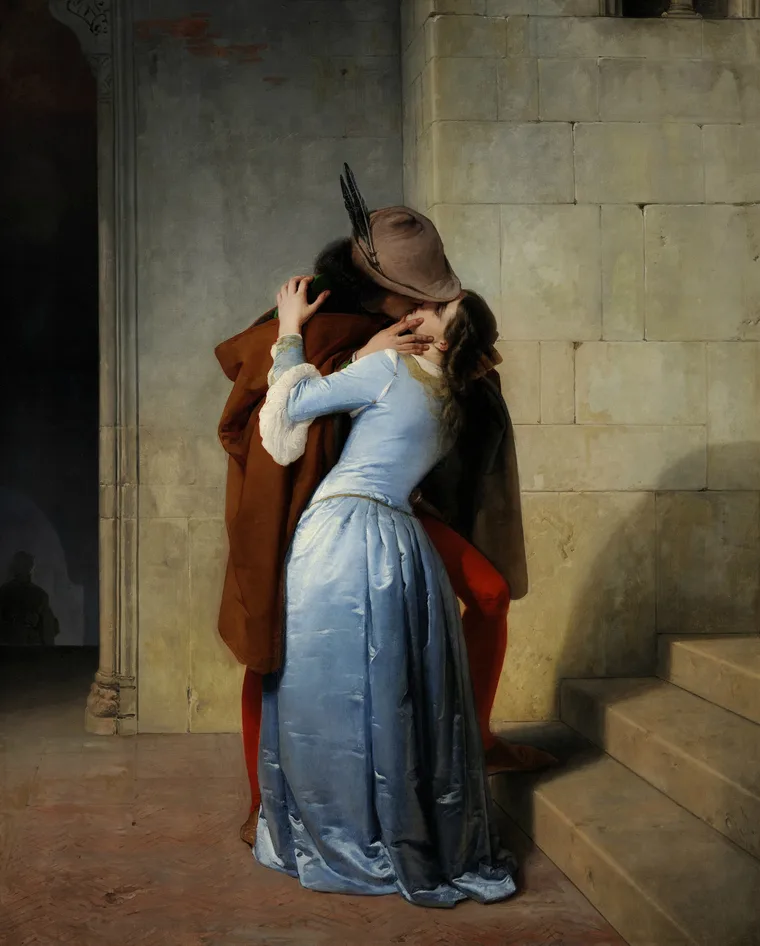
On 8 June 1859, four days after the battle of Magenta, Victor Emmanuel II and Napoleon III entered Milan, and Austrian rule in the city came to an end. In September that year Francesco Hayez, 68 years old and a professor at the Brera academy, showed The Kiss at the annual exhibition here. He had painted it to a commission from Count Alfonso Maria Visconti di Saliceto.
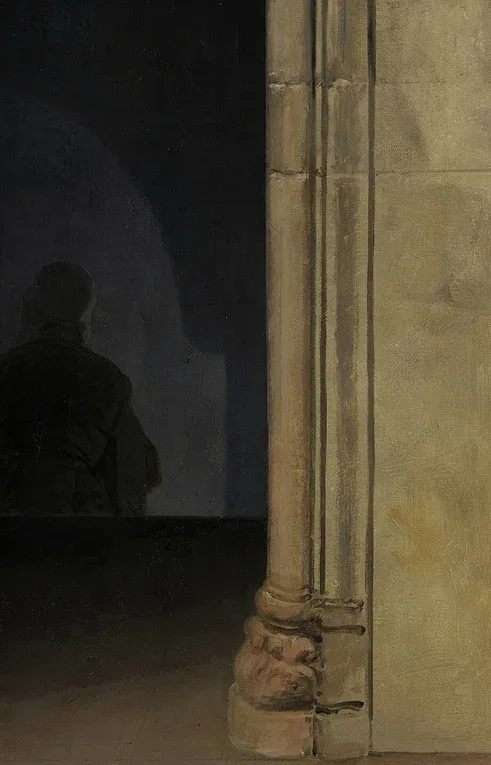
A man kisses a woman, holding her face in his hand, and his own face is hidden under a broad-brimmed feathered hat. His left foot is already on the bottom step of the staircase on the right and the hilt of a dagger sticks out at his hip. In its educational material the museum sees him as a man leaving to fight. The woman has thrown her head back, and her pale blue satin dress catches the light in sharp white highlights. At the lower left, in a dark passage under a pointed arch, a small hooded figure seen from behind can just be made out, and it has been read as a spy, as a fellow conspirator and as a servant.
The museum takes the red stockings and the green lining of the cloak, together with the blue and white of the dress, as a reminder of the flags of Italy and France. Hayez repeated the picture more than once. In the 1861 version, painted for Federico Mylius of Genoa, the dress is white, in the 1867 version for the Exposition Universelle in Paris a white cloth lies on the steps, and the Pinacoteca Ambrosiana in Milan has an oval watercolour of the same composition. The original stayed with the man who commissioned it for more than a quarter of a century, and in 1886 Visconti di Saliceto passed it to the Brera. In 1862 Gerolamo Induno painted Doleful Premonition, which is also in the Brera, and on the wall of its heroine's room hangs a small print of The Kiss.
17. Christ at the Column — Donato Bramante, c. 1490
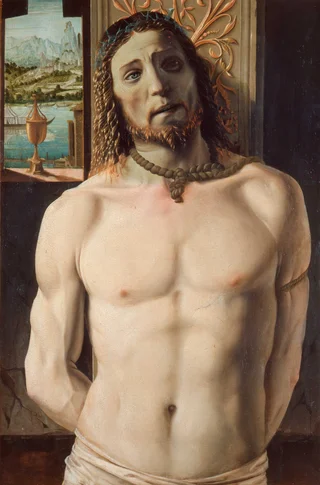
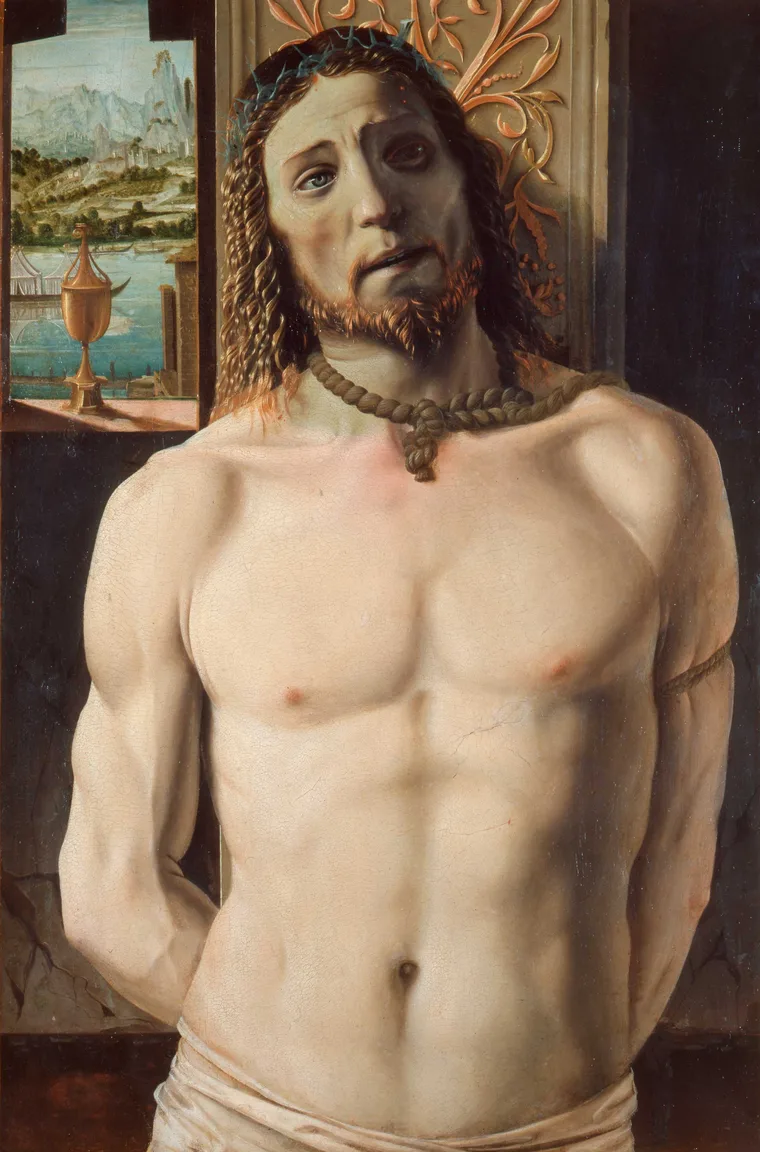
The restorer Mauro Pellicioli, who in 1927 was fixing flaking paint on this panel over and over again, called it “a chronic invalid”. It had come to the Brera in 1915 already badly damaged. According to the museum, it was removed from Chiaravalle Abbey outside Milan for its own safety and because poor storage conditions had led to serious losses and blistering of the paint layer. The Cistercian monks had been expelled from the abbey back in 1798, the abbey church had become a parish church, and the monks returned only in 1952. Since 1915 the picture has been in the Brera on deposit, and the museum's record lists it as a deposit from Chiaravalle Abbey.
Bramante is known above all as an architect, and this panel is often called the only painting on panel by him to survive. Its attribution long went back and forth, and from 1871 to 1958 the panel was also given to Bramantino, his follower, and in one catalogue even to both at once.
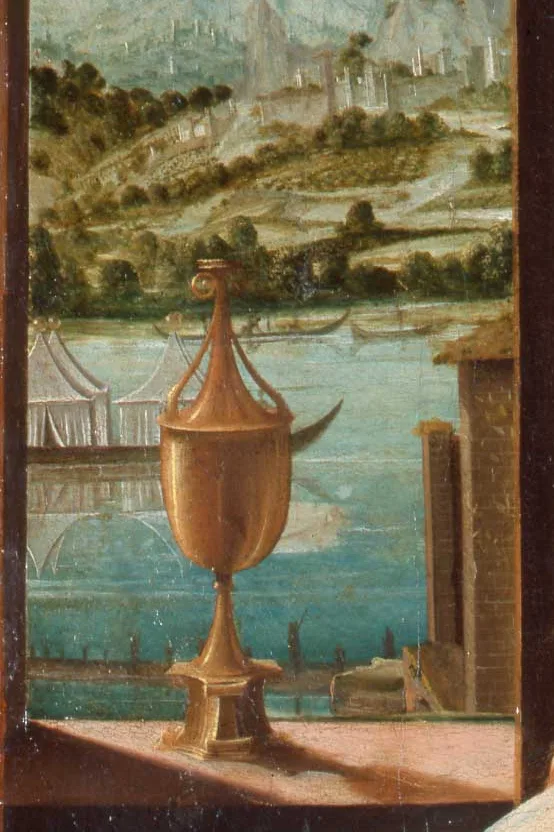
Christ is shown half-length and so close up that his torso fills almost the whole panel. His hands are tied behind his back, a thick twisted rope loops round his neck and is knotted above the breastbone, and a second, thin one presses his shoulder against the post and cuts into the muscle. His lips are parted, showing the upper teeth. The light falls from the left and divides the face in two, one half bright and clearly drawn, the other sinking into a greenish shadow where the eye is almost lost. The post behind him is square, a pilaster with a gilded relief of candelabra and acanthus leaves that curl on either side of his head. On the left, through a window, there is a tiny landscape with blue mountains, a hill town and a river with boats, and on the sill stands a tall gold lidded vessel, a pyx for the Host.
In 1923 the panel was restored by Oreste Silvestri, after Pellicioli it was retouched again in the 1970s and 1980s, and in January 2017, as the microclimate fluctuated, the paint blistered once more. For five months the panel was treated in the Brera's own workshop, and before it went back on show on 1 June 2017 the firm Goppion built a climate-controlled case into the frame itself to protect it from changes in temperature and humidity.
18. Supper at Emmaus — Caravaggio, 1605–1606
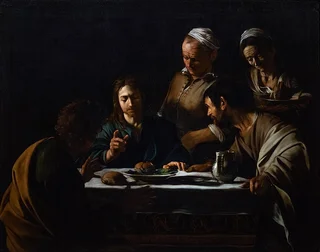
Ettore Modigliani, a former superintendent of the Brera, had been removed from the museum in 1935, and at the end of 1938 he was dismissed from state service under the racial laws because he was Jewish. On 27 April 1939, no longer holding any post, he wrote a confidential letter to the education minister, Giuseppe Bottai, proposing that the Brera buy Caravaggio's Supper at Emmaus, which had belonged to the Roman Patrizi family for more than three centuries. Fernanda Wittgens worked on this with him. That same year the picture was bought from Patrizio Patrizi with money raised by the Friends of Brera society and Milanese patrons and given to the Pinacoteca, and soon afterwards the regime dissolved the society.
Caravaggio painted the picture on the run, after killing Ranuccio Tomassoni in a fight in Rome on the evening of 28 May 1606. He was wounded and sentenced to death, and he took refuge on the estates of the Colonna family outside Rome, in a town that the sources, and even the museum's own texts, name differently. By 6 October he was already in Naples.
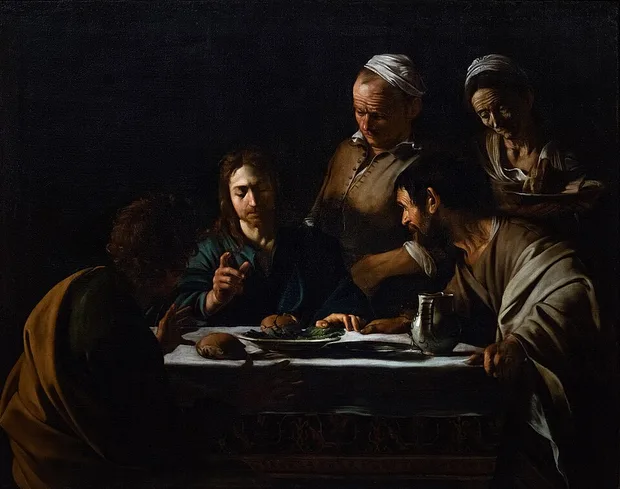
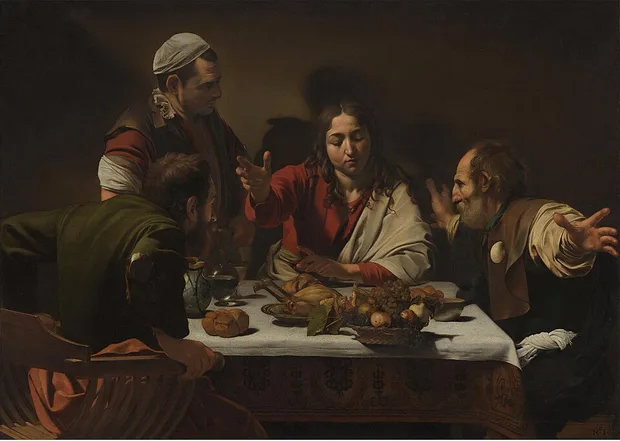
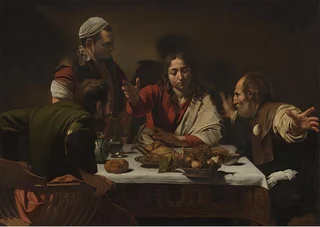
The upper half of the canvas is almost entirely dark, and the five people and the table are crowded into the lower part. Christ sits at the table with his eyes lowered, blessing the bread with two fingers. His face, in the words of the museum's text, is tired and gaunt, and the museum compares it with the London Supper at Emmaus, painted a few years earlier, where Christ is young and beardless and the table is laden with food. Here the table holds bread, a jug and two plain plates. The disciple on the right grips the edge of the table with both hands as if about to stand up. The innkeeper behind Christ's shoulder watches his hand, and the old woman with a dish of meat looks down, the only one of them not looking at Christ.
In 2010 specialists from Florence scanned the picture in infrared and found at the upper left a window with a landscape and a leafy tree, which Caravaggio later painted over with the dark background.
The New Brera
The last two works hang across Via Brera in Palazzo Citterio, which opened in December 2024 for the 20th-century collections. Together with the Pinacoteca it makes up the Grande Brera.
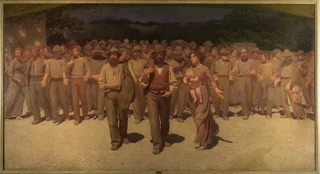
19. Fiumana — Giuseppe Pellizza da Volpedo, 1895–1896
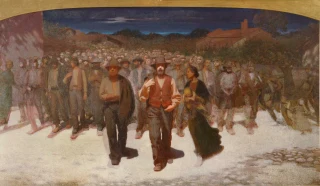
Giuseppe Pellizza da Volpedo was dissatisfied with this canvas, left it unfinished and in 1898 began the same subject over again. The new canvas became The Fourth Estate, completed in 1901–1902. Both were preceded by The Ambassadors of Hunger of 1891–1892, and all three show the same square in front of Palazzo Malaspina in Volpedo, the painter's home village in Piedmont.
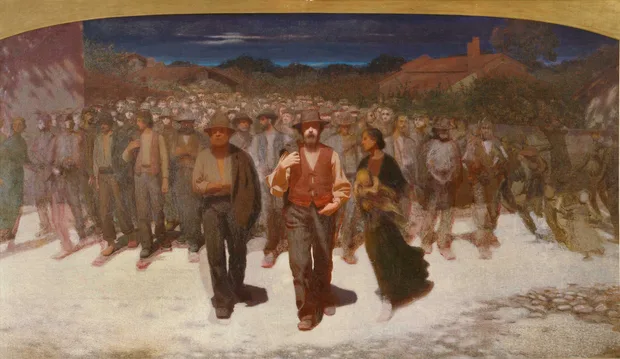
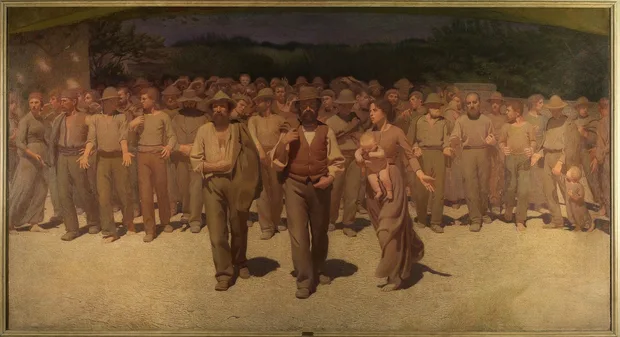
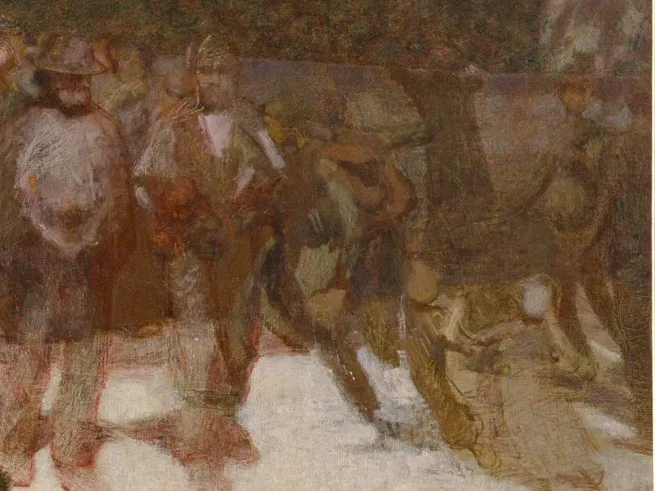
Along a white, dusty road that fills the whole lower third of the wide canvas, a crowd walks straight towards the viewer. Slightly ahead are three people: a man with his arms folded across his chest, a bearded man in a red waistcoat with his jacket slung over his shoulder, and a woman in black carrying a child in yellow swaddling. Behind them a wall of faces under hats stretches from edge to edge. The middle of the crowd and the three in front are fully worked up, while the figures at the right edge are only sketched in, transparent, so that their neighbours' legs show through their bodies. Long violet and pink shadows fall from their feet across the white road.
In 1986 the Milanese financier Angelo Abbondio bought the canvas at auction and gave it to the Brera through his company. According to his son, there were attempts to steer the picture to another Milanese collection, but Abbondio wanted it to be open to everyone.
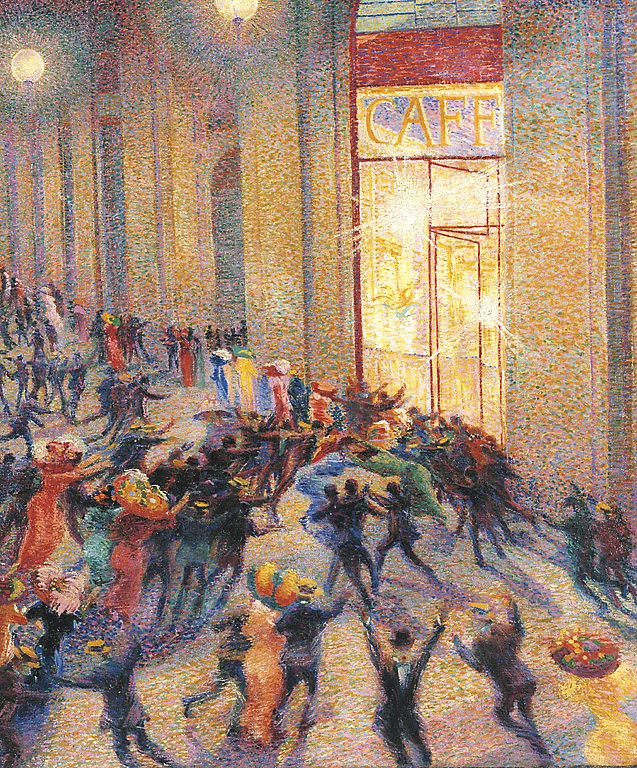
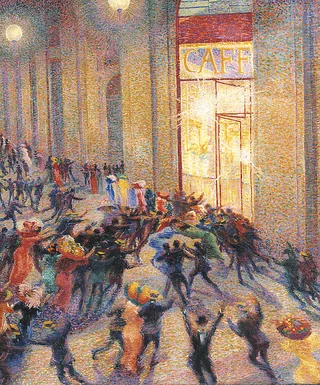
20. Riot in the Gallery — Umberto Boccioni, 1910
The sign over the lit café door breaks off at the letters CAFF and the start of the next word. This is night in Milan's Galleria Vittorio Emanuele II, and everything in the picture (pilasters, arches, floor, people) is built up from dots and short strokes of orange, violet, pink, green and blue. Two electric globes hang at the upper left, each surrounded by a halo of dots. The crowd surges in a single diagonal wave towards the glowing door where, according to scholars, two women have come to blows outside the Caffè Campari. In the foreground are women in huge hats trimmed with flowers and fruit, a man in black flings up both arms, and in the lower right corner a dropped basket of flowers lies on the floor.
Boccioni, born in Reggio Calabria, studied in Rome under Giacomo Balla and then moved to Milan, where in February and April 1910 he signed both manifestos of the Futurist painters. He painted the Riot a few months later, and it was first shown at the turn of 1910 and 1911 at the Famiglia Artistica society in Milan, under the title A Scuffle. Later the picture came to the Milanese businessman Emilio Jesi and his wife Maria. After her husband's death Maria gave their collection to the Brera in 1976, carrying out his wish that it be kept together, and in 1984 she added to the gift. In December 2024 the Jesi collection was moved from the Pinacoteca to the new Palazzo Citterio.
After these 20 works in the Brera you start looking at the edges and surfaces of pictures. Piero's panel was cut down. The paired panels of Gentile's polyptych were sawn apart and later put back together in one frame. The frescoes of Luini, Bramante and the Mocchirolo oratory were taken off their walls. Christ at the Column now stands inside a climate-controlled case. The traces of all these moves can still be seen on the works themselves.
What Else to See
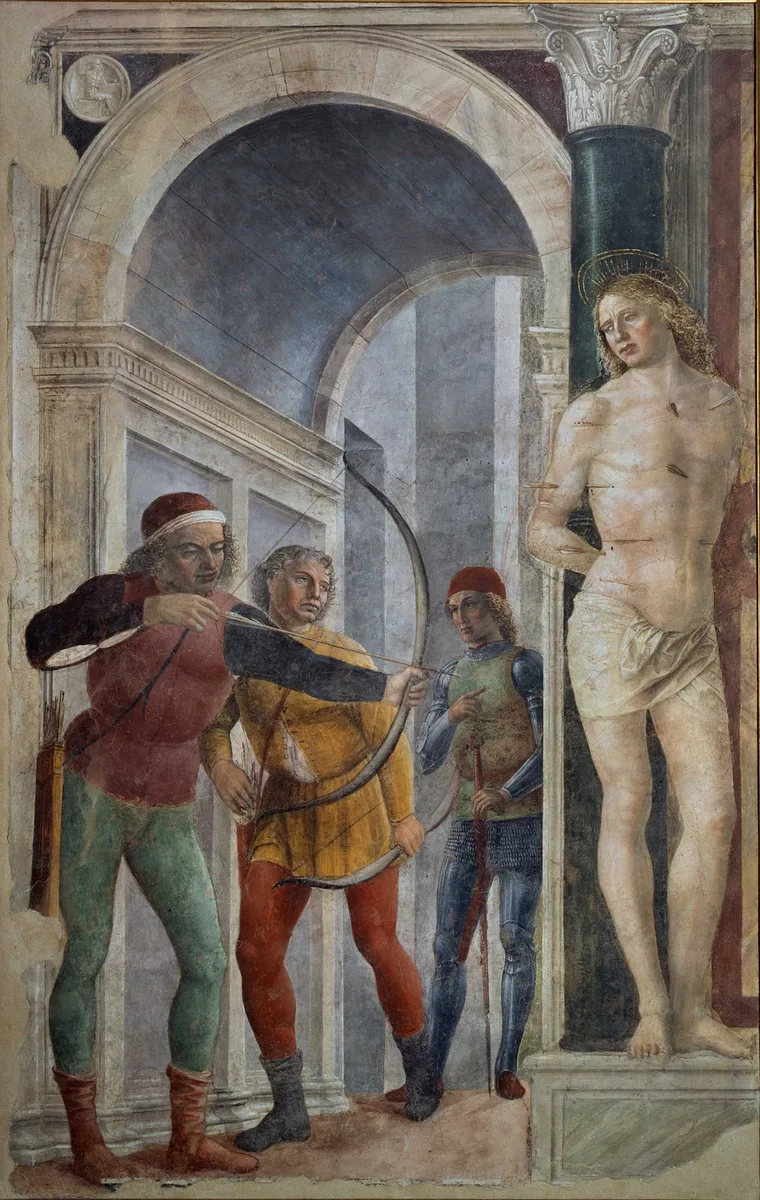
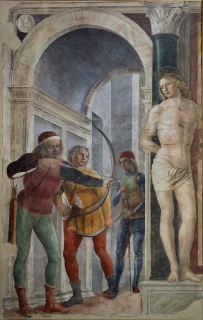
Beyond these 20 works the Brera has many more pictures worth stopping for. Among the Venetians, look out for Carpaccio and Veronese, and among the Lombards for Bramantino and Vincenzo Foppa's Martyrdom of Saint Sebastian, which was taken off the wall of the church of Santa Maria di Brera as early as 1808. In Palazzo Citterio, besides the Jesi collection, the Vitali, Jucker and Mattioli collections are on show. The Jesi collection, which brought Riot in the Gallery to the Brera, also includes Amedeo Modigliani's Portrait of Moïse Kisling.