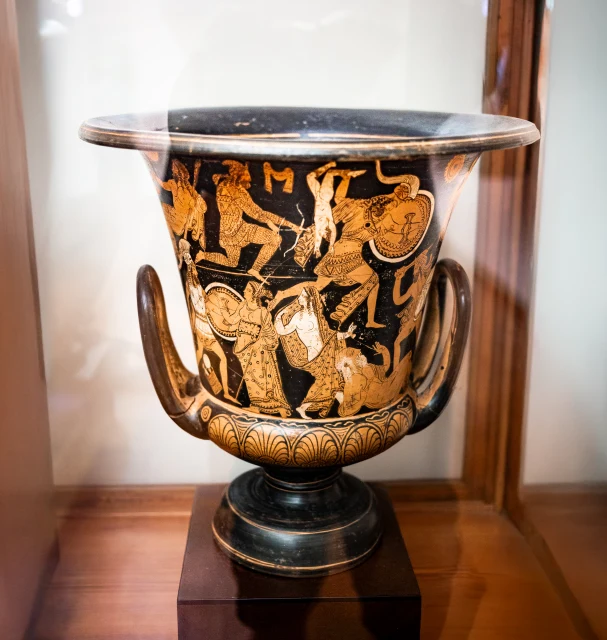
Nazzano Painter
Ager Faliscus
The story
The Nazzano Painter takes his modern name from Nazzano, a small town on the Tiber north of Rome. He worked around the middle of the 4th century BC at Falerii, the chief town of the Faliscans, a people living between the Etruscans and Rome who spoke a language closely related to Latin.
His hand is among the easiest to recognise in Faliscan red-figure. The way he draws figures and their drapery recalls Athenian painters of the early 4th century, such as the Meleager Painter, closely enough that some scholars have wondered whether he was a Greek who had come from Athens. A volute-krater with Athena and Poseidon in the Louvre is his, and so is a calyx-krater in the Museum of Fine Arts in Boston, where the wounded king Telephos holds the infant Orestes at an altar before Agamemnon, a scene linked to a lost play by Euripides.