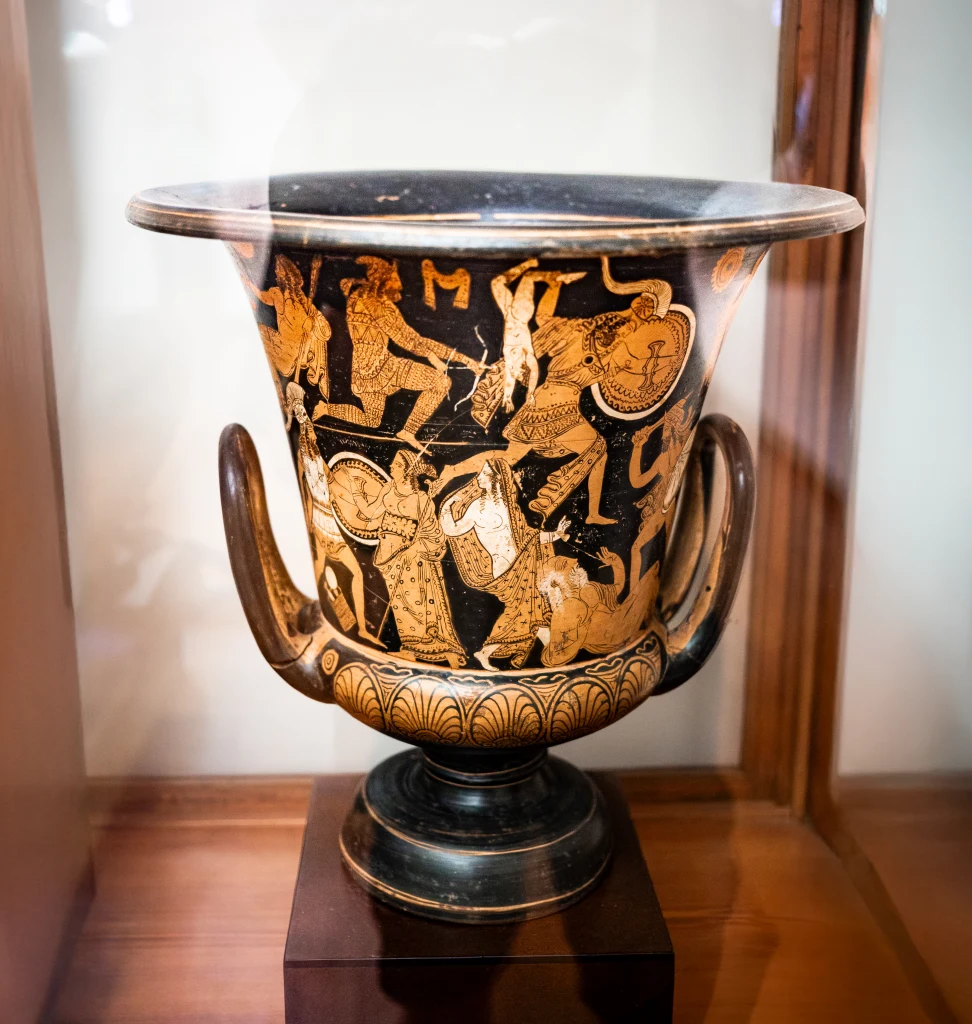
Calyx-Krater with the Sack of Troy
Details
The story
In 357 BC Rome declared war on the Faliscans, who had fought alongside the Etruscan city of Tarquinii and refused to hand over Roman deserters who had fled to Falerii. Raids and battles followed for several years. This krater was painted at Falerii in those same middle decades of the 4th century BC, and its main side shows a city falling, the sack of Troy, the night the Greeks took the city after ten years of war.
The subject came from the repertory of Athenian painters, whom the Faliscan workshops followed closely, and nothing on the vase points to events at home. On the other side a god with a laurel branch, Dionysos or perhaps Apollo, stands with a woman holding a box, a maenad or Ariadne. At 57 centimetres tall, it is a large bowl for mixing wine with water at a banquet. It was found at Falerii, in tomb 21 of the Celle cemetery.