Ogata Kōrin
1658–1716 · Japan · Rimpa school
The story
The Ogata family ran the Kariganeya, a Kyoto kimono house that dressed the women of the imperial court, and Kōrin was its second son. He grew up around pattern books and Noh theatre, inherited money when his father died in 1687, lent much of it to provincial lords who did not repay him, and only settled into painting as a profession in his forties. In 1701 he was granted the rank of hokkyō, an honorary Buddhist title that working artists carried as a mark of standing, and in 1704 he moved to Edo, where the commissions were.
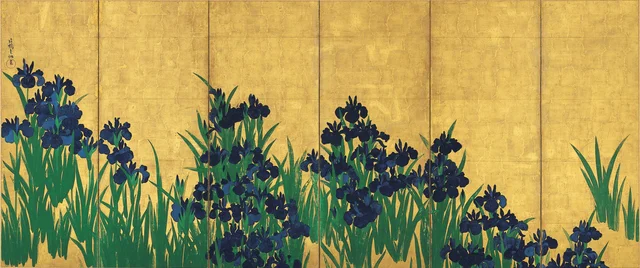
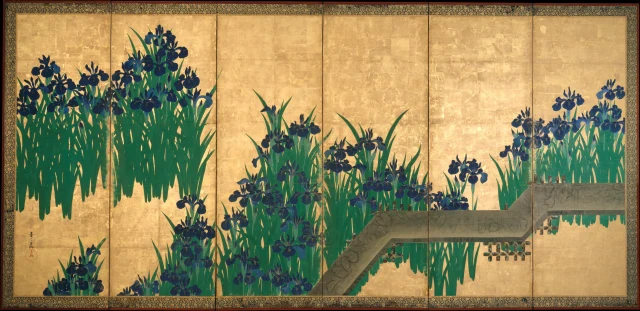
His most famous subject comes from The Ise Stories, a collection of 10th-century episodes every educated person in Kyoto knew. A man leaving the capital in disgrace stops at Yatsuhashi, where a stream splits into eight channels, each with its own plank bridge. Irises are in flower, and his companions ask him for a poem about the wife he has left behind, each line starting with a syllable of kakitsubata, the iris. Kōrin painted the place twice. In the earlier pair of screens, from around 1701, there are only irises on gold. In a later pair, painted after his return to Kyoto in 1709, he brought the bridge back, a run of angular planks cutting across both screens, with the travellers left out.
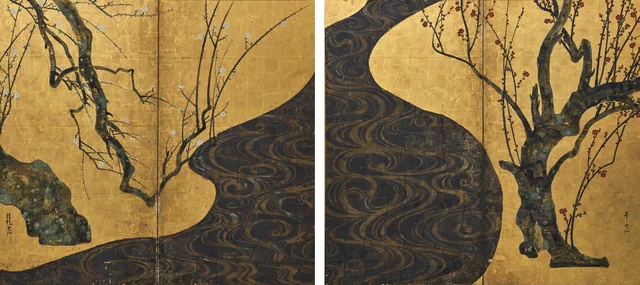
The bridge's weathered wood is done in tarashikomi, dropping pigment into ink while it is still wet so that it pools and mottles, a technique he took from Sōtatsu, the painter he studied a generation back. Kōrin died in 1716, well known and short of money. A century later the painter Sakai Hōitsu, who had collected his drawings, staged a memorial exhibition and published 100 of his designs, which is largely how the Rimpa manner, named after Kōrin himself, carried on into the 19th century.