Waves at Matsushima
Details
The story
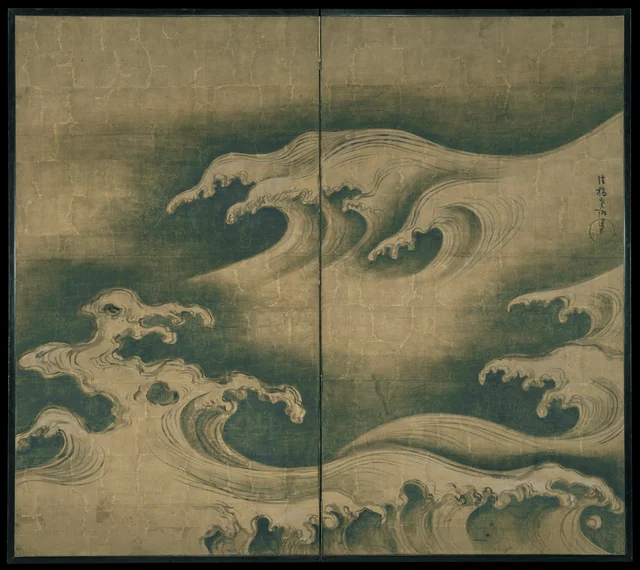
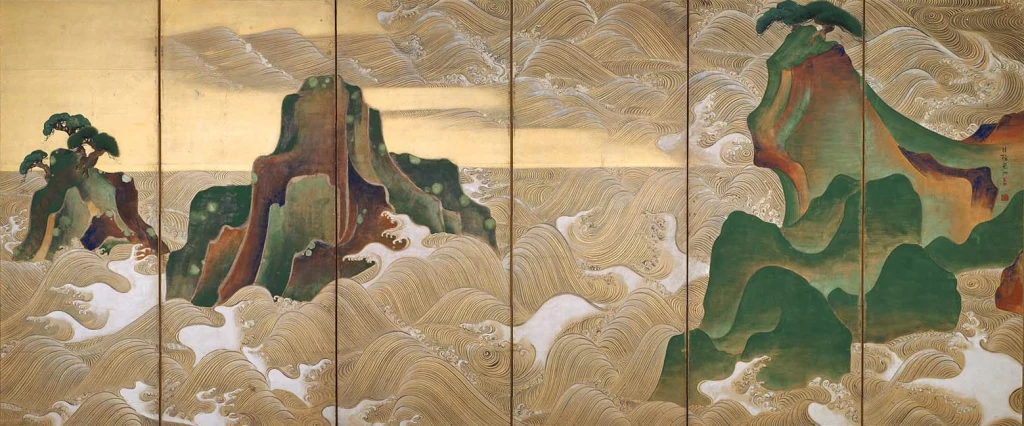
Matsushima is a bay in northern Japan scattered with small pine-covered islands, long counted among the three most celebrated views in the country, and the name has stayed attached to this composition of pine-topped rocks in rough water. The design itself reached Ogata Kōrin from an older painting. Tawaraya Sōtatsu, working in Kyoto around the 1620s, had painted the theme on a pair of screens that are now in the Freer Gallery of Art in Washington. Kōrin kept close to Sōtatsu's arrangement but changed it in key ways, with more assertive waves and sharper contrasts of colour. Curators think he also saw the pine-studded rock as an image of Mount Penglai, the island of the immortals in Chinese legend, a wish for long life. The museum dates the screen only to the 18th century, and it has been heavily retouched in the rocks and pines. Ernest Fenollosa, an American professor then teaching in Japan, acquired it in 1880 and six years later sold it to a Boston doctor, Charles Goddard Weld, whose collection came to the museum in 1911. In 2015 it was lent to Washington and shown alongside Sōtatsu's pair.