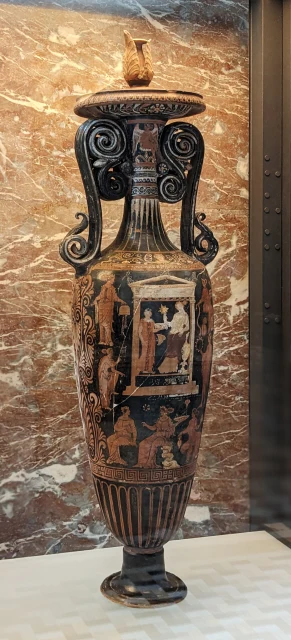
Painter of Louvre MNB 1148
Ancient Greece · Classical Greek art
The story
In the J. Paul Getty Museum in Los Angeles stands a tall Apulian funeral vase on which Niobe mourns inside a small shrine. In the myth she boasted that she had more children than the goddess Leto, and Apollo and Artemis killed them all. On the vase she stands among attendants bringing grave offerings, while her brother Pelops drives up in a chariot with his bride Hippodameia to persuade her to stop grieving. The lower part of her dress is painted white. The painter is showing her turning to stone from the feet up, the end the gods finally gave her.
The vase was made around 330 BC in Apulia, the heel of Italy, where Greek workshops, above all in the city of Taras, today's Taranto, turned out large red-figure vessels for the tombs of the region. Nobody recorded the name of the man who decorated it. The scholars Arthur Dale Trendall and Alexander Cambitoglou, who sorted Apulian vases into the hands of individual painters, named him after another of his vases, the one that carries the inventory number MNB 1148 at the Louvre. They saw him as a follower of an older Apulian master, the Varrese Painter.