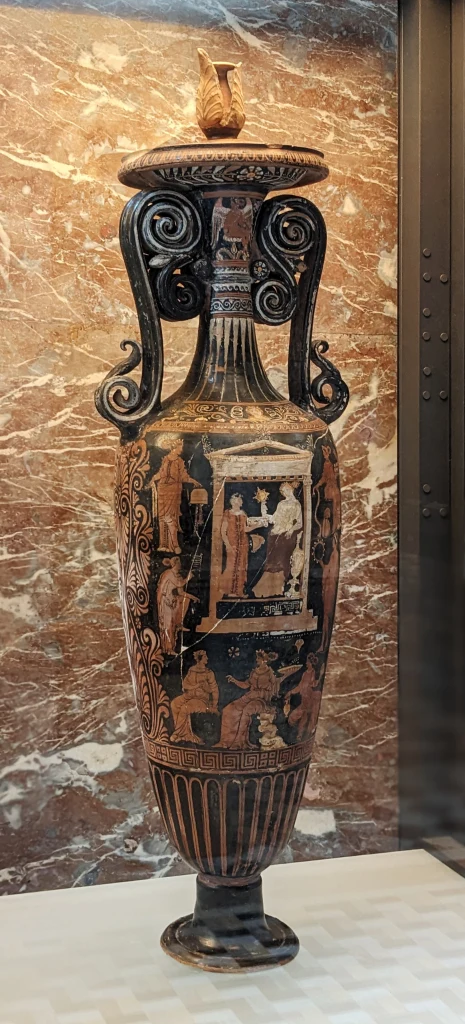
Apulian Red-Figure Loutrophoros with Funerary Naiskos Scenes
Details
The story
In Athens a loutrophoros was the tall jar that carried water for a bride's ritual bath, and the same shape was set on the graves of people who died unmarried. In the Greek workshops of southern Italy it grew larger and served the dead. This one was made in Apulia sometime around 340 to 330 BC and stands 82 centimetres high without its lid.
On the front, a woman holding a mirror stands inside a naiskos, a small shrine with Ionic columns of the kind raised over graves, and she is most likely the dead woman herself. Attendants approach with fans and boxes, a young man appears with a wreath and a staff, and below them three seated women hold small oil flasks and other offerings. The back repeats the idea with another shrine, women and a youth, and on the shoulders female heads look out from curling tendrils. Much of the added white has worn away, and the vase has been glued together and filled in where pieces were lost.
The Louvre gives the lid to a different hand, an anonymous painter known as the Painter of Vienna 113. The museum bought the vase in 1876 from the collection of Eugène Piot, a Paris critic and collector.