Papyrus Painter
Ancient Greece · Mycenaean art
The story
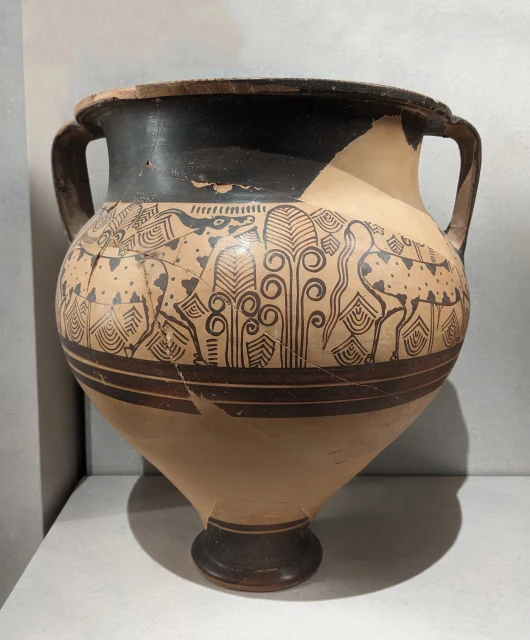
The papyrus is a plant of the Nile marshes, and it does not grow wild in mainland Greece. Even so, in the decades around 1300 BC a vase painter in the Argolid, the plain of Mycenae and Tiryns, kept putting it on his big wine bowls, stylised stems with fanned heads standing among bulls that walk in line. The habit gave him his name. In an article published in 1962 the Greek archaeologist Seraphim Charitonidis showed that a fragment of a krater with a bull among papyrus had been painted by the same hand as a krater in the Louvre, and he called the unknown artist the Mycenaean Papyrus Painter.
He worked in what archaeologists call the pictorial style, Mycenaean pottery painted with animals, chariots and people rather than patterns alone. Large kraters of this kind were made in the Argolid and shipped east, and so many turned up in Cyprus that scholars long took them for Cypriot work, until analysis of the clay traced them back to the Peloponnese. Charitonidis looked east for the papyrus too. He connected the bull among the reeds with Egyptian images of Hathor, the goddess shown as a cow standing in a papyrus thicket.