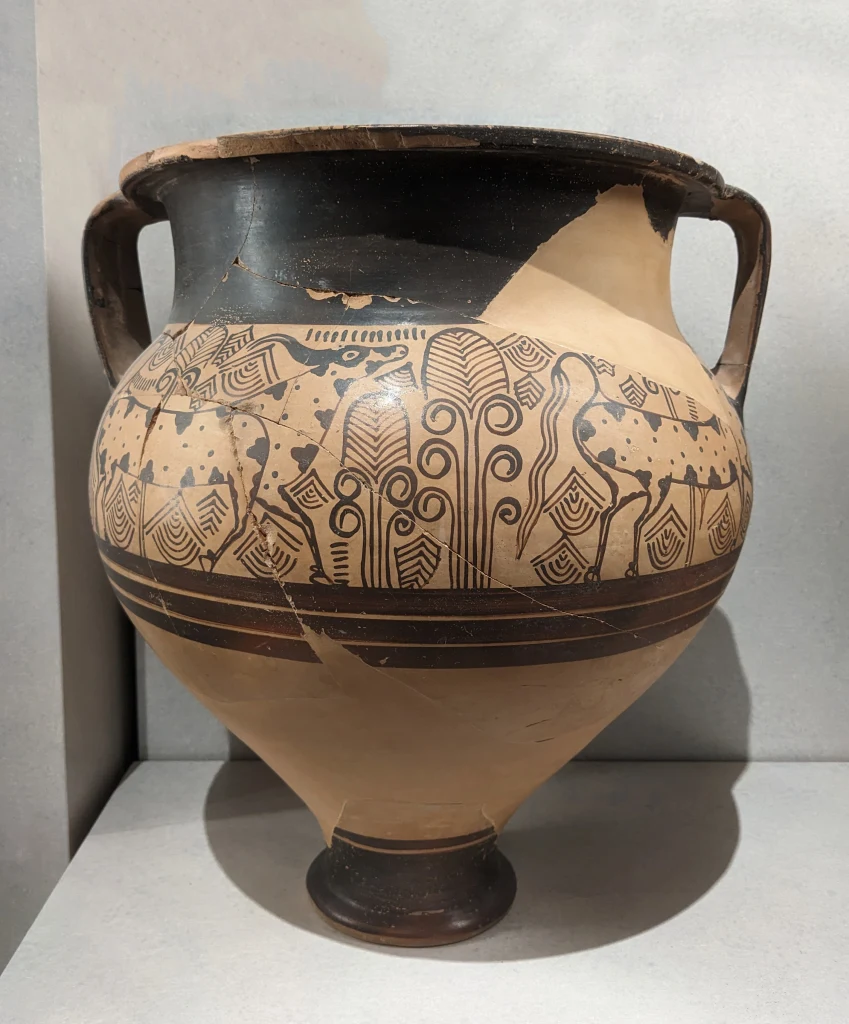
Amphoroid Krater with Bulls and Papyrus
Details
The story
Two bulls walk to the right on each side of this wine-mixing bowl, among tall stylised papyrus plants, and more papyrus leaves fill the space under the handles. Papyrus grew in the marshes of the Nile, and on a Greek vessel it is a borrowed motif, taken from the art of Egypt and of Minoan Crete. The krater was made in the Argolid, the region of Mycenae, around 1300 BC, and it was found on the island of Rhodes, where Mycenaean Greeks had settled by then and which lay on the sea route east towards Cyprus and the Levant.
The Louvre bought it in 1904. Its painter is known only by the name scholars gave him, the Papyrus Painter, partly after the plants on this vase. Pieces of the bowl and the neck are missing and have been filled with plaster, so the second side keeps only the remains of its two bulls.
In 1941 the Swedish archaeologist Arne Furumark illustrated the krater in The Mycenaean Pottery, the classification of shapes and motifs on which the dating of Mycenaean vases still largely rests.