Raden Saleh
1811–1880 · Dutch East Indies · Romanticism
The story
In the 1840s a Javanese aristocrat was one of the more talked-about painters in the German courts, a novelty at princely tables in Dresden and Coburg and a genuinely skilled hand. Raden Saleh had come from Java, then part of the Dutch East Indies, sent to the Netherlands as a young man to be educated, and he stayed in Europe for close to 20 years.
He learned the Western manner from the Belgian landscape painter Antoine Payen and later settled in Dresden, where he came to know the sculptor Bertel Thorvaldsen and the Norwegian landscapist Johan Christian Dahl. What made his name was a subject Europe was hungry for, the animal hunt. Tigers and lions locked with hunters or with each other, painted with Romantic drama, sold well to collectors who wanted the exotic East on their walls, and Saleh, an actual son of that East, gave it to them with real anatomical conviction.
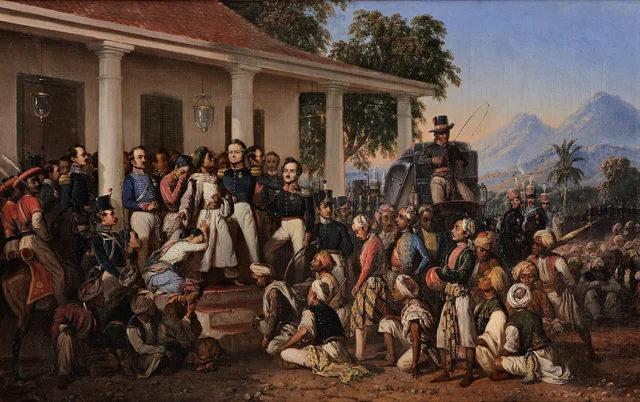
He returned to Java in 1852 and became conservator of the colonial government's art collection and painter to the Dutch governors-general. One of his large canvases stages the 1830 capture of Prince Diponegoro, leader of the Java War against Dutch rule, and Saleh painted the Dutch officers with their heads made a little too large, a detail often read as a quiet protest folded into a court commission.