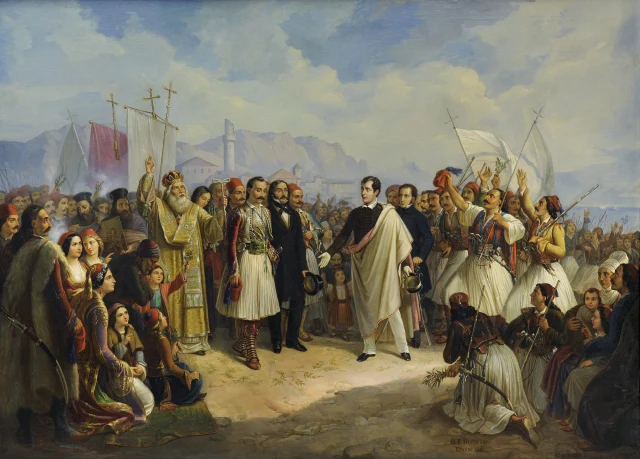
Theodoros Vryzakis
1814–1878 · Kingdom of Greece, Ottoman Empire · Munich School, Romanticism, Academic art
The story
In May 1821, a few months into the Greek uprising against Ottoman rule, Ottoman troops hanged Petros Vryzakis, a fighter from Thebes. His widow took the children into the mountains. The son Theodoros, about seven at the time, ended up in the orphanage that Ioannis Kapodistrias, the first head of the new Greek state, had opened on the island of Aegina. By 1832 his drawings had been noticed by Friedrich Thiersch, a Bavarian classical scholar, who brought him to Munich and placed him in the Panhellenion, a school King Ludwig I of Bavaria kept for orphans of the revolution.
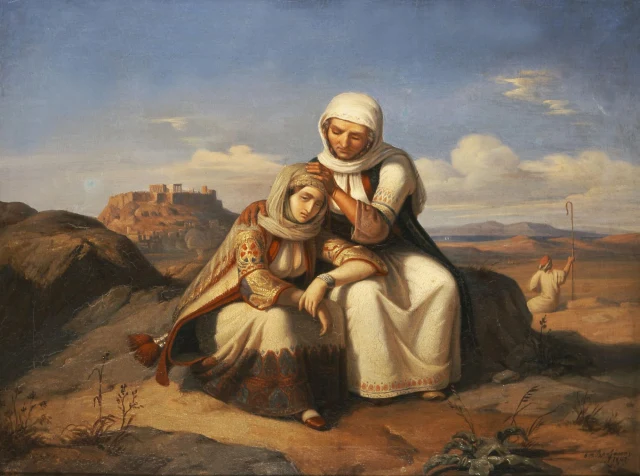
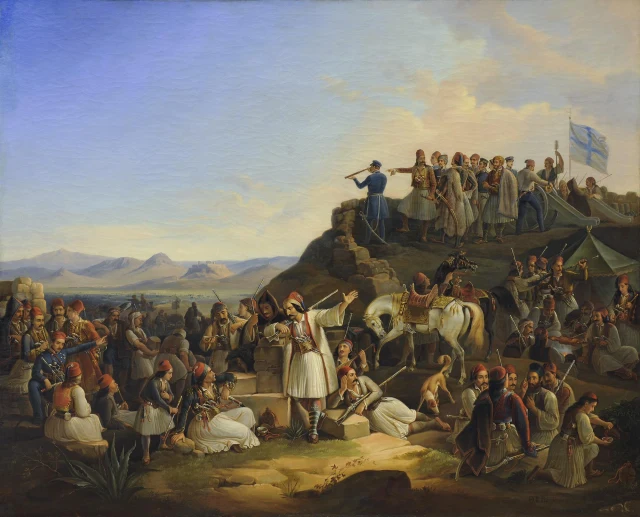
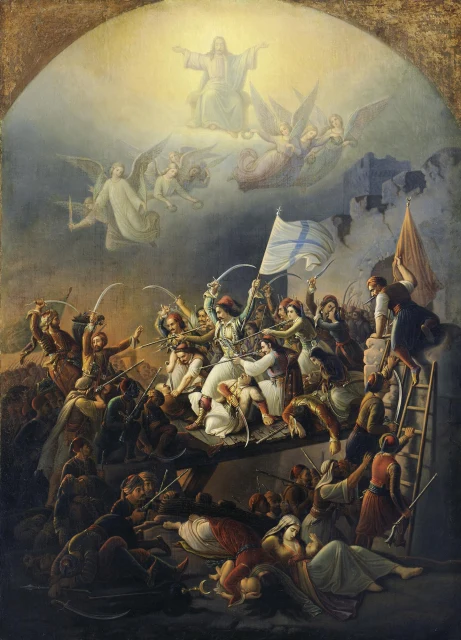
He came back to Munich on a scholarship in 1844 and trained at the Academy under Peter von Hess and Carl Wilhelm von Heideck, two Bavarians who had been in Greece during the war itself. So the founding pictures of the young kingdom were worked up in Bavaria, out of other people's accounts. The Exodus from Missolonghi came in 1853, the camp of the Greek commander Georgios Karaiskakis in 1855, and in 1861 the reception of Lord Byron at Missolonghi, the English poet's arrival in January 1824, three months before he died in the town. Vryzakis painted that scene 37 years after it happened.
In 1865 he painted Bishop Germanos of Old Patras blessing the flag of the revolution at the monastery of Agia Lavra. Historians treat that ceremony as a later legend, and his version of it became the picture in Greek schoolbooks. An eye disease kept him away from Munich artistic life through his last decade. He died there in 1878 and left the contents of his studio to the University of Athens.