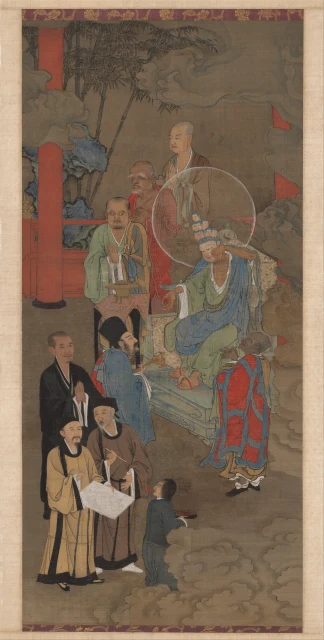
Zhou Jichang
Song dynasty · Southern Song painting, Buddhist art
The story
Almost everything known about Zhou Jichang was written on his own paintings. Starting in 1178, a monk named Yishao, at the Huianyuan, a Buddhist temple in the port city then called Mingzhou and now Ningbo, had a set of 100 hanging scrolls painted of the Five Hundred Luohans, the enlightened disciples of the Buddha, five to a scroll. Local lay people paid for them one at a time, and many of the scrolls carry a dedication naming the donor, the relatives the gift was meant to bless, and the painter. Two painters' names appear, Zhou Jichang and Lin Tinggui, both professionals working in the city. The set took about ten years to finish.
By the 13th century the whole set had crossed the sea to Japan. It belonged to a Zen temple in Kamakura, then to the Hōjō lords of Odawara, then to Toyotomi Hideyoshi, the warlord who unified Japan, and finally came to rest at Daitokuji in Kyoto. In 1894 the temple, short of money for repairs, sent 44 of the scrolls to an exhibition at the Museum of Fine Arts in Boston, arranged by Ernest Fenollosa, an American who had spent years in Japan studying its art. The governor of Kyoto had opposed the sale, and ten scrolls stayed in Boston anyway. They belong to the Boston museum today, two more are in the Freer Gallery in Washington, and most of the others are still at Daitokuji.