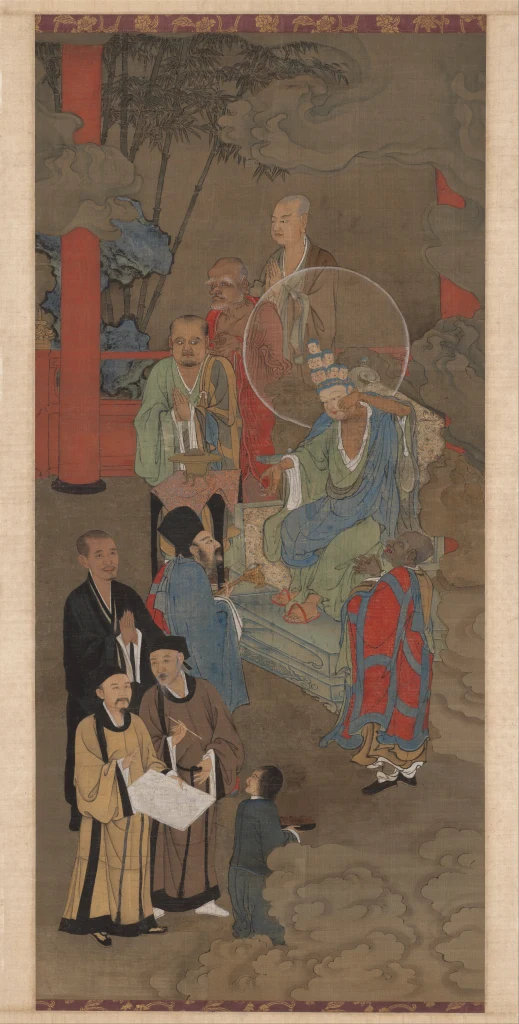
Luohan Manifesting Himself as an Eleven-Headed Guanyin
Details
The story
An old Chinese legend tells of Baozhi, a wonder-working monk of the early 6th century. The emperor Wu of Liang sent his best painter to take the monk's portrait, and as the painter raised his brush, Baozhi drew a finger down his own face. It opened to reveal the face of Guanyin, the bodhisattva of compassion, now kind, now sorrowful, and the painter could not make a single stroke. Scholars generally read this scroll as that story. The monk sits beneath bamboo with one hand at his face, as if peeling it back, and in its place a calm crowned face looks out from under a stack of small heads, the eleven-headed form of Guanyin, inside a pale transparent halo. Look at the bottom of the scroll. Among men in black caps, an older man holds a brush and a younger one a sheet of paper. The scroll was painted in Ningbo around 1178, one of a set of 100, and in 1894 Ernest Fenollosa chose it as the frontispiece of his catalogue for the Boston exhibition.