Adoration of the Magi
Details
The story
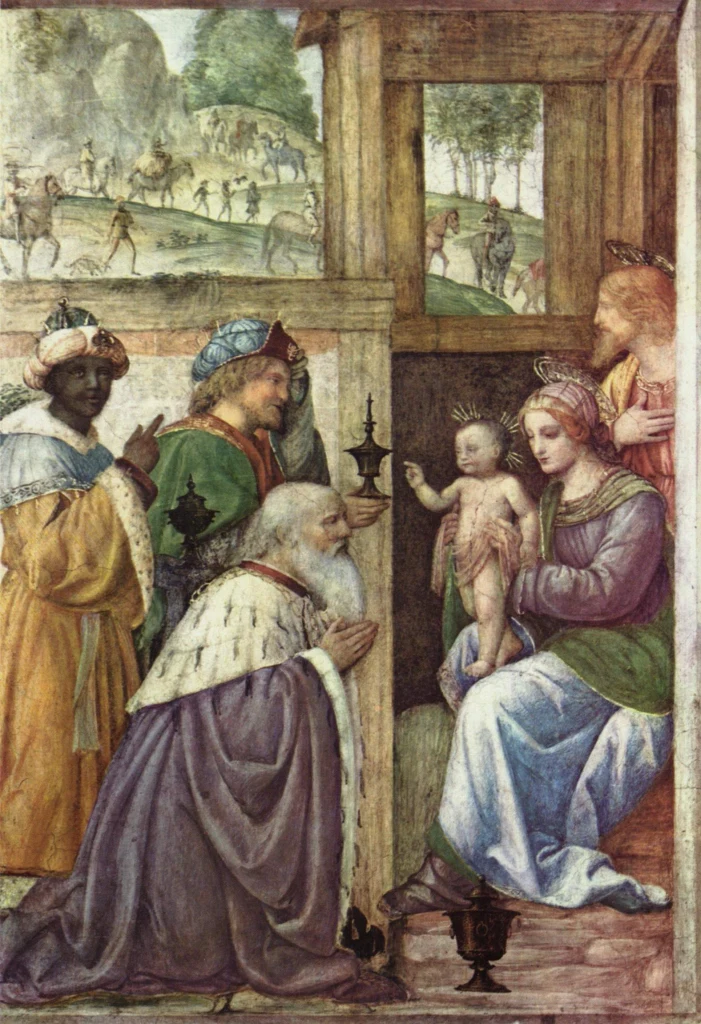
In 1810 Milan was the capital of Napoleon's Kingdom of Italy, and Antonio Litta, grand chamberlain of that kingdom, was made a duke by Napoleon. The same year, at his request, this Adoration of the Magi and other scenes by Luini were stripped from the walls of an oratory at Greco, then a village just outside Milan, and set up in the Litta palace in the city. Stripping a fresco means gluing cloth to the painted surface and pulling the thin skin of colour away from the plaster, which is why a picture made on a wall now hangs like a canvas. Litta's heirs sold the group to the Louvre in the 1860s.
The scene follows the order of rank. The oldest king kneels in an ermine cape, his gift set on the ground, and the Child, standing in his mother's lap, reaches a hand toward him. Behind him wait the two younger kings, one of them shown as an African, holding vessels of gold. Through the openings of the shed their retinue is still winding over the hills on horseback.
The Louvre dates the painting only to the 16th century. The usual dating is around 1520 to 1525, and Luini painted it as the companion to a Nativity of exactly the same size.