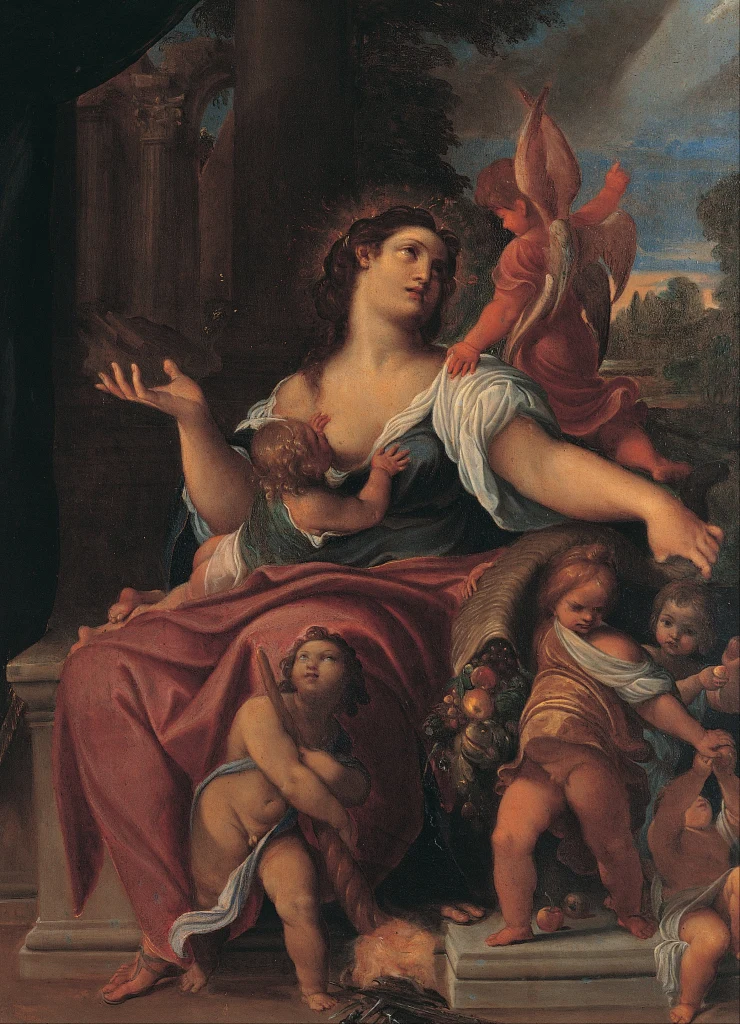
Allegory of Divine Providence
Details
The story
In 1772 the engraver Domenico Cunego made a print of this small picture in Rome. Under the image he engraved the title Providentia, three lines of Latin verse, and a note that the original was kept on the Capitol. The verse comes from Phaedra, a tragedy by the Roman writer Seneca. The great father of the world, it says, seeing how greedy the hands of fate were, made sure that every loss would always be made good by new offspring. That is how the print read the painting, as providence that keeps feeding and renewing life. Ludovico Carracci shows her with a child at the breast and a horn of plenty, with small children crowding around. He painted it around 1604 or 1605 on a sheet of copper about half a metre high, a smooth support that allowed fine, detailed work in a picture meant to be seen at close range.