Jean-Baptiste-Siméon Chardin · PD
The Attributes of Music
Details
The story
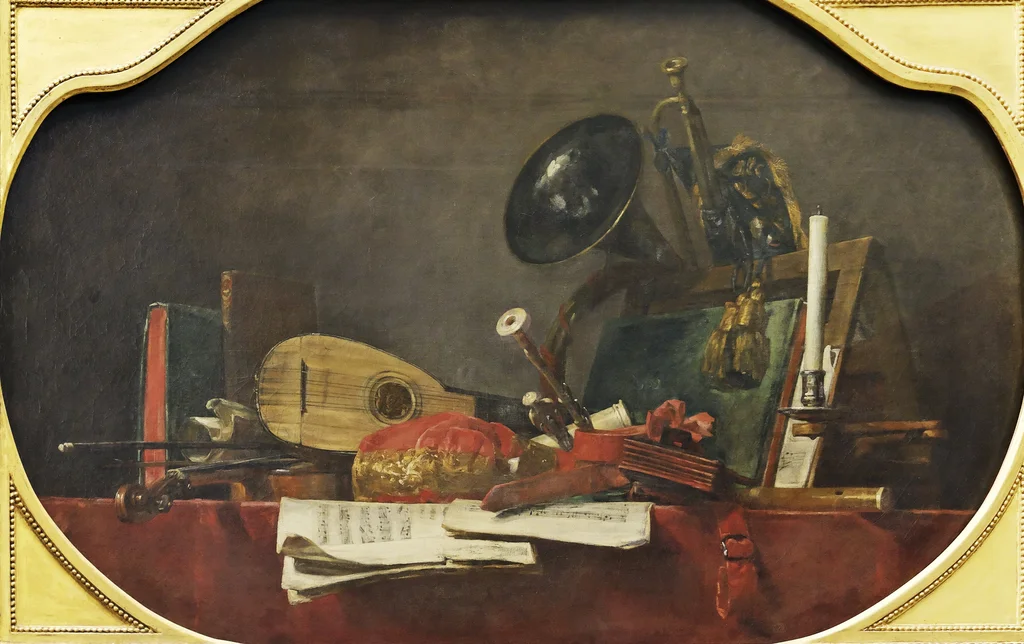
In 1764 Chardin, then in his mid-sixties and celebrated as France's finest painter of humble still life, was handed a royal commission. He was to paint three overdoors for the château of Choisy, one of the king's country houses, on the arts, on music and on the sciences. Instead of gods and allegorical figures, the expected way to honour such subjects, Chardin did what he always did. He painted the things themselves, laid out on a ledge. For music that meant a mandolin, a violin and its bow, a hunting horn, a trumpet hung with a tasselled banner, a musette in red velvet, a music stand with its candle and loose sheets of music, the tools musicians handled every day. He gives a page of music and a candlestick the same grave attention a history painter would give a battle. The canvases were shown at the Salon of 1765, and the third, on the sciences, has since been lost.