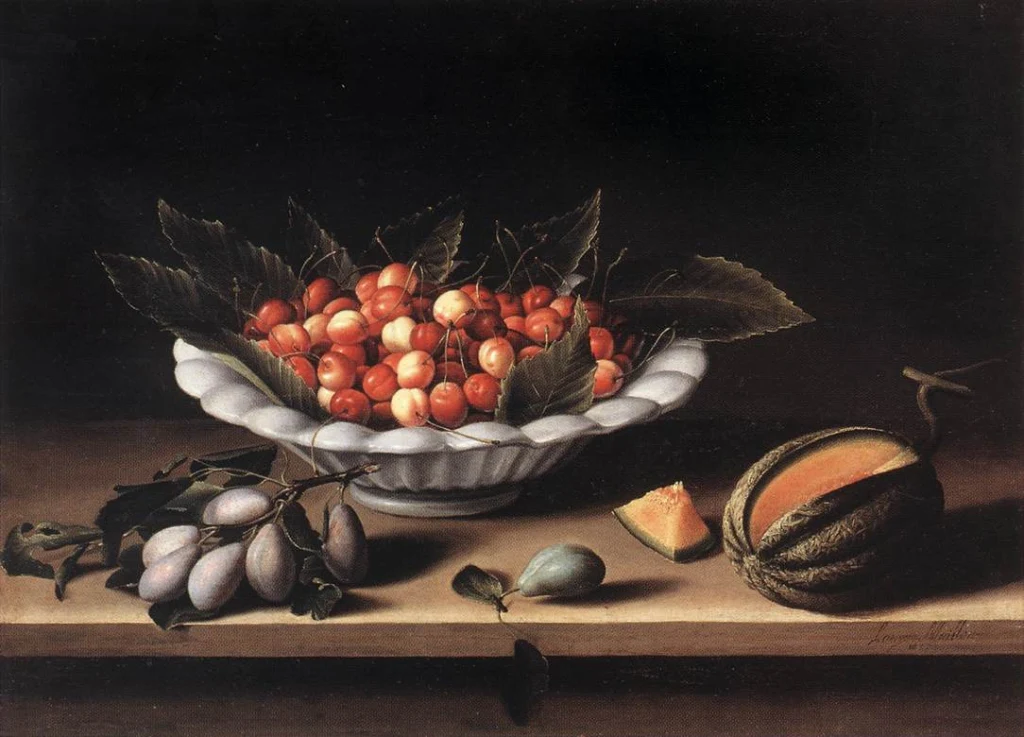
Bowl of Cherries, Plums and Melon
Details
The story
This panel came to the French state in place of a tax payment. It entered the Louvre in 1982 by dation, a procedure created by a law of 1968 that allows certain taxes, inheritance duties above all, to be settled with works of art. Before that it had belonged to the collector Jean Riechers at Neuilly, after surfacing in the Bordeaux art trade in 1953 and passing through Paris galleries.
The Louvre calls it perhaps Louise Moillon's most famous picture. The art historian Pierre Rosenberg, later director of the museum, wrote that much of its charm lies in an acid harmony of colours. The grey-white porcelain bowl holds crisp red and yellow cherries in a ring of dark leaves. There are blue plums, one of them set alone near the middle, and a melon with tender green rind and orange flesh.
The tabletop tilts steeply towards the viewer, an arrangement taken from northern still-life painters of the early 17th century. The museum notes that by the 1630s it was already a little old-fashioned, and that Moillon builds the whole composition on either side of the bowl, which is where the eye goes first.