Bust of Medusa
Details
The story
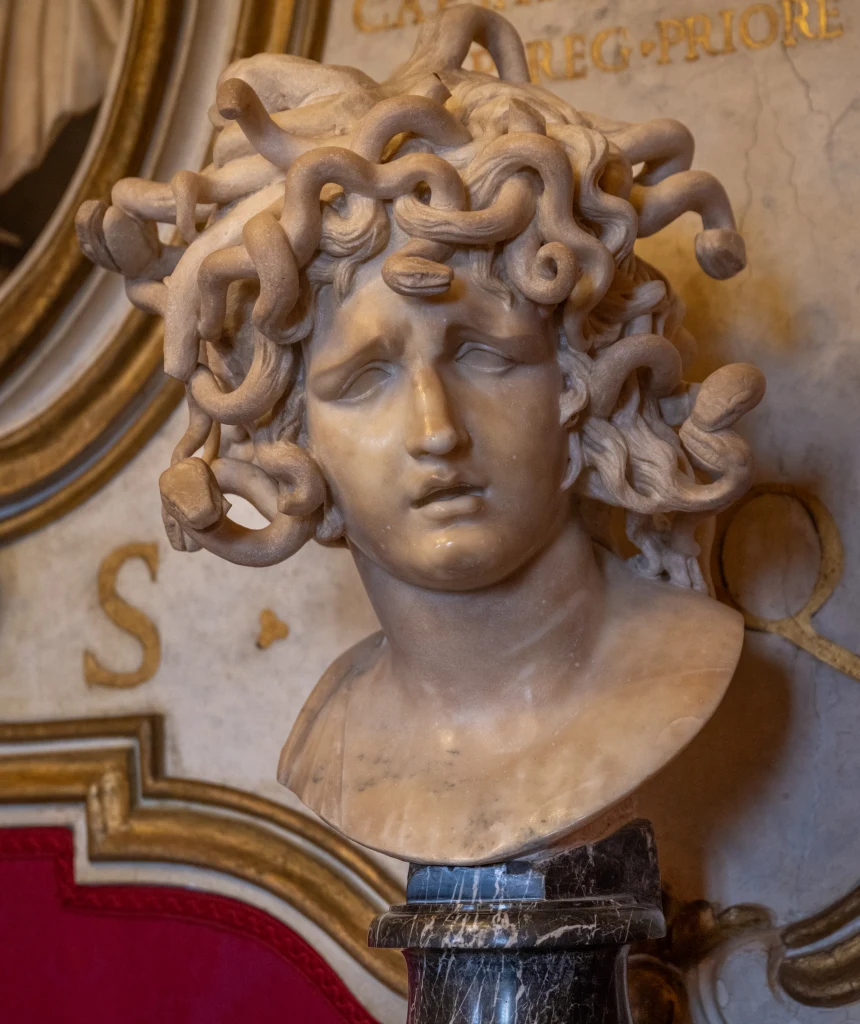
In March 1731 Marchese Francesco Bichi, one of the Conservatori, the magistrates who governed the city from this palace, presented this marble to the Capitol. The Latin inscription on its 18th-century base explains the gift. The image of Medusa, it says, was once carved on Roman shields to strike terror into the enemy, and now it shines on the Capitol through the glory of a most celebrated sculptor. It never gives his name.
The museum attributes the bust to Gian Lorenzo Bernini and dates it between 1644 and 1648, though recent research has suggested it could be a few years earlier, from the late 1630s. In Ovid, Medusa turned to stone anyone who met her gaze. The museum reads this Medusa through a poem by Giovan Battista Marino, in which she wonders whether a mortal chisel carved her, or whether, seeing herself reflected in clear glass, her own sight made her what she is. Bernini catches her in that passing moment, as she grasps the cruel joke and turns to marble before our eyes. The museum stresses that this is a bust, a true portrait of the most beautiful and deadly of the Gorgons.
It is first recorded in the palace inventories of 1734, in the same room where it stands today.