Govert Flinck · PD
Calvary
Details
The story
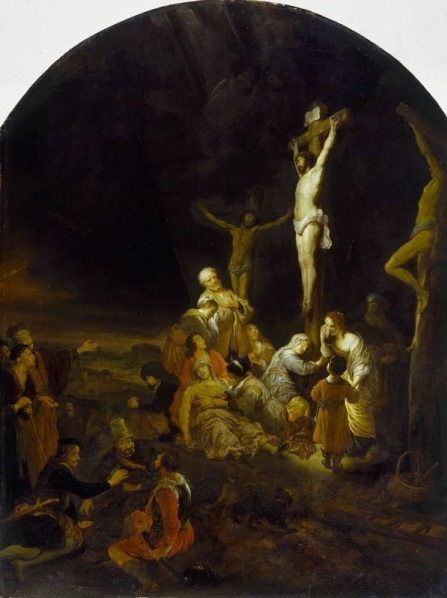
By 1649 the Dutch Republic had just won formal recognition of its independence, a Calvinist state whose whitewashed churches held no altarpieces and no painted saints. A large Crucifixion like this one had nowhere public to hang, so it was made for a private room, a picture to pray before at home. Flinck built it around that intimacy. The three crosses are pushed well to the right and set at an angle, rather than facing us head on. On the central axis, where you expect Christ, stands an ordinary old man at the foot of the cross, gazing up. The same shaft of light that strikes Christ falls on him, and on a young mother with her child close by. The people gathered here do not look like remote figures from scripture. They look like Flinck's own Amsterdam contemporaries, dressed for his century. That was the point of a devotional picture in a Protestant household. You were meant to stand among them, an ordinary onlooker drawn into the light. He painted it on a wood panel a little over a metre tall, the scale of a work made to be lived with at home.