Paul Gauguin · PD
Canoe; Tahitian Family (Te vaa)
Details
The story
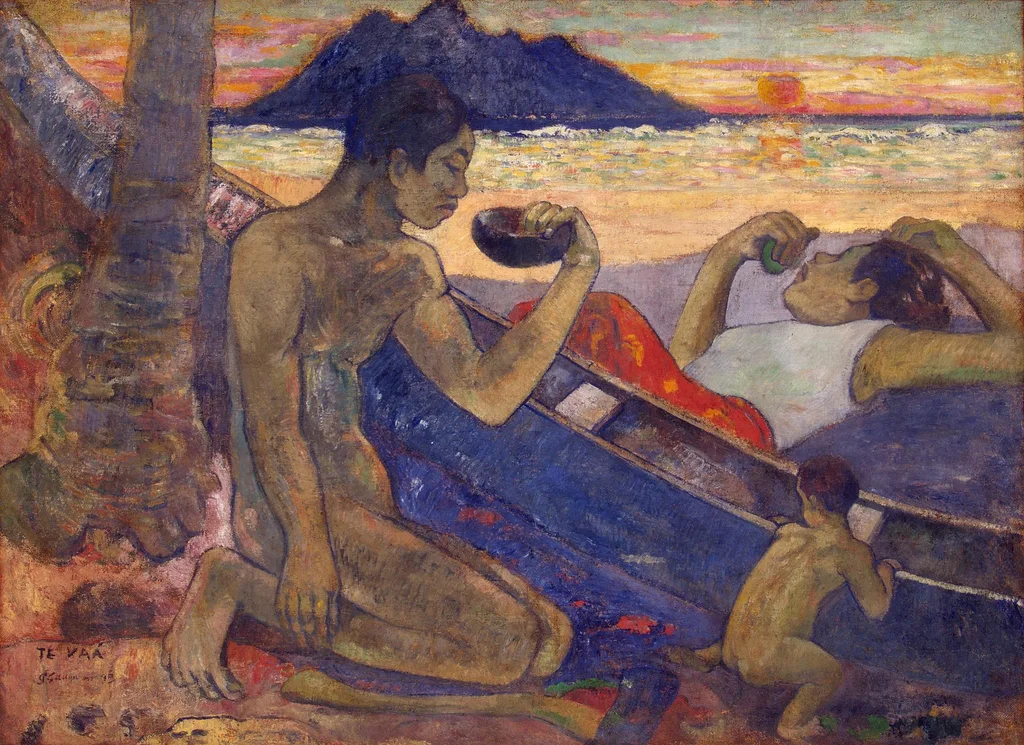
At the Paris Salon of 1881, Puvis de Chavannes showed The Poor Fisherman, a thin, still figure standing in a boat, and many critics were puzzled by it. Gauguin was then a stockbroker who painted in his spare time. Fifteen years later, in Tahiti, he took up the same idea for this canvas and shifted the weight onto the canoe itself, which cuts across the picture on a diagonal. A naked fisherman kneels by a palm trunk drinking from a coconut shell, a woman in a white blouse and red skirt rests beside the boat, and a child leans against its side. Hermitage curators point out that the man's pose owes more to ancient Egyptian tomb painting than to Puvis. In 1900 the Moscow collector Mikhail Morozov bought it in Paris, one of the first Gauguins to reach Russia. The words painted in the lower left corner, Te vaa, simply mean the canoe.