Capitoline Wolf
Details
The story
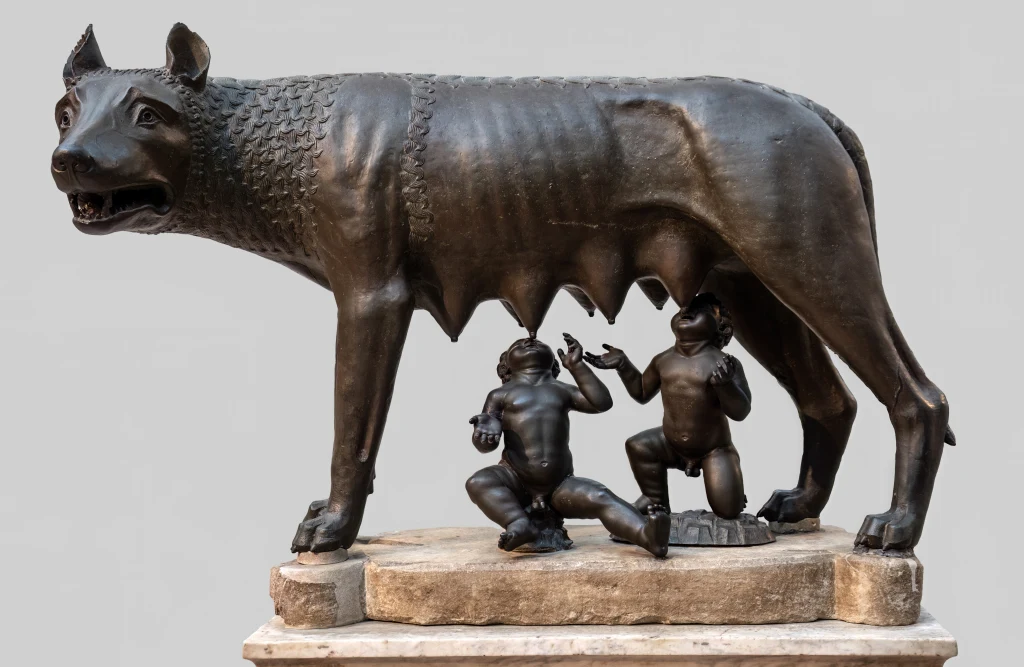
For most of its history this bronze was taken to be ancient, and the museum still dates it to the 5th century BC, to an Etruscan or southern Italian Greek workshop. The museum also notes that it probably had nothing to do with Rome's founding legend when it was made. The twins beneath her are certainly later, added around the end of the 15th century by a sculptor some identify as Antonio del Pollaiolo.
In 1997, during a restoration, the conservator Anna Maria Carruba saw that the wolf had been cast in a single piece. Large ancient bronzes were usually assembled from several parts, and she argued for a medieval origin. In 2007 radiocarbon tests at the University of Salento, on organic traces left in the casting core, pointed to the 11th or 12th century, and later thermoluminescence tests also placed it in the Middle Ages. At a conference in Rome in 2008 most of the scholars present still argued for antiquity. The question remains open.
What is documented is that a bronze wolf stood at the Lateran, the popes' palace, in the Middle Ages. Trials and executions were held 'at the Wolf' there until 1438, and in the 12th century an English visitor known as Master Gregory saw her in the portico at the palace entrance, with no twins at all.