Christ and the Adulteress
Details
The story
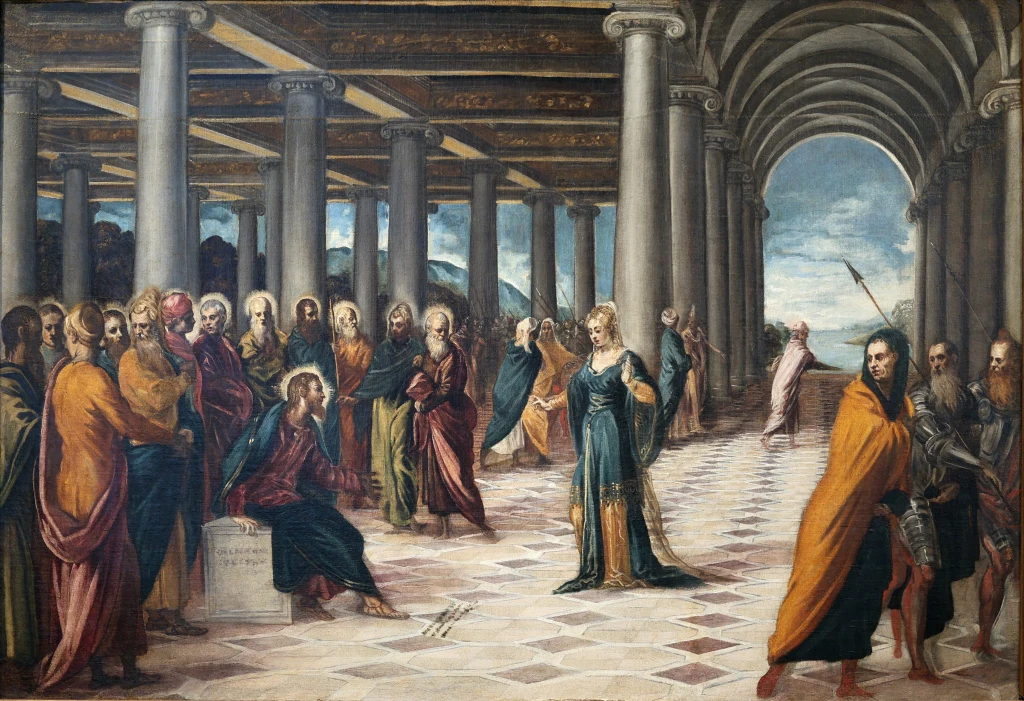
In 1648 the Venetian painter and writer Carlo Ridolfi, in his lives of the painters of Venice, recorded this canvas as a Tintoretto in the house of a collector, Vincenzo Zeno. That is the first record of it. The story comes from the Gospel of John and is nearly over. Christ has just said that whoever is without sin may throw the first stone, the accusers are hurrying away, and the woman lifts her hands, free now. Behind them a maze of columns races off in steep perspective. The museum reads it as the temple, the narrow legalism of the Pharisees, set against the open space of grace in front. By 1664 the picture belonged to Cardinal Flavio Chigi, a nephew of Pope Alexander VII, and a later Prince Chigi gave it to the national gallery in Rome in 1902. While it hung at Palazzo Corsini, the gallery's home in those years, the doubts began. From the 1930s on, scholars gave it to Tintoretto's son Domenico, to an anonymous Master of the Corsini Adulteress, and to a little-known contemporary, Giovanni Galizzi. The museum keeps Jacopo's name and dates it around 1549.