Christ and the Adulteress
Details
The story
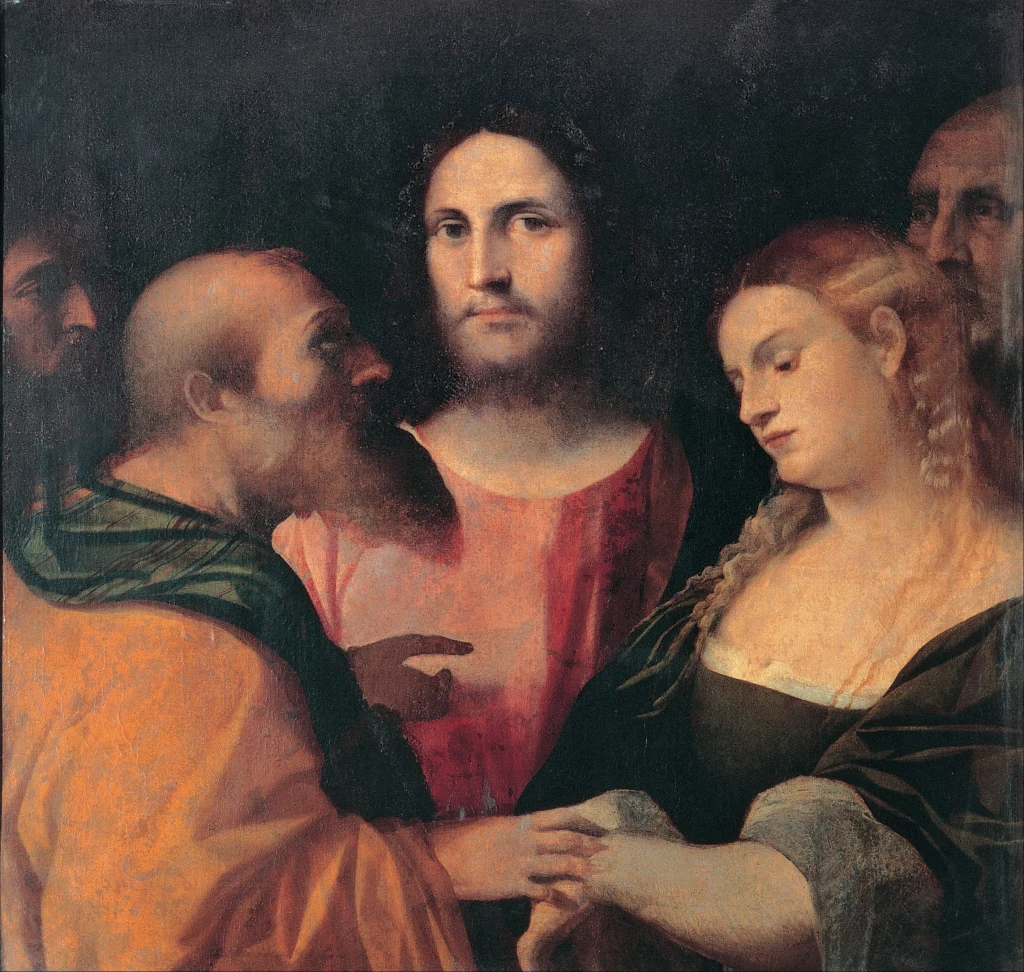
In Venice in the 1520s the Gospel story of the woman taken in adultery was a favourite subject for close-up, half-length pictures. Saint John tells how the scribes and Pharisees brought her before Jesus, reminded him that the law of Moses ordered such women to be stoned, and waited to hear what he would say. He bent down and wrote on the ground, then told them that whoever among them was without sin should throw the first stone.
Here Christ is shown between the woman and a Pharisee, and the museum sees Northern, German influences in the figures. Recent study with X-rays, infrared and other imaging has shown that the picture was still unfinished when Palma died in 1528, and that it was later partly repainted in a way that changed its original meaning. The woman's gaze was altered, and so were her hair and the position of Christ's hand. Some passages were never resolved.
That is why the museum's label adds a second name, with a question mark. Rocco Marconi, a painter from Treviso who worked in Venice, died within a year of Palma, and this was a scene he knew well. Besides copies, nearly a dozen versions of one of his compositions of Christ and the adulteress are known, two of them signed, one in the Gallerie dell'Accademia in Venice.