Christ and the Woman Taken in Adultery
Details
The story
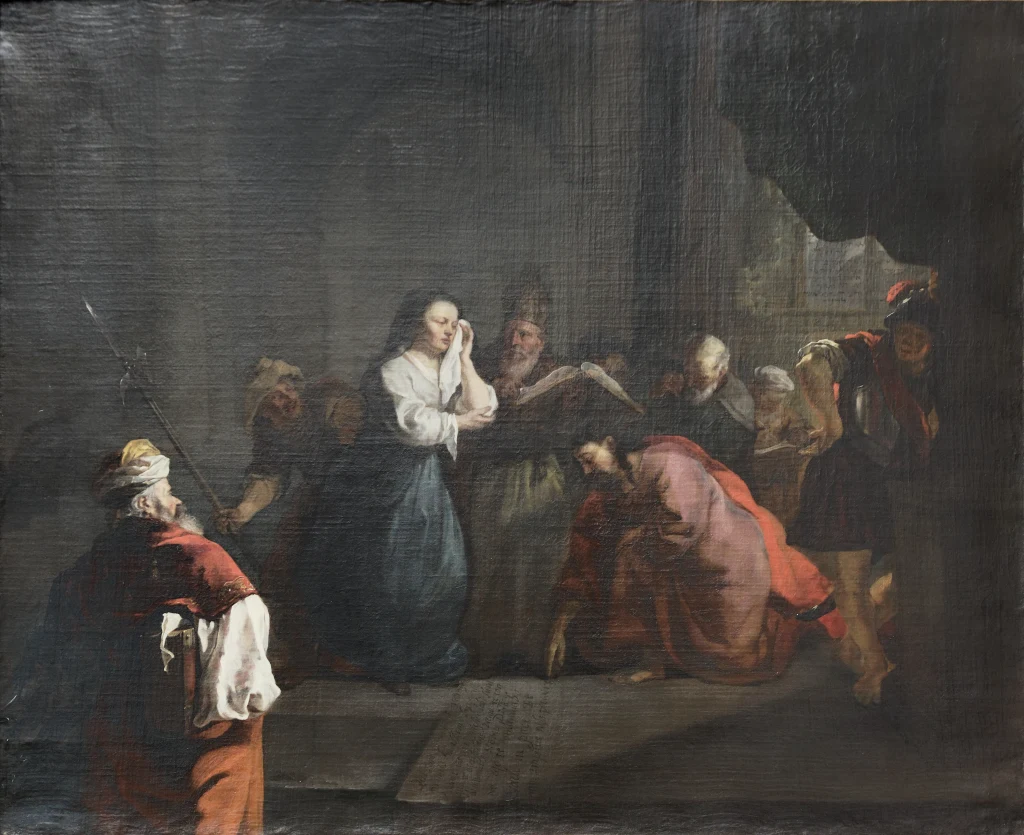
In 1653 two painters took up the same story from the Gospel of John, the woman brought before Christ by men who wanted her stoned, and both pictures ended up in the Louvre. Nicolas Poussin, the French painter working in Rome, gave his a strict classical order. Gabriel Metsu, about 24 and still in his native Leiden, gave his a broad, richly coloured baroque staging on a canvas more than a metre and a half wide.
The Louvre sees in it the influence of Nicolaus Knupfer, a history painter in Utrecht, and counts it among the very few religious pictures Metsu ever made. He signed and dated it at the lower right, his initials joined in a monogram. The canvas went through a Paris sale in 1790 and then belonged to Alfonso Miliotti, a Florentine-born dealer in Paris. When he fled the Revolution his property was seized, and the picture entered the new museum in the Louvre in 1799.