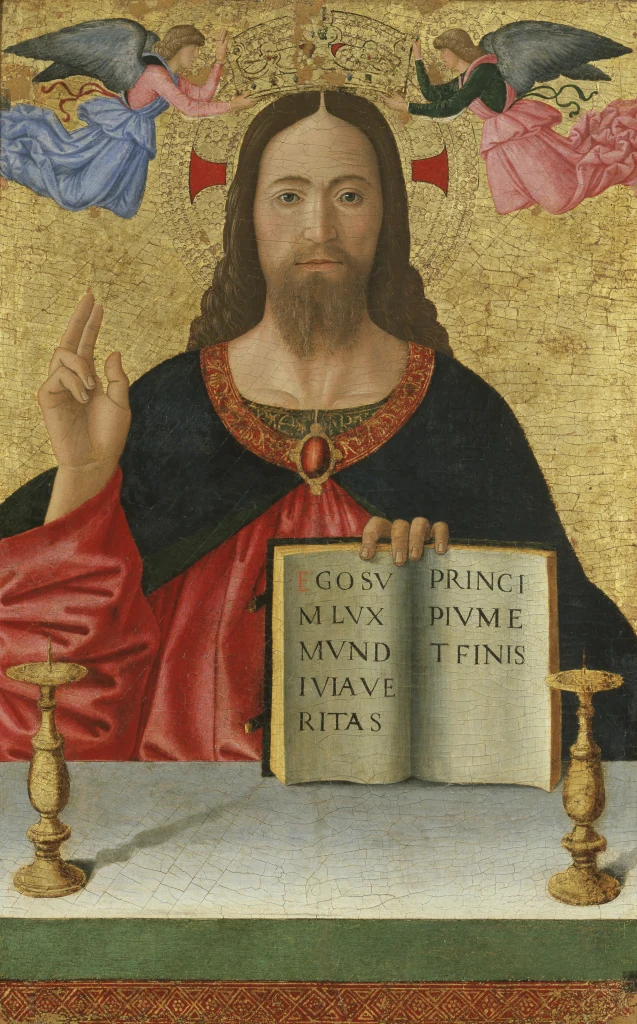
Christ Blessing
Details
The story
In 15th-century Rome the most venerated image of Christ was an icon kept in the Sancta Sanctorum, the old papal chapel at the Lateran, and said not to have been made by human hands. Every August it was carried across the city at night to meet an image of the Virgin, and painters copied it again and again. The art historian Adolfo Venturi thought this panel grew out of those copies, a frontal Christ against gold, with the haloes and the crown above his head punched into the gilding.
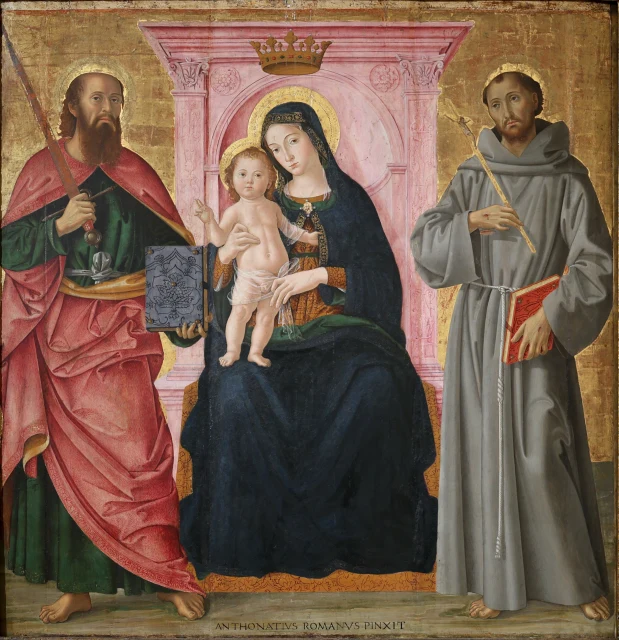
Who painted it has never been settled. In 1926, when it belonged to Riccardo Gualino, the Turin industrialist, Lionello Venturi published it as an early work by Melozzo da Forlì, the painter from Romagna who later worked for the popes. Roberto Longhi wrote in favour of Antoniazzo Romano, the leading painter born in Rome, and the catalogue of the 1938 Melozzo exhibition settled for an unnamed Roman painter. The gallery's own catalogues kept Melozzo's name into the 1970s. The museum now gives it to Antoniazzo, dated broadly between about 1456 and 1469, and scholars compare his small triptych in the Prado, whose Christ follows the same Lateran face.