Anthony van Dyck · PD
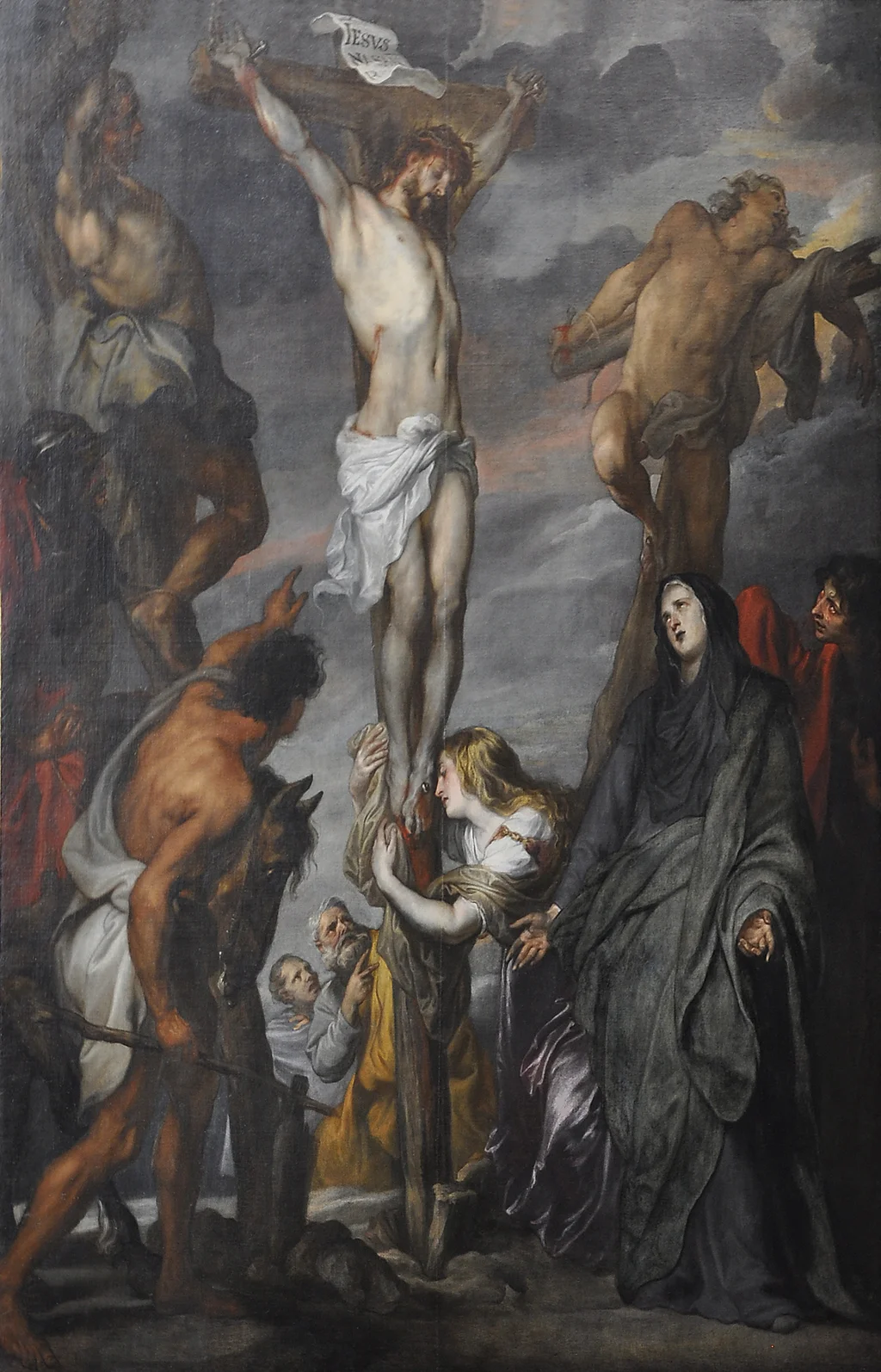
Christ's death on the cross at Golgotha
Details
The story
Around 1630 van Dyck delivered this Crucifixion to the Franciscan friars of Mechelen, for the high altar of their church. A local knight, Jan van der Laen, paid for it and for two more van Dyck compositions on the side altars. The design leans openly on Rubens's Coup de lance, a crucifixion he had painted for the Antwerp Franciscans about ten years earlier.
The church no longer exists. French rule closed the convent in the 1790s and the canvas went to Paris, where it stayed in the Louvre until Napoleon's defeat. When the pictures were sent back after 1815 there was no altar left to return it to, so in 1816 William I, ruler of the newly made United Netherlands, gave it to St Rumbold's Cathedral in the same town. It has hung there ever since, in a side aisle rather than above an altar.