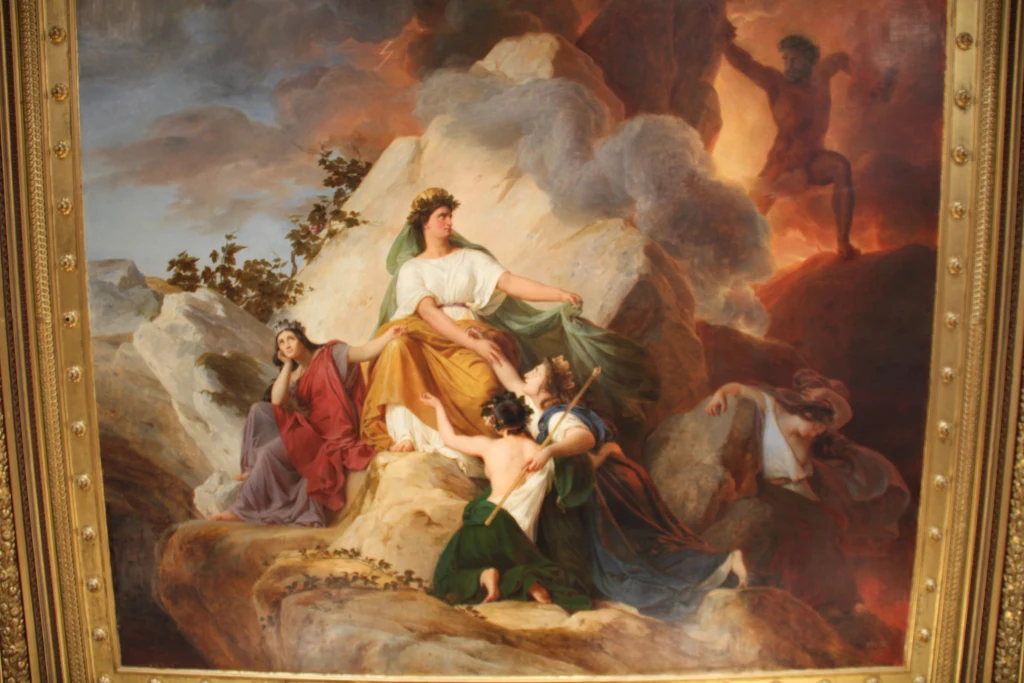
Cybele Protecting the Towns of Stabiae, Herculaneum, Pompeii and Resina from Vesuvius
Details
The story
Three of the four towns in the title had been under the ash for more than 17 centuries when Picot painted them. Pompeii, Herculaneum and Stabiae were buried when Vesuvius erupted in the year 79. The fourth, Resina, was a living town on the Bay of Naples, built over the buried streets of Herculaneum. It was from wells and shafts dug there that the first excavations reached the ancient city in the 18th century, and in 1969 Resina took the name Ercolano.
On the ceiling the towns appear as women gathered round Cybele, the mother goddess whom the Romans honoured as a protector of cities, while the volcano smokes behind them. In the curved coves around the central canvas, painted in the manner of the wall paintings found at Pompeii, are views of all four places.
The commission dates from 1828, for 13,000 francs, when Charles X was still king. He was driven out by the revolution of July 1830, and Picot signed the canvas in 1832, under Louis-Philippe, and showed it at that year's Salon. It is still on the ceiling it was made for, over Room 646, where Greek terracotta figurines from Myrina, in present-day Turkey, are now displayed.