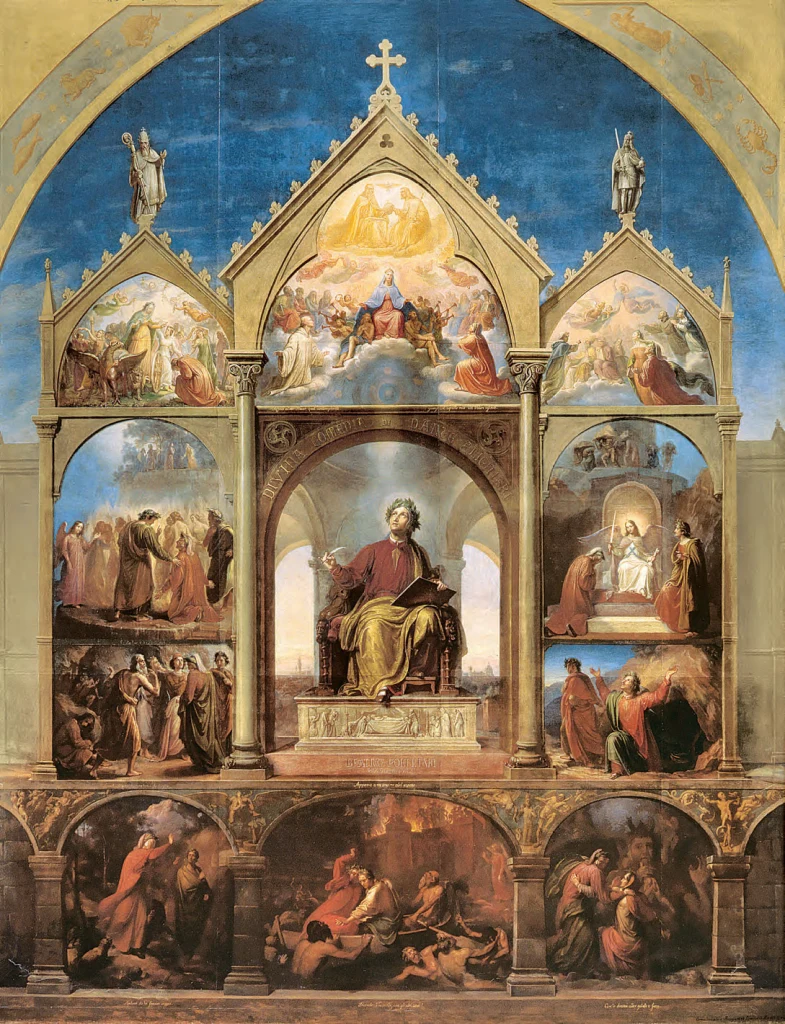
Dante and Ten Episodes from the Divine Comedy
Details
The story
In July 1840 three foreigners living in Florence paid a restorer to scrape the whitewash off a wall in the chapel of the Bargello, and a face came out that everyone agreed was Dante, painted within a generation of his death. It was the news of the decade in Florence. Two years later Vogel von Vogelstein, court painter to the king of Saxony, was working in Rome on this piece, and the museum record notes that he began from a study of that rediscovered portrait. What he built around it is not really a painting on canvas. It is oil on paper mounted into a gilded wooden structure shaped like a gothic frontispiece, modelled on the facade of Orvieto cathedral, with Dante enthroned at the centre, a pope and an emperor in the flanking niches, and ten scenes from the Commedia around them. He meant it as one panel of three, the others taken from Virgil's Aeneid and Goethe's Faust. The Grand Duke of Tuscany bought it when it was shown in Florence in 1844, after which it moved through the Accademia, the Crusca and eventually the offices of the civil engineers, and only came to the modern gallery at Palazzo Pitti in 1971.