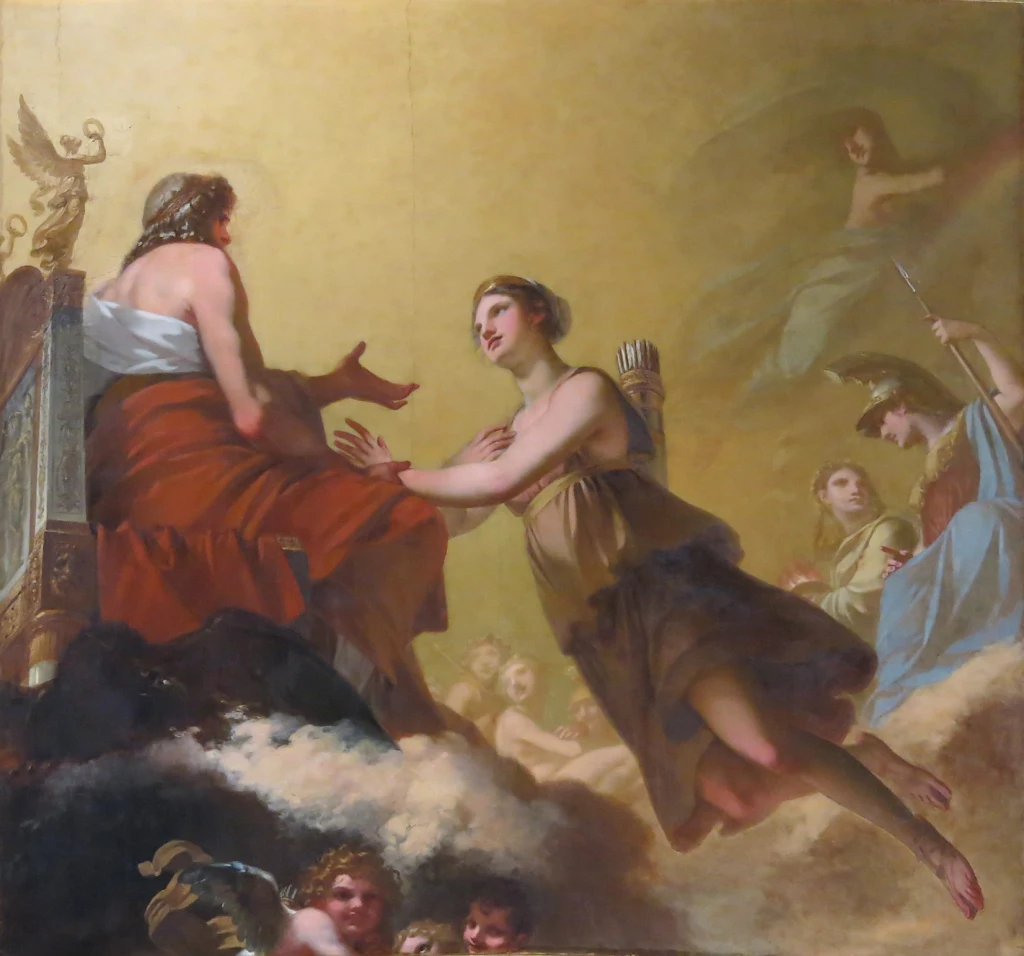
Diana Imploring Jupiter Not to Subject Her to the Laws of Marriage
Details
The story
The plot of this ceiling comes from a Greek poem written in Alexandria about 2,300 years ago. In his hymn to Artemis, the poet Callimachus has the goddess, still a small girl, climb onto the knees of her father Zeus and ask him for a list of gifts, a bow and arrows, a band of nymphs, the mountains to hunt in, and above all to stay a virgin for ever. In Roman dress she is Diana, he is Jupiter, and Prud'hon paints the moment of asking. Diana, her quiver on her shoulder, floats up to the enthroned king of the gods and holds out her hands, while other gods look on from the clouds.
The choice was not his. On 6 March 1801 the council of the Louvre's museum gave him the ceiling of a room in the new galleries of ancient sculpture, and the subjects had been set by Ennio Quirino Visconti, the Italian scholar who curated the antiquities. The plan called for two more scenes on the sides, Diana as bringer of light carrying two torches, and Night putting out the torches of the day. Only this central canvas was painted. It is dated 1803, and it is still in place overhead, in a room of Greek antiquities called the Salle de Diane.
More works by Pierre-Paul Prud'hon
 La Justice et la Vengeance Divine poursuivant le CrimePierre-Paul Prud'hon, 1808
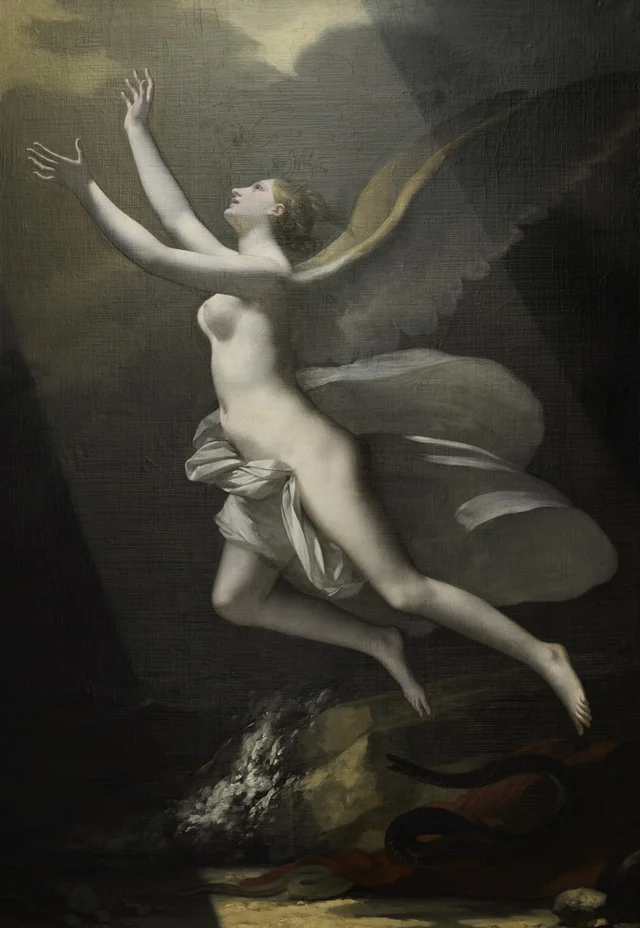 The Soul Breaking the Links Holding it to the EarthPierre-Paul Prud'hon, 1822
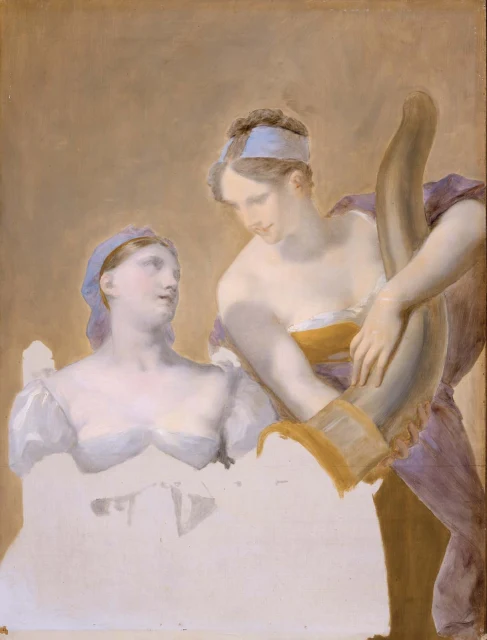 AbundancePierre-Paul Prud'hon, 1816
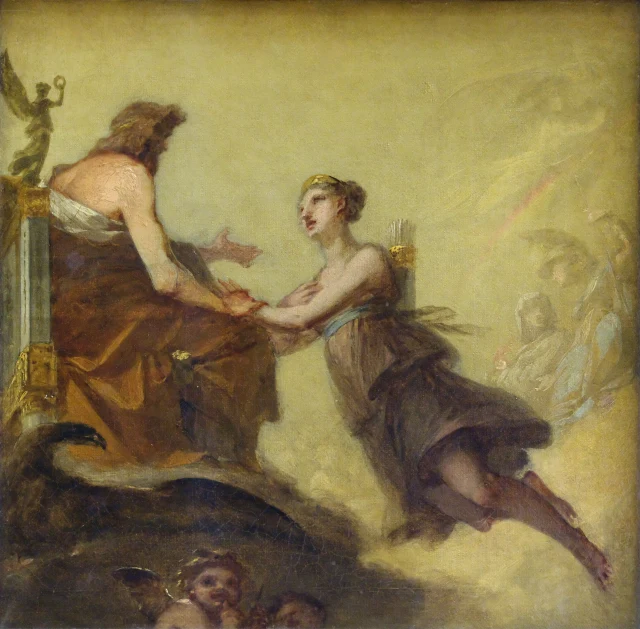 Diana Imploring Jupiter Not to Subject Her to the Laws of Marriage (Sketch)Pierre-Paul Prud'hon, 1802
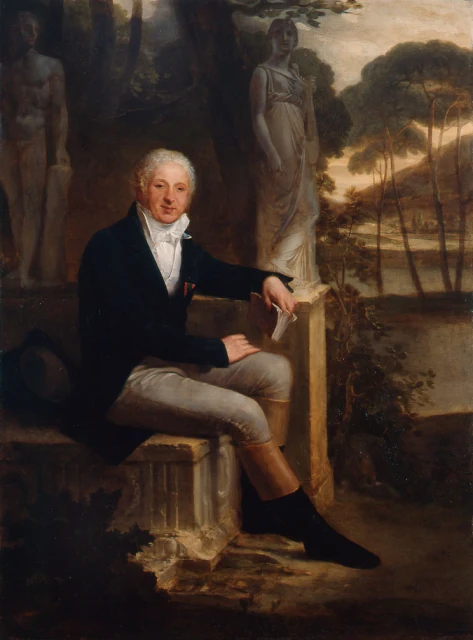 Portrait of Giovanni Battista SommarivaPierre-Paul Prud'hon, 1813