Epitaphios of Abbot Siluan
Details
The story
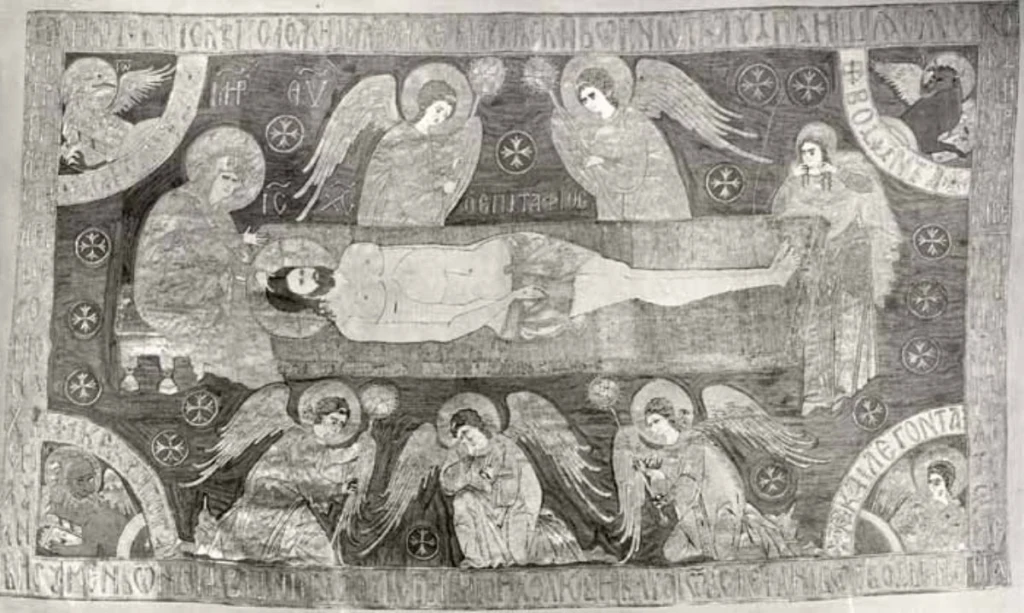
In 1437 Moldavia had been without Alexander the Good for five years. He had ruled for more than three decades, and two of his sons had just ended a civil war by dividing the country between them. At Neamț Monastery in the north, the abbot, Siluan, gave his community this cloth, and his name is worked into the embroidered border. It is an epitaphios, the shroud of Christ that is carried in procession and laid out on Good Friday, which is why it is so large, about two and a half metres long. The monks made it in their own workshop, in coloured silk with silver and gilded thread, tracing the main outlines in small pearls. Christ lies on what the museum calls the red stone of Ephesus. The Virgin sits at his head and bends close to his face, five angels frame the scene, and the four evangelists sit in the corners as their symbols. Nine years earlier the metropolitan of Moldavia had ordered an epitaphios that was probably made in Constantinople, and it was lost during the Second World War. That leaves Siluan's as the earliest dated Moldavian epitaphios to survive. At Christ's feet stands a grieving woman with both hands raised to her hair, in the place where many such scenes put Saint John.