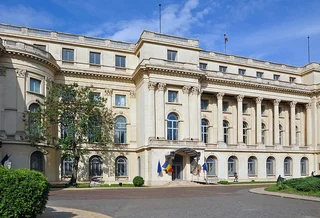
The National Museum of Art of Romania occupies the former royal palace in the centre of Bucharest. The kings lived here until the end of 1947, and a year later the palace became an art museum. In December 1989 the building was caught in the shooting, and bullet marks remain on its façade.
The works inside reached the palace by very different roads. Some were cut from church walls, others were bought by a king, others came by bequest, and others were rescued after an earthquake or a revolution. We chose these fifteen because each has a moment, still traceable, when its fate changed.
We begin with an embroidered shroud from 1437 and end with an iconostasis that was taken out of a monastery church after an earthquake in 1977.
01. From Church to Museum
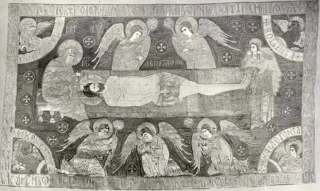
1. Epitaphios of Abbot Siluan, Neamț Monastery, 1437
On Good Friday, Orthodox clergy carry the epitaphios out of the sanctuary. It is a cloth showing Christ laid in the tomb, and they place it on a table in the middle of the church. This one was given to the Moldavian monastery of Neamț by its abbot, Siluan, in 1437, and the donor's name is embroidered in the inscription that runs all the way round the border. The museum label calls him Silvan, while the literature uses Siluan.
The monks of Neamț embroidered it in the monastery's own workshop. They were copying an epitaphios commissioned in 1428 by Macarie, Metropolitan of Moldavia, which was most likely embroidered in Constantinople. In 1686 soldiers of the Polish king Jan Sobieski carried that earlier cloth off to Poland, where it was kept in a museum in Lviv until it disappeared during the Second World War. Siluan's epitaphios remains the earliest surviving dated Moldavian one.
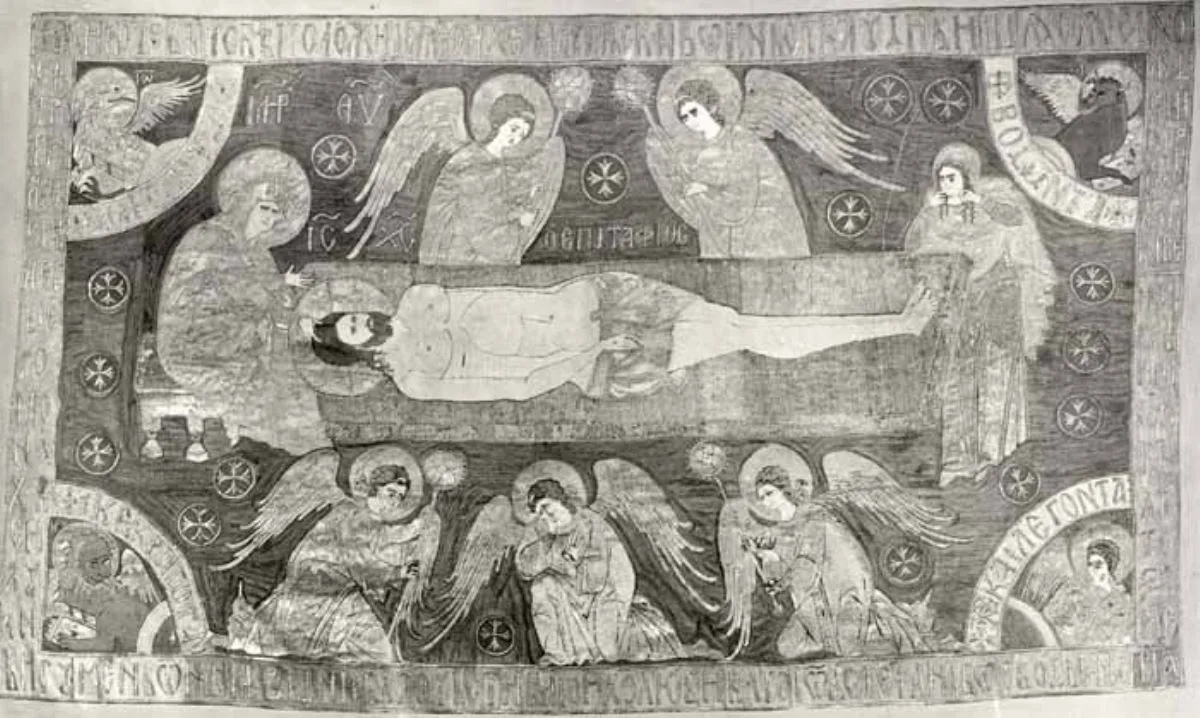
Christ lies across the full width of the cloth on a red slab known as the Stone of Ephesus, his eyes closed and his arms crossed. At his head the Virgin bends low, her face almost touching his. At his feet a woman stands with both hands raised to her head. This is Mary Magdalene, tearing her hair. The apostle John usually stood in this place, and the Neamț workshop put one of the myrrh-bearing women there instead. Above the body two angels hold ripidia, the star-shaped liturgical fans carried on poles, and three more angels bow below, the middle one resting his cheek on his hand. The main outlines are traced in seed pearls, rosettes with crosses are scattered over the dark ground, and the symbols of the four Evangelists are embroidered in the corners.
The epitaphios is longer than a man is tall, because Christ is embroidered on it at full length and it was spread out whole on the table. Researchers have found no documents on how it travelled from Neamț to Bucharest. In 2024 chemists studying its dyes found carminic acid in the red threads. American cochineal reached Europe after 1437, so the red must come from Armenian or Polish cochineal.
2. Caftan, Wallachia, Italian Velvet, c. 1480–1490
Around 1490 the Craiovești brothers, boyars from Oltenia in western Wallachia, founded the monastery of Bistrița and gave it an expensive caftan. A garment like this, the museum says, cost as much as an estate of several dozen hectares. Noble families of the time often gave their ceremonial clothes to the church, where they were made into vestments and liturgical covers. This caftan too was unpicked, and its pieces were sewn into a cover for a tomb, so the museum's inventories listed it as a funeral pall. When conservators examined it, they saw that the pieces had been cut for a caftan, and the museum restored it as a garment.
The cloth was woven in Italy, possibly in Milan. Large gold medallions framed by cloud-like lobes run across dark crimson velvet, and the pattern was woven together with the velvet, so the gold loops stand up above the pile in relief. Seven green bands cross the chest, each fastened with a cluster of small gilded buttons. On the sleeves and at the sides the seams cut the medallions in half, because the cloth was cut to fit a body.
3. Lady Roxanda — Dobromir of Târgoviște, before 1526
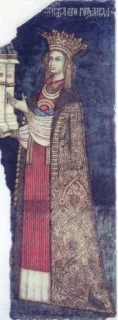
Of a large founders' composition, only Roxanda is left. She holds a white model of a church, and the torn left edge of the fresco runs straight through the building. Her husband Radu, who held the model from the other side, is gone with that part of the wall. She wears a tall gold crown set with rubies, sapphires and pearls, with long pendants hanging by her cheeks, a red dress in fine pleats, and a cloak of gold brocade with a black pattern.
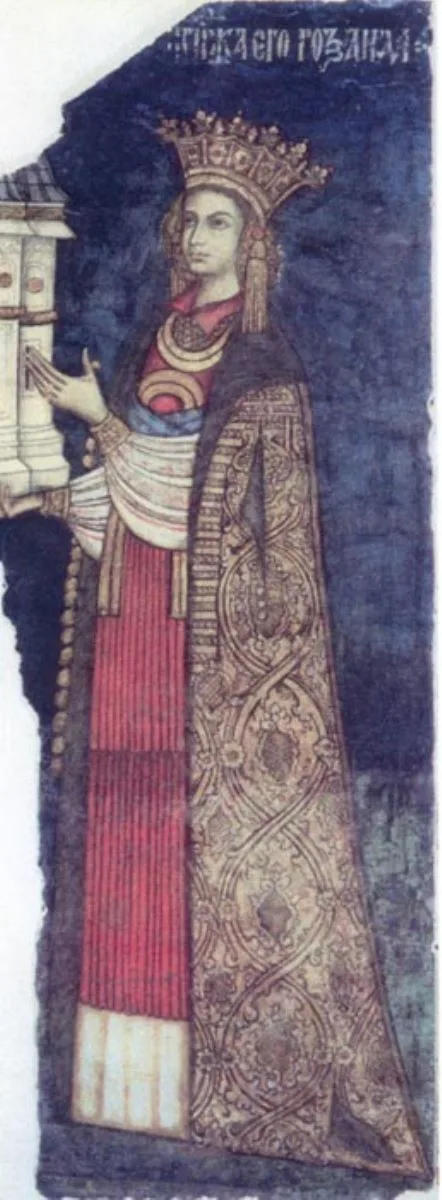
Roxanda was the daughter of the Wallachian prince Neagoe Basarab, who built the church of the Curtea de Argeș monastery. The painting of the church, begun under her father, was finished in 1526 under her husband, Prince Radu of Afumați, and the painter Dobromir of Târgoviște showed the couple together on the west wall as founders holding up the model of their church.
The broken edge was no accident. The Romanian authorities invited the French architect André Lecomte du Noüy to restore the church, and the work lasted from 1875 to 1886. The authorities wanted the old murals replaced with new oil painting, and in 1882 Lecomte du Noüy had 35 fragments of fresco, already blackened by candle soot, cut from the walls. Estimates of how much of the original painting survived range from a twentieth to a tenth. The fragments were sent to the Museum of Antiquities in Bucharest, and most of them later passed to the art museum.
From 1888 young Romanian architects, Ion Mincu among them, accused Lecomte du Noüy of destroying the national heritage. An official inquiry punished no one. Even so, the quarrel was one of the reasons Romania set up its Commission of Historic Monuments in 1892. Of the 35 fragments, 29 are in the National Museum of Art, two in the National Museum of Romanian History and four with the Archdiocese of Argeș.
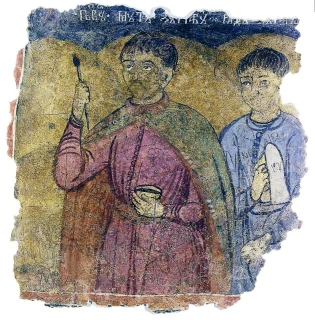
4. Self-portrait — Pârvu Mutu, fresco fragment from the church at Bordești, 1699
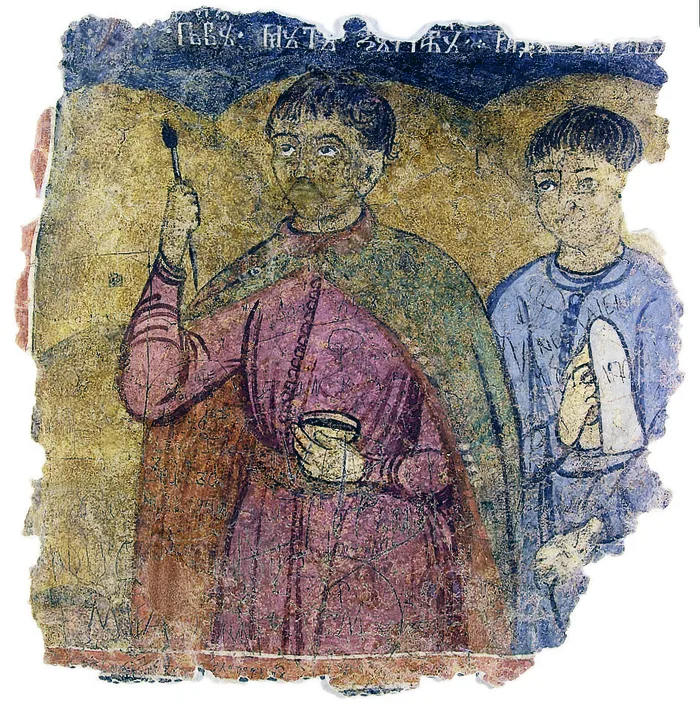
In 1699 Pârvu Mutu was painting the church of the Bordești hermitage, near what was then the border between Wallachia and Moldavia, and he painted himself on its wall. The church had been built by the boyar Mănăilă, an officer of Prince Constantin Brâncoveanu and a man from the circle of the Cantacuzino family, and Mutu was the Cantacuzinos' favourite painter. He stands in a long mauve-pink caftan closed with small buttons and an olive-green cloak. In his raised right hand he holds a brush, and in his left, at his waist, a small round paint vessel that descriptions call a shell. Behind his shoulder stands his apprentice Radu in a plain blue-grey garment, pressing to his chest the pale pointed trowel used to smooth plaster.
Mutu is dressed as a layman, in boyar's clothes. In the post-Byzantine tradition church painters long remained anonymous, and self-portraits like this one appear at the end of the 17th century, when the guilds had grown strong and a master's craft had begun to give him standing in society. Mutu painted himself in other churches as well, and this one is considered the finest.
Scratched letters and marks cover the caftan, the ochre ground and the apprentice's clothes. After 1911 the church stood abandoned and open, and visitors scratched the walls. In the middle of the 20th century a team sent by the Ministry of Culture took the self-portrait off the wall together with a fresco of the Dormition of the Virgin from the same church, and both came to the museum. Mutu also painted the founders' portraits in the church of the Cotroceni monastery, which we return to at the end.
Later in life Mutu became a monk under the name Pafnutie, and in 2017 the Romanian Orthodox Church declared him a saint.
02. The Royal Gallery
The first four works came here from churches and monasteries. At the end of the 19th century the collection gained a different source, when Carol I began buying European old masters for his palace.
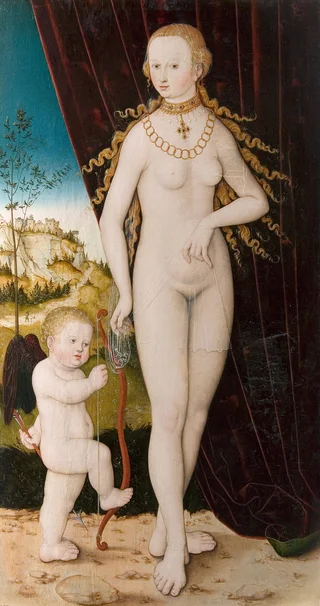
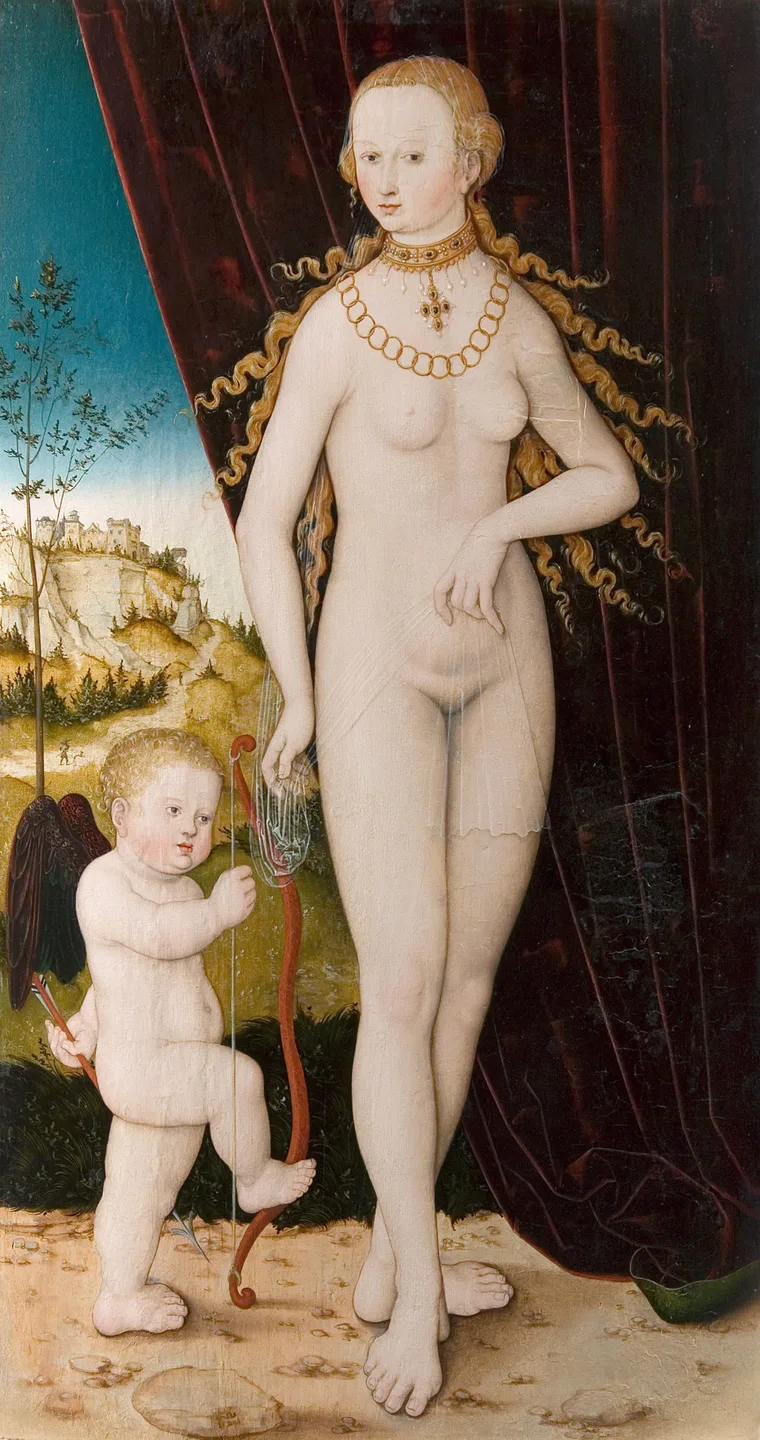
5. Venus and Cupid — Lucas Cranach the Elder or a follower, 1520s
Until the end of the 20th century this Venus looked different. Someone had painted a heavy dark-blue drapery over her body, covering her shoulder, waist and hip. The paint contained Prussian blue, which was first made around 1710, so the covering could not have belonged to the original picture. Even a Romanian postage stamp of 1967 printed Venus in her drapery. Between 1995 and 1999 the museum's conservator Ioan Sfrijan removed it.
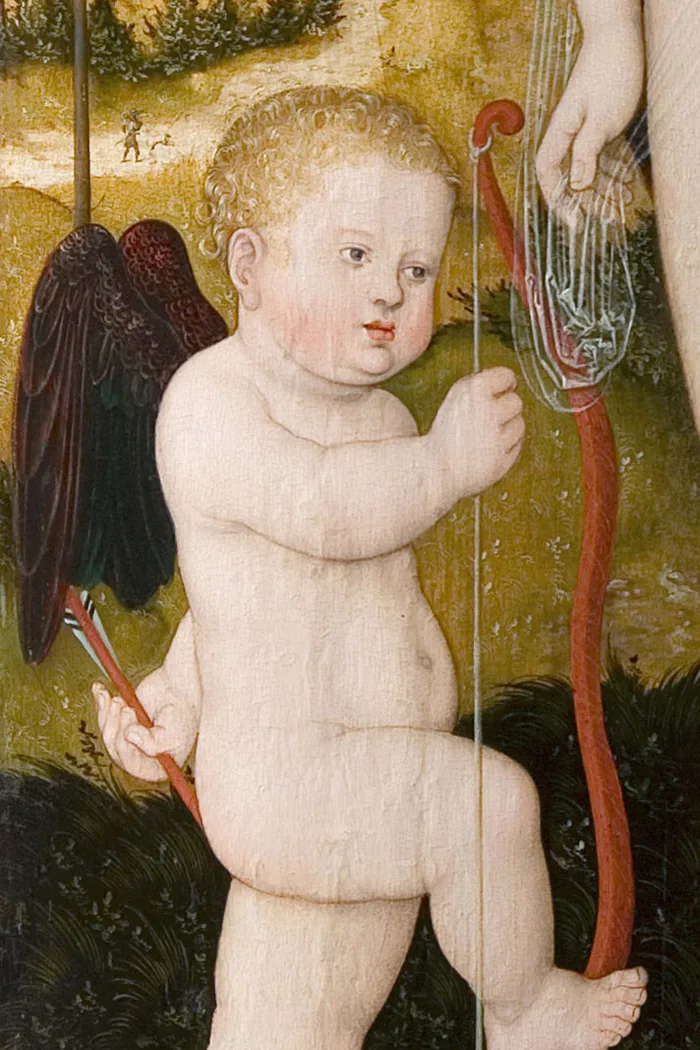
Venus now stands naked again against a dark red velvet curtain, bareheaded, wearing a necklace with a small cross and a heavy gold chain. The painter marked the transparent veil she holds at her belly with nothing more than fine white lines. Cupid, who reaches to her thigh, holds a tall red bow and braces his foot against its lower end, the way an archer does when stringing it, while his right hand goes behind his back. That hand holds an arrow, its feathers visible at the left edge of the panel, and Venus cannot see it.
The picture was bought by Carol I, a German prince of the Hohenzollern family who became Prince and then King of Romania. In 1879 he acquired it from the German consul and collector Felix Bamberg, in the first batch of paintings for a gallery he was assembling for a country that had no collections of old masters of its own. In his will he left the gallery, more than two hundred paintings, to the Crown of Romania, and the Romanian state holds that by the Crown he meant the state itself. In 1948 the royal collections were nationalised and handed to the new museum.
The museum regards the picture as a work by Lucas Cranach the Elder, dated 1520. The Cranach Digital Archive assigns it to a follower and considers Cranach's mark, a wingless serpent on the stone at lower left, most likely not authentic.
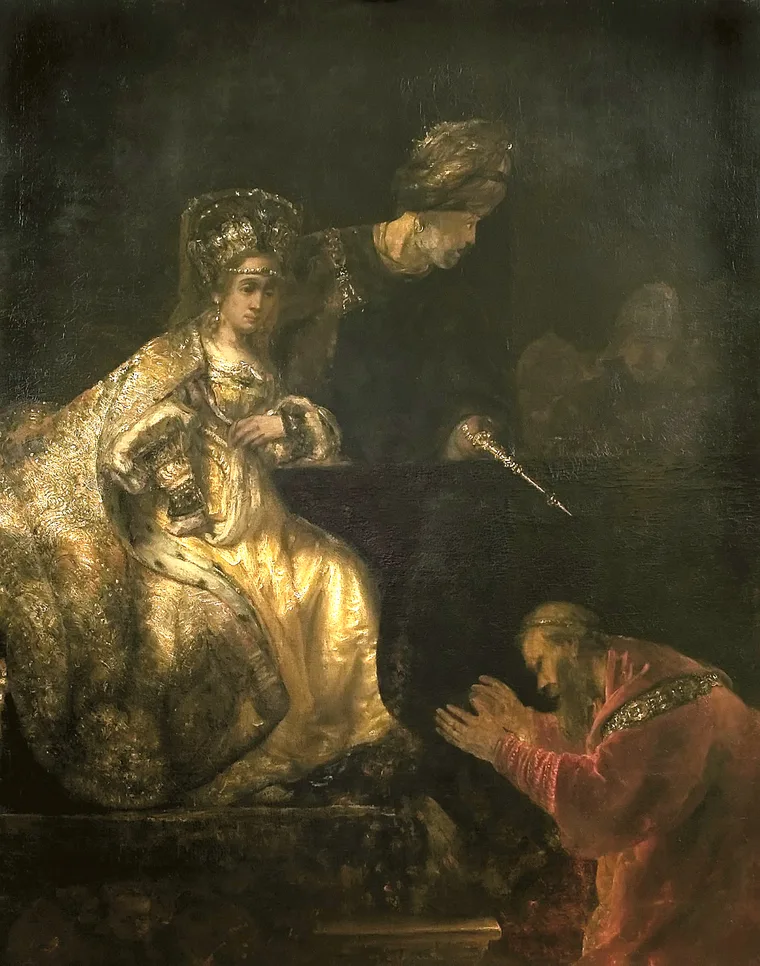
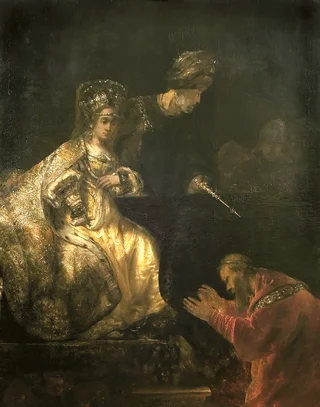
6. Haman before Esther — Rembrandt and studio, c. 1635 and 1660s
According to the biblical Book of Esther, the king's counsellor Haman obtained a decree to destroy the Jews, and Queen Esther, herself a Jew, revealed this to the king, whereupon Haman threw himself on her mercy. Esther sits at the left in a tall pearl crown and a golden dress painted in thick, broken strokes, and she looks down, past Haman. Haman kneels at lower right in red, his head bowed over his folded hands. The king, in a turban, leans out of the shadow behind Esther and looks at Haman, and only his gold sceptre, held out over the dark table, connects the three.
This picture has one important peculiarity, since it is in effect two layers of painting from different decades. The argument over its authorship has gone on since the 1960s. X-rays revealed an earlier layer of about 1635 beneath the present surface, in which the composition already existed but Esther's face was further to the right. In the 1660s the picture was almost entirely repainted, probably in Rembrandt's studio. That is why the museum labels it “Rembrandt and studio”, and the RKD, the Netherlands Institute for Art History, also leaves open the possibility that Rembrandt himself took part.
By 1898 the painting already belonged to Carol, and that year it was sent to the Rembrandt exhibition in Amsterdam from Sinaia, the site of his summer residence, Peleș Castle.
After December 1989 Henk van Os, director of the Rijksmuseum in Amsterdam, came to Bucharest and took two 16th-century panels that had been hit by bullets to the Netherlands for restoration, and with them this canvas, which is not recorded among the works that were shot. It was restored in 1990–1991 at the Rijksmuseum and at the SRAL conservation studio in Maastricht.
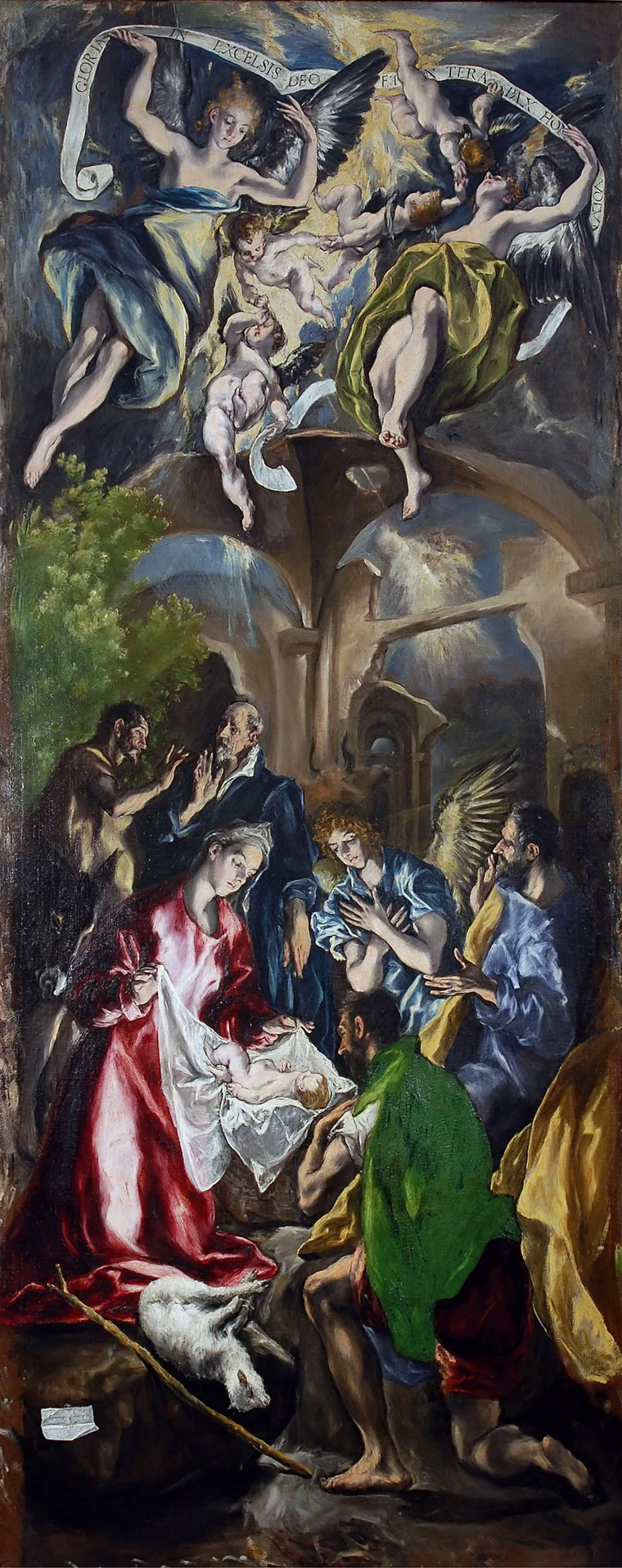
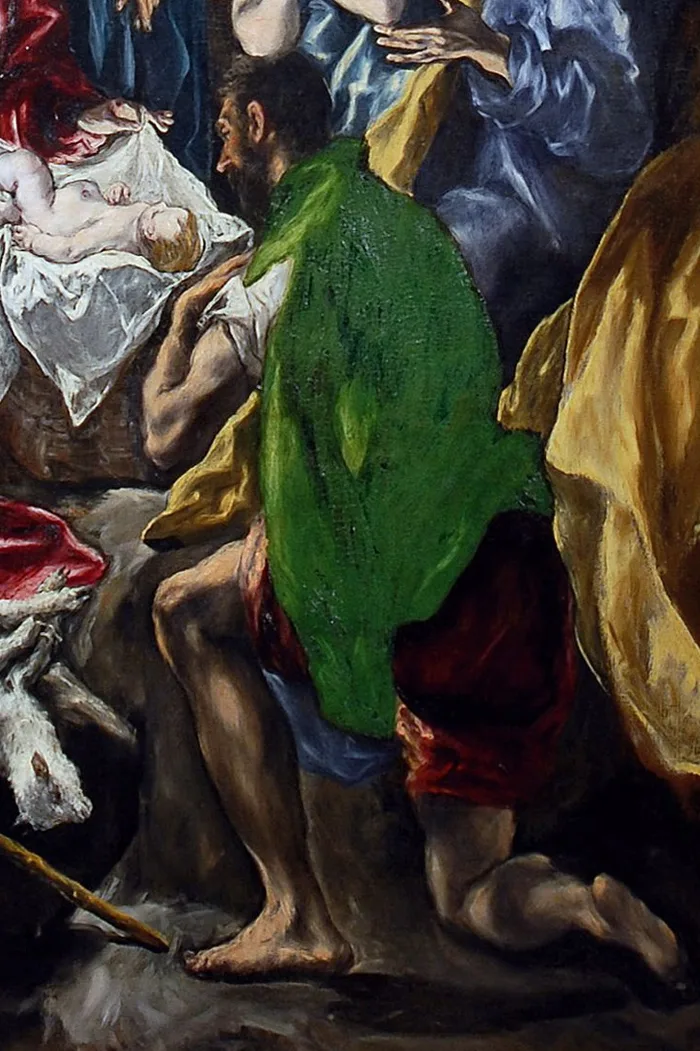
7. Adoration of the Shepherds — El Greco, 1596–1600
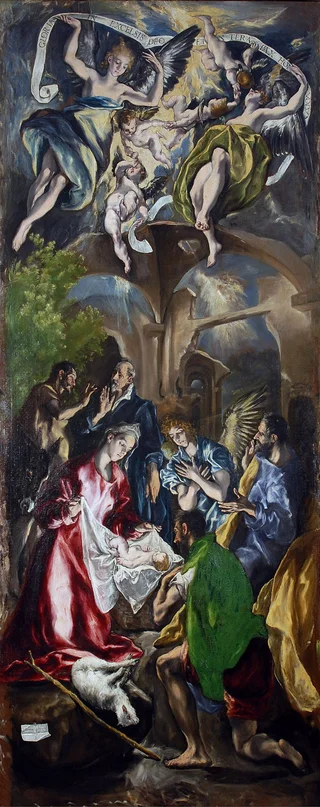
The only commission El Greco received in Madrid was the high altar for the church of a seminary known as the Colegio de Doña María de Aragón, after its founder, a lady-in-waiting to the queen. The contract was signed in 1596. Doña María died before the work was finished, the commission passed to the Council of Castile, and in 1600 the altarpiece was installed. In the accepted reconstruction it had two tiers of three paintings each, and the Adoration of the Shepherds stood at the left of the lower tier. That is why the canvas is nearly twice a person's height and as narrow as one bay of the altarpiece.
The lower half is night, and the light comes from the Child lying on a white cloth, so the faces around him are lit from below. Mary, in a crimson dress with a white veil over her head, draws the cloth back with both hands to show him to the shepherds. In front of her lies a white lamb with its legs bound, a sign of the sacrifice to come, and in the foreground a shepherd in an acid-green jacket kneels half turned away from us, the bare, dirty sole of his foot showing at the very edge of the picture. Above, two large angels hold a ribbon with the words “Glory to God in the highest”, and naked putti tumble between them.
When the college was closed under Joseph Bonaparte in 1808–1809, the altarpiece was taken apart. In the 19th century the painting passed through Louis-Philippe's Spanish Gallery in Paris, then a London sale and several private collections, until it reached Felix Bamberg, from whom Carol I bought it. The other five canvases of the altarpiece are in the Prado, and in 2000 the Prado brought all six together, borrowing the Bucharest canvas for the occasion.
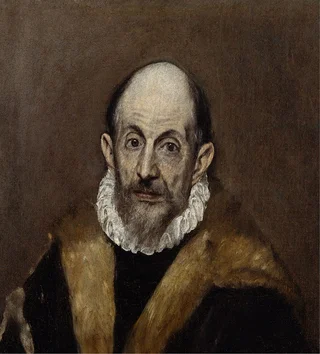
Carol I owned several paintings by El Greco, and three of them remained in Bucharest: this one, The Marriage of the Virgin and Saint Maurice. The fate of the former royal collection is still disputed. In 2025 Christie's pulled another El Greco from that collection out of a sale after the Romanian government lodged a claim.
03. Romanian Artists
Carol was collecting European old masters for Bucharest. Meanwhile Romanian artists were painting revolution, modern city life, landscape, and people who had scarcely appeared in the national painting before.
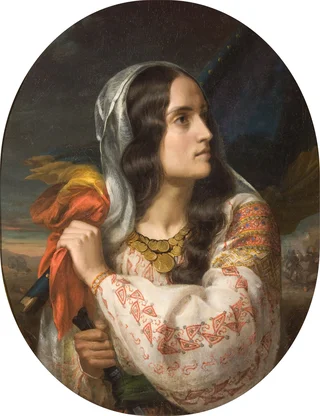
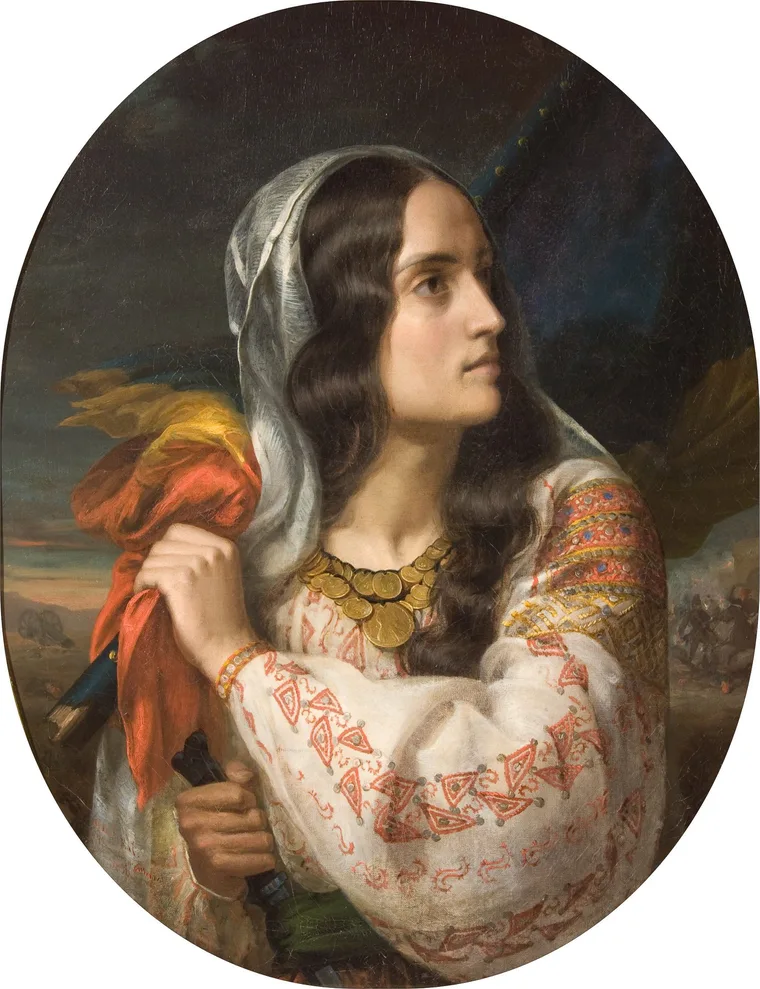
8. Revolutionary Romania — Constantin Daniel Rosenthal, 1850
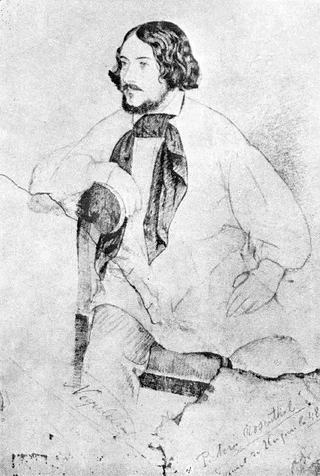
When the Turks crushed the revolution in Wallachia in September 1848 and arrested its leaders, Maria Rosetti, wife of one of them, the journalist Constantin A. Rosetti, disguised herself as a peasant woman so that she could follow the prisoners and win their release. She was born Mary Grant on the island of Guernsey, to a Scottish father and a French mother. In 1850, in Paris, where the exiles had gathered, she was painted by Constantin Daniel Rosenthal, Rosetti's friend since their student days in Vienna. A Jew born in Pest, Rosenthal had been granted Wallachian citizenship in 1848 for his part in the revolution.
The canvas is oval, and the young woman fills almost all of it. She wears a white peasant blouse from the Muscel region, with rows of red embroidery and spangles on the sleeves, and a necklace of several rows of gold coins. She has turned her head sharply to the right and looks up, beyond the edge of the picture. With one hand clenched into a fist she holds a flagstaff against her shoulder, and its splintered, broken end sticks out at lower left. The blue, yellow and red cloths are crumpled and gathered at her shoulder. In her other hand she holds a dagger pointing down, and far off to the right horsemen clash in the smoke.
At the beginning of July 1851 Rosenthal travelled to Transylvania carrying Rosetti's propaganda papers. The French authorities intercepted his letters and warned Vienna, and he was arrested in Pest. He died in prison on the night of 22 to 23 July. The Austrian authorities announced that he had hanged himself in his cell, while in Romania the tradition persists that he was tortured to death under interrogation because he would not betray his comrades.
C. A. Rosetti kept the painting himself and died on 8 April 1885. In his will he wrote that while he lived he had not had the strength to part with these “icons”, and he instructed his wife and sons to give both of Rosenthal's historical paintings to the national museum in Rosenthal's name, as the painter had wished: this one and Romania Breaking Her Chains on the Field of Liberty.
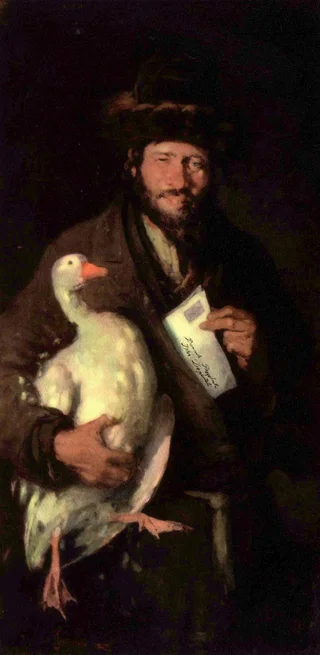
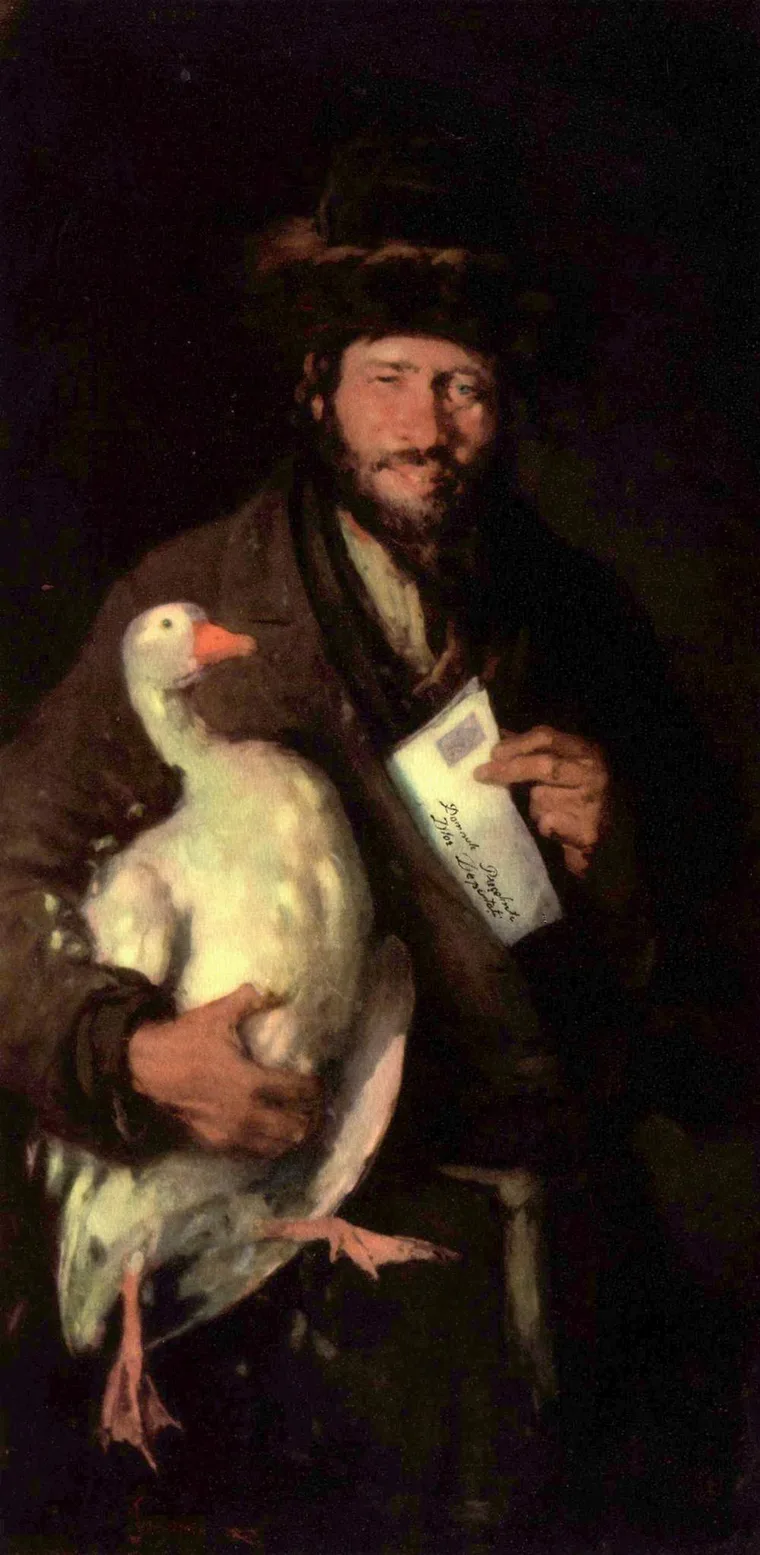
9. Jew with Goose — Nicolae Grigorescu, 1880
The Romanian constitution of 1866 allowed only Christians to be naturalised. The Congress of Berlin in 1878 made recognition of Romania's independence conditional on removing that clause, and in October 1879 the article was revised. The religious bar was lifted, yet citizenship was still granted one person at a time. Each applicant submitted a petition, and parliament voted on each one separately.
In the spring of 1880 Nicolae Grigorescu, who was then living in France, showed this painting at the Paris Salon. Later the painter himself called it A Prospective Romanian Citizen. A man in a round fur hat, with a dark beard, grins broadly at the viewer. Under his right arm he holds a live white goose, his fingers sunk deep into its feathers, and with his left hand he pulls a folded paper with a stamp in its corner from the front of his coat. The writer Alexandru Vlahuță, who wrote a book on Grigorescu, read the opening of the petition: “Mr President, Honourable Deputies…”.
In 1887 Grigorescu held a large exhibition in Bucharest, at the Eforie Palace, and this painting fetched the highest price of any work there. It was bought for 8,000 lei by Gheorghe Grigore Cantacuzino, whose wealth had earned him the nickname “the Nabob”.
The dispute is about whom Grigorescu is laughing at. Vlahuță described the man in openly antisemitic terms and saw the goose as a gift for an official. Later scholars have increasingly moved the target of the satire onto the naturalisation procedure itself, in which the state had abolished the religious bar yet still made parliament vote separately on each person's citizenship. In that reading the goose becomes part of a joke about the system.
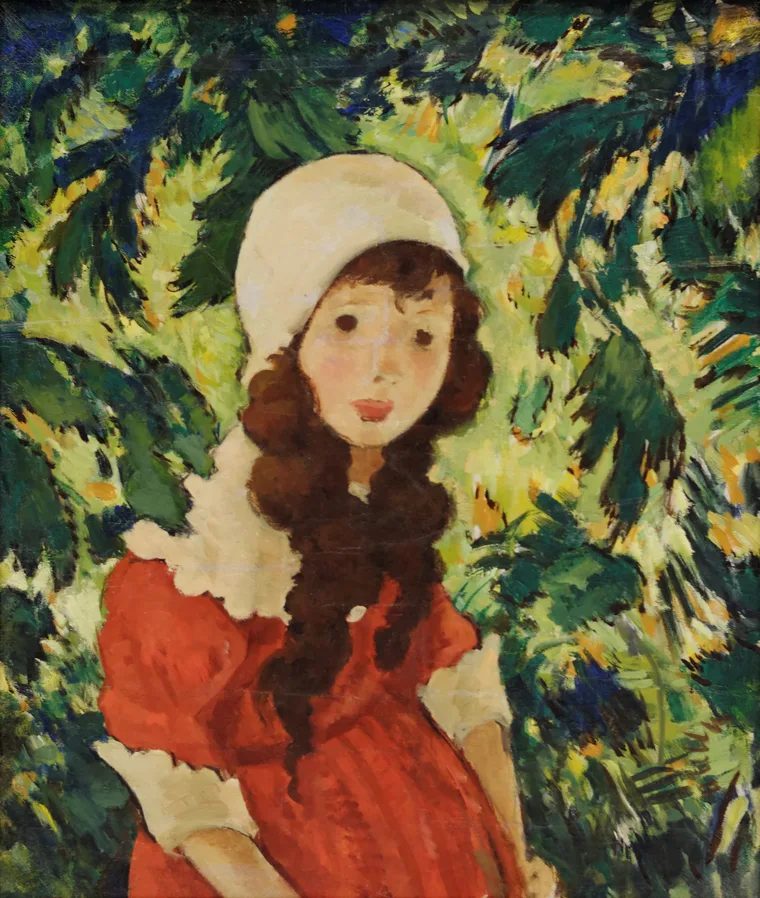
10. The Forester's Daughter — Nicolae Tonitza, c. 1925
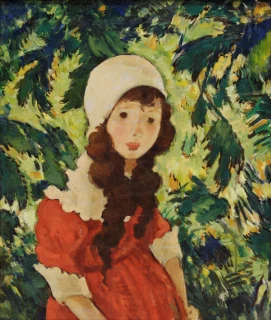
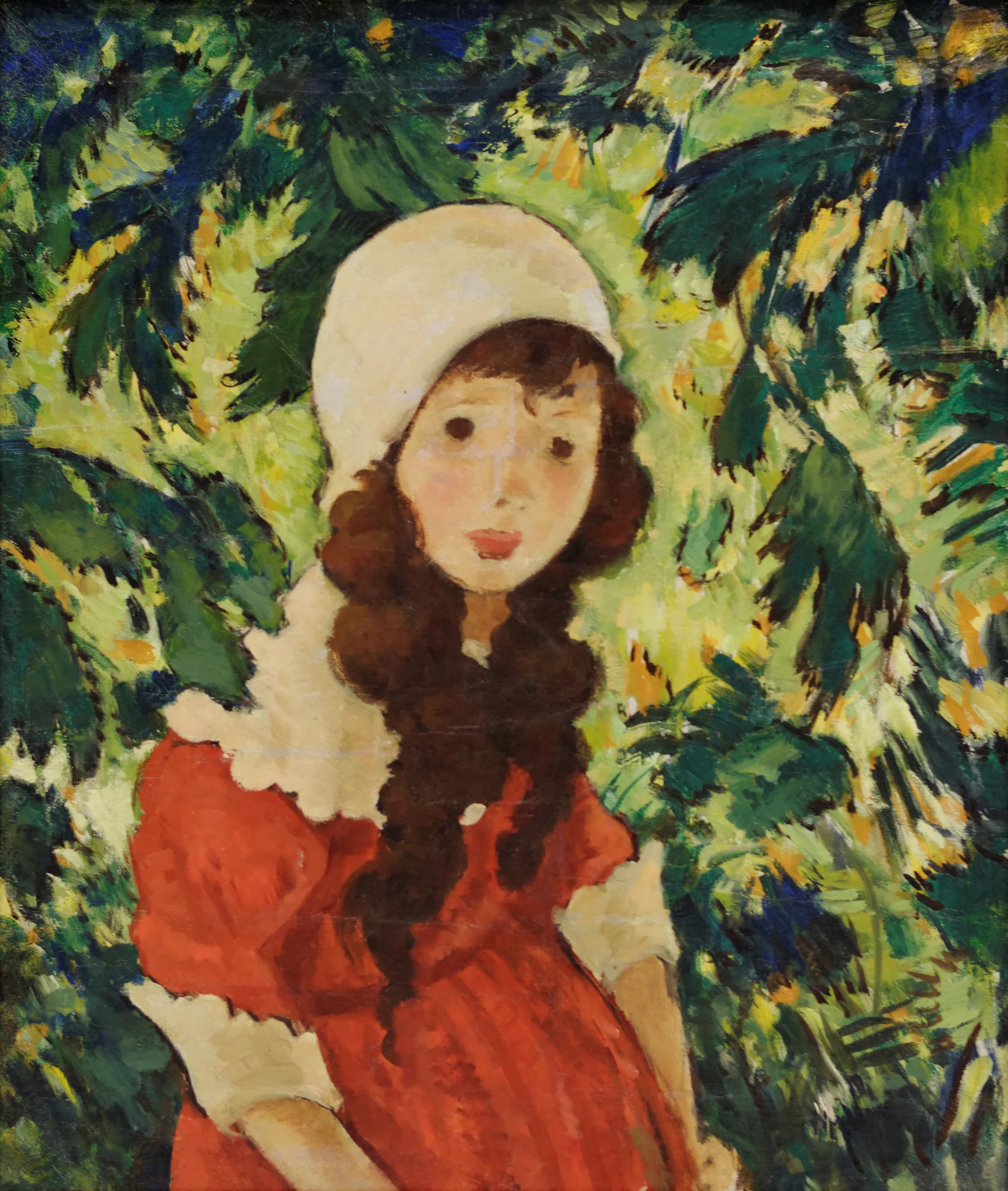
The girl in the picture has almost no whites to her eyes. Two dark, nearly black discs, set wide apart, look straight at the viewer and reflect nothing. Her gaze seems turned inward, and eyes like these make Nicolae Tonitza's portraits of children instantly recognisable. She wears a white bonnet and a bright red dress with puffed shoulders and a broad white ruffled collar, and her dark chestnut curls fall almost to her waist. The whole background is taken up by dark blue-green foliage, painted in long pointed strokes over an acid-yellow light. Tonitza links the red and the green with ochre, white and brown.
The sitter's name has not survived. In 1924 Tonitza exhibited at the Venice Biennale, and in 1926, together with the painters Francisc Șirato and Ștefan Dimitrescu and the sculptor Oscar Han, he opened the first exhibition of the Group of Four. Romanian critics came to call him “the painter of children”.
This is probably the most widely reproduced Romanian painting of the 20th century, and the museum itself counts it among its principal works. In 2023 the state listed it as Treasure, the highest category of Romania's national cultural heritage.
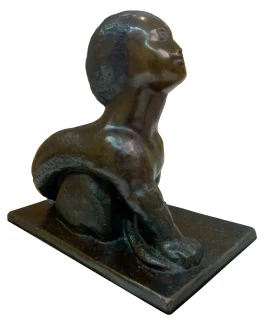
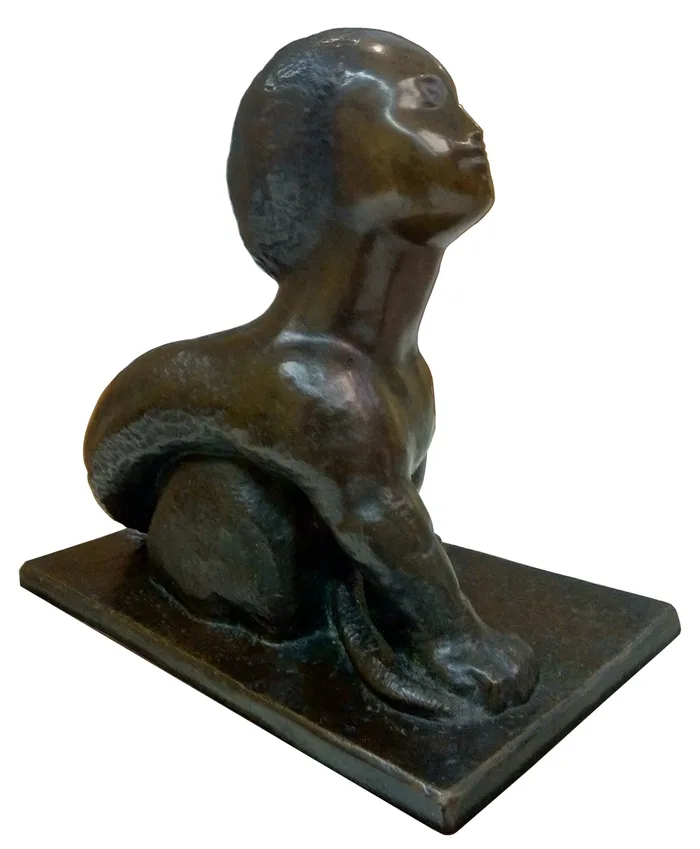
11. The Chimera of the Earth — Dimitrie Paciurea, 1927–1928
The Chimera of the Earth is small enough to stand on a table. A woman's head is thrown back, the smooth face with its heavy lowered lids looks like a mask, and the long thick neck takes up almost half the figure. At the front the body rests on short lion's paws, while at the back it seems to sink into a hump of stone and grow into it. A thin serpent's tail emerges from beneath it and winds around the base. The bronze is dark, the face, forehead and neck are polished to a shine, and the hair at the back of the head is left rough.
This is one of the chimeras Dimitrie Paciurea made in the second half of the 1920s. For The Chimera of the Air, a life-size figure, he won the National Prize for Sculpture in 1927. From 1909 Paciurea taught sculpture at the Bucharest School of Fine Arts, where Cornel Medrea, Ion Jalea and Oscar Han were among his students, and he worked in a studio in the courtyard of the museum of the painter Theodor Aman, of which he was curator. The chimeras puzzled the public, since by then the Symbolism of the 19th century was giving way to the radical avant-garde.
Little is known about how this bronze reached the museum. The label says “Provenance: purchase”, and when it was cast has not been published. The museum's Chimera of the Air was cast in 1967, 35 years after the sculptor's death.
Paciurea died of cancer on 14 July 1932. The Bucharest newspaper Dimineața wrote that he died poor, and his friends collected the money for his funeral.
12. The Prayer — Constantin Brâncuși, 1907
The contract Constantin Brâncuși signed in Paris on 18 April 1907 called for a weeping woman. The client, Eliza Stănescu of the town of Buzău, had been widowed in October 1905, about five months after her wedding, when her husband, the lawyer and member of parliament Petre Stănescu, died. For his grave she ordered a stone base, an allegorical figure and a bust of the dead man, for 7,500 lei. Brâncuși was 31, and that spring he had left Rodin's studio after working there for about a month.
At first he made what was asked for, a draped woman bowed in grief over the tomb, her hair loose, and this figure is known from a photograph. Then he destroyed it and began again. In the bronze cast in 1910 the woman is naked and kneeling, her whole body leaning forward from the knees in one long diagonal, her head bowed low onto her chest. Her right arm is bent, the fist pressed to her chest, and Brâncuși himself cut off the left arm above the elbow, following Rodin's example. He had not yet begun to polish his surfaces as he later would, and the marks of modelling remain on the dark bronze, breaking the light into small glints.
In 1910 The Prayer was shown at the Salon des Indépendants in Paris, and in 1914 Brâncuși came to Buzău himself, carved the base from stone on the spot and put up the monument in the Dumbrava cemetery. The painter Ștefan Popescu, who had advised the widow to approach Brâncuși, wrote that there was a scandal when the monument was handed over, though it was put up all the same.
The museum bought The Prayer from the Stănescu family in 1958 for 70,000 lei, a year after the state confiscated another Brâncuși, The Wisdom of the Earth. A copy was placed on the grave, and the bust of Petre Stănescu is also in the museum. The copy was stolen in 1996, found in 1998 and stolen again in 2005. Since June 2014 a new bronze copy has stood on the grave, cast from a mould taken from the museum's original and paid for by the Rotary Club of Buzău and private donors.
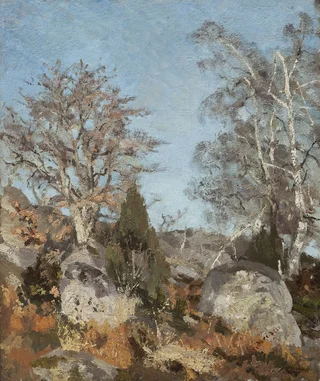
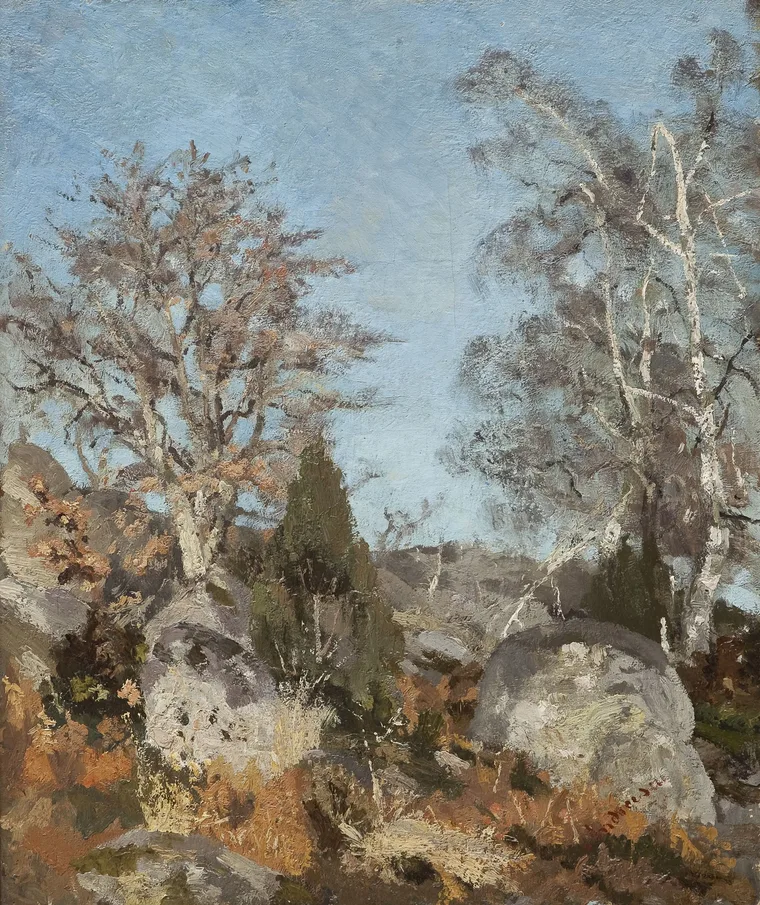
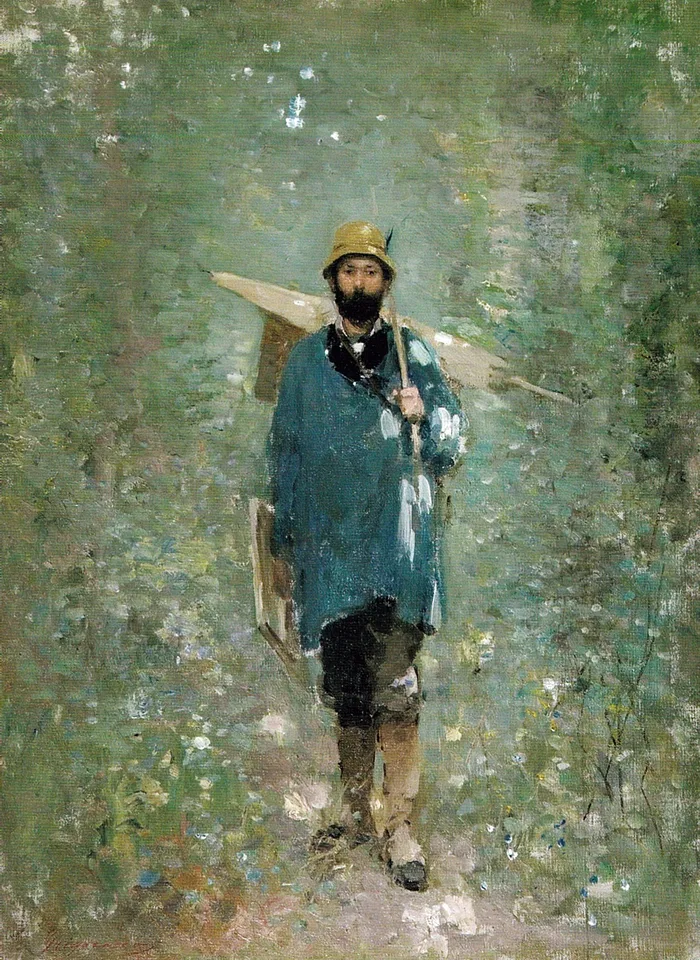
13. Rocks and Birch Trees — Ion Andreescu, undated
The upper half of the canvas is an even pale blue sky without a single cloud, painted with a dry brush so that the paint catches on the weave. On the right stands a group of birches, each trunk laid down in one thick white stroke flecked with dark bark, and one thin trunk falls diagonally towards the centre. In the middle rises a narrow dark juniper, on the left a tree with sparse russet leaves, and in the foreground two large boulders lie among russet bracken, grey-white and patched with lilac and pale green lichen. At lower right, at the foot of a boulder, the signature “Andreescu” is written in red-brown paint.
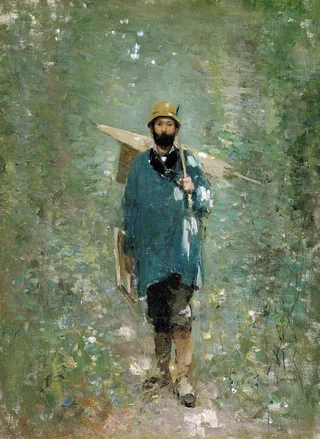
Nobody has dated it exactly. Some place it in his years at Buzău, others in his French period, and the handling recalls the lessons of Fontainebleau. From 1872 to 1878 Andreescu taught drawing and calligraphy in Buzău and taught himself to paint landscapes. At the end of 1878 he went to Paris on a scholarship, studied at the Académie Julian and then worked at Barbizon, on the edge of the forest of Fontainebleau, alongside Grigorescu. It was there that Grigorescu painted his portrait, Andreescu at Barbizon, which is also in the museum.
In 1881 his Winter at Barbizon hung in the Paris Salon. In 1882 Bucharest saw the only solo exhibition of his lifetime, about 60 paintings, and on 22 October of that year he died of tuberculosis at the age of 32. In Romania he is placed beside Grigorescu and Luchian among the founders of modern Romanian painting. In 2020 the museum showed his Poplars at the Edge of the Village among 47 paintings that had been hit by bullets in December 1989 and restored by the museum's conservators.
04. The Palace Under Fire
The last two works bring us back to the museum building itself. In December 1989 the former royal palace stopped being simply the place where the collection was kept and was drawn into the events.
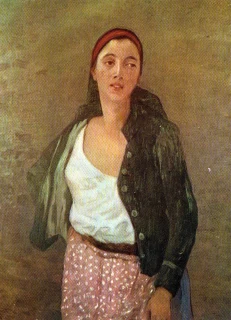
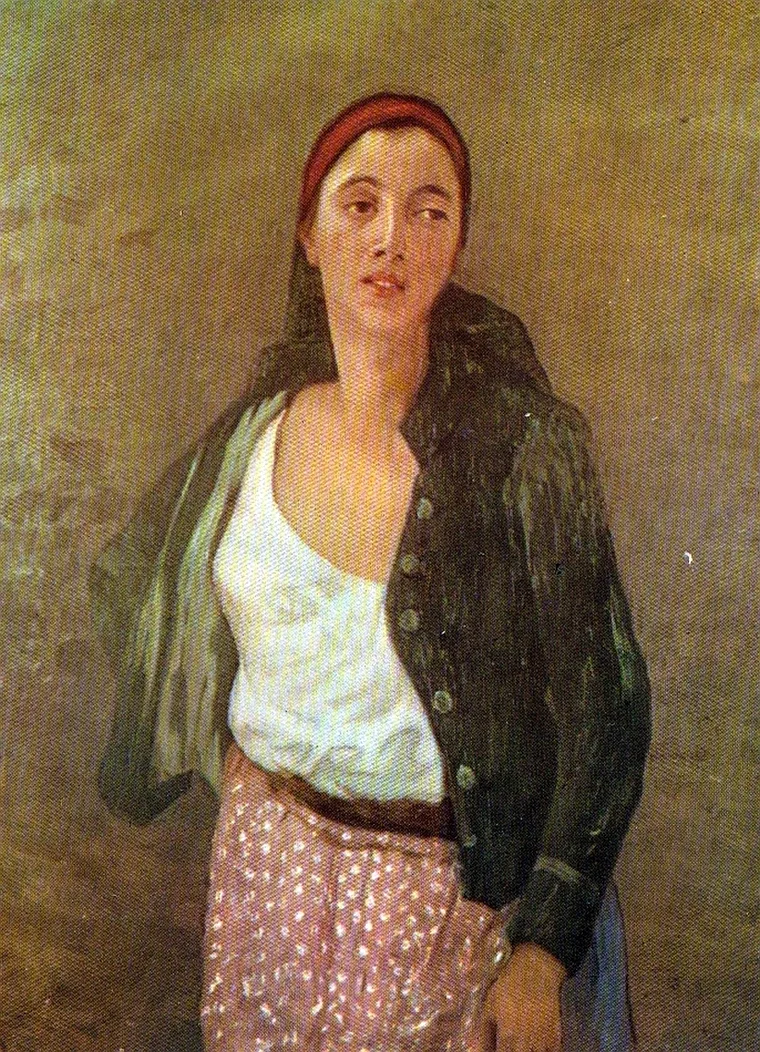
14. Safta the Flower Girl — Ștefan Luchian, c. 1900
On the evening of 22 December 1989 shooting broke out in the square between the former Central Committee building and the palace that housed the museum. That night the museum's easel-painting conservation studio burned, while staff and volunteers, among them the art historian Dorana Coșoveanu and eighteen-year-old Miriam Țarălungă, hid paintings on the inner staircases. The museum later counted 30 paintings lost, 17 European and 13 Romanian.
Ștefan Luchian's Safta the Flower Girl was hanging in the permanent display, and two bullets struck it, both from the front. One went through the woman's chest near the collarbone, the other tore a large ragged hole in the dark jacket over her heart. Luchian painted Safta, whom the state register of monuments describes as a young Roma woman, around 1900, before the illness that later paralysed him. She stands in a dark red headscarf pulled down over her forehead, a dark jacket slipping off one shoulder and a low-cut white blouse painted in thick, raised strokes, and her eyes slide to the right, past the viewer. Behind her the warm ochre ground is laid on in broken strokes, like plaster.
Museum staff recalled that some of the female figures were shot at deliberately, while the prosecutors' files also contain testimony that the firing was random. No one can now establish which account is true.
Restoration of the damaged paintings began in the museum's studio in January 1990. In 2020 the conservator and curator Sorina Gheorghiță and the head of the studio, Ioan Sfrijan, made Safta the poster image of Laboratory II. 1989, an exhibition on the restoration of the paintings hit by bullets. The poster showed the restored face and chest, with the two bullet holes in inset photographs.
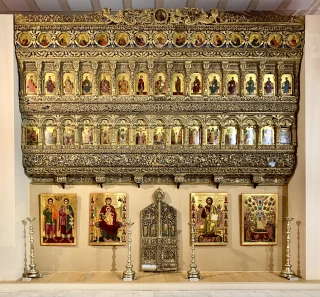
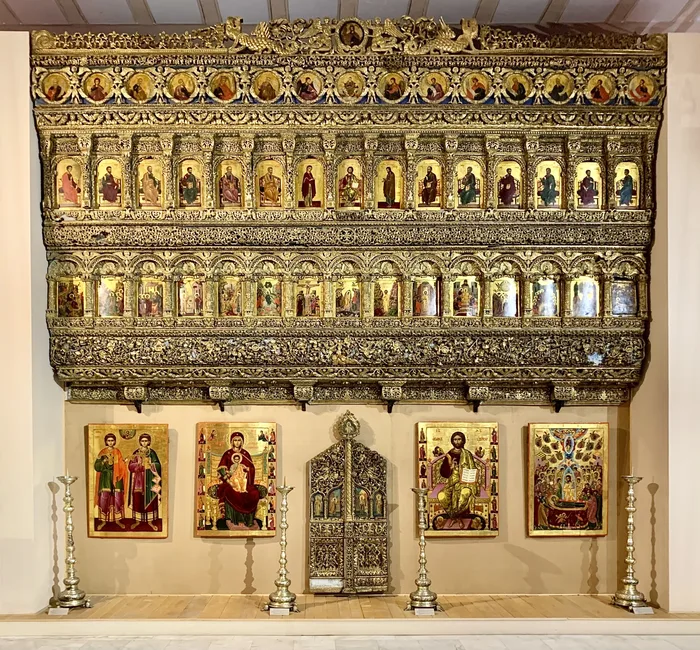
15. Iconostasis of the Cotroceni Monastery Church, 1682
After the earthquake of 4 March 1977, museum staff removed the iconostasis and other furnishings from the church of the Cotroceni monastery, most of them gifts from its founder. Seven years later, in 1984, the church was demolished on Ceaușescu's orders so that the Cotroceni Palace could become a residence. By then the iconostasis was no longer inside.
The iconostasis was commissioned by the Wallachian prince Șerban Cantacuzino for the church of the Cotroceni monastery he had founded, completed in 1682. The carving was done by a local workshop, and the icons were painted by Constantinos, probably the same painter who a decade later led the painting of the Hurezi monastery. Above the Royal Doors the carvers placed a reclining Jesse, and from him grows a gilded vine that spreads across the whole carved screen. In this way the carvers showed Christ's descent from the house of David. Constantinos painted the icons in sharp combinations of red, blue and green on a gold ground.
Before the demolition the architect Camil Roguski managed to save the church's stone, columns and frescoes and have them taken to the Cernica monastery. Among the rescued fragments were the founders' portraits by Pârvu Mutu, the same painter whose self-portrait from Bordești we have already seen.
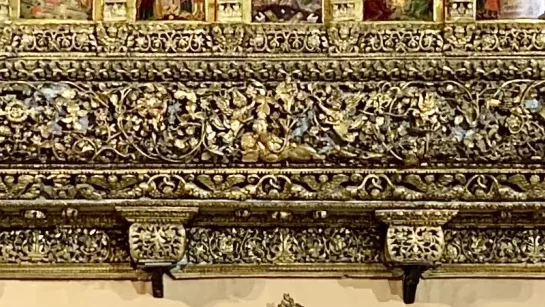
According to museum staff, bullets also struck the iconostasis in December 1989, though no one recorded where. The restoration was completed in 2002, and within a quarter of a century the iconostasis was dismantled and reassembled three times, in 1977, after 1989 and in 2002.
In 2009 the government decided that the iconostasis and some 140 other objects from Cotroceni kept in the museum should be handed over to the Presidential Administration for the rebuilt church. The museum's conservators and curators protested, arguing that another dismantling would put the iconostasis at risk and that the climate inside the new church was unsuitable. The rest of the church furnishings went back to Cotroceni and have been on display there since October 2014.
The rebuilt Cotroceni church now has a copy. The original stayed here, in the former royal palace. Over several centuries the works in this museum have been cut from walls, cut up and resewn, bought, bequeathed, rescued after an earthquake and restored after gunfire. That is why, alongside the history of art, there is almost always a second history running here, of how exactly each work came to be in front of us.
Beyond the List
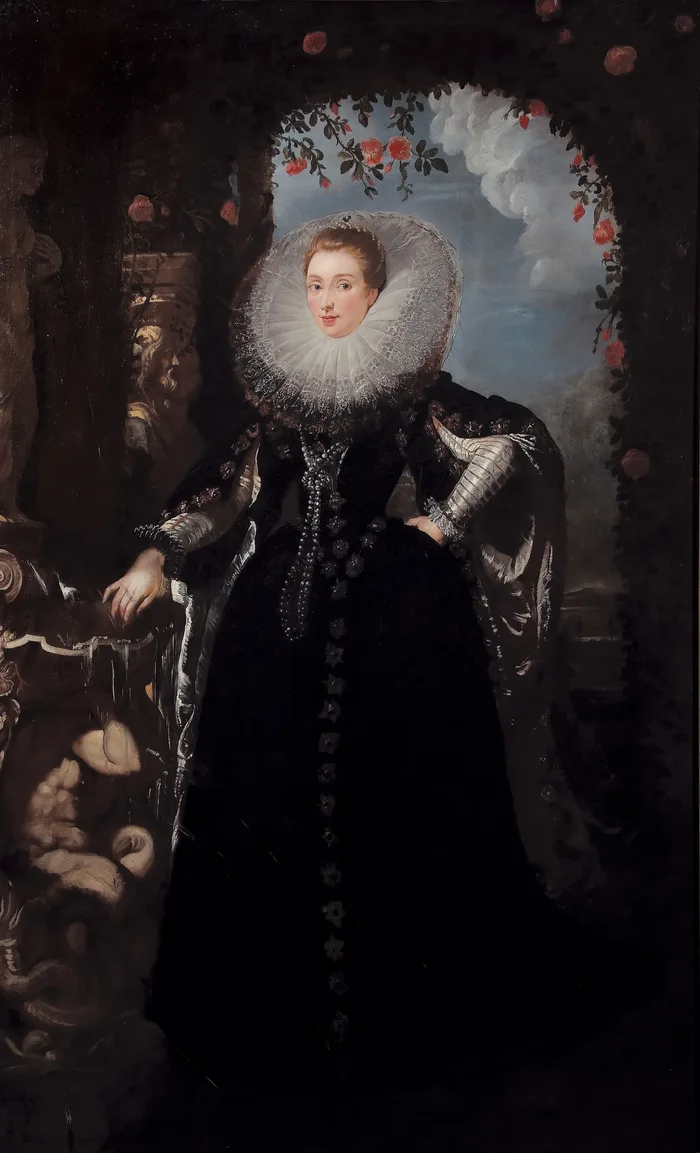
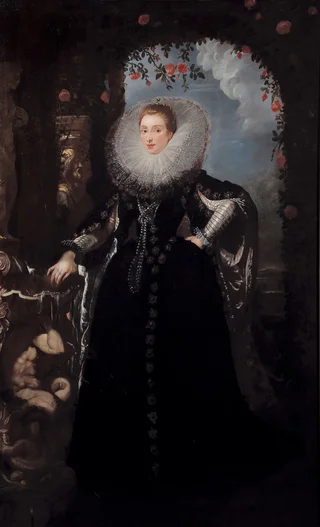
This list was built around works whose journey to the palace is a story in itself, and Tonitza and Andreescu were two deliberate exceptions. Beyond it there is much more worth coming for. In the gallery of Old Romanian Art, look for the epitaphios from the Cozia monastery of 1395–1396 and the processional cross made by Dosoftei of Putna in 1561. The European gallery has two more El Grecos, The Marriage of the Virgin and Saint Maurice, and Rubens's Portrait of Giovanna Spinola Pavese. In the Romanian gallery, look for Luchian's Anemones, Grigorescu's Girls Spinning at the Gate and Theodor Pallady's Flowers at the Window, Place Dauphine.