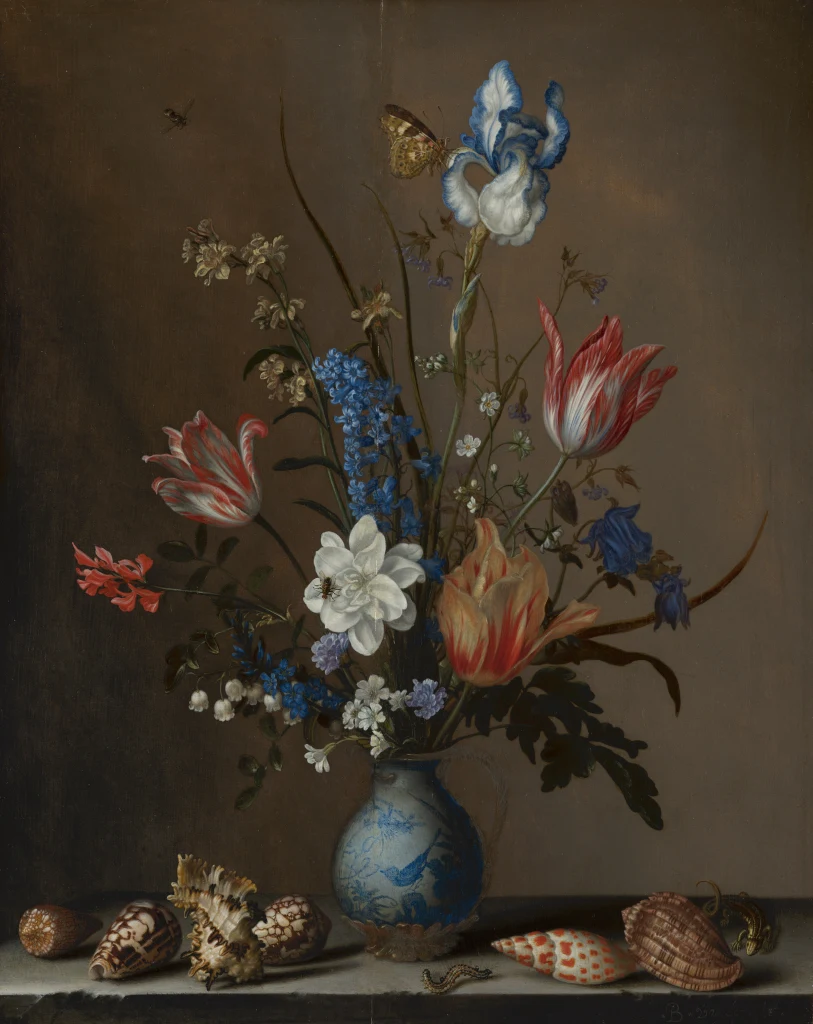
Flowers in a Wan-Li Vase, with Shells
Details
The story
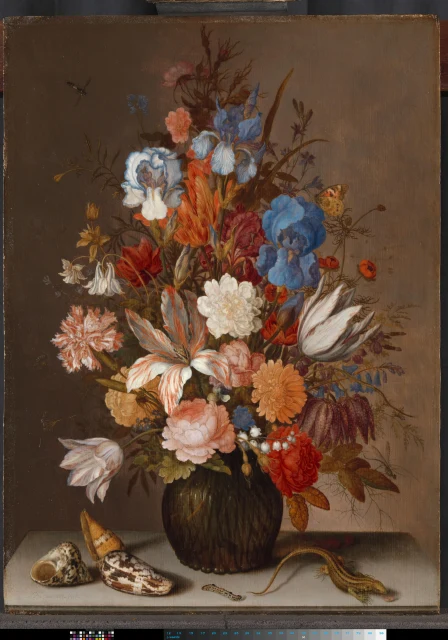
The vase was a costly thing. Its blue-and-white porcelain was made in China under the Wanli emperor, who reigned from 1573 to 1620, and Dutch ships brought such wares home in large quantities. The Dutch called them kraak porcelain, probably after the Portuguese carracks that the Dutch East India Company seized early in the century, whose cargoes were auctioned in Amsterdam.
Van der Ast painted this panel late in life, around 1640 to 1650, when he had long been settled in Delft. The Mauritshuis points out that the bouquet is painted more freely than those of his predecessors and holds only a few kinds of flower, which makes it easier to believe it once really stood on a table. Tulips, an iris, hyacinths and lily of the valley rise from the vase, while shells, a caterpillar and a small lizard lie along the ledge. The panel came to the museum on long-term loan in 1996 from its Friends' foundation, to which the collector J. H. Loudon had just left it.