Fortune-Teller with a Fool
Details
The story
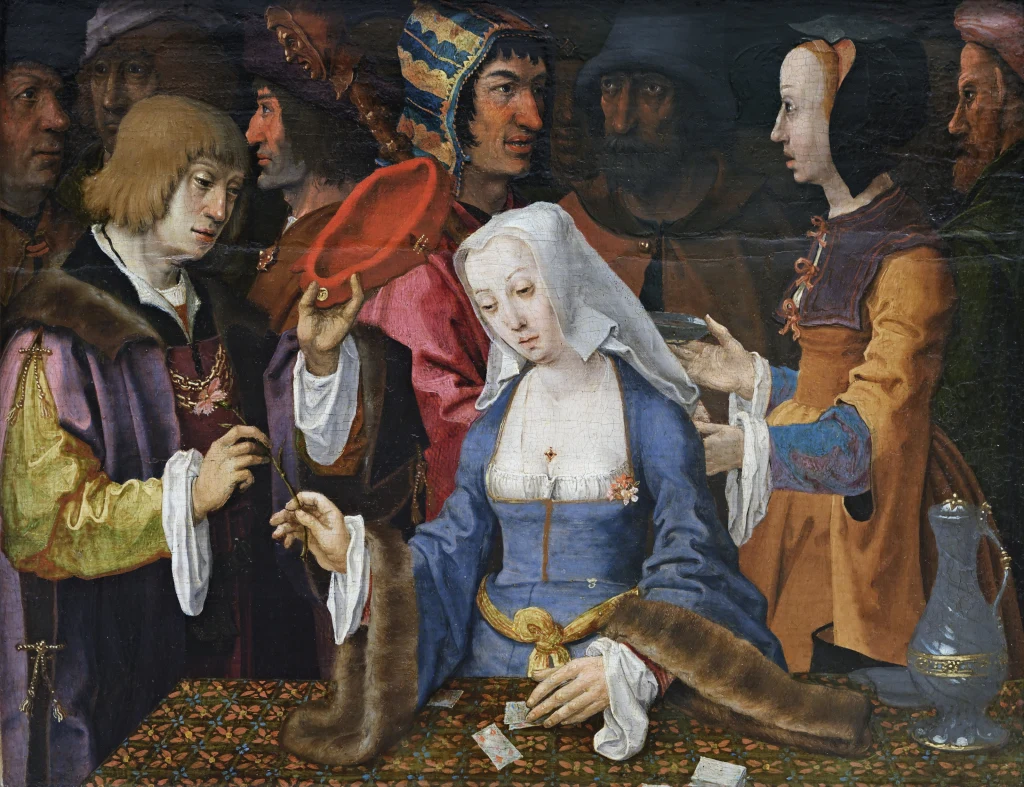
For much of the 20th century this little panel was not thought to be by Lucas van Leyden himself. In 1923, when it belonged to Alfred Luzarche d'Azay at Azay-le-Ferron in central France, it was listed as a copy of a lost original. His daughter, Marie-Marguerite Lebaudy, the wife of a sugar industrialist, left it to the Louvre in 1949 as attributed to Lucas or a painter of his circle, keeping the use of it for her lifetime. When it finally entered the museum at her death in 1962, it came in under his name. The Louvre gives it no date beyond the 16th century, and it is usually placed in his early years, around 1508 to 1510. A young woman lays out playing cards on a patterned cloth. A young man in a fur-trimmed coat holds out a carnation, and she already wears one pinned to her bodice. In pictures of this time the carnation could stand for a betrothal. Just behind the couple, in a jester's hood, a fool looks on, and in 2024 he earned the panel a place in the Louvre's exhibition on the figure of the fool.